Somewhere on the internet right now, a 22-year-old is standing next to a rented Lamborghini, telling you he made $47,000 last month selling a course about making money online. A screenshot of a Stripe dashboard fills the screen. The comments are full of fire emojis and “How do I start?” replies.
And somewhere else on the internet, a person who actually tried is sitting at their kitchen table at 11 PM, staring at $43.17 in their PayPal account after three months of work, wondering what they’re doing wrong.
Both of these stories are real. Both happen every day. But only one of them gets talked about, and it’s not the one that would actually help you set realistic expectations.
This guide exists to fill that gap. No rented cars. No cherry-picked screenshots. No “if I can do it, anyone can” motivational speeches disguised as business advice. Just honest, data-grounded income ranges for the most common ways people make money online, broken down by what you can realistically expect during your first 12 months.
Some of these numbers will excite you. Some will disappoint you. All of them will prepare you better than any income screenshot ever could.
Why Most “How Much I Made” Content Is Misleading
Before we get into real numbers, it’s worth understanding why your expectations are probably skewed before you even start.
Survivorship Bias Is Distorting Your View
When someone earns $10,000/month online, they write a blog post about it. They create a YouTube video about it. They build a course around it.
When someone tries the same thing and earns $200/month, they quietly move on with their life. No blog post. No video. No course. Their experience disappears from the public record.
This means the information you consume about online income is heavily filtered toward success stories. The people who failed, stalled, or earned modest amounts aren’t creating content about their experience, which creates the illusion that high earnings are common when they’re actually the exception.
Revenue Is Not Profit
A creator showing you $30,000 in monthly revenue might be spending $18,000 on ads, $4,000 on software and tools, $3,000 on contractors, and $2,000 on product costs. Their actual profit is $3,000, which is a far cry from what the revenue screenshot suggests.
When you see income reports online, ask: Is this revenue or profit? Gross or net? Before or after expenses? Before or after taxes? The answer changes everything.
Timing and Context Get Erased
Someone who earned $100,000 from their blog last year probably started that blog 3-5 years ago. The income report shows the harvest, not the years of planting, watering, and waiting. When a beginner sees that number and expects similar results in their first year, they’re comparing their starting line to someone else’s finish line.
The “Anyone Can Do It” Fallacy
Online income advice often implies that the strategy is the only variable. Follow these steps, get these results. But outcomes depend on dozens of factors: your niche, your existing skills, your available time, your financial runway, your network, your geographic location, and plain luck.
Two people can follow the same blogging playbook. One works in a high-CPM niche, has professional writing experience, and can dedicate 30 hours a week. The other works in a low-CPM niche, has never written publicly, and has 8 hours a week after their day job. Their first-year results will be dramatically different, even though their strategy is identical.
The Honest Framework: What Determines Your Year-One Income
Before looking at specific income models, understand the four factors that most heavily influence how much you’ll earn in your first year online.
Factor 1: Your Starting Skill Set
Someone starting a freelance web design business who already has five years of design experience will earn money faster than someone who needs to learn design from scratch first. Existing skills compress the timeline between “I started” and “I got paid.”
This doesn’t mean you need expertise to begin. It means being honest about your starting point helps you set realistic expectations about how quickly money will arrive.
Factor 2: Your Available Time Investment
A person working 40 hours per week on their online business will progress faster than someone investing 8 hours per week. That’s not a judgment. It’s arithmetic. The part-time builder should expect part-time timelines.
Rough guideline: If most income projections assume 20-30 hours per week of focused work, adjust proportionally based on your actual availability. Working 10 hours a week? Expect results to take roughly twice as long.
Factor 3: Your Willingness to Invest Money
Some online income paths require upfront investment (inventory for ecommerce, ads for lead generation, tools and software for content creation). Others require almost no money but compensate with higher time requirements.
Having a budget to invest in tools, education, advertising, or inventory can accelerate your results. Having no budget isn’t a barrier, but it does mean relying on slower, organic growth methods.
Factor 4: Your Chosen Income Model
Different online income paths have fundamentally different earning curves. Some pay quickly but cap early. Others pay nothing for months but compound aggressively over time. Understanding which curve you’re on prevents premature quitting.
Let’s break down each major income model with honest year-one numbers.
Freelancing and Client Services
What it includes: Writing, design, web development, social media management, virtual assistance, consulting, coaching, video editing, bookkeeping, and any other skill-based service delivered to clients.
The Income Curve
Freelancing has the fastest path to first income among all online business models. You’re exchanging time and skill for money with no audience-building phase required. If you have a marketable skill, you can earn money within your first month.
The tradeoff: your income is directly tied to your time. You earn when you work. You stop earning when you stop.
Realistic Year-One Numbers
Months 1-3: The Hustle Phase
You’re building your portfolio, finding your first clients, and figuring out your pricing. Most of your time goes to prospecting, not paid work.
- Typical monthly income: $0-$1,500
- Most common outcome: Landing 1-3 small clients at low-to-moderate rates
- You’ll probably underprice yourself. That’s okay. Early clients are portfolio builders.
Months 4-6: Finding Your Rhythm
You have testimonials, a small portfolio, and a clearer sense of what you’re good at and who your ideal client is. Referrals start trickling in.
- Typical monthly income: $1,000-$4,000
- Most common outcome: A mix of project-based and retainer work. Some months are strong, others are lean.
Months 7-12: Building Stability
You’ve raised your rates at least once. Your client base is more stable. Word-of-mouth brings in a percentage of new work without active outreach.
- Typical monthly income: $2,000-$7,000
- Most common outcome: Enough income to consider going full-time if combined with savings or a partner’s income.
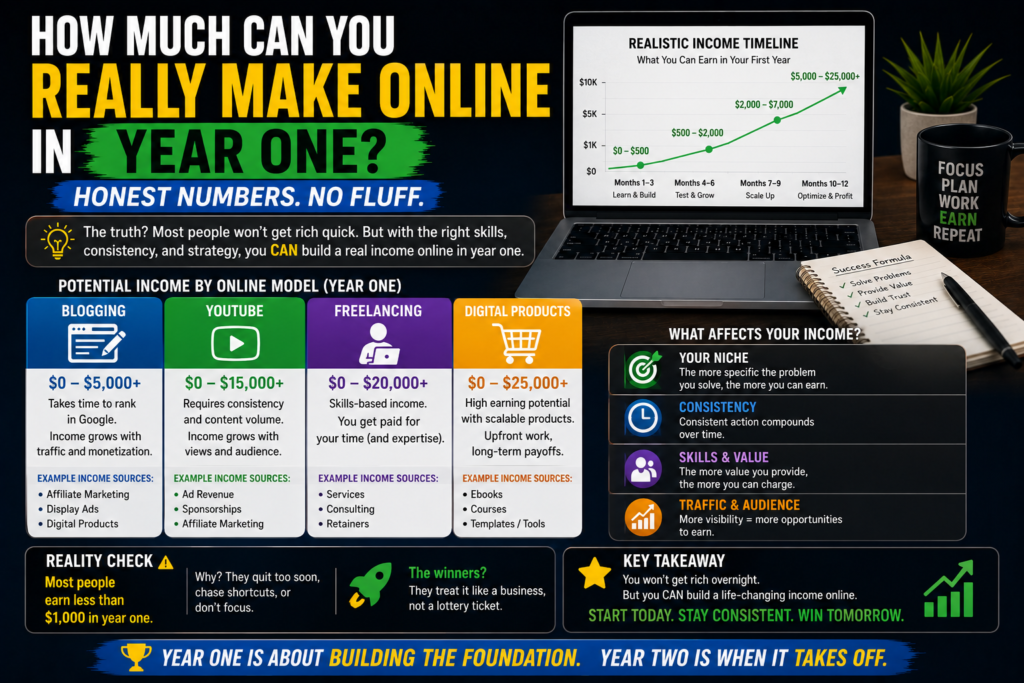
Year-one total (realistic range): $12,000-$50,000
The wide range reflects differences in skill level, niche demand, hours invested, and pricing confidence. A freelance writer working 15 hours a week in their first year might land on the lower end. A freelance developer working 35 hours a week with prior professional experience might exceed the upper end.
What Most People Get Wrong About Freelancing
They spend too long preparing and not enough time pitching. A slightly imperfect portfolio that lands clients beats a perfect portfolio that sits unseen for three months.
They undercharge because they feel unqualified. Imposter syndrome costs freelancers thousands of dollars per year. Your rate should reflect the value you deliver, not how many years of experience you have.
They rely on one or two clients. Losing a single client when they represent 80% of your income is devastating. Diversify early, even if it means taking smaller projects to spread risk.
Blogging and Content Websites
What it includes: Building a blog or content website, driving traffic through search engines and social media, and monetizing through display ads, affiliate marketing, digital products, or sponsored content.
The Income Curve
Blogging has the slowest start and the most aggressive compounding. You will earn little to nothing for the first 3-6 months. This isn’t a sign that something is broken. It’s how the model works. Search engines take time to trust new websites, and traffic needs to reach certain thresholds before monetization becomes meaningful.
The bloggers who earn significant income are the ones who pushed through the silent months without quitting.
Realistic Year-One Numbers
Months 1-3: The Desert
You’re publishing content, learning SEO, and watching your analytics show single-digit daily visitors. Income is effectively zero.
- Typical monthly income: $0
- Most common outcome: 200-1,000 page views per month. No meaningful revenue.
Months 4-6: Signs of Life
Some posts start ranking. Traffic trickles in from Google. You apply to affiliate programs and start placing links in your content.
- Typical monthly income: $0-$150
- Most common outcome: 1,000-5,000 page views per month. Your first affiliate commission might come during this phase. It’ll probably be under $50.
Months 7-9: Early Traction
Traffic grows more noticeably. You have enough content for Google to see topical authority forming. Affiliate commissions become more consistent.
- Typical monthly income: $100-$500
- Most common outcome: 5,000-15,000 page views per month. You might qualify for a display ad network, adding a passive income layer.
Months 10-12: The Inflection Point
Your older posts climb in rankings. Newer posts rank faster because your domain has earned some authority. Multiple income streams start contributing.
- Typical monthly income: $200-$1,500
- Most common outcome: 10,000-40,000 page views per month. A mix of ad revenue, affiliate income, and possibly your first digital product sale.
Year-one total (realistic range): $500-$5,000
Yes, those numbers are small compared to the “I made $10K/month from my blog” posts you’ve seen. Those posts are almost always from bloggers who have been at it for 2-4 years. Year one is the investment period. Years two and three are when blogging income typically jumps to $2,000-$10,000+ per month for consistent, strategic publishers.
What Most People Get Wrong About Blogging
They expect quick returns. Blogging is a long-game asset. If you need income this month, blogging alone won’t provide it. Pair it with freelancing or another faster income model while your blog grows.
They write about whatever interests them instead of what people search for. Keyword research isn’t optional. Writing brilliant posts about topics nobody searches for is creative expression, not income strategy.
They quit during months 3-5. This is the most common quitting window because traffic is still flat and the effort-to-result ratio feels terrible. Pushing through this phase is the single biggest differentiator between bloggers who earn and bloggers who don’t.
YouTube
What it includes: Creating video content, building a subscriber base, and earning through AdSense revenue, sponsorships, affiliate links, merchandise, and channel memberships.
The Income Curve
YouTube’s monetization threshold (1,000 subscribers and 4,000 watch hours in the past 12 months, or 1,000 subscribers and 10 million Shorts views in 90 days) creates a binary gate. Below the threshold, you earn $0 from ads. Above it, ad revenue starts flowing.
Most creators take 6-18 months to hit the threshold, depending on niche, content quality, and publishing consistency.
Realistic Year-One Numbers
Months 1-4: Learning and Publishing
You’re figuring out your on-camera presence, editing workflow, and content strategy. Views are low. Growth is slow. Many videos get fewer than 100 views.
- Typical monthly income: $0
- Most common outcome: 50-500 subscribers. You’re nowhere near monetization.
Months 5-8: Building Momentum
A few videos gain traction. You start understanding what your audience responds to. Subscriber growth accelerates slightly. You might hit the monetization threshold during this phase if you publish consistently in a growing niche.
- Typical monthly income: $0-$200
- Most common outcome: 500-2,000 subscribers. If monetized, early AdSense payments are small ($50-$200/month).
Months 9-12: Early Monetization
You’ve hit the monetization threshold or you’re close. Ad revenue begins. You might land your first brand sponsorship or start earning affiliate commissions from links in video descriptions.
- Typical monthly income: $100-$1,000
- Most common outcome: 1,000-5,000 subscribers. Ad revenue of $100-$500/month. Possibly one or two small sponsorships at $200-$500 each.
Year-one total (realistic range): $0-$5,000
The range starts at $0 because many creators don’t hit the monetization threshold in their first year. That doesn’t mean the year was wasted. The subscriber base, video library, and production skills built during year one are what power year-two earnings.
What Most People Get Wrong About YouTube
They compare themselves to established creators. A creator with 500,000 subscribers and a production team is not your benchmark. Compare your month 3 to your month 1.
They prioritize production quality over content quality. A mediocre video with a $5,000 camera still underperforms a great video shot on a phone. Invest in better ideas before better equipment.
They publish inconsistently. YouTube’s algorithm rewards consistent publishing because it builds viewer habits and signals channel reliability. Two videos per week outperforms one video per month in almost every scenario.
Ecommerce and Dropshipping
What it includes: Selling physical products online through your own store (Shopify, WooCommerce) or marketplaces (Amazon, Etsy). Products can be your own, sourced from suppliers, or dropshipped.
The Income Curve
Ecommerce can generate revenue immediately because you’re selling a product, not building an audience. But “revenue” and “profit” diverge sharply in ecommerce. Product costs, shipping, advertising, returns, and platform fees eat into every sale.
Realistic Year-One Numbers
Months 1-3: Setup and First Sales
You’re building your store, sourcing products, running initial ads, and learning what converts. Most early ad campaigns lose money as you test audiences and creatives.
- Typical monthly revenue: $500-$5,000
- Typical monthly profit: -$500 to $500 (many stores lose money during this phase due to ad testing and setup costs)
- Most common outcome: You’ve made some sales but haven’t found consistent profitability yet.
Months 4-6: Finding What Works
You’ve identified a few products that sell. Your ad campaigns are getting more efficient. You understand your customer acquisition cost and lifetime value.
- Typical monthly revenue: $2,000-$15,000
- Typical monthly profit: $200-$3,000
- Most common outcome: One or two products driving most of the revenue. Profit margins of 15-30% after all costs.
Months 7-12: Scaling or Stalling
If you’ve found product-market fit, revenue scales with ad spend. If you haven’t, this is where many ecommerce stores plateau or close.
- Typical monthly revenue: $5,000-$30,000+
- Typical monthly profit: $1,000-$8,000
- Most common outcome: The stores that survive this phase have dialed in their advertising, found reliable suppliers, and built some repeat customer base.
Year-one total profit (realistic range): $0-$40,000
The enormous range reflects the reality that ecommerce outcomes are highly variable. Some stores never find a profitable product and close with a net loss. Others find a winning product early and scale quickly. The median outcome is somewhere between $5,000 and $15,000 in profit for a seriously committed first-year store.
A critical note on dropshipping specifically: The “build a dropshipping store in a weekend and make passive income” narrative is almost entirely false. Dropshipping has thin margins (often 10-20% after ads and product costs), heavy competition, significant customer service demands, and high return rates. It’s a legitimate business model, but it’s not passive, not easy, and not the get-rich-quick shortcut it’s marketed as.
What Most People Get Wrong About Ecommerce
They underestimate ad costs. Most ecommerce stores need paid advertising to generate sales. Testing ads until you find profitable campaigns costs money. Budget $1,000-$3,000 for ad testing before expecting consistent returns.
They mistake revenue for profit. A $20,000/month revenue store with $16,000 in costs generates $4,000/month in profit. That’s a real business, but it’s very different from the $20,000 headline number.
They pick products based on what’s trending instead of what they can sustainably source and sell. Trends fade. Supply chains break. A product with steady demand and reliable sourcing beats a viral product that disappears in six months.
Online Courses and Digital Products
What it includes: Creating and selling ebooks, courses, templates, printables, software tools, presets, or any other digital product that’s built once and sold repeatedly.
The Income Curve
Digital products have the highest profit margins of any online business model (often 80-95% profit after platform fees). The challenge is that they require an audience or traffic source to sell to. Without eyeballs on your offer, the best product in the world earns nothing.
Most first-year creators sell digital products as an extension of another platform, such as a blog, YouTube channel, email list, or social media following. The product itself might be built in a weekend, but the audience that buys it takes months to cultivate.
Realistic Year-One Numbers
If you’re building an audience from scratch:
- Months 1-6: $0-$200 (most of your time goes to audience building, not product sales)
- Months 7-12: $200-$2,000/month (as your audience grows and you refine your offer)
- Year-one total: $500-$8,000
If you already have an audience (email list, blog traffic, social following):
- Month 1: $500-$5,000 from your initial launch
- Months 2-12: $200-$3,000/month from ongoing sales, additional launches, and audience growth
- Year-one total: $3,000-$30,000
The Launch Math
Digital product income tends to be lumpy rather than consistent. A launch to your email list might generate $3,000 in a week, followed by $200/month in passive sales until your next launch.
A realistic launch to a 1,000-person email list:
- Open rate: 35% (350 people see the offer)
- Click-through rate: 15% (53 people visit the sales page)
- Conversion rate: 5% (roughly 3 sales)
- Product price: $47
- Launch revenue: $141
That’s sobering compared to the “$10,000 launch” stories you’ve seen. But those $10,000 launches are from creators with 10,000-50,000 person lists built over years. A $141 launch from a 1,000-person list is actually a healthy conversion rate that scales as your list grows.
What Most People Get Wrong About Digital Products
They build before validating. Spending three months creating a course nobody wants is a painful lesson. Validate demand first by pre-selling, surveying your audience, or testing with a minimum viable product.
They expect passive income immediately. “Build it once, sell it forever” is true in theory, but every sale requires a customer who discovered your product somehow. Marketing is never passive, even when the product is.
They price too low. A $9 ebook requires massive volume to generate meaningful income. A $97 mini-course requires far fewer sales. New creators typically underprice because they’re afraid of rejection at higher price points.
Affiliate Marketing (as a Primary Income Source)
What it includes: Recommending other people’s products and earning a commission on each sale, typically through a blog, YouTube channel, email list, or social media content.
The Income Curve
Affiliate marketing as a primary income source follows a traffic-dependent curve. You earn in proportion to the number of people clicking your affiliate links, which depends on your traffic or audience size.
Realistic Year-One Numbers
Through a blog or website:
- Months 1-4: $0-$50/month
- Months 5-8: $50-$300/month
- Months 9-12: $200-$1,000/month
- Year-one total: $500-$4,000
Through YouTube or social media:
- Months 1-4: $0-$100/month
- Months 5-8: $50-$500/month
- Months 9-12: $200-$1,500/month
- Year-one total: $500-$6,000
Through an email list:
- Highly dependent on list size and niche
- Revenue per subscriber per month: $0.50-$3.00
- A 1,000-subscriber list might generate $500-$3,000/year in affiliate income
The Commission Structure Matters
Your choice of affiliate programs dramatically affects your earning potential:
| Program Type | Typical Commission | Example |
|---|---|---|
| Amazon Associates | 1-5% per sale | $0.50-$5 on a $100 product |
| Physical product brands | 5-15% per sale | $5-$15 on a $100 product |
| Software and SaaS | 20-40% recurring | $10-$40/month per active user |
| Financial products | $50-$200 per signup | Credit cards, investing platforms |
| Course and coaching affiliates | 30-50% per sale | $30-$250 per sale |
A blogger promoting Amazon products needs thousands of clicks to earn meaningful income. A blogger promoting software with 30% recurring commissions can earn more from 20 signups than 200 Amazon sales.
What Most People Get Wrong About Affiliate Marketing
They promote products they’ve never used. Audiences sense inauthenticity. The most successful affiliate marketers genuinely use and can speak in depth about the products they recommend.
They spread links everywhere without creating context. An affiliate link without a compelling reason to click it converts at near-zero rates. Product reviews, comparison posts, and tutorial content that naturally incorporates the product convert at much higher rates.
They choose low-commission programs in competitive niches. If you’re going to compete for rankings and attention, choose products that pay enough per conversion to make the effort worthwhile.
Social Media Content Creation
What it includes: Building a following on Instagram, TikTok, Twitter/X, or other platforms and monetizing through brand deals, UGC creation, affiliate links, digital products, or creator fund payments.
The Income Curve
Social media income varies more wildly than any other category because it depends on follower count, engagement rate, niche, platform, and monetization strategy. Two creators with identical follower counts can have drastically different incomes.
Realistic Year-One Numbers
For a creator focused on brand deals and sponsorships:
- Months 1-6: $0-$500 (mostly product-for-post trades, not cash)
- Months 7-12: $200-$2,000/month (mix of paid and gifted collaborations)
- Year-one total: $500-$10,000
For a creator focused on UGC (user-generated content):
- Months 1-3: $0-$1,000 (building portfolio, landing first clients)
- Months 4-12: $500-$3,000/month (consistent client work)
- Year-one total: $3,000-$25,000
For a creator monetizing with digital products or services:
- Months 1-6: $0-$500 (audience building phase)
- Months 7-12: $200-$2,000/month (product launches, service clients)
- Year-one total: $500-$12,000
Platform-specific ad revenue (creator funds):
- YouTube: Covered above
- TikTok Creator Fund: $0.02-$0.04 per 1,000 views. A video with 1 million views earns roughly $20-$40. This is supplement income, not primary income.
- Instagram bonuses: Sporadic, invitation-only, and inconsistent. Don’t plan your finances around them.
What Most People Get Wrong About Social Media Income
They chase followers instead of income. A creator with 3,000 engaged followers and a digital product can out-earn a creator with 50,000 passive followers and no offer.
They rely on platform payments. Creator funds pay pennies. Real social media income comes from using the platform as a lead generation tool for products, services, and brand partnerships.
They compare across niches. A finance creator with 10,000 followers earns more per follower than a comedy creator with 100,000 followers because finance audiences have higher commercial value. Niche selection is a business decision, not just a passion decision.
Print on Demand and Merch
What it includes: Designing graphics for t-shirts, mugs, posters, phone cases, and other products that are printed and shipped by a third-party service only when an order is placed.
Realistic Year-One Numbers
- Months 1-3: $0-$100/month (learning design, uploading products, testing)
- Months 4-8: $50-$500/month (finding designs that sell, building a catalog)
- Months 9-12: $100-$1,000/month (scaling winning designs, expanding platforms)
- Year-one total: $500-$5,000
Print on demand is a volume game. Individual profit per item is low ($3-$10 per sale, typically). Success comes from uploading hundreds of designs across multiple platforms (Merch by Amazon, Redbubble, TeePublic, Etsy) and letting a small percentage of designs generate consistent sales.
What Most People Get Wrong About Print on Demand
They treat it as passive income from day one. The passive income part comes after you’ve uploaded 200-500+ designs and identified which ones sell. Getting there takes months of active work.
They underestimate the importance of niche targeting. Generic designs sell poorly. Designs that speak to specific subcultures, professions, hobbies, or inside jokes perform dramatically better because they feel personal to the buyer.
The Overall Picture: Year-One Income by Model
Here’s a consolidated view of realistic year-one income for someone investing 15-25 hours per week consistently:
| Income Model | Year-One Range | Time to First Dollar | Ongoing Time Requirement |
|---|---|---|---|
| Freelancing | $12,000-$50,000 | 1-4 weeks | High (trading time for money) |
| Ecommerce | $0-$40,000 profit | 2-8 weeks | High (operations, ads, customer service) |
| UGC Creation | $3,000-$25,000 | 2-6 weeks | Moderate (per-project work) |
| Digital Products | $500-$30,000 | 1-6 months | Low-Moderate (front-loaded creation) |
| Social Media (brand deals) | $500-$10,000 | 3-8 months | High (constant content creation) |
| YouTube | $0-$5,000 | 6-12 months | High (production and publishing) |
| Affiliate Marketing | $500-$6,000 | 3-8 months | Moderate (content creation) |
| Blogging | $500-$5,000 | 4-8 months | Moderate (writing and SEO) |
| Print on Demand | $500-$5,000 | 1-3 months | Low-Moderate (design uploading) |
The pattern is clear: Models that pay quickly (freelancing, ecommerce) require ongoing active work. Models that compound over time (blogging, YouTube, digital products) start slowly but build passive and semi-passive income streams.
The smartest approach for most beginners is combining a fast-paying model with a compounding model. Freelance while building your blog. Do UGC work while growing your YouTube channel. Use the fast income to fund your living expenses while the slow-burn asset grows in the background.
What the Top 10% Do Differently
When you study people who earn in the top 10% of their chosen income model during year one, patterns emerge.
They pick one model and commit. The person who tries freelancing for two months, switches to dropshipping for six weeks, pivots to YouTube, and then starts a blog has four half-built foundations and zero income streams. The person who picks freelancing and grinds through twelve months of ups and downs ends the year with clients, testimonials, a reputation, and real income.
They treat it like a job, not a hobby. Showing up consistently, even when motivation fades, is the dividing line between earning and not earning. The people who publish every week, pitch every day, and create every morning outperform the ones who work in bursts when inspiration strikes.
They invest in learning the right skills. Not “buy every course available” learning. Targeted skill development in the specific areas that drive income: copywriting, SEO, sales, paid advertising, email marketing, product development. One focused course applied thoroughly beats ten courses left unfinished.
They track their numbers obsessively. Revenue, expenses, profit, traffic, conversion rates, hours worked, hourly effective rate. Data tells you what’s working and what’s wasting your time. Without data, you’re guessing.
They play the long game. The top earners in year one are already building for year three. They don’t chase shortcuts or quick wins at the expense of sustainable systems. They accept that month two won’t be profitable and push through because they understand the curve they’re on.
The Hidden Costs Nobody Mentions
Your first-year income projection should account for expenses that erode your earnings. Common costs that new online earners underestimate:
Tools and software: Email marketing platform, website hosting, design tools, scheduling tools, SEO tools, accounting software. Budget $50-$200/month.
Education: Courses, books, coaching, or mentorship. Budget $200-$2,000 for the year, spent selectively on specific skill gaps.
Advertising (if applicable): Facebook ads, Google ads, Pinterest ads. If your model requires paid traffic, budget $500-$3,000 for testing before you find profitable campaigns.
Professional services: Accountant or tax preparer, legal setup (LLC formation), possibly a virtual assistant as you scale. Budget $500-$2,000 for the year.
Taxes: Self-employment tax in the US is roughly 15.3% on top of your income tax rate. A freelancer who earns $40,000 might owe $6,000-$12,000 in taxes depending on deductions and their total tax situation. Set aside 25-30% of every dollar earned for taxes.
Opportunity cost: The hours you spend building your online business are hours you could spend at a traditional job. If you leave a $25/hour job to go full-time on your online business, your first year needs to earn at least $50,000 pretax to match what you gave up (accounting for lost benefits and employer tax contributions).
How to Maximize Your First-Year Earnings
Month 1-3: Focus on Speed to First Dollar
Your priority is earning your first dollar as fast as possible. Not because the dollar matters financially, but because it proves the model works and transforms your mindset from “maybe this could work” to “this is working and I need to do more of it.”
- Choose the fastest path available to you (freelancing or selling a skill)
- Set a 30-day deadline for your first paid client or customer
- Accept imperfect work, imperfect pricing, and imperfect conditions
- Document everything you learn for content you’ll create later
Month 4-6: Optimize What’s Working
By now you know which activities generate income and which are busywork. Double down on what’s working.
- Raise your rates or prices based on what you’ve learned about market demand
- Eliminate or reduce time spent on activities that don’t directly contribute to income
- Start building a system (templates, processes, workflows) to do the same work in less time
- If you’re pairing a fast model with a slow model, make sure the slow model (blog, YouTube, email list) is getting consistent attention
Month 7-9: Add a Second Income Stream
One income stream is fragile. Two is more stable. Three is where things get interesting.
- If you’re freelancing, launch a digital product that packages your expertise
- If you’re blogging, start building your email list and add affiliate links to high-traffic posts
- If you’re creating content on social media, start UGC work or launch a product
Month 10-12: Scale and Systematize
You’ve survived the hardest part. Now build systems that let the same effort produce more output.
- Outsource or automate repetitive tasks
- Focus your personal time on high-value activities (strategy, creation, relationships)
- Set your year-two income goal based on data from year one, not wishes
- Review every expense, every tool, and every process for efficiency
What Happens After Year One
Year one is the foundation. Years two and three are where most online earners see their income jump significantly, but only if they built the right foundation.
Bloggers who published consistently in year one often see their income double or triple in year two as their content compounds in search rankings.
Freelancers who raised rates, narrowed their niche, and built a reputation in year one can hit $75,000-$150,000 in year two.
YouTubers who hit the monetization threshold late in year one often see rapid growth in year two as their video library generates recurring views.
Ecommerce operators who found profitable products in year one can scale through expanded product lines, new advertising channels, and email marketing in year two.
The people who quit during year one never see this curve. The people who push through, even when the numbers are disappointing, are the ones who write the income reports that inspire the next wave of beginners.
The Bottom Line
The honest answer to “How much can you make online in year one?” is: less than the gurus claim, more than the skeptics believe, and entirely dependent on what you do with the time between now and twelve months from now.
Most people who start an online business in their first year will earn between $1,000 and $20,000, with a median closer to $5,000-$10,000 for someone investing 15-25 hours per week consistently.
That’s not life-changing money. It might not even cover your monthly expenses. But it’s real, earned income from an asset that didn’t exist twelve months ago. And if you keep building, that asset grows in value every month.
The gap between “I made $43 in my first three months” and “I made $4,300 in my twelfth month” isn’t talent, luck, or a secret strategy. It’s twelve months of showing up, learning, adjusting, and refusing to let slow results mean no results.
Start with clear eyes. Track your numbers. Adjust your approach based on data, not feelings. And give yourself the full twelve months before judging whether it’s working.
The income is real. The timeline is just longer than anyone wants to admit.