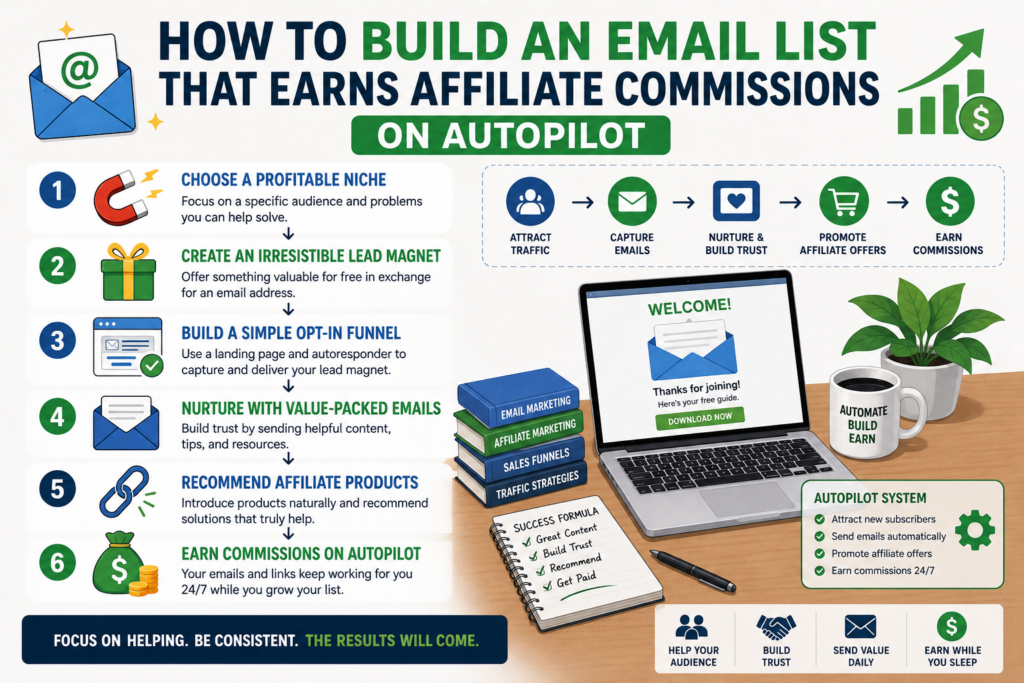
Most affiliate marketers chase traffic. They pour hours into SEO, social media, and paid ads, hoping someone clicks their link and buys. Some days it works. Most days, it doesn’t. And they start over again tomorrow.
Here’s what separates affiliates who earn inconsistent commissions from those who wake up to payment notifications every morning: an email list.
An email list puts you in direct contact with people who already raised their hand and said, “Yes, I’m interested in what you have to say.” No algorithm changes. No ad costs eating into your margins. No guessing whether your content will get seen.
This guide walks you through building an email list from scratch, setting up automated sequences that recommend affiliate products at exactly the right time, and turning subscribers into long-term buyers who trust your recommendations.
Why Email Still Outperforms Every Other Affiliate Channel
Social media reach keeps shrinking. Organic search takes months to gain traction. Paid ads require constant budget. Email, on the other hand, gives you direct access to your audience’s inbox, a place most people check multiple times a day.
Here are the numbers that matter:
- Email marketing returns an average of $36 for every $1 spent, according to industry benchmarks.
- The average email open rate across industries hovers around 21%, which means roughly one in five subscribers sees your message every time you hit send.
- Click-through rates on emails consistently outperform social media engagement rates by a wide margin.
For affiliate marketers, email offers something no other channel can: the ability to build a relationship before making a recommendation. When someone trusts you, they’re far more likely to buy through your link. That trust compounds over time, and so do your commissions.
Step 1: Choose a Niche That Supports Recurring Affiliate Income
Before you write a single email, you need clarity on your niche. The best niches for affiliate email marketing share three traits:
- The audience has ongoing problems. One-time purchases are fine, but recurring needs mean recurring commissions. Think software subscriptions, health supplements, or business tools.
- Quality affiliate programs exist. Look for programs offering recurring commissions (SaaS products are great for this), competitive payouts, and solid cookie durations.
- People actively search for solutions. If nobody is Googling the problems your niche solves, building an audience will be an uphill battle.
Strong niches for affiliate email marketing include personal finance, online business tools, health and fitness, digital marketing software, and productivity apps.
Weak niches are those with low-priced products, no recurring commission options, or audiences that don’t engage with email.
Step 2: Pick the Right Email Marketing Platform
Your email platform is the engine behind your entire operation. Choose the wrong one and you’ll hit walls as your list grows.
Here’s what to prioritize:
- Automation capabilities. You need a platform that lets you build multi-step sequences triggered by subscriber behavior (opens, clicks, purchases). Without this, “autopilot” stays a fantasy.
- Segmentation tools. Not every subscriber cares about the same products. Segmentation lets you send the right recommendations to the right people.
- Deliverability rates. If your emails land in spam folders, nothing else matters.
- Affordable scaling. Some platforms get expensive fast as your list grows. Check pricing tiers before committing.
Popular options include ConvertKit (built for creators), ActiveCampaign (strong automation), GetResponse (has built-in funnel tools), and MailerLite (budget-friendly with solid features).
Start with the platform that fits your current budget and growth plans. You can always migrate later, but it’s easier to start on the right foundation.
Step 3: Create a Lead Magnet That Attracts Buyers (Not Freebie Seekers)
This is where most affiliate marketers go wrong. They create a generic lead magnet, attract a bunch of subscribers who just wanted something free, and then wonder why nobody buys anything.
Your lead magnet should do two things:
- Solve a specific, immediate problem your target audience faces.
- Naturally lead into the affiliate products you plan to recommend.
That second point is the one most people miss. Your lead magnet isn’t just a list-building tool. It’s the first step in a sales process.
Lead magnet examples that convert into affiliate sales:
- “The 5-Tool Tech Stack I Use to Run My Online Business” (naturally mentions affiliate products as part of the solution)
- “My Personal Budget Template” (leads into financial tool recommendations)
- “The Beginner’s SEO Checklist” (opens the door to recommending SEO tools you’re an affiliate for)
- “7-Day Email Course: Launch Your First Digital Product” (recommends hosting platforms, email tools, and design software along the way)
Lead magnets that attract the wrong people:
- Generic “ultimate guides” with no clear connection to products
- Giveaways of physical items (attracts bargain hunters, not buyers)
- Content that’s too broad and doesn’t signal purchase intent
A good rule of thumb: if someone downloads your lead magnet, they should already be partway down the path to needing the products you recommend.
Step 4: Build High-Converting Opt-In Pages
Your opt-in page (or landing page) has one job: convince visitors to hand over their email address. Everything on the page should serve that single goal.
Elements of a high-converting opt-in page:
- A headline that states the benefit clearly. “Get My Free SEO Checklist” is fine. “Download the Exact 23-Step Checklist I Used to Rank on Page One in 90 Days” is better.
- A brief description of what they’ll get and why it matters. Two to three sentences is enough. Focus on the outcome, not the format.
- A clean opt-in form. Ask for an email address only. Every extra field you add (name, phone number, company) reduces conversions. You can collect more information later.
- Social proof, if you have it. Subscriber counts, testimonials, or logos of publications you’ve been featured in.
- No navigation links. Remove your site header, footer, and sidebar. Every link that isn’t the opt-in button is an exit door.
Tools like Leadpages, Unbounce, or your email platform’s built-in page builder work well for this. If you’re on WordPress, plugins like Thrive Leads or OptinMonster let you create opt-in forms and pop-ups without coding.
Step 5: Drive Targeted Traffic to Your Opt-In Page
A beautiful landing page means nothing without visitors. Here are the most effective traffic sources for building an affiliate-focused email list:
Content Marketing (Long-Term, Compounding)
Write blog posts, create YouTube videos, or start a podcast that addresses the same problems your lead magnet solves. Include opt-in calls to action within your content. This approach builds slowly but creates a steady, reliable flow of subscribers over time.
Example: If your lead magnet is an SEO checklist, write blog posts targeting keywords like “how to do keyword research,” “on-page SEO tips,” or “best free SEO tools.” Each post includes a content upgrade or opt-in box promoting your checklist.
Social Media (Medium-Term, Relationship-Driven)
Share valuable insights on platforms where your audience hangs out. Use your bio link and pinned posts to promote your lead magnet. Twitter/X, LinkedIn, and Instagram all work depending on your niche. The key is consistency and providing genuine value in your posts, not just linking to your opt-in page constantly.
Paid Advertising (Short-Term, Scalable)
Facebook ads, Google ads, or YouTube ads can drive targeted traffic to your opt-in page quickly. This approach works best when you’ve already validated your funnel and know that subscribers convert into affiliate commissions at a rate that justifies the ad spend.
A rough benchmark: if you’re spending $2 to acquire a subscriber and each subscriber is worth $5 or more over their lifetime on your list, paid ads make sense.
Guest Content and Collaborations
Write guest posts for blogs your audience reads. Appear on podcasts in your niche. Collaborate with other creators on joint webinars or content swaps. Each appearance introduces you to a warm audience and gives you a chance to promote your lead magnet.
Step 6: Build an Automated Welcome Sequence That Sells
This is where the “autopilot” part becomes real. Once someone joins your list, an automated email sequence takes over. This sequence runs 24/7, regardless of whether you’re at your desk or on vacation.
A strong welcome sequence typically spans 7 to 10 emails over two to three weeks. Here’s a proven structure:
Email 1 (Immediately after sign-up): Deliver and set expectations
Deliver the lead magnet. Thank them for joining. Tell them exactly what to expect from your emails (how often, what topics, what value they’ll get). This email should feel warm and personal.
Email 2 (Day 2): Share your story
Why do you care about this topic? What’s your experience? What mistakes have you made? People buy from people they connect with. This email builds that connection.
Email 3 (Day 3): Provide unexpected value
Share a tip, framework, or insight that surprises them with its usefulness. No affiliate links yet. You’re building trust and demonstrating that your emails are worth opening.
Email 4 (Day 5): Introduce a problem and soft-recommend a solution
Identify a common pain point your audience faces. Share how you dealt with it. Mention the tool or product that helped you, including your affiliate link. Keep the tone casual and genuine, like you’re telling a friend what worked for you.
Email 5 (Day 7): Go deeper on the recommendation
Share a more detailed breakdown of the product you mentioned in Email 4. Include specific results you’ve gotten, features you use most, and who the product is (and isn’t) a good fit for. This is a direct recommendation, not a hard sell.
Email 6 (Day 9): Address objections
What stops people from buying the product? Price concerns? Complexity? Alternatives? Address the most common objections honestly. If there’s a cheaper alternative that works for beginners, mention it. This honesty builds trust and actually increases conversions.
Email 7 (Day 11): Social proof and results
Share testimonials, case studies, or your own measurable results from using the product. Numbers speak louder than claims. “This tool helped me increase my email open rates by 34%” is more convincing than “this tool is amazing.”
Email 8 (Day 14): Introduce a second product
Once you’ve made your first recommendation, introduce a complementary product. If you recommended an email platform in emails 4 through 7, maybe now you recommend a landing page builder or a course on email copywriting.
Emails 9 and 10 (Days 17 and 21): Value, value, value
Close the sequence with pure value. Share your best tips, answer common questions, or link to your most helpful content. End by inviting them to reply with questions. This keeps engagement high and sets the stage for ongoing emails.
Step 7: Segment Your List for Higher Conversions
Sending the same email to your entire list is like shouting the same message to a room full of different people. Some will care. Most won’t.
Segmentation fixes this by grouping subscribers based on their behavior, interests, or stage in the buying process.
Practical ways to segment your affiliate email list:
- By lead magnet. If you have multiple lead magnets, each one tells you something about what that subscriber cares about.
- By email engagement. Separate active openers/clickers from inactive subscribers. Send your best affiliate offers to engaged subscribers. Send re-engagement campaigns to the rest.
- By link clicks. If a subscriber clicks on a link about SEO tools but ignores your emails about social media tools, they’ve told you what they’re interested in. Tag them accordingly and adjust future recommendations.
- By purchase history. If someone already bought the product through your link, stop recommending it. Instead, suggest advanced products or complementary tools.
Most email platforms (ConvertKit, ActiveCampaign, GetResponse) let you set up tags and segments based on these behaviors automatically.
Step 8: Write Emails That People Actually Want to Open
Your subject line determines whether your email gets opened or ignored. Your email body determines whether your subscriber clicks your affiliate link or moves on.
Subject line principles:
- Keep them short (6 to 10 words tends to perform well)
- Create curiosity without being clickbait (“The tool I wish I’d found sooner” beats “YOU WON’T BELIEVE THIS AMAZING SOFTWARE”)
- Use specifics when possible (“How I saved 4 hours a week on content creation”)
- Test different approaches: questions, statements, numbers, personalization
Email body principles:
- Write like you’re emailing one person, not a crowd. Use “you” and “I” freely.
- Keep paragraphs short. One to three sentences maximum. Long blocks of text get skimmed or skipped.
- Front-load the value. Don’t make readers scroll through three paragraphs of preamble before getting to the point.
- Use one clear call to action per email. If you want them to click your affiliate link, make that the primary (ideally only) ask.
- Be honest about affiliate relationships. A simple disclosure like “Full transparency: I earn a commission if you purchase through my link, at no extra cost to you” builds trust rather than eroding it.
Step 9: Set Up Ongoing Broadcast Campaigns
Your welcome sequence handles the first few weeks. After that, you need a consistent broadcast strategy to keep subscribers engaged and continue earning commissions.
A simple weekly email schedule for affiliate marketers:
- One value email per week. Share a tip, answer a reader question, break down a strategy, or react to industry news. No affiliate links required (though you can include them naturally if relevant).
- One recommendation email every two to three weeks. This is a dedicated email focused on a product recommendation, a review, a comparison, or a “tools I’m using this month” roundup.
- One personal/story email per month. Share a behind-the-scenes look at your business, a mistake you made, or a win you’re celebrating. These emails often get the highest engagement and replies.
The ratio matters. If every email is a pitch, subscribers will tune out or unsubscribe. If you consistently provide value and only occasionally recommend products, your affiliate links will perform significantly better when you do include them.
Step 10: Track, Test, and Optimize
Building the system is half the work. Optimizing it is what separates decent results from serious income.
Key metrics to track:
- Opt-in conversion rate. What percentage of landing page visitors join your list? Aim for 25% or higher. Below 15%, your offer or page needs work.
- Email open rate. Industry average is around 21%. If you’re consistently below that, work on your subject lines and sending frequency.
- Click-through rate. How many subscribers click your affiliate links? Track this per email and per product.
- Revenue per subscriber. Divide your total affiliate earnings by your list size. This tells you the dollar value of each subscriber and helps you determine what you can afford to spend on acquisition.
- Unsubscribe rate. A small number of unsubscribes after each email is normal and healthy. A spike indicates a problem with your content, frequency, or targeting.
What to test:
- Subject lines (A/B test two variations with each send)
- Send times and days of the week
- Email length (short vs. long)
- Call-to-action placement (beginning, middle, end, or multiple)
- Product recommendation style (casual mention vs. detailed review)
Small improvements compound. A 5% increase in open rates combined with a 10% increase in click-through rates and a 5% increase in conversion rates can double your affiliate income from the same list size.
Step 11: Avoid These Common Mistakes
Promoting too many products at once. Pick two to four core products you genuinely believe in and build your recommendations around them. Promoting a new product every week makes you look like a billboard, not a trusted advisor.
Ignoring list hygiene. Remove or re-engage subscribers who haven’t opened an email in 90 days. A smaller, engaged list outperforms a large, dead one. Dead subscribers hurt your deliverability, which means fewer of your emails reach the inbox.
Skipping the relationship-building phase. If your first email after the lead magnet delivery is a hard pitch, you’ll lose people. Invest in the relationship first. Commissions follow trust.
Not disclosing affiliate relationships. Beyond being a legal requirement in many countries (including FTC guidelines in the US), transparency actually increases trust. Readers appreciate honesty, and they’re more likely to buy through your link when they know you’re being upfront.
Relying on a single affiliate product. Programs change their terms, reduce commissions, or shut down entirely. Diversify your recommendations so your income doesn’t depend on one company’s decisions.
Step 12: Scale What Works
Once your email funnel is generating consistent affiliate commissions, it’s time to pour fuel on the fire.
Scaling strategies:
- Create additional lead magnets targeting different segments of your audience. Each new lead magnet opens a new entry point into your funnel.
- Increase traffic to your best-performing opt-in pages. If a page converts at 35%, send more traffic to it through paid ads, guest posts, or content promotion.
- Build product-specific sequences. When you find a product that converts well via email, create a dedicated email sequence just for that product and trigger it based on subscriber behavior.
- Negotiate higher commission rates. Once you’re consistently driving sales for an affiliate partner, reach out and ask for a rate increase. Many programs offer custom rates for top performers.
- Expand into new but related niches. If you’ve built a successful email funnel in the SEO tools niche, you could expand into content marketing tools, analytics platforms, or web hosting.
Putting It All Together: Your 30-Day Action Plan
Week 1:
- Choose your niche and research affiliate programs
- Set up your email marketing platform
- Create your first lead magnet
Week 2:
- Build your opt-in landing page
- Write your 7 to 10 email welcome sequence
- Set up basic automation and tagging
Week 3:
- Start driving traffic (publish two to three pieces of content, share on social media)
- Set up tracking for opt-in rates, open rates, and clicks
- Begin your first A/B test on subject lines
Week 4:
- Analyze early results and adjust
- Start planning your weekly broadcast schedule
- Create your second lead magnet or content upgrade
- Reach out for one guest posting or collaboration opportunity
You won’t see massive commissions in the first 30 days. That’s normal. What you will have is a system that grows more valuable with every subscriber who joins, every email you send, and every week that passes.
The affiliates who earn consistent, autopilot commissions didn’t get there overnight. They built a system, refined it over time, and let compound growth do the heavy lifting. Your email list is that system.
Start building it today. Your future commissions depend on the subscribers you collect now.
What’s one affiliate product you’d love to promote through email but haven’t figured out how to position yet? That question might be the best starting point for your first lead magnet.