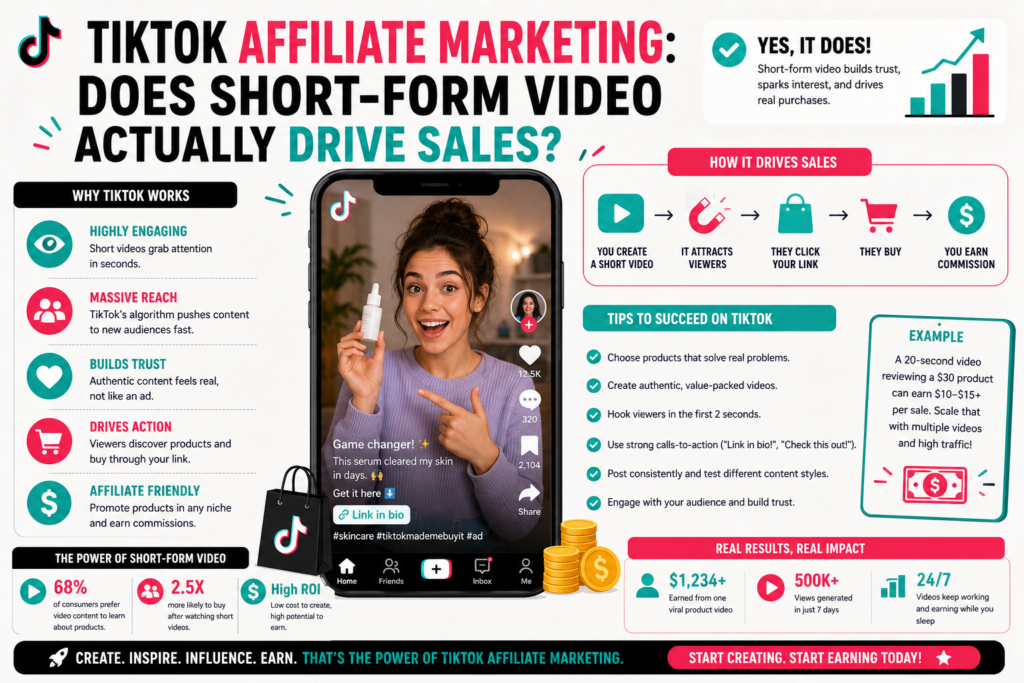
TikTok has over a billion monthly active users, and the platform has turned ordinary people into overnight product promoters. A 30-second video of someone showing off a kitchen gadget, a skincare routine, or a pair of running shoes can rack up millions of views in 48 hours.
But here’s the question that actually matters: do those views translate into affiliate sales?
The answer is more nuanced than the “I made $10,000 in one month on TikTok!” crowd wants you to believe. Short-form video can and does drive affiliate sales, but the way it works, the conditions that need to be in place, and the timeline for results look different from what most people expect.
This article breaks down the real mechanics of TikTok affiliate marketing, what’s working right now, what’s overhyped, and how to build a strategy that turns short clips into actual commissions.
The Case for TikTok as an Affiliate Marketing Channel
Before getting into strategy, it’s worth understanding why TikTok even works for selling products. The platform has a few structural advantages that most other social channels don’t offer.
Algorithmic distribution favors new creators.
On Instagram or YouTube, your content mostly reaches people who already follow you. On TikTok, the For You Page algorithm pushes content to people based on interest signals, not follower count. A brand-new account with zero followers can get a video in front of 50,000 people if the content matches what those viewers are interested in. That kind of cold reach is rare on any other platform.
The content format mirrors real conversation.
TikTok videos feel like a friend showing you something cool. They’re casual, unscripted, and shot on a phone. That format builds trust faster than a polished ad or a text-based product review. When someone on TikTok says “you need this,” it feels like a genuine recommendation, not a pitch.
Purchase intent is rising.
TikTok has invested heavily in commerce features. TikTok Shop, product tagging, live shopping events, and in-app checkout have turned the platform from a pure entertainment app into a discovery-to-purchase pipeline. According to internal TikTok data and various marketing reports, a significant percentage of TikTok users have purchased a product after seeing it on the platform.
Content production is fast.
A TikTok video takes 5 to 15 minutes to create. Compare that to a 2,000-word blog post (3 to 6 hours) or a polished YouTube video (5 to 15 hours including editing). The speed of content production means you can test more products, more angles, and more hooks in less time.
How TikTok Affiliate Marketing Works (The Mechanics)
There are three primary ways to do affiliate marketing on TikTok:
1. Traditional Affiliate Links (Link in Bio)
This is the most straightforward approach. You join an affiliate program (Amazon Associates, ShareASale, Impact, CJ Affiliate, individual brand programs), get your tracking link, and direct viewers to click the link in your bio.
How it works in practice:
- You create a product-focused TikTok video
- At the end of the video, you say “Link in bio” or use a text overlay pointing to your profile
- Your bio contains either a direct affiliate link or a link-in-bio tool (Linktree, Stan Store, Beacons) that houses multiple affiliate links
- Viewers tap your profile, click the link, and if they purchase, you earn a commission
The friction problem: This method requires multiple steps from the viewer. They have to stop watching, go to your profile, find the link, click it, and then complete the purchase on a separate website. Every step loses a percentage of potential buyers. Conversion rates through bio links are typically lower than methods with fewer steps.
2. TikTok Shop Affiliate Program
TikTok Shop changed the game for affiliate marketing on the platform. Instead of sending people off-platform through a bio link, you can tag products directly in your videos. Viewers see a small shopping bag icon, tap it, and can purchase the product without leaving TikTok.
How it works in practice:
- You apply to become a TikTok Shop affiliate (through the TikTok Seller Center or Creator Marketplace)
- You browse the TikTok Shop product catalog and select items you want to promote
- When creating a video, you tag the product directly
- The commission rate is set by the seller (typically 5% to 20%, sometimes higher for promotional campaigns)
- When someone buys through your tagged video, you earn the commission
Why this method converts better: The purchase happens inside TikTok. No external redirects, no extra tabs, no friction. The buyer sees the product, taps, checks out, done. This in-app checkout flow dramatically reduces drop-off compared to bio link methods.
3. Creator Marketplace and Brand Partnerships
The TikTok Creator Marketplace connects brands with creators for paid promotions. While this is technically closer to sponsored content than pure affiliate marketing, many of these deals include affiliate components, where you get paid a flat fee plus a commission on sales generated.
Some brands offer hybrid arrangements: a smaller upfront payment combined with a higher affiliate commission, giving you ongoing passive income from a single video that continues to perform.
Does Short-Form Video Actually Convert? The Evidence
This is the real question. Let’s look at what the data and real-world experience tell us.
What Works in Favor of Conversion
Impulse purchases thrive in short-form video.
TikTok is an impulse-driven platform. The price sweet spot for TikTok affiliate products is $10 to $50. At that range, people don’t need to think too hard. They see a cool product, the price feels reasonable, and they buy it in the moment. Products like kitchen gadgets, phone accessories, beauty tools, organizing products, and affordable fashion perform well because the decision-making process is fast.
Visual demonstration builds immediate desire.
Reading about a product is one thing. Watching someone peel a perfectly boiled egg with a $12 gadget while you’re lying on your couch at 11 PM is something else entirely. Video creates an emotional response that text rarely matches. You can see the product working, hear the creator’s genuine reaction, and picture yourself using it. That combination shortens the gap between awareness and purchase.
Social proof compounds quickly.
When a TikTok goes viral, the comment section becomes its own sales engine. Comments like “just ordered mine,” “I bought this last week and it’s incredible,” and “link??” create a bandwagon effect. The more people validate the product in the comments, the more new viewers feel confident buying.
TikTok’s algorithm rewards commercial content that performs well.
Unlike platforms that suppress overly commercial posts, TikTok’s algorithm doesn’t penalize product content as long as it generates engagement. A product review that holds attention, sparks comments, and gets shared will be pushed to more viewers, regardless of its commercial intent.
What Works Against Conversion
Short attention spans create short purchase windows.
A viewer is interested for 15 to 30 seconds. If they don’t act immediately, they’ll scroll to the next video and forget about your product within minutes. Unlike a blog post that someone bookmarks and returns to, or a YouTube video they find through search, TikTok content has a very short window of active purchase intent.
Attribution and tracking are messy.
One of the biggest challenges with TikTok affiliate marketing is knowing what actually drove a sale. If you’re using bio links, tracking is fairly straightforward. But many viewers see a product on TikTok, then search for it on Amazon or Google later. You don’t get credit for that sale. The gap between influence and attribution means TikTok likely drives more sales than affiliate dashboards show, but you don’t get paid for the ones you can’t track.
Higher-ticket items face resistance.
Products above $75 to $100 are harder to sell through short-form video. The more expensive the purchase, the more research people want to do before committing. They might discover the product through TikTok, but they’ll read blog reviews, watch YouTube comparisons, and check Reddit threads before buying. TikTok becomes the top of the funnel rather than the point of sale.
Content shelf life is unpredictable.
A blog post optimized for search can generate traffic for years. A YouTube review continues to surface in search results long after publishing. A TikTok video typically has a performance window of 24 to 72 hours. Some videos have a second wave of reach weeks later, but most of your traffic comes in a short burst. This means you need a constant stream of new content to maintain consistent affiliate income.
What’s Actually Selling on TikTok Right Now
Certain product categories consistently outperform others on TikTok. If you’re choosing a niche for affiliate marketing, these categories have proven demand.
Beauty and skincare – This has been TikTok’s strongest affiliate category since the platform exploded in 2020. Skincare routines, makeup tutorials, and product comparisons generate massive engagement. Affordable brands and “dupe” (cheaper alternatives to luxury products) content perform especially well.
Kitchen and home gadgets – The “TikTok made me buy it” trend lives here. Unusual kitchen tools, clever storage solutions, and oddly satisfying cleaning products consistently go viral.
Affordable fashion and accessories – Outfit inspiration, try-on hauls, and “find of the day” posts drive steady affiliate sales, particularly for Amazon fashion and fast-fashion brands.
Tech accessories – Phone cases, ring lights, portable chargers, Bluetooth speakers under $40, and desk setup accessories. The key is products that look good on camera and are easy to demonstrate in a few seconds.
Health and fitness – Workout equipment for small spaces, protein snacks, supplements, and fitness trackers. Content that shows visible results or clever workout hacks tends to perform.
Books – BookTok is one of the most powerful communities on TikTok. A single BookTok video has propelled titles onto bestseller lists. Book recommendation videos with Amazon affiliate links can generate surprising commission volume.
Pet products – Funny, cute, or clever pet products with an animal actually using them on camera. Pet content gets high engagement, and pet owners are willing spenders.
A TikTok Affiliate Strategy That Actually Works
Here’s a tactical breakdown of how to approach TikTok affiliate marketing with a realistic plan.
Phase 1: Foundation (Weeks 1-3)
Pick a specific niche angle.
“Tech reviews” is too broad. “Budget desk setup for remote workers” is specific enough to attract a defined audience. The narrower your focus, the easier it is to become the go-to account in that space and the more relevant your product recommendations will feel.
Set up your profile for conversions.
Your username should be clear and relevant to your niche. Your bio should tell people exactly what kind of content you post and include either a direct link or a link-in-bio tool. If you don’t have 1,000 followers yet (TikTok’s typical threshold for adding a bio link), focus on growing first with consistent content.
Join affiliate programs.
Start with Amazon Associates (broad product range, easy approval, trusted checkout) and apply to TikTok Shop’s affiliate program if it’s available in your region. As you grow, add niche-specific programs for higher commission rates.
Study what’s working in your niche.
Before creating your own content, spend a week studying successful affiliate creators in your space. What hooks do they use? How do they structure their videos? What products are they promoting? What do the comments tell you about what viewers want? Take notes on patterns.
Phase 2: Content Creation and Testing (Weeks 4-8)
Post 1 to 3 videos per day.
Volume matters on TikTok, especially early on. You’re trying to find what resonates with the algorithm and your audience. Not every video will perform. Some will get 200 views. Occasionally, one will get 200,000. Posting frequently gives the algorithm more data to work with and gives you more chances at a breakout video.
Follow the 80/20 content mix.
80% of your content should be pure value: tips, information, entertainment, or education related to your niche. 20% can be direct product recommendations with affiliate links. If every video is a sales pitch, your audience will tune out. Build trust through helpful content, then make recommendations that feel earned.
Test different video formats.
Try these formats and see which ones your audience responds to:
- The “Holy Grail” find – “I’ve been searching for a [product type] that actually works, and I finally found it.”
- The comparison – Side-by-side testing of two similar products. “I tried both so you don’t have to.”
- The problem-solution – Open with a relatable frustration, then present the product as the fix.
- The skeptic review – “I didn’t think this would work, but…” (Skepticism followed by genuine surprise is extremely persuasive.)
- The listicle – “3 things that made my morning routine 10x better.” Quick hits with multiple products.
- The story format – Share a personal experience that naturally leads to a product recommendation.
Optimize your hooks.
The first 1 to 2 seconds of your video determine whether someone watches or scrolls. Strong hooks include:
- “Stop scrolling if you [have this problem].”
- “This $14 product replaced my $200 [item].”
- “I wish someone had told me about this sooner.”
- “The internet is obsessed with this, and here’s why.”
- “Unpopular opinion: this product is overhyped. Here’s what I use instead.”
Avoid starting with “Hey guys!” or any slow introduction. Get to the point immediately.
Phase 3: Scaling What Works (Months 3-6+)
Double down on winning products.
When you find a product that generates clicks and sales, create multiple videos about it from different angles. One product can support 5 to 10 different videos: a first impression, a 30-day update, a comparison with a competitor, a tutorial on how to use it, a “who should and shouldn’t buy this” take, and so on.
Build content series.
Series content encourages follows and return viewers. “Budget desk setup Part 1, 2, 3…” or “Rating every viral Amazon find” gives people a reason to follow your account and watch your future content, which means more eyes on future affiliate recommendations.
Add TikTok Live to your strategy.
Live sessions are underrated for affiliate marketing. You can demonstrate products in real time, answer questions, and engage directly with your audience. TikTok Shop allows you to showcase products during a Live session, which creates a home-shopping-network-style experience that drives impulse purchases. Creators who go live consistently report higher conversion rates than those who rely on pre-recorded content alone.
Expand to a second platform.
Once you’ve found your groove on TikTok, repurpose your best content to Instagram Reels, YouTube Shorts, or Pinterest Idea Pins. The same video can reach a different audience on each platform, and each platform provides additional link placement options. This diversifies your traffic sources and protects you against TikTok algorithm changes.
Start collecting emails.
This is the part most TikTok affiliates skip, and it’s the biggest mistake for long-term income. Use a free landing page tool (ConvertKit, Beehiiv, Mailchimp) and offer something free (a product recommendation guide, a discount code roundup, a curated list of your top picks) in exchange for email addresses. An email list gives you a direct line to your audience that no algorithm can take away.
Realistic Income Expectations
Let’s ground this in reality. TikTok affiliate income varies wildly depending on niche, content quality, consistency, and the products you promote.
Micro-level example (small creator, 5,000 to 20,000 followers):
If you post one product video per day and average 2,000 to 10,000 views per video, you might generate 20 to 100 clicks per day to your affiliate links. At a 3% to 5% conversion rate and an average commission of $3 to $5 per sale, that’s roughly $2 to $25 per day, or $60 to $750 per month.
Mid-level example (growing creator, 20,000 to 100,000 followers):
With higher view counts (10,000 to 100,000 per video) and a mix of Amazon Associates and higher-commission programs, creators at this level typically earn $500 to $3,000 per month from affiliate commissions. Occasional viral videos can create significant spikes.
Top-level example (established creator, 100,000+ followers):
Creators with large, engaged audiences in profitable niches can earn $5,000 to $20,000+ per month through a combination of TikTok Shop commissions, traditional affiliate programs, and hybrid brand deals. These creators usually have diversified income streams beyond just affiliate marketing (brand sponsorships, their own products, courses, etc.).
The viral wildcard:
A single viral video can generate hundreds or even thousands of dollars in affiliate commissions within a few days. But viral moments aren’t reliable income. Building consistent daily revenue through steady content production is more sustainable than chasing virality.
Common Pitfalls That Kill TikTok Affiliate Accounts
Promoting products you haven’t used.
Audiences on TikTok can spot inauthentic recommendations instantly. If your review sounds like you’re reading a product description, you’ll lose trust fast. Use the products. Show them in your space. Share real opinions, including what you don’t love about them.
Ignoring FTC disclosure requirements.
You are legally required to disclose affiliate relationships. Use “#ad” or “#affiliate” in your caption, or include a verbal disclosure in your video. “Full disclosure, I earn a small commission if you purchase through my link” is simple and effective. Skipping this step puts your account and your credibility at risk.
Chasing trending sounds instead of building a niche.
Trending audio can boost views, but if your content is all over the place topically, you’ll attract a scattered audience that doesn’t convert. An account that posts about skincare one day, crypto the next, and dog toys after that will struggle to build the focused audience that affiliate marketing requires. Use trending sounds when they fit your niche, but don’t let trends dictate your content strategy.
Giving up after 2 weeks.
Most people who try TikTok affiliate marketing quit within the first month because they didn’t go viral immediately. The algorithm needs time to understand your content and who to show it to. Your first 30 to 50 videos are essentially training data for TikTok’s recommendation system. Consistency through that initial period is what separates people who build real income from those who decide “TikTok doesn’t work.”
Neglecting video quality basics.
You don’t need professional equipment, but you do need three things: decent lighting (natural light or a cheap ring light), clear audio (the built-in phone mic is fine in a quiet room, but consider a $20 lapel mic if you have background noise), and a clean background that doesn’t distract from the product. Poor lighting and muffled audio will tank your retention rate, which tells the algorithm to stop pushing your video.
Putting the product link in the wrong place.
Don’t bury your affiliate link three levels deep in a Linktree page. If you’re using a link-in-bio tool, make the currently promoted product the first visible link. Update it frequently to match your latest content. If you mentioned a product in today’s video, that product’s link should be at the top of your bio page today.
TikTok vs. Other Platforms for Affiliate Marketing
How does TikTok stack up against the alternatives?
| Factor | TikTok | YouTube | ||
|---|---|---|---|---|
| Reach potential (new accounts) | Very high | Moderate | Low | Moderate |
| Content shelf life | Short (days) | Long (years) | Medium (weeks) | Long (months) |
| Purchase friction | Low (TikTok Shop) | Medium (description links) | Medium (bio/story links) | Low (direct pin links) |
| Best price range for products | $10-$50 | $50-$500+ | $20-$100 | $10-$75 |
| Content creation time | 5-15 min | 2-15 hours | 15-45 min | 15-30 min |
| Audience purchase intent | Impulse-driven | Research-driven | Aspiration-driven | Search-driven |
The takeaway: TikTok excels at driving impulse purchases of affordable products to new audiences. YouTube wins for higher-ticket items where buyers want in-depth reviews. Instagram works best when you have an established following with strong personal brand loyalty. Pinterest captures people who are actively searching for products to buy.
The strongest affiliate marketers don’t rely on one platform. They use TikTok for discovery and reach, then funnel interested buyers to longer-form content on YouTube or direct purchase through email lists.
The Verdict: Does Short-Form Video Drive Affiliate Sales?
Yes, but with important caveats.
Short-form video on TikTok drives affiliate sales best when:
- The product is under $50 and visually demonstrable
- The content is authentic and the creator has actually used the product
- The purchase path has minimal friction (TikTok Shop > bio link)
- The creator posts consistently (daily or near-daily) over a sustained period
- The niche is specific enough to attract a targeted, interested audience
Short-form video struggles for affiliate marketing when:
- The product is expensive and requires research before buying
- The creator treats TikTok like a billboard rather than a conversation
- Content is sporadic or inconsistent
- The creator promotes products across too many unrelated categories
- There’s no system for capturing audience contact information outside the platform
TikTok won’t replace blog-based affiliate marketing or YouTube review channels for high-ticket, research-heavy purchases. But for affordable, visually interesting products marketed to an impulse-friendly audience, TikTok is one of the most effective affiliate channels available right now.
The creators making real money on TikTok affiliate marketing aren’t doing anything magical. They’re showing up every day, recommending products they genuinely use, making their content watchable and specific, and treating the platform like a long-term business rather than a get-rich-quick experiment.
If you’re willing to commit to that approach, short-form video can absolutely drive affiliate sales. The 15-second format isn’t a limitation. In many cases, it’s an advantage.