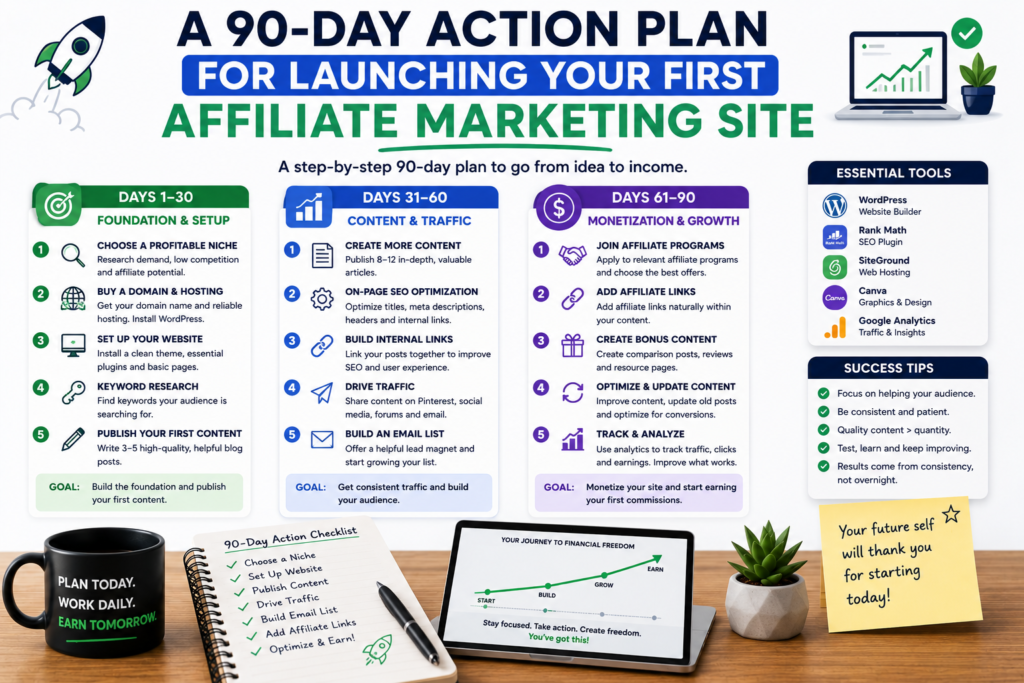
Ninety days from now, you could have a fully functioning affiliate marketing site with published content ranking in search engines, an email list capturing subscribers, affiliate links generating clicks, and possibly your first commissions hitting your account.
Or you could spend those same 90 days reading blog posts, watching YouTube tutorials, and “researching” without ever publishing a single page. That’s where most aspiring affiliate marketers get stuck. Not because they lack information, but because they lack a structured plan that tells them exactly what to do and when to do it.
This is that plan.
What follows is a detailed, week-by-week blueprint for taking your affiliate site from zero to fully operational in 90 days. No vague advice. No “it depends” hedging. Just concrete tasks, clear deadlines, and the reasoning behind each step so you understand why you’re doing what you’re doing.
A few ground rules before we start:
This plan assumes you’re building a content-based affiliate site. That means a website (WordPress) that publishes reviews, comparisons, guides, and informational content optimized for search engine traffic. This is the most proven, sustainable affiliate model for beginners.
Expect to invest 10 to 15 hours per week. This plan is designed for people with day jobs, family obligations, or other commitments. You don’t need to quit your job or work 60-hour weeks. But you do need consistent, focused effort. Ten hours a week for 90 days is roughly 130 hours, which is enough to build a real foundation if you use the time well.
Results won’t be instant. Search engines take time to discover, crawl, index, and rank new content. Most affiliate sites don’t see meaningful organic traffic until months 3 to 6. This plan front-loads the foundational work so that your content is positioned to grow once Google starts paying attention.
Let’s get to work.
Phase 1: Foundation (Days 1–30)
The first 30 days are about making smart decisions that compound over the next 60 days and beyond. Rush through this phase, and you’ll spend months cleaning up avoidable mistakes. Get it right, and everything that follows moves faster.
Week 1: Niche Selection and Validation (Days 1–7)
This is the single most consequential decision you’ll make. Your niche determines your audience, your content topics, your affiliate programs, your competition level, and your long-term earning potential. Spend the full week here. Don’t shortcut this.
Day 1–2: Brainstorm niche candidates.
Write down 10 to 15 niche ideas based on three criteria:
- Personal knowledge or genuine interest. You’ll be writing dozens (eventually hundreds) of articles about this topic. If you have zero interest in it, the work becomes unbearable by month two. You don’t need to be an expert, but you need enough curiosity to research products thoroughly and enough baseline knowledge to write with credibility.
- Buyer intent exists. People in this niche actively search for product recommendations, reviews, and comparisons. A niche like “meditation techniques” has plenty of informational searches but limited buying behavior. A niche like “meditation apps” or “meditation cushions” has clear commercial intent. Look for niches where people spend money on products or tools.
- Affiliate programs are available. Verify that products in your niche are sold through affiliate programs. Check Amazon Associates (covers almost every physical product category), ShareASale, Impact, CJ Affiliate, and individual company affiliate programs. If you can’t find at least 10 to 15 products with affiliate programs in your niche, the monetization potential is limited.
Day 3–4: Validate demand and competition.
For your top 3 to 5 niche candidates, run this validation process:
- Search volume check. Use a free tool like Ubersuggest, Google Keyword Planner, or Google Trends to confirm that people are actually searching for product-related terms in this niche. Look for keywords like “best [product type],” “[product] review,” and “[product A] vs [product B].” If the main commercial keywords have fewer than 500 monthly searches, the niche might be too small.
- Competition assessment. Google your target keywords and examine the first page of results. Who ranks there? If every result is a massive authority site (Wirecutter, Forbes, CNET, Healthline), breaking through will be extremely difficult for a new site. Ideal niches show a mix of large sites and smaller niche blogs on page one, because that proves smaller sites can compete.
- Commission potential. Calculate a rough estimate of potential monthly earnings. If the average product in your niche costs $50 and the affiliate commission is 5% ($2.50 per sale), you’d need 400 sales per month to earn $1,000. If the average product costs $200 with a 10% commission ($20 per sale), you only need 50 sales for the same income. Higher-priced products or products with recurring commissions (SaaS tools, subscriptions) give you a faster path to meaningful revenue.
Day 5–6: Make your final niche decision.
Based on your research, pick one niche. Not two. Not three. One. Spreading your effort across multiple niches in the first 90 days guarantees mediocre results in all of them. You can expand later once your first site is generating traffic and income.
Write down your niche selection and the reasoning behind it. This document becomes your reference point whenever you second-guess your decision in the weeks ahead (and you will second-guess it, everyone does).
Day 7: Map your affiliate programs.
Sign up for every relevant affiliate program in your niche. This includes:
- Amazon Associates (broad product coverage, lower commissions)
- Direct affiliate programs from major brands in your niche
- Affiliate networks like ShareASale, Impact, CJ Affiliate, or Awin
- SaaS affiliate programs if your niche includes software recommendations
Create a spreadsheet tracking each program: company name, commission rate, cookie duration, payment terms, and signup status. Some programs approve instantly. Others require a review period or a minimum traffic threshold. Apply now so approvals are in place when your content goes live.
Week 2: Domain, Hosting, and Site Setup (Days 8–14)
Day 8–9: Choose and register your domain name.
Your domain name should be:
- Brandable and memorable. Something like “GearLabPro.com” or “HomeBrewAdvice.com” works better than “best-coffee-makers-reviews-2026.com.” Brandable names are easier to remember, look more professional, and don’t limit you if you expand your topic coverage later.
- Easy to spell and pronounce. If you can’t tell someone your domain name verbally without them asking you to spell it, pick something simpler.
- Reasonably short. Under 15 characters is ideal. Under 20 is acceptable. Anything longer gets unwieldy.
- A .com extension if possible. It’s the most trusted and recognized extension. If your ideal .com is taken, consider .co, .io, or .net before resorting to unusual extensions.
Register through a reputable registrar like Namecheap, Cloudflare, or Google Domains. Expect to pay $8 to $15 per year.
Day 10–11: Set up hosting and install WordPress.
Choose a reliable hosting provider. For a new site, shared hosting is perfectly adequate. Popular options include SiteGround, Cloudways, and A2 Hosting. Expect to pay $3 to $15 per month.
Most hosts offer one-click WordPress installation. Install WordPress, log into your dashboard, and familiarize yourself with the admin interface.
Day 12–13: Install your theme and configure your site.
Install a fast, clean, SEO-friendly theme. Free options like GeneratePress, Kadence, or Astra provide excellent performance without any cost. If you’re willing to invest $50 to $80 upfront, the premium versions of these themes offer additional customization.
Complete these setup tasks:
- Set your permalink structure to “Post name” (Settings → Permalinks)
- Create your main pages: Home, About, Contact, Privacy Policy, Affiliate Disclosure
- Install core plugins: an SEO plugin (Rank Math or Yoast, both free), a caching plugin (WP Super Cache or LiteSpeed Cache), and a link management plugin (Pretty Links free version)
- Set up your site’s navigation menu
- Add your site logo (create a simple one in Canva for free)
- Configure your SEO plugin with basic site-wide settings (site title, meta description template, sitemap enabled)
Day 14: Set up analytics and search tools.
Install Google Analytics 4 on your site using either the GA4 tracking code or a plugin like Site Kit by Google. Set up Google Search Console and verify your domain ownership. Submit your XML sitemap (generated by your SEO plugin) to Search Console.
These two tools are your eyes and ears. Without them, you’re guessing about traffic, rankings, and user behavior. With them, every decision you make going forward is backed by data.
Week 3: Keyword Research and Content Planning (Days 15–21)
This week transforms your niche knowledge into a concrete content roadmap. By the end of it, you’ll know exactly what to write for the next 60 days.
Day 15–16: Build your master keyword list.
Open Ubersuggest (free tier), Google Keyword Planner, or Google’s autocomplete feature and start generating keyword ideas. You’re looking for three types of keywords:
- Buyer-intent keywords (your highest priority): “best [product],” “[product] review,” “[product A] vs [product B],” “is [product] worth it,” “[product] for [specific use case].” These attract people who are ready to buy and are most likely to click affiliate links.
- Informational keywords with commercial undertones: “how to choose a [product],” “what to look for in a [product],” “[product type] buying guide,” “do I need a [product].” These attract people earlier in the buying process who may convert after reading your content.
- Supporting informational keywords: “how to use [product],” “[product] tips,” “[product category] for beginners,” “how does [product type] work.” These build topical authority and attract traffic that you can funnel to your commercial pages through internal links.
Aim for 50 to 80 keywords across all three types. Record each keyword in a spreadsheet with the following columns: keyword, monthly search volume, keyword difficulty/competition score, search intent (buyer, informational, or mixed), and priority level (high, medium, low).
Day 17–18: Prioritize and organize your keywords.
Sort your keyword list by a combination of buyer intent and achievable difficulty. Your top priorities for the first 90 days should be:
- Buyer-intent keywords with low competition (difficulty score under 25 to 30)
- “Best of” and comparison keywords where smaller sites rank on page one
- Long-tail variations of competitive head terms (e.g., “best running shoes for flat feet wide toe box” instead of “best running shoes”)
Group related keywords into content clusters. A cluster might look like:
- Pillar article: “Best Robot Vacuums for Pet Hair”
- Supporting articles: “[Brand A] Robot Vacuum Review,” “[Brand B] vs [Brand C] for Pet Hair,” “How to Choose a Robot Vacuum for Pets,” “Robot Vacuum Maintenance Tips”
This cluster approach helps Google understand that your site covers the topic comprehensively, which boosts rankings for the entire cluster.
Day 19–20: Create your 90-day content calendar.
Map your prioritized keywords to a publishing schedule. For the remaining weeks of this plan (roughly 10 weeks), plan to publish 2 to 3 articles per week. That’s 20 to 30 articles total.
Structure your calendar like this:
- Weeks 4–6 (Phase 1 remaining + early Phase 2): Publish your highest-priority buyer-intent articles first. These are the pages that will eventually generate affiliate commissions, and they need the most time to get indexed and start ranking.
- Weeks 7–9 (Mid Phase 2): Mix buyer-intent content with informational supporting content. The supporting articles build topical authority and create internal linking opportunities to your money pages.
- Weeks 10–13 (Phase 3): Fill gaps in your content coverage, publish comparison posts that link to individual reviews you’ve already written, and create any remaining supporting content.
Day 21: Outline your first 5 articles.
Before the writing phase begins, create detailed outlines for your first 5 articles. Each outline should include:
- Target keyword and secondary keywords to include
- Working title (with keyword placement)
- H2 and H3 heading structure
- Key points to cover under each heading
- Products to feature (with affiliate program details)
- Competitor analysis notes (what the current top-ranking articles cover and where you can do better)
- Target word count (typically 1,500 to 3,000 words for reviews, 2,500 to 5,000 for comprehensive guides and “best of” posts)
Pre-outlining prevents writer’s block and ensures each article is strategically structured before you type a single paragraph.
Week 4: Write and Publish Your First Content (Days 22–30)
Day 22–25: Write your first 3 articles.
Start with your highest-priority keyword targets. For each article:
- Follow your outline, but let the writing flow naturally. Outlines are guardrails, not straitjackets.
- Write in a clear, conversational tone. Read your sentences aloud. If they sound stiff or unnatural, rewrite them.
- Include your affiliate links where they fit organically. Don’t force 15 links into a 2,000-word article. Two to four well-placed links in a product review are plenty. In a “best of” list, one link per featured product is standard.
- Add images: product photos (your own or properly sourced), screenshots, comparison tables, and any custom graphics that add value. Compress images before uploading to keep page speed fast.
- Write a compelling meta title (under 60 characters) and meta description (under 155 characters) using your SEO plugin. Include your target keyword in both.
- Use proper heading hierarchy (H2 for main sections, H3 for subsections). Include your target keyword and variations in at least 2 to 3 headings.
Day 26–27: Edit and polish your articles.
Let each article sit for at least 24 hours after writing, then edit with fresh eyes. Check for:
- Clarity: Is every paragraph easy to understand on first read?
- Flow: Do sections transition smoothly from one to the next?
- Accuracy: Are all product details, prices, and specifications current and correct?
- Grammar and spelling: Run through Grammarly or a similar tool, then do a manual pass.
- Readability: Break up long paragraphs. Vary sentence length. Use bullet points and numbered lists where they improve scannability.
- Affiliate disclosure: Include a clear affiliate disclosure statement at the top of every article containing affiliate links. This is both a legal requirement (FTC guidelines) and a trust-building practice.
Day 28–30: Publish and perform initial optimization.
Publish your first 3 articles. For each published article:
- Submit the URL to Google Search Console using the URL Inspection tool for faster indexing
- Create internal links between your articles where relevant
- Share on any social media profiles you have (even personal ones, if you’re comfortable)
- Create 3 to 5 Pinterest pins for each article and publish them to relevant boards
- Record the publish date in your content calendar
Congratulations. You now have a live affiliate site with real content. Most aspiring affiliate marketers never get this far. You’re already ahead.
Phase 2: Content Engine (Days 31–60)
Phase 1 built the foundation. Phase 2 is about building the content engine that powers your site’s growth. The goal: publish consistently, start building an email list, and establish your site as a genuine resource in your niche.
Week 5: Content Production Rhythm (Days 31–37)
Establish your writing routine.
The single biggest predictor of affiliate site success is consistent content production. Not sporadic bursts of inspiration followed by weeks of silence. Consistent, scheduled output.
Design a weekly routine that fits your life:
- Option A (weekday writer): Write one article Tuesday through Thursday, edit Friday, publish Saturday.
- Option B (weekend warrior): Research and outline during weekday evenings, write and edit Saturday and Sunday, publish Sunday evening or Monday morning.
- Option C (batch producer): Dedicate one full day to writing 2 to 3 articles, then spend shorter sessions throughout the week on editing, formatting, and publishing.
Pick the option that matches your energy patterns and schedule. Then protect that time fiercely. Treat your writing sessions as non-negotiable appointments.
Publish articles 4 through 6 this week.
Follow the same process from Week 4: write, wait 24 hours, edit, add images and links, optimize SEO elements, publish, and submit to Search Console.
Start weaving internal links into a deliberate structure. When you mention a product in an informational article, link to your detailed review of that product. When your review references a broader category, link to your “best of” roundup. This internal linking web helps Google understand your site’s structure and passes authority between your pages.
Week 6: Launch Your Email List (Days 38–44)
Starting your email list in week 6 (not month 6 or month 12) is a deliberate choice. Here’s why it matters: every day your site exists without an email capture mechanism is a day you’re losing potential subscribers who may never return.
Day 38–39: Choose an email platform and set up your account.
Free options for beginners:
- Mailchimp (free up to 500 subscribers, 1,000 emails/month)
- MailerLite (free up to 1,000 subscribers)
- ConvertKit free tier (up to 10,000 subscribers, limited automation)
Pick one. Don’t agonize over the choice. You can migrate later if needed. The best platform right now is the one you actually set up and use.
Day 40–41: Create your lead magnet.
A lead magnet is the free resource you offer in exchange for an email address. It should be:
- Directly related to your niche and the problems your audience faces
- Immediately useful (something they can apply or reference right away)
- Quick to consume (a one-page cheat sheet, a short checklist, a resource list, or a simple template)
- Easy for you to create (don’t spend two weeks building an elaborate ebook)
Examples by niche:
- Home office gear: “The Complete Home Office Setup Checklist: 27 Things You Need (and 5 You Don’t)”
- Coffee equipment: “Brewing Ratios Cheat Sheet: Perfect Measurements for Every Method”
- Pet care: “New Puppy Shopping List: What to Buy (and What to Skip) in the First 30 Days”
- Running gear: “Training Plan Template: 12-Week Half Marathon Schedule for Beginners”
Create your lead magnet in Google Docs or Canva, export as a PDF, and upload it to your email platform for automated delivery.
Day 42–43: Build your opt-in forms and welcome sequence.
Create two types of opt-in forms:
- Inline form: A signup box embedded within your blog posts, typically placed after the introduction or within the body of the article where engagement is highest.
- Pop-up or slide-in form: A form that appears after a visitor has been on the page for 30 to 60 seconds or has scrolled 50% of the page. This catches engaged readers who might otherwise leave without subscribing.
Write a 3-email welcome sequence:
- Email 1 (immediate): Deliver the lead magnet. Introduce yourself briefly (one to two sentences about who you are and what your site covers). Set expectations for future emails.
- Email 2 (Day 2): Share your most helpful published article. Position it as “one of the most popular posts on the site” or “the article I wish I’d read when I started [topic].”
- Email 3 (Day 4): Recommend a product with your affiliate link. Frame it as a personal recommendation, not a sales pitch. Explain why you use or recommend it, who it’s best for, and include an honest assessment.
Day 44: Add opt-in forms to all existing articles.
Go back through every published article and add an inline opt-in form. Place it after the first major section (where readers are engaged but haven’t gotten their answer yet) and near the end of the article (where readers who’ve consumed the whole piece are most likely to want more from you).
Week 7: Content Acceleration (Days 45–51)
Publish articles 7 through 10.
By now, your writing process should feel smoother. You know your niche, you have your templates, and your outlines are pre-built. Push to publish 3 to 4 articles this week.
Expand your content types.
If your first 6 articles were primarily product reviews, add different formats this week:
- A comprehensive “best of” roundup that links to your individual reviews: “Best [Product Category] in 2026: [Number] Top Picks Tested and Compared”
- A buying guide that helps beginners understand what to look for: “How to Choose the Right [Product Type]: A Beginner’s Buying Guide”
- A comparison post between two popular products you’ve already reviewed: “[Product A] vs [Product B]: Which One Is Actually Worth Your Money?”
Content diversity serves two purposes. It captures different types of search queries (some people search for “best X,” others search for “X vs Y,” others search for “how to choose X”). And it creates a natural internal linking structure where each piece strengthens the others.
Start a simple link-building effort.
Backlinks (links from other websites to yours) are one of Google’s strongest ranking signals. For a new site, you won’t attract many natural backlinks yet, so initiate a basic outreach strategy:
- Broken link building: Use a free tool like Check My Links (Chrome extension) to find broken links on resource pages in your niche. Email the site owner, let them know about the broken link, and suggest your content as a replacement.
- Resource page outreach: Find “best resources for [your topic]” pages and email the owners asking if they’d consider including your most comprehensive guide.
- Forum and community participation: Share your expertise (not just your links) in Reddit threads, Quora answers, and niche forums. When your content genuinely answers someone’s question, include a link. Build credibility first, promote second.
Aim for 3 to 5 outreach emails per week. The response rate will be low (5% to 15% is normal), but even a few quality backlinks accelerate your rankings meaningfully.
Week 8: Analytics Review and Optimization (Days 52–58)
Conduct your first data review.
You’ve been live for roughly 4 weeks. Open Google Search Console and Google Analytics and look at:
- Which pages have been indexed. Use the Coverage report in Search Console to confirm Google has found and indexed your published pages. If any are missing, investigate and fix the issue (usually a noindex tag, a sitemap problem, or thin content).
- Early keyword impressions. Check the Performance report in Search Console. Even with minimal traffic, you’ll see which queries your pages are appearing for. This data tells you whether Google is associating your content with the right keywords.
- User behavior metrics in GA4. Look at engagement rate, average engagement time, and pages per session. If a page has very low engagement (under 30% engagement rate), the content likely isn’t meeting visitor expectations. Revisit the article, compare it to what competitors offer, and improve it.
- Click-through rate from search results. If a page is getting impressions but very few clicks, your title tag and meta description aren’t compelling enough. Rewrite them to be more specific, benefit-focused, and click-worthy.
Optimize your existing content.
Based on your data review, make targeted improvements:
- Rewrite weak meta titles and descriptions on pages with low click-through rates
- Add more depth to thin articles that aren’t performing well
- Improve internal linking between related articles
- Add or replace images for better visual engagement
- Update any product information that’s already changed since you published
Publish articles 11 through 13.
Continue your publishing rhythm. Every article you publish adds another potential traffic source, another keyword target, and another page that can earn affiliate commissions.
Phase 3: Growth and Monetization (Days 61–90)
Your foundation is solid. Your content engine is running. Phase 3 is about amplifying what’s working, fixing what isn’t, and positioning your site for serious growth in the months ahead.
Week 9: Monetization Audit (Days 59–65)
Review your affiliate link performance.
If you’ve been using Pretty Links or Bitly to track affiliate link clicks, review the data:
- Which articles generate the most affiliate clicks?
- Which products get clicked most often?
- Where are your affiliate links placed within those articles (top, middle, bottom)?
- What call-to-action language produces the most clicks?
If you don’t have enough click data yet (very possible at this stage), study your highest-traffic pages and make sure they have well-placed, clearly visible affiliate links with compelling calls-to-action.
Optimize your highest-potential pages.
Identify your top 5 pages by traffic (or by search impressions if traffic is still building). These are your money pages, the ones most likely to generate affiliate income first. Give each one a thorough optimization pass:
- Ensure affiliate links are placed at every logical point where a reader might be ready to check a product (after a positive review section, within comparison tables, at the conclusion).
- Test different call-to-action phrases. “Check the current price on Amazon” often outperforms generic text like “click here” or “buy now.” Specific, benefit-oriented language converts better.
- Add comparison tables if your articles feature multiple products. A well-formatted table with product names, key specs, ratings, and linked “check price” buttons significantly increases clicks.
- Include a clear “winner” or “top pick” recommendation. Readers making buying decisions want guidance, not just information. Tell them which product you’d choose and why.
Diversify your affiliate programs.
If you’ve been relying solely on Amazon Associates, explore direct affiliate programs from brands you review. Many companies offer higher commissions through their own programs than through Amazon. A brand that pays 10% directly versus Amazon’s 3 to 4% makes a meaningful difference as your traffic grows.
Check each brand’s website footer for an “Affiliates” or “Partners” link. Sign up for programs that offer better terms than your current options.
Week 10: Email Marketing Activation (Days 66–72)
Assess your list growth.
Check your subscriber count. If your opt-in forms have been active for 3 to 4 weeks, you might have anywhere from 5 to 50 subscribers (depending on your traffic). That’s fine. The goal right now isn’t a massive list. It’s building the system that grows automatically as your traffic increases.
If your subscriber count is zero or near-zero, troubleshoot:
- Are your opt-in forms actually visible and functioning? Test them yourself.
- Is your lead magnet compelling enough? Ask someone in your target audience if they’d trade their email for it.
- Are your forms placed in high-visibility positions within your articles?
Create your first broadcast email.
Beyond your automated welcome sequence, send your first “broadcast” email to your entire list. Share a recent article, offer a tip related to your niche, and include one affiliate product recommendation. Keep the tone helpful and conversational. This is a relationship-building exercise, not a sales event.
Set an email schedule.
Commit to emailing your list once per week or every two weeks. Consistency matters more than frequency. A reliable biweekly email builds more trust than an erratic schedule of daily emails followed by weeks of silence.
Each email should follow a simple structure:
- A brief, engaging opening (a question, a personal observation, or a timely hook)
- One piece of genuine value (a tip, a recommendation, a resource, or a link to your latest content)
- One affiliate product mention (positioned as a personal recommendation, not an advertisement)
- A short sign-off
Week 11: Traffic Diversification (Days 73–79)
Expand your Pinterest strategy.
If you started pinning in Week 4, you should have 15 to 25 pins published. Review which pins are getting the most impressions and clicks. Create more pins in similar styles and for similar topics.
Scale your pinning routine:
- Create 5 to 10 new pins per week for your existing articles
- Test different pin designs: different colors, different headline placements, different images
- Write keyword-rich pin descriptions for better search visibility within Pinterest
- Join 3 to 5 relevant group boards or Tailwind Communities to expand your reach
Explore additional traffic channels.
Based on your niche, one or more of these channels may be worth testing:
- Reddit: Find subreddits related to your niche. Become a genuine contributor (answer questions, share experiences, provide value) before ever linking to your content. Reddit communities are allergic to self-promotion but receptive to genuinely helpful members who occasionally share relevant resources.
- Quora: Answer questions related to your niche keywords. Write thorough, helpful answers and include a link to your relevant article where appropriate. Quora answers can rank in Google search results, creating an additional traffic stream.
- Niche forums: Many niches have active forums where enthusiasts discuss products and share recommendations. Participate authentically. Over time, your expertise becomes recognized, and linking to your comprehensive reviews feels natural rather than promotional.
- Facebook Groups: Join groups related to your niche. Follow group rules strictly (most prohibit direct self-promotion). Build credibility through helpful comments and answers. When someone asks a question that your content addresses directly, share the link with context.
Publish articles 14 through 18.
Keep the content engine running. You should be publishing 2 to 3 articles per week at this point. If you’re struggling to maintain that pace, batch your writing on weekends and schedule publishing throughout the week.
Week 12: Content Refresh and Strategic Expansion (Days 80–86)
Update your earliest articles.
Your first 3 to 5 articles are now 7 to 8 weeks old. Review them with fresh eyes and the knowledge you’ve gained since writing them:
- Are the product recommendations still current? Check for price changes, new models, or discontinued products.
- Can you add more depth based on questions you’ve seen from readers, forum threads, or new information you’ve discovered?
- Are your internal links pointing to articles that didn’t exist when you first published? Add new internal links to your more recent content.
- Can you improve the headline, introduction, or meta description based on what you’ve learned about your audience?
Content refreshes signal to Google that your site is actively maintained. Updated content often sees a ranking boost within a few weeks of being refreshed.
Identify content gaps.
Look at your content library and identify what’s missing:
- Are there products in your niche that you haven’t reviewed yet?
- Have competitors published comparison posts or guides that you haven’t covered?
- Are there long-tail keywords from your original research that you haven’t targeted yet?
- Have readers or forum members asked questions that your content doesn’t answer?
Add these gaps to your content calendar for the coming months. A systematic approach to content gap analysis keeps your site expanding in the right directions.
Publish articles 19 through 21.
Push to reach 20+ published articles by the end of this week. Twenty well-researched, properly optimized articles give your site enough content depth for Google to begin treating it as a legitimate resource in your niche.
Week 13: 90-Day Review and Planning (Days 87–90)
Conduct a comprehensive performance review.
Open your analytics tools and assess where you stand:
Google Search Console metrics:
- Total impressions over the past 28 days
- Total clicks from organic search
- Number of indexed pages
- Average position for your target keywords
- Top-performing queries and pages
Google Analytics 4 metrics:
- Total users and sessions
- Top traffic sources (organic search, direct, social, referral)
- Most-visited pages
- Engagement rate by page
- Outbound link clicks (your affiliate links)
Email metrics:
- Total subscribers
- Welcome sequence completion rate
- Open rate on broadcast emails
- Click rate on emails containing affiliate links
Affiliate program metrics:
- Total clicks on affiliate links
- Any conversions or commissions earned
- Highest-clicked products
Document your results honestly.
Write a 90-day retrospective that covers:
- What worked well (which content types, topics, and traffic sources performed best)
- What underperformed (which articles flopped, which strategies didn’t produce results)
- What you learned about your niche and audience
- What you’d do differently if starting over
- Your biggest wins (even small ones count, like your first indexed page, your first subscriber, or your first affiliate click)
Create your next 90-day plan.
Based on your review, build a plan for days 91 through 180. This plan should:
- Double down on content types and topics that showed early traction
- Reduce or eliminate strategies that consumed time without producing results
- Set specific, measurable goals for the next quarter (target traffic numbers, subscriber count, published articles, and revenue targets)
- Include a more aggressive link-building strategy now that you have content worth linking to
- Plan for content depth, filling out your topic clusters with supporting articles that strengthen your money pages
What to Expect at the 90-Day Mark
Let’s set honest expectations. Here’s what a typical new affiliate site looks like after 90 days of consistent execution:
Traffic: 100 to 1,000 monthly visitors from organic search, depending on your niche’s competitiveness and the search volume of your target keywords. Some articles may not have been indexed long enough to rank yet. This is normal.
Email subscribers: 10 to 100, depending on your traffic and the strength of your lead magnet. Even 10 subscribers represent 10 people who trust your content enough to share their email address.
Published content: 20 to 30 articles covering a mix of product reviews, comparisons, guides, and informational content.
Affiliate commissions: $0 to $200. Many sites don’t earn their first commission within 90 days, and that’s completely fine. The content infrastructure you’ve built during this period is an asset that will generate commissions for months and years ahead. If you’ve earned anything at all in the first 90 days, you’re ahead of schedule.
Search rankings: Several articles should be appearing in Google’s top 100 results for their target keywords. A few may have cracked the top 20 or even the first page for low-competition, long-tail terms.
Here’s what matters most: The comparison isn’t between where you are at day 90 and where a successful site is at day 900. The comparison is between where you are at day 90 and where you were at day 0. If you have a functioning site with quality content, growing (if small) traffic, and the beginning of an email list, you’ve built something real. The exponential growth phase typically begins between months 4 and 8 for sites that maintain consistent publishing.
The Mistakes That Derail 90-Day Plans
Having laid out exactly what to do, here are the pitfalls that cause most beginners to stall, stagnate, or quit before reaching day 90.
Switching niches mid-plan. Around week 3 or 4, almost every new affiliate marketer has the thought: “Maybe I should have picked a different niche.” This is normal doubt, not a sign you made the wrong choice. Unless you’ve discovered a fundamental problem (zero affiliate programs, no search demand, or a niche you genuinely can’t stand writing about), stick with your original decision. Switching niches at day 30 means restarting from day 1.
Prioritizing design over content. Spending 20 hours customizing your site’s fonts, colors, and layout while you have zero published articles is procrastination disguised as productivity. A clean, fast theme with default settings and 30 well-written articles will always outperform a custom-designed site with 3 articles. Content is your revenue engine. Design is the paint job.
Writing for search engines instead of people. If you stuff keywords into every sentence, write awkward headings just to match exact-match keywords, and produce content that reads like it was written for a robot, both Google and your readers will punish you. Write for humans first. Optimize for search engines second. Google’s algorithms are sophisticated enough to understand topic relevance without literal keyword repetition in every paragraph.
Ignoring mobile experience. Over 60% of web traffic comes from mobile devices. If your site is hard to read on a phone (tiny text, slow loading, unresponsive layout, pop-ups that cover the screen), you’re losing the majority of your potential audience. Test your site on your own phone regularly. Every page you publish should look clean and load quickly on mobile.
Comparing your day 30 to someone else’s year 3. The affiliate marketing internet is full of income reports showing $20,000 months and screenshots of impressive dashboards. Those results are real, but they represent years of accumulated effort. Comparing your first-month traffic to a three-year-old site’s traffic is like comparing a seedling to an oak tree. Track your own growth trajectory, not someone else’s current position.
Publishing thin content to hit quantity targets. A 500-word “review” that summarizes a product’s Amazon listing adds zero value to the internet and won’t rank for anything. If you can’t publish 3 quality articles in a week, publish 2. Or 1. Quality content that actually helps readers will always outperform a higher quantity of throwaway posts.
Neglecting the legal basics. Every affiliate site needs an affiliate disclosure (FTC requirement in the U.S.), a privacy policy (required by most ad networks and affiliate programs), and proper disclosure on individual pages containing affiliate links. Skipping these can result in affiliate account termination or legal complications. Set them up during Week 2 and never think about them again.
Beyond Day 90: Where This Goes
The 90-day plan gets you to launch. Here’s a brief look at what comes next.
Months 4–6: Your content library matures. Older articles climb in rankings as they accumulate authority and engagement signals. New articles rank faster because your domain has established credibility. Traffic growth accelerates noticeably. Affiliate commissions become more regular. You start seeing which products and content types generate the most revenue per visitor.
Months 7–12: Compounding takes hold. Your best articles may reach page one for competitive keywords. Your email list grows faster as traffic increases. You develop a clear picture of your site’s economics: average revenue per article, conversion rate per product, and lifetime value of an email subscriber. Monthly affiliate income reaches $500 to $3,000+ for sites with consistent output and good niche selection.
Year 2 and beyond: Your site becomes a genuine authority. Content production can slow down (quality over quantity at this stage) while revenue continues to grow from your existing library. You might hire writers to maintain output while you focus on strategy. Some affiliates expand into related niches, launch additional sites, or build complementary revenue streams (display ads, sponsored content, digital products).
The affiliate site you launch today doesn’t reach its full potential in 90 days. It reaches its potential through the compound effect of consistent effort applied over months and years. But without the first 90 days, that compound effect never begins.
Your Day 1 Starts Now
Print this plan. Bookmark this page. Open a project management tool and enter every weekly milestone as a task with a deadline.
Then close every other tab. Stop consuming information about affiliate marketing and start acting on it. You have a clear roadmap. The niche research methodology, the site setup checklist, the content calendar framework, the email list strategy, the analytics review process, and the optimization techniques are all here.
The difference between people who earn affiliate commissions and people who talk about earning affiliate commissions is execution. Not talent. Not luck. Not some secret strategy that’s hiding behind a paywall. Execution.
Day 1 starts with picking your niche. That’s it. That’s your only job today. Do it, check it off, and come back tomorrow for day 2.
Ninety days from now, you’ll have built something real, and you’ll wonder why you waited so long to start.