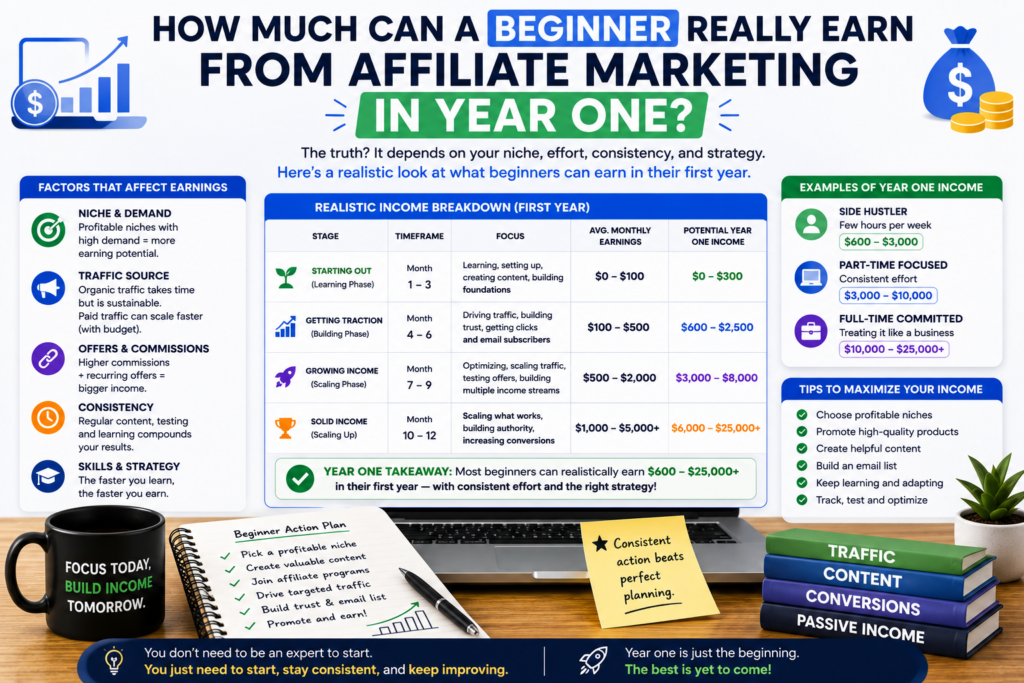
There’s a story that circulates through every affiliate marketing forum, YouTube comment section, and Reddit thread. Someone started a blog, posted product reviews for a few months, and now earns $8,000 per month in passive income while traveling Southeast Asia.
That story might be true. For that specific person.
What the story leaves out is the 97 other people who started at the same time, followed similar advice, and earned less than $300 in their entire first year. Not because they did something wrong, but because the timeline for affiliate marketing income is longer, slower, and more variable than the success stories suggest.
If you’re considering affiliate marketing or you’re already a few months in and wondering whether your numbers are normal, this article gives you the unfiltered breakdown. Not projections from someone selling a course. Not income screenshots from people with a decade of head start. Just an honest look at what first-year affiliate earnings look like across different platforms, niches, and commitment levels, and why the money you earn in year one is almost never the point.
The Baseline: What “Average” Looks Like
Pinning down an average first-year income for affiliate marketers is difficult because the data is scattered, self-reported, and heavily skewed by survivorship bias. The people who share their income reports online are disproportionately the ones doing well. The people who earned $73 in twelve months don’t write blog posts about it.
That said, pulling from multiple industry surveys, affiliate network reports, and community discussions, a rough picture emerges.
Of people who start affiliate marketing and stick with it for a full 12 months:
- Roughly 30% to 40% earn less than $100 total
- Roughly 25% to 30% earn between $100 and $1,000
- Roughly 15% to 20% earn between $1,000 and $5,000
- Roughly 5% to 10% earn between $5,000 and $20,000
- Less than 5% earn above $20,000
These numbers include everyone from the person who published 8 blog posts and gave up in month 4 to the person who quit their job and worked 50 hours a week from day one. The range is enormous because the inputs (time, skill, niche, platform, strategy, consistency) vary just as enormously.
The number that’s most useful for setting expectations: if you publish content consistently for 12 months and treat affiliate marketing as a serious part-time commitment, earning $1,000 to $5,000 in year one puts you solidly in the top third of beginners. That might sound underwhelming compared to the income screenshots online, but it’s the reality for someone building from nothing.
Why Year-One Income Is Almost Always Disappointing
Before breaking down the numbers further, it’s worth understanding the structural reasons why affiliate marketing pays poorly at the start. This isn’t a flaw in the model. It’s how content-based businesses work.
The Traffic Lag
Affiliate income is a function of traffic. No traffic, no clicks. No clicks, no commissions. And traffic takes time to build, regardless of your platform.
For bloggers relying on SEO: Google’s algorithm is slow to trust new domains. A brand-new website publishing excellent content might wait 3 to 8 months before seeing meaningful organic search traffic. During that window, you’re writing into a void. The content is accumulating, but almost nobody is reading it yet.
For YouTubers: YouTube’s algorithm takes time to understand your channel and audience. Your first 20 to 30 videos are essentially training data for the recommendation system. View counts on early videos are typically low until the algorithm begins surfacing your content to interested viewers.
For social media creators: Platforms like TikTok can surface content to new audiences quickly, but converting views into affiliate clicks involves friction (profile visits, bio link clicks, external redirects). Building the trust needed for followers to act on your recommendations takes repeated exposure over months.
The traffic lag means your first 3 to 6 months will likely produce the majority of your effort and a minority of your income. This is the phase where most people quit.
The Skill Curve
Your first piece of affiliate content will almost certainly be your worst. That’s not a criticism. It’s just how skill development works.
Month-1 you doesn’t know which keywords to target, how to structure a product review that converts, where to place affiliate links for maximum clicks, how to write calls-to-action that feel natural, or how to balance helpfulness with commercial intent.
Month-12 you understands all of those things, at least at a functional level, because you’ve practiced them repeatedly and learned from the data. The content you publish in months 10 through 12 will dramatically outperform the content you published in months 1 through 3.
This creates a back-loaded income pattern. Your best-earning content is produced toward the end of year one, but it hasn’t had enough time to fully mature (rank higher, gain shares, attract backlinks) by the time the year ends. The full earning potential of your year-one content often doesn’t manifest until year two.
The Compounding Delay
Affiliate marketing income compounds, but the compounding is delayed.
Each piece of content you publish is a long-term asset that can generate traffic and commissions for months or years. Blog post #1 earns while you’re writing blog post #50. Video #5 continues generating views while you’re filming video #40. Over time, the cumulative effect of all that content producing income simultaneously creates exponential growth.
But compounding needs a critical mass of content before its effects become visible. With 10 published posts, the compounding is barely noticeable. With 50 published posts, you start to feel it. With 100+ published posts, it becomes the dominant driver of your income growth.
Most beginners in year one are still building toward that critical mass. They’re planting seeds, not harvesting crops. The harvest comes later.
Earnings Breakdown by Platform
Your choice of content platform significantly affects both the speed and the ceiling of your year-one income.
Blogging: The Slow Burn
Blogging is the most popular affiliate marketing platform and the slowest to produce first-year income. The trade-off is that blog content has the longest productive lifespan. A blog post that ranks well in Google can generate affiliate commissions for 3 to 5 years with minimal updates.
What first-year blogging income actually looks like:
The first 3 to 4 months: nearly zero. Your new domain has minimal authority. Google hasn’t ranked most of your content. Your traffic comes from the occasional social share or direct visit. Affiliate clicks are rare, and conversions are rarer.
Months 5 through 8: the trickle phase. Some long-tail keyword pages start appearing on page 1 or 2 of Google. Traffic grows from dozens per day to low hundreds. You start seeing regular affiliate clicks and occasional conversions. Monthly income: $10 to $100.
Months 9 through 12: the momentum phase. Your content library is large enough for compounding to become visible. Traffic growth accelerates. Your best posts start ranking for competitive terms. Monthly income: $50 to $500, depending on niche and content volume.
Typical year-one blog earnings by publishing pace:
| Weekly Publishing Pace | Posts at Year End | Estimated Year-One Total |
|---|---|---|
| 1 post per week | ~50 posts | $200 to $1,500 |
| 2 to 3 posts per week | ~100 to 150 posts | $500 to $3,500 |
| 5+ posts per week (full-time) | ~250+ posts | $1,500 to $8,000+ |
These ranges assume the blogger is targeting keywords with commercial intent, writing quality content with genuine product knowledge, and gradually improving their SEO skills over the year. A blogger publishing 3 posts per week about random topics with no keyword strategy will likely fall below these ranges.
YouTube: The Middle Ground
YouTube sits between blogging and social media in terms of speed-to-income. Videos can start generating views within days of publishing (faster than blog posts), and YouTube search traffic carries strong purchase intent (viewers actively searching for product reviews and comparisons).
The barrier is production time. A quality YouTube video takes 3 to 10 hours from concept to upload. A blog post takes 2 to 5 hours. That time difference means a YouTuber typically publishes fewer total pieces of content than a blogger working the same hours.
What first-year YouTube affiliate income looks like:
Month 1 to 2: Low view counts on most videos. Occasional videos catch the algorithm and spike to a few thousand views. Affiliate clicks from video descriptions are minimal. Monthly income: $0 to $15.
Month 3 to 5: Your channel is starting to develop a viewer base. Some videos rank in YouTube search for product-related queries. Subscription growth creates a base level of views on new uploads. Monthly income: $15 to $100.
Month 6 to 9: You’ve published enough videos to understand what works. Your best-performing video formats are clearer. View counts are climbing. The affiliate links in your most popular videos are generating consistent clicks. Monthly income: $100 to $400.
Month 10 to 12: Your content library is working for you. Older videos continue generating views. Holiday season (if applicable) creates a significant spike. You might have one or two breakout videos driving disproportionate traffic. Monthly income: $200 to $800.
Typical year-one YouTube earnings by publishing pace:
| Weekly Publishing Pace | Videos at Year End | Estimated Year-One Total |
|---|---|---|
| 1 video per week | ~50 videos | $300 to $2,500 |
| 2 to 3 videos per week | ~100 to 150 videos | $800 to $5,000 |
| Daily uploads (shorts + long-form) | ~300+ videos | $2,000 to $10,000+ |
YouTube has one significant income advantage over blogging: once your channel reaches monetization thresholds (1,000 subscribers and 4,000 watch hours), you earn ad revenue in addition to affiliate commissions. This dual income stream can meaningfully boost total year-one earnings for channels that hit the threshold early.
TikTok and Instagram Reels: The Fast Start
Short-form video platforms offer the quickest path to reaching an audience. TikTok’s algorithm, in particular, can push a video from a zero-follower account to tens of thousands of viewers if the content resonates.
The challenge for affiliate income is the conversion gap. Short-form video viewers are in a passive consumption mode. Converting that passive attention into an active behavior (visiting your profile, clicking a bio link, navigating to an external site, making a purchase) involves multiple steps, each of which loses a percentage of potential buyers.
What first-year social media affiliate income looks like:
Month 1 to 2: Follower growth is the primary focus. Content experimentation to find what resonates. Bio link clicks are sporadic. Monthly income: $0 to $20.
Month 3 to 5: You’ve identified content formats that perform. Follower count is growing. Some videos spike in views. Bio link clicks are becoming more regular, especially on product-focused content. Monthly income: $20 to $150.
Month 6 to 9: Your audience is engaged enough to act on recommendations. You’ve added TikTok Shop products or direct brand partnerships with higher commission rates. Monthly income: $100 to $400.
Month 10 to 12: Content creation is streamlined. You have a repeatable process for product content that drives clicks. Holiday content boosts earnings temporarily. Monthly income: $200 to $600.
Typical year-one social media affiliate earnings:
| Daily Posting Frequency | Estimated Year-One Total |
|---|---|
| 1 post per day | $300 to $2,000 |
| 2 to 3 posts per day | $800 to $4,000 |
| 3+ posts per day (multi-platform) | $1,500 to $7,000+ |
The social media approach produces faster early income than blogging (you might earn $20 in month 2 while a blogger earns $0), but the income curve flattens relative to blogging by the end of year one. Blog content compounds because it keeps earning passively through search traffic. Social media content needs continuous new production to maintain the traffic flow.
The Multi-Platform Approach
Some beginners use multiple platforms from the start: a blog for SEO content, a YouTube channel for video reviews, and social media for quick product showcases. This approach maximizes total reach but divides your time and attention across platforms, which can slow growth on each individual channel.
The multi-platform approach tends to produce slightly higher total year-one income than any single platform alone, but the per-platform growth is slower. If you have limited time (10 to 15 hours per week), focusing on one platform and doing it well typically outperforms spreading yourself thin across three.
Earnings Breakdown by Niche
Your niche determines the size of your commission checks. The math is brutal and simple: a 3% commission on a $25 product is $0.75 per sale. A 30% commission on a $200 digital product is $60 per sale. You need 80 sales at the first rate to match one sale at the second.
High-Commission Niches
Financial products and services
Credit card affiliates, brokerage account referrals, insurance leads, and personal finance tools. Commission per conversion: $25 to $200+.
A finance blogger who generates 5,000 monthly visitors by month 12 and converts 0.3% into credit card signups at $100 per approval earns $1,500 per month from that single content stream.
Year-one potential if you can build traffic: $2,000 to $15,000+.
The catch: financial content is among the most competitive online. Google scrutinizes financial content heavily (it falls under YMYL, “Your Money or Your Life”). New sites without established authority struggle to rank for profitable financial terms. Building enough traffic to earn meaningful commissions typically takes longer than in less competitive niches.
Software and SaaS tools
Email marketing platforms, website builders, design tools, project management software, VPN services, hosting providers. Commission rates: 20% to 50%, often recurring.
The recurring commission model is powerful. If you refer someone to an email marketing platform that costs $30/month and you earn 30% recurring ($9/month), that single referral pays $108 over the first year and continues paying every month the customer stays subscribed. Ten referrals become $90/month in recurring income, growing with each new referral.
Year-one potential: $1,000 to $10,000+, with recurring commissions building a growing baseline.
The catch: most SaaS affiliate programs require you to attract an audience that actively uses or is interested in these tools. If your content doesn’t naturally attract business owners, marketers, freelancers, or creators, SaaS recommendations will feel forced and won’t convert.
Online education and courses
Course platforms, individual online courses, certification programs. Commission rates: 20% to 50%. Course price points range from $50 to $2,000+.
Year-one potential: $500 to $8,000+, depending on course price points and your ability to reach people in the decision-making phase of choosing a course.
Mid-Commission Niches
Home and kitchen products
Kitchen gadgets, home appliances, furniture, home improvement tools. Commission rates: 3% to 8% on Amazon, 8% to 15% through direct brand programs. Average product price: $30 to $300.
Year-one potential: $300 to $4,000. This niche benefits from steady year-round demand and strong gift-season spikes in Q4.
Tech and electronics
Headphones, keyboards, monitors, computer accessories, phone accessories, smart home devices. Commission rates: 2% to 8% on Amazon, 5% to 12% through direct brand programs. Average product price: $30 to $500.
Year-one potential: $400 to $5,000. Tech content has strong search volume, and tech buyers are active online researchers who read reviews before purchasing.
Health and fitness
Workout equipment, supplements, fitness trackers, workout programs, meal delivery services. Commission rates: 5% to 30%, depending on the product type (supplements and digital programs pay higher than physical equipment on Amazon).
Year-one potential: $300 to $5,000. Health content requires extra care with claims and accuracy, as regulatory scrutiny is higher in this space.
Beauty and skincare
Cosmetics, skincare products, beauty tools, hair care. Commission rates: 4% to 15%. Average product price: $15 to $80.
Year-one potential: $200 to $3,500. Beauty content thrives on visual platforms (YouTube, TikTok, Instagram) where product demonstrations create strong purchase desire.
Lower-Commission Niches
Books and media
Amazon pays 4.5% on physical books. A $16 book earns $0.72 per sale.
Year-one potential: $50 to $800 from book affiliate links alone. Book bloggers and BookTok creators often supplement affiliate income with Amazon bounties (Kindle Unlimited signups, Audible free trials) and display advertising.
Fashion and accessories
Commission rates: 4% on Amazon, 5% to 20% through direct brand programs. Fashion content has a short shelf life because trends change quickly, meaning less compound value from older content.
Year-one potential: $200 to $2,500.
Pet products
Commission rates: 3% to 10%. Dedicated pet owners spend consistently, but average product prices are modest ($10 to $60 for most items).
Year-one potential: $100 to $1,500.
The Commission Rate Multiplier Effect
To illustrate how dramatically niche selection affects earnings, consider this comparison:
Scenario A: Kitchen gadget blog
- 8,000 monthly visitors at month 12
- 5% click-through rate = 400 clicks
- 6% conversion rate on Amazon = 24 sales
- Average commission per sale: $2.50 (4% on $62 average order)
- Month-12 income: $60
Scenario B: SaaS review blog
- 8,000 monthly visitors at month 12 (same traffic)
- 5% click-through rate = 400 clicks (same CTR)
- 3% conversion rate on SaaS signups = 12 conversions (lower conversion rate)
- Average commission per conversion: $45 (30% on $150 annual plan)
- Month-12 income: $540
Same traffic. Same CTR. Lower conversion rate in Scenario B. Yet the SaaS blog earns 9x more because the commission per conversion is 18x higher. Even with half the conversion rate, the higher commission dominates the equation.
This is why niche selection is the single most impactful decision in affiliate marketing. You can optimize your content, improve your CTR, and increase your traffic, but none of those levers move the needle as dramatically as choosing a niche with higher commission potential.
The Time Investment Reality
Money earned means nothing in isolation. What matters is money earned relative to time invested. Let’s calculate the actual hourly return for our first-year affiliate marketer.
The Part-Time Beginner (10 to 15 Hours Per Week)
Time investment over 12 months:
12.5 hours/week average × 50 weeks = 625 hours
If year-one earnings are $1,500 (mid-range for a part-time beginner):
$1,500 ÷ 625 hours = $2.40 per hour
That number looks miserable. And in isolation, it is. You’d earn more per hour working minimum wage at a fast-food restaurant.
But the affiliate marketing calculation includes a variable the fast-food job doesn’t: residual value. The content you created in year one doesn’t disappear on December 31st. It continues earning in year two. And year three. And potentially year five.
Adjusted calculation including year-two projected earnings:
If month-12 earnings are $350/month and grow to an average of $600/month in year two through content maturation and continued publishing, year-two income is approximately $7,200, generated partially by content that was created in year one.
Attributing half of year-two income to year-one content: $3,600 in residual value from year-one work.
Adjusted hourly rate including residual value:
($1,500 year-one earnings + $3,600 attributed year-two residual) ÷ 625 hours = $8.16 per hour
Still not spectacular, but meaningfully better. And the residual value continues to grow in years three, four, and five, pushing the effective hourly rate progressively higher.
The part-time beginner who quits after year one earns $2.40/hour. The one who continues earns an effective rate that increases every year the content continues producing income.
The Full-Time Beginner (30 to 40 Hours Per Week)
Time investment over 12 months:
35 hours/week × 50 weeks = 1,750 hours
If year-one earnings are $5,000 (higher end for a committed full-time beginner):
$5,000 ÷ 1,750 hours = $2.86 per hour
The hourly rate is almost identical to the part-time beginner despite the higher total earnings. Why? Because the full-time beginner invested proportionally more hours. The per-hour return in year one is low regardless of commitment level.
The full-time beginner’s advantage shows up in year two and beyond. They’ve built a larger content library, developed their skills faster, and established more domain authority. Their year-two earnings typically outpace the part-time beginner’s by a wider margin than year-one earnings suggest.
If the full-time beginner’s year-two income reaches $25,000 to $40,000 (realistic for someone who worked full-time for 12 months building a strong content base), the effective hourly rate for the combined two-year effort rises to $8.50 to $12.85 per hour, and continues climbing in subsequent years.
Why This Matters
The hourly rate analysis reveals an uncomfortable truth: affiliate marketing is a terrible short-term earning opportunity and a strong long-term one. The people who succeed are the ones who accept the year-one economics and keep building because they understand the compounding math.
Every person who quits at month 6 because the hourly rate is insulting has made a rational short-term decision and an irrational long-term one. They’ve accumulated 6 months of skills and content, the hardest and most valuable months in the entire process, and walked away right before the growth curve steepens.
What Separates the Top 10% From Everyone Else
Within the cohort of beginners who stick with affiliate marketing for a full year, the gap between the top earners and the average is significant. Here’s what the top performers consistently do differently.
They Choose Commercially Viable Keywords From Day One
Average beginners write content about whatever interests them and hope for traffic. Top performers research keywords before writing anything and prioritize keywords that signal purchase intent.
The difference between writing “How Standing Desks Help Your Posture” (informational intent) and “Best Standing Desks Under $500 for Home Offices” (commercial intent) is the difference between attracting readers who want information and attracting readers who want to buy something.
Both articles might take the same time to write. Both might attract similar traffic volumes eventually. But the commercial intent article will generate 5x to 20x more affiliate clicks because the readers who find it are already in buying mode.
Top performers spend 30 to 60 minutes researching keywords before writing each piece of content. That upfront investment dramatically improves the earning potential of every article or video they produce.
They Optimize Relentlessly
Average beginners publish content and move on to the next piece. Top performers publish content, monitor its performance, and come back to optimize.
Optimization includes:
- Moving affiliate links higher in the content after seeing scroll-depth data showing most readers don’t reach the bottom
- Adding comparison tables when they notice that pages with tables have higher click-through rates than pages without
- Updating post titles and meta descriptions to improve click-through rates from search results
- Refreshing product information, pricing, and availability every 2 to 3 months
- Testing different call-to-action language (“Check today’s price” vs. “See it on Amazon” vs. “Read verified buyer reviews”) to find what generates more clicks
- Adding internal links from high-traffic pages to high-converting pages to funnel more potential buyers toward their best-earning content
A single blog post optimized three times over the course of a year might earn 3x what it would have earned in its original, unoptimized state. Across 50 to 100 posts, that optimization habit creates a substantial income difference.
They Diversify Affiliate Programs Early
Average beginners use Amazon Associates for everything because it’s easy and familiar. Top performers use Amazon as a starting point, then actively seek higher-commission alternatives.
For every product category they cover, top performers ask: “Is there a direct brand affiliate program that pays more than Amazon?” The answer is yes in the majority of cases. Switching a single product recommendation from a 4% Amazon commission to a 12% direct brand commission triples the income from every sale of that product, with zero additional traffic or content effort.
By month 6 to 8, top performers typically have accounts with 3 to 5 affiliate programs, strategically using each for the categories where it pays the highest rate. Amazon handles the long tail (products where no better program exists). Direct brand programs handle the top-recommended products. Affiliate networks like ShareASale, CJ, and Impact fill the gaps.
They Treat It Like a Business, Not a Hobby
This distinction shows up in daily behaviors:
- Business mindset: Publishes on a consistent schedule regardless of motivation. Tracks income and expenses. Sets monthly content targets and meets them. Makes decisions based on performance data. Invests time in learning (SEO, copywriting, conversion optimization) as part of the work.
- Hobby mindset: Publishes when inspired. Doesn’t track performance systematically. Sets vague goals (“I want to make money online”). Relies on intuition instead of data. Consumes affiliate marketing content (YouTube videos, courses, Reddit threads) more than they produce their own content.
The business mindset doesn’t require quitting your day job or investing thousands of dollars. It requires treating the 10 to 15 hours per week you dedicate to affiliate marketing as real work, with defined outputs, measurable goals, and consistent execution.
They Build Email Lists From the Start
Top first-year performers begin collecting email addresses from month 1, even when their traffic is tiny. By month 12, they’ve accumulated a list of 500 to 2,000 subscribers who are highly interested in their niche.
That email list becomes a direct revenue channel. A single email recommending a product to 1,000 engaged subscribers can generate more affiliate clicks than a week’s worth of organic blog traffic. Email subscribers have opted in because they value your recommendations, which makes them significantly more likely to click and purchase.
The affiliate marketers who skip list building in year one often cite their small traffic as the reason: “I’ll start an email list when I have more visitors.” But the subscribers you capture in month 3 are some of the most engaged you’ll ever have, they found you early and chose to follow your growth. Waiting until month 12 means losing 9 months of potential subscriber accumulation.
They Don’t Chase Viral Moments
Average beginners spend disproportionate energy trying to create content that goes viral. They chase trending topics, copy popular video formats, and pivot their entire strategy every time something seems to be blowing up in their niche.
Top performers build systems for consistent, compounding growth. They create content that serves a specific search query or addresses a specific need, knowing that 50 pieces of content each attracting 200 monthly visitors (10,000 total) is more reliable and more sustainable than hoping one piece attracts 10,000 visitors.
Viral content produces a spike and then a crash. Consistent, search-optimized content produces a ramp that rises steadily. The ramp wins over any 12-month period.
The Q4 Factor: How Holiday Season Warps First-Year Numbers
If your first year of affiliate marketing includes the October-through-December holiday shopping season, prepare for a significant distortion in your income trajectory.
Q4 is the peak earning period for affiliate marketers in almost every consumer product niche. Black Friday, Cyber Monday, and Christmas shopping create a surge in buyer intent. People who normally research for weeks before buying are making faster purchase decisions. Conversion rates increase. Average order values increase. Commission checks jump.
How Q4 affects first-year numbers:
A blogger who earns $50/month in September might earn $80 in October, $150 in November, and $200 in December. Those three months alone could represent 40% to 50% of total year-one income.
This creates two potential traps:
Trap 1: The false confidence spike. If December is your month 6, you might see a jump in earnings and conclude your strategy is working perfectly. In reality, January and February will likely drop back to pre-holiday levels. The spike was seasonal, not permanent.
Trap 2: The false discouragement dip. If you start affiliate marketing in January, your first 11 months might produce modest growth, with the real acceleration not coming until December. If you quit in October because growth feels too slow, you miss the period when your accumulated content would have earned the most.
The strategic takeaway: plan your content calendar around Q4. Start publishing gift guides, holiday buying guides, and seasonal comparison content by September at the latest. These posts need time to get indexed and ranked before the shopping rush begins. Affiliates who have seasonal content ready when buyers start searching capture a disproportionate share of Q4 commissions.
Setting the Right Expectations: A Framework
Instead of fixating on a specific dollar amount, use this framework to evaluate your first-year progress.
The Milestones That Actually Matter
Milestone 1: First affiliate click (typically month 1 to 2).
Someone clicked your affiliate link. The mechanics work. Your content reached a real person who was interested enough to want more information about a product you recommended.
Milestone 2: First commission (typically month 2 to 4).
Someone bought through your link. You earned money from your content. Whether it’s $0.47 or $47, this proves the model: content → traffic → clicks → purchases → income.
Milestone 3: First $100 month (typically month 4 to 8).
You’ve crossed from “random lucky sale” to “repeatable, if small, income.” At $100/month, you have enough data to start identifying what types of content, what products, and what traffic sources drive your earnings.
Milestone 4: First $500 month (typically month 8 to 14).
At this level, affiliate marketing is covering some real expenses: your hosting costs, a software subscription, a few meals out. The compounding effect is becoming visible. Your older content is contributing alongside your newer content.
Milestone 5: First $1,000 month (typically month 12 to 18).
This is the point where most affiliate marketers stop viewing their activity as an experiment and start viewing it as a business. $1,000/month is $12,000/year, meaningful supplemental income for most people.
Where You Should Be at 6 Months
At the 6-month mark, your primary measure of progress should be content assets, not income.
Healthy 6-month indicators:
- 30 to 80 published pieces of content (blog posts, videos, or social media pieces)
- Some organic traffic growth (for blogs: 500 to 5,000 monthly visitors depending on niche competitiveness)
- Regular affiliate clicks (even if small: 50 to 300 per month)
- At least 1 to 5 commissions earned
- A growing understanding of what content formats and topics resonate with your audience
- An email list started (even with just 50 to 200 subscribers)
Warning signs at 6 months:
- Fewer than 15 published pieces (publishing too infrequently to build momentum)
- Zero affiliate clicks (content isn’t reaching anyone or isn’t including clear product recommendations)
- No understanding of what’s working (not tracking data)
- No content ranking for any search terms (potential SEO or content quality issues)
Where You Should Be at 12 Months
At the 12-month mark, income matters more, but it should be evaluated alongside trajectory, not in isolation.
Healthy 12-month indicators:
- 70 to 200+ published pieces of content
- Growing organic traffic month over month (for blogs: 5,000 to 30,000+ monthly visitors)
- Monthly affiliate clicks in the hundreds or thousands
- Monthly commissions of $100 to $500+ (with a clear upward trend)
- 2 to 5 affiliate programs diversified by commission rate
- An email list of 200 to 2,000+ subscribers
- A clear understanding of your highest-performing content types, products, and traffic channels
- A documented content strategy for year two based on data from year one
The trajectory matters more than the absolute number. If you earned $50 in month 9, $80 in month 10, $120 in month 11, and $180 in month 12, your trajectory is excellent even though your total year-one income is modest. That upward curve suggests you’ve figured out the fundamentals and are poised for stronger year-two growth.
If you earned $300 in month 3 (from a viral moment), $40 in month 6, $25 in month 9, and $15 in month 12, your total might be higher, but the downward trajectory is concerning. It suggests dependence on one-time spikes rather than sustainable growth.
What Changes in Year Two
Understanding what comes after year one helps contextualize why the year-one investment is worth making.
Content compounds. Everything you published in year one continues producing traffic and commissions in year two. But in year two, each piece of content has had more time to mature in search rankings. Posts that ranked on page 2 of Google in month 10 may have climbed to page 1 by month 14. That ranking improvement happens without additional work on your part.
Skills compound. The content you produce in year two is better than year-one content. Better writing, better keyword targeting, better link placement, better conversion optimization. Each piece of year-two content is more efficient at generating income than an equivalent piece from year one.
Authority compounds. Your domain has more backlinks, more indexed pages, and a longer history. Google trusts it more. New content ranks faster. Older content holds its rankings more firmly. The same article that took 5 months to rank in year one might rank in 5 weeks in year two.
Relationships compound. By year two, you’ve built relationships with affiliate managers, brand contacts, and other creators in your niche. These relationships lead to higher commission rates, exclusive offers, early access to products, and collaborative opportunities that weren’t available in year one.
The practical result: affiliate marketers who earned $2,000 to $5,000 in year one commonly earn $10,000 to $30,000 in year two, and $25,000 to $75,000+ in year three. The growth rate accelerates because every factor working in your favor is compounding simultaneously.
The Bottom Line
Year one of affiliate marketing will likely pay you less per hour than almost any alternative use of your time. The income is back-loaded, the growth is slow, and the gap between effort invested and money earned will test your patience repeatedly.
The people who build real affiliate income understand that year one is foundation work. You’re building a content library, developing skills, growing an audience, and accumulating data. The income is a byproduct, not the primary output. The primary output is an asset, a body of content and an audience relationship, that will generate income for years after the initial work is done.
If you publish consistently, choose a niche with reasonable commission potential, create content that genuinely helps people make purchase decisions, and track your data well enough to improve over time, earning $1,000 to $5,000 in year one is a realistic target for a part-time beginner.
That number won’t replace your income. It won’t fund your dream lifestyle. It won’t match the income screenshots from people who started five years before you.
What it will do is prove the model works, give you the data to optimize your approach, and position you for year-two growth that makes the year-one grind retroactively worth every hour you invested.
The affiliate marketers making $10,000 per month today were once making $47 per month and wondering if it was all a waste of time. It wasn’t. But they only know that because they kept going.