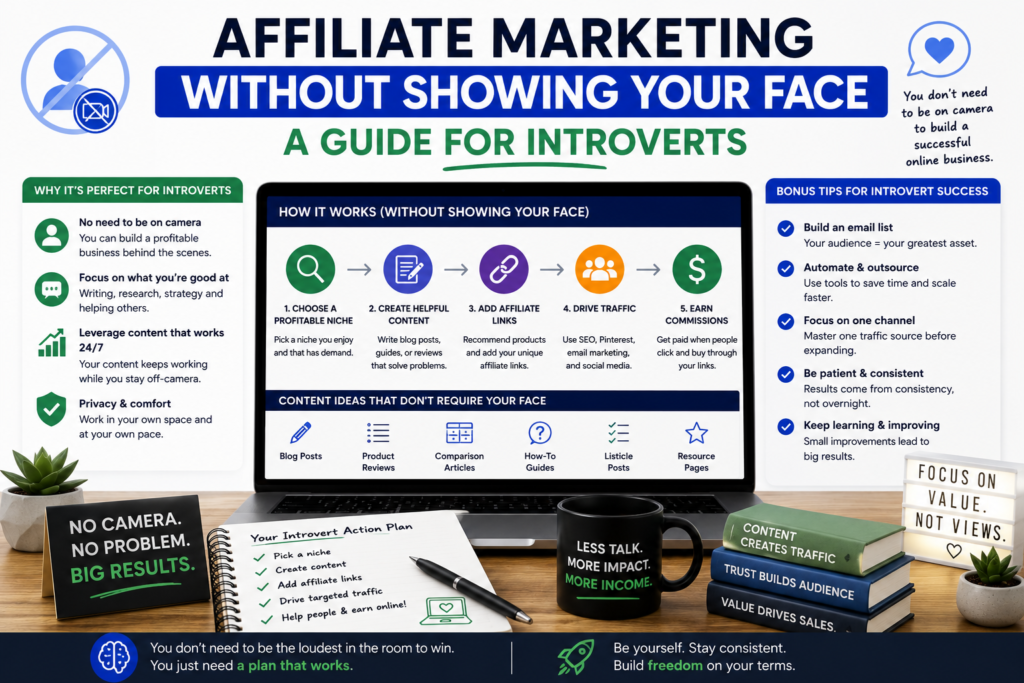
Scroll through any affiliate marketing subreddit, YouTube channel, or online course, and you’ll walk away believing that success requires one thing above all else: putting yourself in front of a camera. Talking heads reviewing products. Instagram influencers holding up their latest purchase. TikTok creators pointing at floating text while dancing in their living rooms.
If that makes your stomach tighten, you’re not alone. And you’re not disqualified from earning real money with affiliate marketing.
The idea that you need a personal brand built around your face, your personality, or your on-camera charisma to succeed as an affiliate is one of the most persistent myths in the industry. It’s repeated so often that introverts, camera-shy creators, and privacy-conscious marketers assume this business model isn’t for them.
They’re wrong.
Some of the most profitable affiliate websites on the internet are run by people you’ve never seen. No face. No name recognition. No personal brand in the traditional sense. Just well-researched content, smart traffic strategies, and product recommendations that earn commissions month after month.
This guide is for every introvert, every privacy-focused marketer, and every person who’s been told they “need to get comfortable on camera” and thought, “No thanks.” You’ll learn exactly how to build a legitimate affiliate marketing business without ever showing your face, recording your voice if you don’t want to, or building a personal following.
Why Faceless Affiliate Marketing Works
Let’s clear something up right away. Going faceless isn’t a compromise. It’s a legitimate business strategy with real structural advantages.
Your content becomes the brand. When there’s no personality to fixate on, readers judge your site by the quality of your information. This creates a meritocratic dynamic where the best research, clearest writing, and most helpful recommendations win. You compete on substance rather than charisma, and substance scales better.
The business is easier to sell. Affiliate websites built around a personal brand are notoriously difficult to sell because the value is tied to one person. A faceless affiliate site built on evergreen content and organic traffic is a transferable asset. Buyers on marketplaces like Flippa and Empire Flippers actively seek these sites because they can take over operations without the original creator. Faceless sites typically sell for 30x to 40x monthly profit.
You can operate multiple sites. Without tying your identity to one brand, you can build affiliate sites across several niches simultaneously. Many successful faceless affiliates run portfolios of 3 to 10 sites across different markets, diversifying their income and reducing risk.
Privacy protection. The internet is permanent. Once your face is attached to a brand, it stays there. Faceless affiliate marketing lets you earn income without sacrificing personal privacy, dealing with trolls who target your appearance, or worrying about how your online business might affect other areas of your life.
No energy drain from performing. Introverts lose energy from social performance. Recording videos, doing live streams, responding to comments about your personality, and maintaining a public persona is exhausting for people who recharge through solitude. Faceless affiliate marketing lets you do deep, focused work (writing, research, analysis) that aligns with introverted strengths rather than fighting against them.
The Faceless Affiliate Marketing Business Models
There’s no single way to do affiliate marketing without a face. Here are the proven models, ranked by how well they suit introverts.
Model 1: The Niche Authority Blog
This is the classic faceless affiliate model, and it remains one of the most reliable. You build a website around a specific topic, publish high-quality written content optimized for search engines, and earn commissions when readers click your affiliate links and buy products.
Why it’s perfect for introverts: The entire operation runs on writing and research, two activities that introverts typically excel at. You work alone, on your own schedule, with no need for video, audio, or social interaction. The traffic comes from Google, not from followers who expect regular personal engagement.
How it works in practice: Pick a niche (home office equipment, pet care, outdoor gear, personal finance software). Build a WordPress site. Research keywords with buyer intent. Write thorough product reviews, comparison posts, and buying guides. Optimize for SEO. Let Google send you traffic. Earn commissions.
Revenue potential: Established niche blogs earn anywhere from $1,000 to $50,000+ per month depending on the niche, content volume, and traffic levels. The average timeline to meaningful income is 6 to 18 months of consistent publishing.
Example in action: Imagine a site focused entirely on standing desks. No face, no personal brand. Just meticulously researched reviews of every standing desk on the market, comparison charts, ergonomic guides, and buying advice. Someone searching “best standing desk under 500” finds the site, reads the review, clicks the affiliate link, and buys. The site owner earns a commission without ever revealing who they are.
Model 2: Faceless YouTube Channel
YouTube isn’t just for talking heads. Entire categories of successful channels never show a face. Screen recordings, slideshows with voiceover, animated explainers, product B-roll with text overlays, and compilation-style content all perform well on the platform.
Why it works for introverts: If you’re comfortable with your voice but not your face, voiceover content lets you leverage YouTube’s massive audience without being on camera. If you prefer complete anonymity, text-based or music-backed videos work in many niches.
Faceless YouTube formats that drive affiliate sales:
- Screen recording tutorials. “How to Set Up ConvertKit in 30 Minutes” with a screen capture of you walking through the process. Your voice guides viewers through each step while the screen does the visual work. Include your affiliate link in the description.
- Product showcase videos. Film the product (not yourself) from multiple angles. Add text overlays highlighting features and specs. Use background music or a text-to-speech voiceover if you prefer not to use your own voice.
- Slideshow reviews. Create a well-designed presentation and record it as a video with voiceover narration. “Top 5 Budget Laptops for Students 2026” with slides showing specs, pros, cons, and pricing.
- Compilation and list videos. “10 Must-Have Home Office Gadgets” with stock footage or product images, text descriptions, and background music. No face, no voice required.
- Whiteboard or animation style. Use tools like Doodly, Vyond, or even Canva’s video editor to create animated explainers. These stand out in crowded niches and feel professional without requiring any on-camera presence.
Revenue potential: Faceless YouTube channels can generate affiliate income through description links and pinned comments, plus YouTube ad revenue once monetized. Channels in product review and tutorial niches often earn $2,000 to $20,000+ per month from the combination of affiliate commissions and ad revenue.
Model 3: Pinterest-Driven Affiliate Marketing
Pinterest is a visual search engine, not a social media platform in the traditional sense. Users search for ideas, solutions, and products, which makes it a natural fit for affiliate marketing. And nobody on Pinterest cares what you look like.
Why it’s perfect for introverts: Pinterest requires zero social interaction. No comments to respond to (well, very few). No DMs to manage. No live appearances. You create pins (essentially visual bookmarks), link them to your content or directly to affiliate offers (where permitted), and let the platform’s search algorithm do the distribution work.
How it works: Create a Pinterest business account. Design eye-catching pins using Canva (no photography skills needed, just templates and text overlays). Link each pin to a blog post containing your affiliate links. Pinterest users click the pin, land on your article, and potentially click through to buy the product you’ve recommended.
Best niches for Pinterest affiliate marketing: Home decor, DIY and crafts, recipes and cooking, fashion (outfit inspiration boards), personal finance, health and wellness, travel planning, and education. These are Pinterest’s strongest categories, and they all support affiliate promotion.
Revenue potential: Pinterest can drive substantial traffic to affiliate content. Combined with a blog, Pinterest-focused affiliates commonly earn $500 to $5,000+ per month. The traffic tends to be more seasonal than Google traffic, but pins can continue driving clicks for months or years after publication.
Model 4: Email-First Affiliate Marketing
This model flips the typical approach. Instead of building a website and hoping for traffic, you build an email list first and promote affiliate products directly through your emails.
Why it works for introverts: Email is a private, one-to-many communication channel. You write in solitude, send to your list, and never interact face-to-face (or screen-to-screen) with anyone. Subscribers judge you by the quality of your emails, not your appearance or personality.
How it works: Create a simple landing page with a compelling lead magnet (free guide, checklist, template, or resource list). Drive traffic to that landing page through SEO content, Pinterest, forum participation, or paid ads. Once someone subscribes, nurture them with a mix of helpful content and affiliate product recommendations.
The key advantage: Email converts at dramatically higher rates than cold website traffic. A subscriber who’s been receiving valuable content from you for three weeks and then sees your recommendation for a specific tool is far more likely to buy than a random Google visitor reading a review for the first time. Email subscribers have opted into a relationship with your content, even if they have no idea who you are behind it.
Revenue potential: Email-focused affiliates with lists of 5,000 to 20,000 engaged subscribers can earn $2,000 to $15,000+ per month depending on niche, product selection, and email frequency.
Model 5: Faceless Social Media Content
TikTok, Instagram Reels, and YouTube Shorts have created a new wave of faceless content creators. Short-form video doesn’t require showing your face if you get creative with the format.
Faceless short-form formats that work:
- Screen recordings with text overlays. Scroll through a product page, highlight features, add text commentary. “I tested this $30 Amazon gadget for a week” with footage of the product in use (hands only, no face).
- Photo slideshows with trending audio. Carousel-style content showing product comparisons or “things I bought that were worth it” with images and on-screen text.
- ASMR-style product unboxings. Close-up shots of hands opening packages, demonstrating products, and showcasing details. No face, no voice. Just satisfying visuals and ambient sound. These perform surprisingly well on TikTok and Reels.
- Text story format. Black screen or simple background with text telling a story, sharing a tip, or reviewing a product. Add trending audio. This format has generated millions of views for faceless creators.
- POV (point of view) content. Film from your perspective, showing what you see rather than showing yourself. “POV: Setting up the perfect home office” with a camera showing your desk, your screen, and your hands arranging equipment.
Revenue potential: Faceless social media accounts can grow quickly due to algorithmic distribution. Once you have a following, affiliate link clicks from your bio or stories can generate $500 to $10,000+ per month. The challenge is that social media traffic is less predictable than search traffic.
Choosing Your Niche as a Faceless Affiliate
Niche selection matters for every affiliate, but it carries extra weight when you’re operating without a personal brand. In personal-brand affiliate marketing, your personality and trust can carry mediocre niche choices. In faceless affiliate marketing, the niche needs to do more heavy lifting.
The best niches for faceless affiliates share these traits:
High search volume with informational and commercial intent. You need people actively searching for product information, reviews, and comparisons. Niches where people browse casually but rarely buy (celebrity gossip, memes, general entertainment) don’t work well for affiliate marketing.
Products that benefit from objective analysis. Niches where buyers want data, specs, comparisons, and detailed breakdowns favor faceless content. Nobody needs to see your face to trust a well-researched comparison of five different robot vacuums. They need accurate specifications, honest performance assessments, and clear recommendations.
Limited “trust barrier” for purchase decisions. Some niches, like personal coaching, therapy, or high-ticket consulting, rely heavily on personal connection and trust in a specific individual. These are tough for faceless affiliates. Products where the buyer trusts the product brand (not the reviewer’s personal brand) are ideal. Consumer electronics, software, home goods, and hobby equipment all fall into this category.
Evergreen demand. Faceless affiliate sites thrive on content that stays relevant for years with periodic updates. Niches driven by fleeting trends require constant content production just to stay visible. Evergreen niches let you build a content library that compounds in value over time.
Strong niches for faceless affiliates include:
- Technology and gadgets (headphones, laptops, monitors, smart home devices)
- Software and SaaS tools (email marketing, project management, design tools)
- Home and garden (furniture, kitchen appliances, gardening equipment)
- Personal finance (credit cards, banking, investing platforms, budgeting tools)
- Pet care (food, toys, health products, training tools)
- Outdoor and fitness gear (camping equipment, running shoes, gym accessories)
- Hobbies (photography equipment, musical instruments, art supplies, gaming)
- Education and learning (online courses, language learning, certification prep)
Creating High-Converting Content Without a Face
The content you produce as a faceless affiliate needs to work harder in one specific area: building trust without personal connection. Here’s how to do that across different formats.
Written Content: Your Strongest Asset
Writing is the introvert’s superpower in affiliate marketing. A well-written, thoroughly researched article builds trust through competence rather than personality. Readers trust you because you clearly know what you’re talking about, not because they like your smile or your on-camera energy.
How to build trust through writing alone:
Show your research process. Instead of just listing specs, explain how you evaluated the product. “I tested battery life across three scenarios: continuous video playback, mixed use with Wi-Fi browsing and email, and standby mode. Here’s what I measured.” This signals expertise and effort.
Include original data when possible. Run your own tests, create your own comparison charts, or compile data from multiple sources into a single useful resource. Original data is nearly impossible to replicate, which makes your content stand out from the dozens of other reviews rehashing the manufacturer’s spec sheet.
Use a consistent, knowledgeable editorial voice. You don’t need to share personal stories or reveal your identity. Just write with clarity, precision, and the confidence that comes from genuinely understanding your subject. Think “knowledgeable friend who did the homework” rather than “anonymous stranger copying product descriptions.”
Be specific about limitations. Generic praise sounds fake. Specific criticism sounds honest. “The battery lasted 6 hours and 20 minutes in my testing, which falls short of the advertised 9 hours” is more credible than “great battery life!” Readers trust reviewers who point out flaws because it signals that the positive assessments are genuine too.
Structure content for different reading styles. Some readers want the quick answer. Others want every detail. Use clear headings, summary boxes at the top, detailed analysis in the body, and a final verdict at the bottom. This structure serves both reading styles and keeps people on your page longer, which improves your search rankings.
Visual Content: Professional Without Being Personal
Faceless content doesn’t mean ugly content. Strong visuals increase time on page, reduce bounce rates, and make your affiliate content more shareable.
Product photography tips for camera-shy affiliates:
- Photograph products on a clean background (a white poster board works perfectly). Show different angles. Include close-ups of important details.
- Use your hands in photos if you’re comfortable (this adds a human element without revealing your identity). A hand holding a gadget, pressing a button, or pointing to a feature makes the image more engaging than a product sitting alone on a table.
- Take comparison photos showing products side by side. These are incredibly useful for readers and rarely available elsewhere.
- Screenshot software interfaces, dashboards, and features. Annotate them with arrows and text callouts to highlight what you’re discussing.
Custom graphics and infographics:
- Create comparison tables in Canva or a similar tool. A visual side-by-side comparison of three products with color-coded ratings is more impactful than a written list.
- Design infographics that summarize complex information. “How to Choose the Right Standing Desk” as a visual decision flowchart earns shares and backlinks.
- Build spec comparison charts that readers can reference quickly. These are high-value additions that increase dwell time.
Video Content: Faceless Doesn’t Mean Boring
If you venture into video, here are specific techniques that keep you off camera while maintaining viewer engagement.
B-roll with narration. Film the product in use (hands-only shots, tabletop demonstrations, close-up functionality tests) while your voiceover explains what’s happening. This is how many of the highest-performing product review channels on YouTube operate.
Animated screen recordings. For software and SaaS reviews, record your screen as you navigate the product. Use a tool like Loom, OBS, or even a simple screen recorder. Add zooms, highlights, and annotations during editing to direct viewer attention.
Overhead camera setup. A camera mounted above your desk (pointing down) captures product unboxings, demonstrations, and comparisons without ever showing your face. This perspective feels personal and engaging while maintaining complete visual anonymity.
AI-powered voiceover. If you prefer not to use your own voice, modern text-to-speech tools produce remarkably natural-sounding narration. Tools like ElevenLabs or Murf create voiceovers that many viewers can’t distinguish from a real human voice. This gives you full anonymity if that’s your preference.
Editing for engagement. Faceless videos need slightly more dynamic editing to hold attention since there’s no face to create a personal connection. Use jump cuts between scenes, add text overlays to emphasize key points, include background music at a low volume, and keep the pacing brisk. Dead air and static shots lose viewers quickly in faceless content.
Traffic Strategies for Faceless Affiliates
Without a personal brand driving followers and fans to your content, you need reliable traffic sources that work independently of who you are. Here are the most effective channels for faceless affiliate marketers.
Search Engine Optimization (SEO)
SEO is the backbone of faceless affiliate marketing. When someone types “best wireless earbuds for running” into Google, they don’t care who wrote the article that answers their question. They care that the information is accurate, thorough, and helpful. This levels the playing field completely.
SEO priorities for faceless affiliate sites:
Target buyer-intent keywords. Focus on search queries that signal purchase readiness: “best [product category],” “[product name] review,” “[product A] vs [product B],” “is [product] worth it.” These keywords attract visitors who are close to making a buying decision.
Build topical authority. Don’t just write product reviews. Create supporting content that covers every aspect of your niche. A site about wireless earbuds should publish content on audio technology, workout gear, commuter accessories, and mobile audio tips. This supporting content signals to Google that your site is an authority in the space, which helps your money pages rank higher.
Earn backlinks through quality. Faceless sites earn links the same way personal brands do: by creating content worth linking to. Original research, comprehensive guides, unique data, and genuinely helpful resources attract natural backlinks from other websites. You can supplement this with strategic guest posting (which can be done under a pen name or brand name).
Prioritize technical SEO. Site speed, mobile responsiveness, clean URL structures, proper heading hierarchy, and schema markup all influence your search rankings. Faceless sites can’t rely on brand recognition to compensate for poor technical performance. Make sure your site loads fast and runs cleanly.
Pinterest Marketing
As mentioned earlier, Pinterest is a natural fit for faceless affiliates. The platform’s users are actively searching for ideas, products, and solutions. Your pins serve as visual gateway content that drives traffic to your affiliate articles.
Pinterest strategy for faceless affiliates:
- Create 5 to 10 pin designs per article using different images, headlines, and color schemes. This lets you test which visuals resonate without creating new content.
- Use keyword-rich pin descriptions. Pinterest’s search algorithm relies heavily on text, so include your target keywords naturally in every pin description.
- Pin consistently. 10 to 25 pins per day (a mix of your own content and repins of relevant content from others) keeps your account active and visible.
- Join group boards and Tailwind Communities to expand your reach beyond your own followers.
Forum and Community Participation
Reddit, Quora, niche forums, and Facebook groups are full of people asking questions that your content can answer. Participating in these communities (under a username, not your real identity) drives targeted traffic to your site.
How to do this without being spammy:
- Spend 80% of your time providing genuinely helpful answers without linking to anything. Build a reputation as someone who knows the topic.
- When your content directly answers a question, share it naturally. “I wrote a detailed comparison of these two products that might help: [link].” This feels helpful, not promotional.
- Never drop affiliate links directly in forums. Always link to your content, which then contains your affiliate links. Direct affiliate links in forums look spammy, often violate community rules, and erode trust.
Paid Traffic (Optional)
If you have budget to invest, paid traffic can accelerate a faceless affiliate business. Google Ads, Pinterest Ads, and even Facebook Ads can drive targeted visitors to your content without requiring any personal branding.
The key principle: Don’t send paid traffic directly to an affiliate link. Send it to your own content (a detailed review, a comparison post, or a landing page with an email opt-in). Your content pre-sells the visitor, builds trust through quality information, and then directs them to the affiliate offer. This two-step approach converts far better than sending cold traffic straight to a sales page.
Building Trust Without a Face: The Psychology
The biggest objection to faceless affiliate marketing is the trust question. “Won’t people trust me less if they can’t see who I am?”
The short answer: not if your content does its job.
Trust in online content comes from several sources, and personal familiarity is only one of them. Here’s what actually builds trust for faceless affiliates:
Competence signals. Detailed, accurate, well-organized content signals expertise. When a reader finds an article that clearly and thoroughly answers their question, they trust the source, regardless of whether they know the author’s name. Think about it: when you Google a technical question and find a perfectly clear answer on a site you’ve never visited, do you dismiss it because you don’t know the author? Or do you use the information because it’s obviously correct?
Consistency. Publishing quality content regularly builds cumulative trust. A reader who finds three different articles on your site, all well-researched and helpful, develops trust in the site as a whole. Each piece of content reinforces the others.
Transparency about methodology. Explaining how you test products, what criteria you use for recommendations, and what your evaluation process looks like builds trust through transparency. You’re showing your work, which is more convincing than a smiling face.
Balanced perspectives. As mentioned earlier, acknowledging product weaknesses builds more trust than unqualified praise. Readers are sophisticated. They know every product has drawbacks. When you’re upfront about limitations, your positive assessments carry more weight.
Social proof from readers. As your site grows, enable comments on your articles. Positive comments from readers (“Thanks, this review helped me decide” or “I bought the one you recommended and love it”) serve as social proof that builds trust for future visitors. You don’t need to be visible yourself, just let your readers vouch for the quality of your recommendations.
Professional site design. A clean, well-designed website signals professionalism. A cluttered site with pop-ups, flashing ads, and poor formatting signals the opposite, regardless of who runs it. Invest in a quality theme, clear navigation, and a professional layout. This is one area where a small upfront investment pays ongoing dividends.
Tools and Resources for Faceless Affiliate Marketers
Here’s a practical toolkit for running a faceless affiliate operation:
Content creation:
- WordPress (website platform, self-hosted)
- Google Docs or Notion (writing and planning)
- Grammarly or Hemingway Editor (writing polish)
- Canva (graphics, pin designs, infographics, video editing)
SEO and research:
- Google Search Console (search performance tracking, free)
- Google Analytics 4 (visitor behavior analytics, free)
- Ubersuggest free tier or Google Keyword Planner (keyword research)
- Ahrefs Webmaster Tools (free backlink and site health data)
Video production (if applicable):
- OBS Studio (free screen recording)
- DaVinci Resolve (free professional video editing)
- Canva video editor (simple video creation)
- ElevenLabs or Murf (AI voiceover generation)
Email marketing:
- Mailchimp free plan (up to 500 subscribers)
- MailerLite free plan (up to 1,000 subscribers)
- ConvertKit free plan (up to 10,000 subscribers with limited features)
Link management:
- Pretty Links free version (WordPress redirect and tracking)
- Bitly (link shortening and basic click tracking)
Pinterest marketing:
- Tailwind free tier (Pinterest scheduling)
- Canva (pin design)
Overcoming the Introvert’s Specific Challenges
Being an introvert gives you real advantages in affiliate marketing: deep focus, analytical thinking, comfort with solitary work, and strong writing skills. But there are a few challenges worth addressing head-on.
The isolation factor. Working alone on a faceless business can feel lonely, even for introverts who prefer solitude. Join private communities (paid mastermind groups, Slack channels, or Discord servers for affiliate marketers) where you can connect with peers without public exposure. These small-group environments provide support, accountability, and knowledge sharing in a format that suits introverted communication preferences.
Networking without personal branding. Building relationships with affiliate managers, product vendors, and other affiliates helps your business grow. You can do this through email without ever showing your face or attending events. A well-written email introducing yourself and your site’s performance metrics is often more effective than a handshake at a conference. Let your results speak louder than your presence.
Perfectionism and publishing paralysis. Introverts tend toward perfectionism, especially in written work. This can lead to spending weeks polishing an article that could have been published and refined over time. Set a “good enough” standard for initial publication and commit to updating content after it’s live. A published article that’s 85% polished starts earning traffic and commissions immediately. A perfect draft sitting on your hard drive earns nothing.
Avoiding burnout from content production. The sustained writing output required for a successful affiliate blog can drain even the most dedicated introvert. Batch your work: research one day, outline the next, write the next, edit the next. Breaking the process into discrete tasks makes each session feel manageable and prevents the overwhelm of trying to produce a complete article in one sitting.
Comparison with extroverted marketers. It’s easy to watch a charismatic YouTuber pull in millions of views and feel like your quiet, written content can’t compete. Resist that comparison. Different traffic sources reward different strengths. Google’s algorithm doesn’t care about charisma. It cares about content quality, relevance, and user satisfaction. Your well-researched, deeply informative articles compete on a level playing field in search results, and search traffic often converts at higher rates than social media traffic because the intent is stronger.
Scaling Your Faceless Affiliate Business
Once your faceless affiliate business generates consistent income, here’s how to scale without ever stepping in front of a camera.
Hire writers. Train freelance writers to produce content following your editorial standards and review framework. Provide detailed briefs, templates, and style guides. Review and edit their work before publishing. This multiplies your content output without multiplying your personal workload. Many successful affiliate site owners manage teams of 3 to 10 writers while never revealing their own identity.
Expand into adjacent niches. If your standing desk site is profitable, launch a site about ergonomic office chairs, or monitor arms, or home office lighting. Each site follows the same proven playbook. Your operational knowledge transfers directly, reducing the learning curve for each new project.
Build systems and standard operating procedures. Document every repeatable process: keyword research workflow, content creation steps, publishing checklist, link insertion protocol, analytics review schedule. Written SOPs let you delegate tasks to virtual assistants or team members without being personally involved in every step.
Acquire existing sites. Once you have cash flow, consider buying established affiliate sites in complementary niches. Marketplaces like Flippa, Empire Flippers, and Motion Invest list sites with verified earnings. You can apply your proven optimization strategies to accelerate their growth. This is faster than building from scratch and lets you compound your portfolio quickly.
Automate repetitive tasks. Email sequences, social media scheduling, pin creation, analytics reporting, and content distribution can all be partially or fully automated with the right tools and workflows. Every hour you reclaim from repetitive tasks is an hour you can spend on high-impact activities like content strategy and product research.
The One-Year Faceless Affiliate Roadmap
Here’s a realistic timeline for building a faceless affiliate business from zero to meaningful income.
Months 1-2: Foundation. Choose your niche. Set up your WordPress site. Research your first 30 to 50 target keywords. Publish 8 to 12 pieces of foundational content (mix of reviews, comparisons, and informational articles). Set up Google Search Console and Google Analytics. Create a Pinterest account and start pinning. Traffic will be minimal. Income will be close to zero. This is normal and expected.
Months 3-4: Content acceleration. Maintain a publishing schedule of 2 to 4 articles per week. Focus on buyer-intent keywords with low competition. Set up an email opt-in and start capturing subscribers. Continue building your Pinterest presence. You’ll start seeing some pages appear in search results, mostly on pages 2 and 3. A few early commissions may trickle in.
Months 5-7: Traction. Older content starts climbing in search rankings. Traffic grows noticeably. Your first pages reach Google’s first page. Affiliate commissions become more regular, though still modest ($100 to $500/month). Your email list grows. Pinterest traffic supplements your organic search traffic. This is the phase where many people quit, right before the compounding curve starts to steepen.
Months 8-10: Momentum. Your content library is large enough that Google recognizes your site as an authority in its niche. Rankings improve across the board. Traffic accelerates. Commissions grow to $500 to $2,000/month. You start identifying which content types, products, and keywords generate the highest ROI and double down on those.
Months 11-12: Optimization and scaling. You’ve learned what works for your specific niche and audience. Optimize top-performing content with better calls-to-action, updated information, and improved internal linking. Consider hiring your first writer to increase content output. Monthly income reaches $1,500 to $5,000+ depending on niche and effort level.
Beyond year one: The compounding effect takes over. Each new piece of content builds on the authority your site has already established. Older content continues earning traffic and commissions with minimal maintenance. You shift from grinding out new content to strategically expanding and optimizing your existing portfolio.
Your Starting Checklist
Here’s what to do this week to launch your faceless affiliate marketing business:
- Pick a niche where you have knowledge or genuine interest, and where buyers actively search for product recommendations online.
- Register a domain name that’s brandable and niche-relevant (avoid using your personal name). A name like “DeskSetupLab.com” or “TrailGearReviews.com” works perfectly.
- Set up a WordPress site with a clean, fast theme. Keep the design professional and simple.
- Research 20 keywords with buyer intent using free tools like Ubersuggest or Google Keyword Planner.
- Sign up for 2 to 3 affiliate programs relevant to your niche (Amazon Associates for physical products, individual SaaS programs for software, or networks like ShareASale and Impact for variety).
- Write and publish your first article, a thorough product review or comparison post targeting one of your researched keywords.
- Set up Google Search Console and Google Analytics so you can track performance from day one.
- Create a Pinterest business account and design your first 5 pins linking to your article.
That’s it. No camera needed. No social media following required. No personality-driven brand to maintain. Just solid research, clear writing, and a systematic approach to creating content that helps people make informed buying decisions.
The affiliate marketers building quiet, profitable, faceless businesses right now are people who decided that the spotlight wasn’t for them, and then got to work anyway. The internet doesn’t care about your face. It cares about your value. And value is something introverts are exceptionally good at delivering.