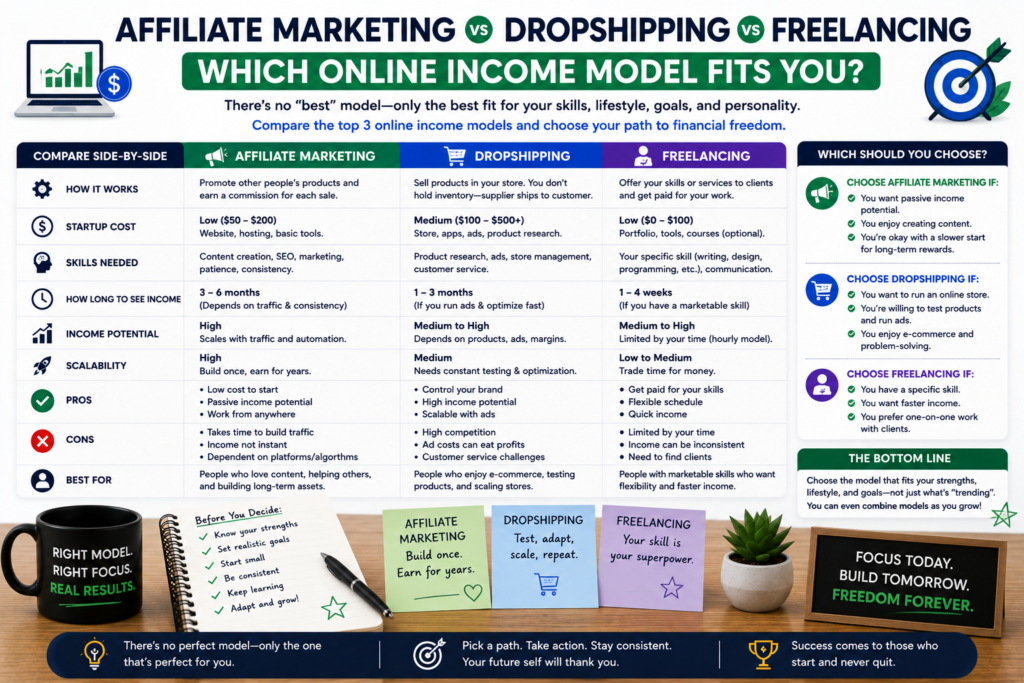
In the vast landscape of the digital economy, three business models consistently dominate the conversation for those seeking financial independence: Affiliate Marketing, Dropshipping, and Freelancing. Each offers a unique path to income, distinct risk profiles, and varying requirements for time, capital, and skill.
Choosing the right model isn’t just about potential earnings; it’s about alignment with your personal strengths, resources, and lifestyle goals. Are you a creative builder, a persuasive communicator, or a skilled service provider? In this comprehensive guide, we dissect these three giants to help you decide which path is yours.
1. Affiliate Marketing: The Power of Influence
The Concept:
Affiliate marketing is a performance-based strategy where you earn a commission by promoting other companies’ products or services. You act as a bridge between a customer and a merchant. When someone clicks your unique link and makes a purchase, you get paid.
The Pros
- Low Barrier to Entry: You don’t need to create a product, handle inventory, or manage customer service. Your only job is traffic generation.
- Passive Income Potential: Once content (blogs, videos, social posts) is created and optimized, it can generate commissions while you sleep.
- Flexibility: Work from anywhere with an internet connection. You can choose niche markets ranging from tech gadgets to sustainable fashion.
- No Upfront Costs: Many affiliate programs are free to join. Costs are generally limited to hosting a website or running ads if you choose to scale.
The Cons
- Lack of Control: You rely entirely on the merchant’s product quality, shipping times, and return policies. If they mess up, your reputation takes the hit.
- Fixed Commission Rates: You cannot set your prices. You are stuck with the percentage offered, which typically ranges from 5% to 30%.
- High Competition: Popular niches (like “make money online” or “weight loss”) are saturated, making it difficult to rank in search engines without significant SEO effort or ad spend.
- Dependency Risk: Programs can change terms, ban affiliates, or discontinue products overnight.
Who Is It For?
Affiliate marketing is ideal for content creators, bloggers, and social media influencers who enjoy writing, filming, or curating information. If you have patience for long-term SEO growth and a knack for building trust with an audience, this model could be your golden ticket.
2. Dropshipping: The Retail Revolution
The Concept:
Dropshipping allows you to sell physical products without ever holding inventory. When a customer buys from your store, you forward the order to a third-party supplier who ships the product directly to the customer. You keep the difference between your selling price and the supplier’s cost.
The Pros
- Scalability: Since you don’t manage warehousing, you can theoretically scale sales volume rapidly without logistical nightmares.
- Product Variety: You can test dozens of products simultaneously without financial risk, pivoting quickly based on trends.
- Brand Building: Unlike affiliate marketing, you own the storefront and the customer relationship, allowing you to build a recognizable brand.
- Pricing Power: You set your own retail prices and profit margins, unlike the fixed rates in affiliate marketing.
The Cons
- Thin Margins: Intense competition often drives down prices. After accounting for advertising costs (Facebook/Google Ads), profit margins can be razor-thin.
- Customer Service Headaches: You are responsible for returns, delays, and quality issues even though you never touch the product. Dealing with international suppliers can be complex.
- High Upfront Advertising Costs: To succeed, you usually need to invest significantly in paid ads before seeing any return. Organic reach is difficult in a crowded market.
- Supplier Reliability: Sourcing issues, stockouts, or shipping delays from overseas suppliers can ruin your reputation instantly.
Who Is It For?
Dropshipping suits entrepreneurs with an eye for trends, basic marketing skills, and some startup capital. If you are willing to treat it like a serious e-commerce business—testing products, optimizing ads, and managing logistics—it offers higher ceiling potential than passive affiliate work.
3. Freelancing: The Skill-for-Money Exchange
The Concept:
Freelancing involves trading your specific skills (writing, coding, design, consulting, etc.) directly to clients for a fee. You are essentially running a service-based consultancy business on a project basis.
The Pros
- Immediate Cash Flow: Unlike the months-long ramp-up for SEO in affiliate marketing, you can land a client and get paid within weeks.
- Full Control: You set your rates, choose your clients, and define your scope of work.
- Low Overhead: No inventory, no ad spend (unless you pay for leads), and no product development costs. Just your time and talent.
- Skill Development: Constantly working on diverse projects sharpens your expertise, increasing your value over time.
The Cons
- Time for Money Trap: Income is capped by the hours you can work. Unless you productize your service or hire a team, scaling requires hiring others.
- Client Acquisition: You are always hunting for the next gig. Income instability is common, especially for beginners.
- Scope Creep: Clients may demand more than agreed upon, requiring strong boundary-setting skills.
- Market Saturation: Common skills like general writing or data entry face intense global competition, driving down rates. Specialization is key.
Who Is It For?
Freelancing is perfect for specialists and skilled professionals who want quick access to income and control over their work. Writers, graphic designers, developers, and consultants thrive here. If you prefer tangible output over theoretical traffic metrics, this is the safest bet.
Comparative Analysis: The Decision Matrix
To visualize how these models stack up, consider the following dimensions:
| Feature | Affiliate Marketing | Dropshipping | Freelancing |
|---|---|---|---|
| Startup Cost | Very Low ($50–$200) | Low/Medium ($500–$2k+) | Very Low ($0–$100) |
| Time to First $ | Slow (3–6 months) | Medium (1–3 months) | Fast (Weeks) |
| Scalability | High (Content scales) | High (Ads scale) | Low (Time-bound) |
| Risk Level | Low (No inventory) | Medium (Ad spend risk) | Low (Time investment) |
| Control | Low (Merchant dependent) | High (Store owner) | High (Service provider) |
| Key Skill Needed | Content & SEO/Traffic | Marketing & Logistics | Professional Skill |
| Income Ceiling | Unlimited | Unlimited | Limited by time (unless scaled) |
How to Choose Your Path
Deciding between these three doesn’t have to be an either/or choice. Many successful entrepreneurs eventually blend them. However, to start, ask yourself these three questions:
1. What is your starting budget?
If you have $0, Freelancing is your best friend. Sell what you already know. If you have $500–$2,000 for testing ads, Dropshipping becomes viable. If you have time but little money, Affiliate Marketing via organic SEO or social media is the way to go.
2. What are your core strengths?
- Creative & Persuasive? Go Affiliate Marketing. You need to tell stories and build trust.
- Analytical & Tactical? Try Dropshipping. You need to interpret data, optimize ad spend, and manage supply chains.
- Technical & Expert? Choose Freelancing. Leverage a hard skill like coding, writing, or design.
3. What is your tolerance for risk?
Freelancing has the lowest financial risk but the highest “reputation” risk if you deliver bad work. Dropshipping carries financial risk due to ad spend. Affiliate marketing carries the risk of spending months building traffic that yields zero conversions if the algorithm changes.
The Hybrid Future
Don’t feel boxed into one lane. The most resilient online businesses often evolve.
- Freelancer to Agency: Start freelancing to build cash flow, then hire others to do the work while you focus on sales (scaling your service).
- Freelancer to Affiliate: Once you have an audience of clients, recommend tools you use and earn affiliate commissions.
- Dropshipper to Brand Owner: Use dropshipping to validate a product, then switch to holding inventory to increase margins and control quality.
Final Thoughts
There is no “best” model, only the model that best fits your current reality.
- Need money now? Freelance.
- Want to build a brand and have some cash to burn? Dropship.
- Dreaming of passive income and willing to grind for years? Affiliate.
The most dangerous mistake is waiting for the “perfect” plan. Pick one, commit to it for at least six months, and start learning. The online economy rewards action, not just analysis.