Introduction
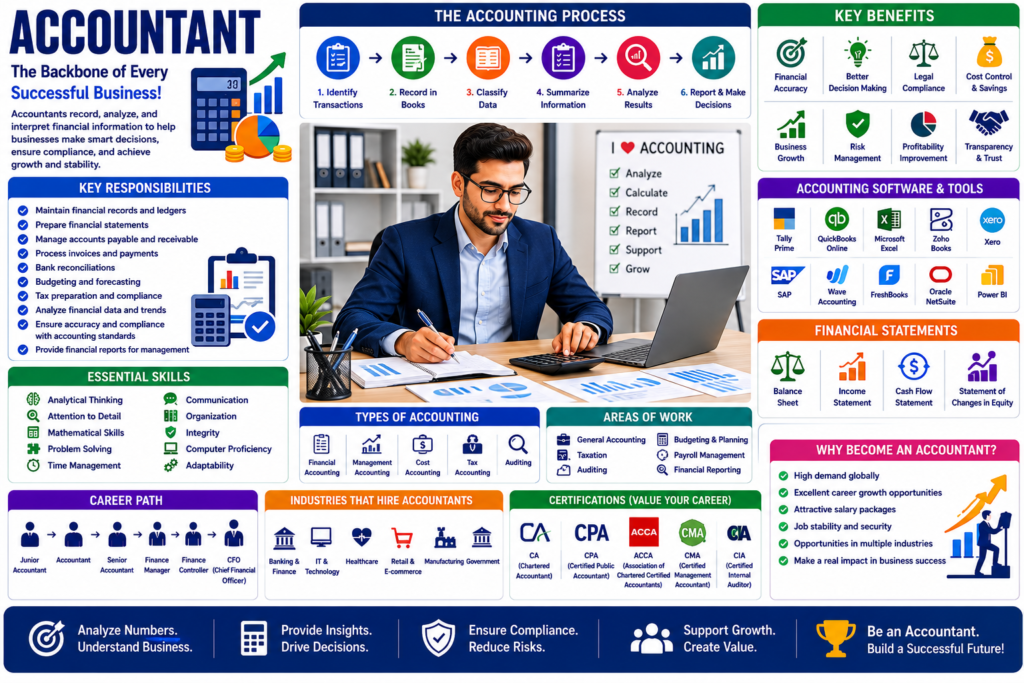
Every successful business, organization, and government institution relies on accurate financial information to make informed decisions. Behind these critical financial records and reports is the Accountant, a professional responsible for managing, analyzing, and maintaining financial data.
Accountants play a vital role in ensuring organizations remain financially healthy, compliant with regulations, and prepared for future growth. They help businesses track income and expenses, prepare financial statements, manage taxes, analyze performance, and provide valuable financial insights.
As global economies become increasingly complex and businesses continue expanding, the demand for skilled accountants remains strong across virtually every industry.
This guide explores the responsibilities, skills, certifications, career opportunities, and future trends shaping the accounting profession.
What Is an Accountant?
An Accountant is a financial professional responsible for recording, analyzing, verifying, and reporting financial information.
Their primary objective is to ensure financial records are accurate, compliant, and useful for decision-making.
Accountants typically handle:
- Financial reporting
- Bookkeeping
- Tax preparation
- Budgeting
- Auditing
- Financial analysis
- Payroll management
- Compliance reporting
- Expense tracking
- Business forecasting
Accountants help organizations understand their financial position and make sound business decisions.
Why Accountants Are Important
Maintain Financial Accuracy
Accurate financial records support better business decisions.
Ensure Regulatory Compliance
Accountants help organizations comply with tax laws and financial regulations.
Improve Financial Planning
Businesses rely on accounting data for budgeting and forecasting.
Support Business Growth
Financial insights help organizations allocate resources effectively.
Reduce Financial Risks
Proper accounting practices help prevent costly errors and fraud.
Key Responsibilities of an Accountant
Bookkeeping
Recording financial transactions accurately.
Financial Reporting
Preparing reports that summarize financial performance.
Tax Preparation
Calculating and filing taxes according to regulations.
Budget Management
Creating and monitoring budgets.
Payroll Processing
Managing employee compensation and deductions.
Financial Analysis
Evaluating business performance using financial data.
Compliance Management
Ensuring adherence to accounting standards and regulations.
Types of Accountants
Financial Accountant
Focuses on financial reporting and compliance.
Management Accountant
Provides internal financial insights for decision-making.
Tax Accountant
Specializes in tax preparation and planning.
Public Accountant
Provides accounting services to multiple clients.
Auditor
Examines financial records for accuracy and compliance.
Forensic Accountant
Investigates financial crimes and fraud.
Government Accountant
Manages public sector financial activities.
The Accounting Cycle
1. Transaction Recording
Documenting financial activities.
2. Journal Entries
Recording transactions in accounting journals.
3. Ledger Posting
Organizing financial data into accounts.
4. Trial Balance
Verifying account balances.
5. Adjusting Entries
Updating records for accuracy.
6. Financial Statements
Preparing reports for stakeholders.
7. Closing Entries
Finalizing accounting periods.
The accounting cycle ensures financial data remains organized and accurate.
Essential Skills for Accountants
Analytical Thinking
Interpreting financial data effectively.
Attention to Detail
Accuracy is essential in accounting work.
Problem Solving
Identifying and resolving financial issues.
Communication
Explaining financial information to stakeholders.
Organization
Managing records and deadlines efficiently.
Mathematical Skills
Working with financial calculations and analysis.
Technology Proficiency
Using accounting software and financial systems.
Key Financial Statements
Income Statement
Shows revenues, expenses, and profits.
Balance Sheet
Provides a snapshot of assets, liabilities, and equity.
Cash Flow Statement
Tracks cash entering and leaving the business.
Statement of Equity
Reports changes in ownership equity.
These reports help organizations evaluate financial performance.
Accounting Principles
Accountants follow established standards to ensure consistency and reliability.
Generally Accepted Accounting Principles (GAAP)
Commonly used accounting framework.
International Financial Reporting Standards (IFRS)
Global accounting standards used in many countries.
Accrual Accounting
Records transactions when they occur.
Cash Accounting
Records transactions when cash changes hands.
Understanding accounting principles is essential for accurate reporting.
Tax Accounting
Tax accounting focuses on:
- Tax planning
- Tax compliance
- Tax return preparation
- Tax deductions
- Corporate taxation
- Personal taxation
Tax Accountants help individuals and businesses minimize liabilities while remaining compliant.
Auditing
Auditors review financial records to ensure accuracy and compliance.
Internal Auditing
Evaluates internal processes and controls.
External Auditing
Provides independent verification of financial information.
Auditing helps organizations improve transparency and accountability.
Accounting Software and Technology
Modern accountants rely heavily on technology.
Popular accounting tools include:
QuickBooks
Widely used accounting software for businesses.
Xero
Cloud-based accounting platform.
Sage
Financial management and accounting solution.
FreshBooks
Popular among freelancers and small businesses.
Oracle NetSuite
Enterprise-level financial management system.
SAP
Large-scale accounting and ERP platform.
Microsoft Excel
Essential for financial analysis and reporting.
Financial Analysis and Reporting
Accountants provide valuable insights through financial analysis.
Common activities include:
Budget Analysis
Comparing planned and actual spending.
Profitability Analysis
Evaluating business performance.
Forecasting
Predicting future financial outcomes.
Cost Analysis
Identifying opportunities for savings and efficiency.
Performance Measurement
Monitoring financial KPIs.
Important Accounting Metrics
Revenue
Total income generated by the business.
Net Profit
Income remaining after expenses.
Gross Margin
Profitability before operating expenses.
Current Ratio
Measures liquidity and short-term financial health.
Return on Investment (ROI)
Evaluates investment performance.
Debt-to-Equity Ratio
Measures financial leverage.
Certifications for Accountants
Professional certifications enhance credibility and career opportunities.
CPA (Certified Public Accountant)
One of the most recognized accounting certifications worldwide.
CMA (Certified Management Accountant)
Focuses on management accounting and business strategy.
ACCA (Association of Chartered Certified Accountants)
International accounting certification.
CIA (Certified Internal Auditor)
Specialized auditing certification.
CFA (Chartered Financial Analyst)
Advanced finance and investment credential.
Enrolled Agent (EA)
Tax-focused professional certification.
Industries Hiring Accountants
Public Accounting Firms
Providing accounting services to clients.
Corporate Finance
Managing business finances and reporting.
Government Agencies
Supporting public-sector financial operations.
Healthcare
Managing healthcare financial systems.
Manufacturing
Supporting production and operational accounting.
Technology Companies
Handling financial planning and compliance.
Nonprofit Organizations
Managing budgets, grants, and reporting requirements.
Career Path for Accountants
Accounting Clerk
Entry-level accounting support role.
Staff Accountant
Handles day-to-day accounting activities.
Senior Accountant
Manages complex financial responsibilities.
Accounting Manager
Leads accounting teams and processes.
Controller
Oversees organizational accounting functions.
Finance Director
Manages broader financial strategy.
Chief Financial Officer (CFO)
Executive responsible for organizational financial leadership.
Best Practices for Accountants
Maintain Accuracy
Double-check financial records and calculations.
Stay Current
Keep up with accounting standards and regulations.
Use Technology Effectively
Leverage software and automation tools.
Protect Confidential Data
Maintain strong security and confidentiality practices.
Meet Deadlines
Ensure timely reporting and compliance.
Focus on Continuous Learning
Accounting regulations and technologies evolve regularly.
Future Trends in Accounting
Artificial Intelligence
AI automates repetitive accounting tasks.
Cloud Accounting
Organizations increasingly use cloud-based financial systems.
Automation
Routine bookkeeping becomes more automated.
Data Analytics
Accountants play a larger role in business intelligence.
Cybersecurity
Financial data protection becomes increasingly important.
Strategic Advisory Services
Accountants increasingly contribute to business strategy and decision-making.
Benefits of Becoming an Accountant
- Strong job stability
- High demand across industries
- Competitive salaries
- Clear career progression
- Professional certifications and advancement opportunities
- Valuable financial expertise
- Opportunities for leadership roles
Conclusion
Accountants are essential professionals who help organizations manage finances, maintain compliance, and make informed business decisions. Through accurate reporting, financial analysis, tax management, and strategic planning, they contribute directly to business success and long-term sustainability.
As businesses continue adapting to evolving financial regulations and digital technologies, skilled accountants will remain highly valuable. Professionals who develop expertise in accounting principles, financial analysis, technology, and compliance can build rewarding careers while playing a crucial role in organizational growth and financial health.