Introduction
Every successful business depends on accurate financial records. From tracking daily transactions to managing invoices and preparing reports, Bookkeepers play a critical role in maintaining an organization’s financial health.
Bookkeepers are responsible for recording financial activities, organizing accounting information, monitoring cash flow, and supporting business decision-making. Their work forms the foundation of a company’s accounting system and ensures financial data remains accurate and up to date.
As businesses continue to rely on financial transparency and regulatory compliance, skilled Bookkeepers remain highly valuable across industries, from small startups to multinational corporations.
What Is a Bookkeeper?
A Bookkeeper is a financial professional responsible for recording, organizing, and maintaining a company’s financial transactions.
Their primary duties include:
- Recording income and expenses
- Managing invoices
- Processing payments
- Tracking financial transactions
- Reconciling bank accounts
- Managing payroll records
- Maintaining financial documentation
- Assisting accountants with reporting
Bookkeepers help ensure financial records remain accurate, organized, and compliant.
Why Bookkeepers Are Important
Maintain Accurate Records
Businesses rely on precise financial data for daily operations.
Support Decision-Making
Accurate records help leaders make informed financial decisions.
Improve Cash Flow Management
Bookkeepers monitor incoming and outgoing funds.
Ensure Compliance
Proper records support tax filing and regulatory requirements.
Reduce Financial Errors
Consistent bookkeeping minimizes mistakes and discrepancies.
Key Responsibilities of a Bookkeeper
Recording Transactions
Tracking sales, purchases, payments, and receipts.
Accounts Payable
Managing bills, vendor payments, and expenses.
Accounts Receivable
Monitoring customer invoices and incoming payments.
Bank Reconciliation
Comparing accounting records with bank statements.
Payroll Support
Processing employee wages and deductions.
Financial Reporting
Preparing basic financial reports and summaries.
Document Management
Maintaining organized financial records and receipts.
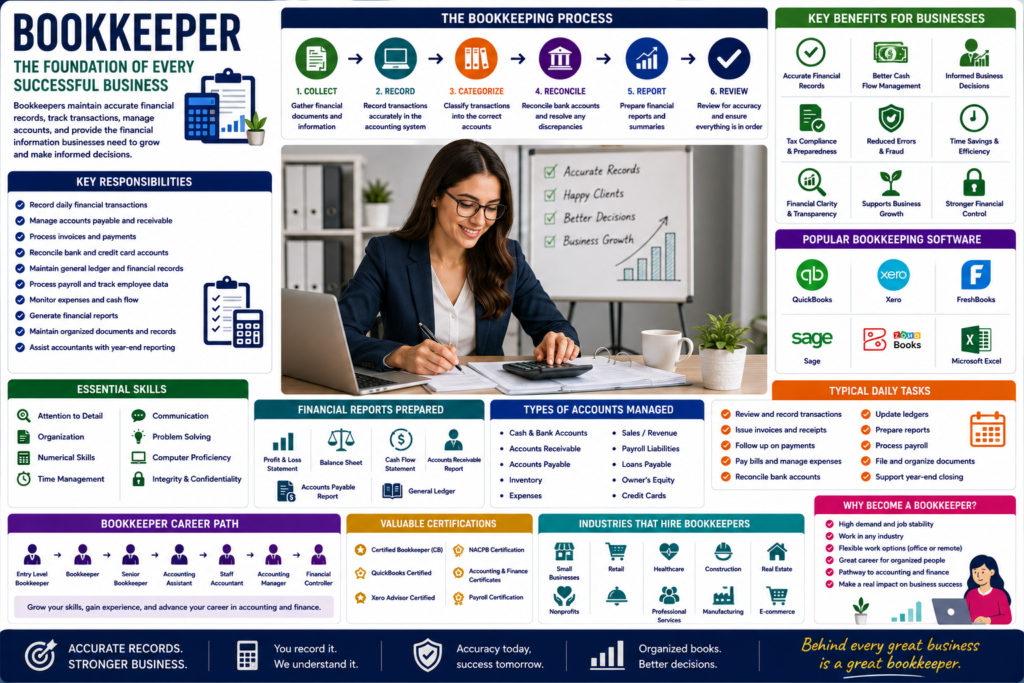
The Bookkeeping Process
1. Collect Financial Documents
Gather receipts, invoices, bank statements, and payment records.
2. Record Transactions
Enter financial data into bookkeeping systems.
3. Categorize Expenses
Assign transactions to appropriate accounts.
4. Reconcile Accounts
Verify records against bank and financial statements.
5. Generate Reports
Prepare financial summaries and statements.
6. Review Accuracy
Ensure records are complete and error-free.
Essential Skills for Bookkeepers
Attention to Detail
Accuracy is crucial when managing financial records.
Organization
Maintaining orderly financial documentation.
Numerical Skills
Working comfortably with financial calculations.
Time Management
Meeting deadlines and managing recurring tasks.
Communication
Working effectively with clients, vendors, and accountants.
Technology Skills
Using accounting and bookkeeping software efficiently.
Problem Solving
Identifying and correcting financial discrepancies.
Types of Bookkeeping
Single-Entry Bookkeeping
Simple system often used by small businesses.
Double-Entry Bookkeeping
More comprehensive method used by most organizations.
Double-entry bookkeeping records both debit and credit transactions, improving accuracy and accountability.
Common Bookkeeping Tasks
Daily responsibilities often include:
- Entering financial transactions
- Managing invoices
- Tracking expenses
- Processing payments
- Updating ledgers
- Reconciling accounts
- Reviewing reports
- Maintaining records
Bookkeeping Software and Tools
Modern Bookkeepers rely on specialized software.
QuickBooks
One of the most widely used bookkeeping platforms.
Xero
Cloud-based accounting and bookkeeping solution.
FreshBooks
Popular among freelancers and small businesses.
Zoho Books
Comprehensive bookkeeping and accounting software.
Sage
Financial management and bookkeeping platform.
Microsoft Excel
Frequently used for reporting and financial analysis.
Financial Reports Bookkeepers Prepare
Profit and Loss Statement
Shows business income and expenses.
Cash Flow Report
Tracks money entering and leaving the business.
Accounts Receivable Report
Monitors customer balances and payments.
Accounts Payable Report
Tracks outstanding vendor obligations.
General Ledger
Central record of financial transactions.
Bookkeeper vs Accountant
Bookkeeper
Focuses on recording and organizing financial transactions.
Accountant
Analyzes financial information and prepares advanced reports.
Bookkeepers create the financial records that accountants use for analysis, tax preparation, and strategic planning.
Bookkeeper vs Accounting Clerk
Bookkeeper
Handles broader financial recordkeeping responsibilities.
Accounting Clerk
Typically performs specific accounting-related tasks.
Bookkeepers often have greater responsibility for overall financial records.
Industries Hiring Bookkeepers
Small Businesses
Managing daily financial activities.
Retail
Tracking sales, inventory, and expenses.
Healthcare
Supporting medical practice finances.
Construction
Managing project expenses and billing.
Real Estate
Tracking commissions, payments, and transactions.
Nonprofit Organizations
Managing donations and financial reporting.
Professional Services
Supporting consultants, agencies, and service providers.
Certifications for Bookkeepers
Certified Bookkeeper (CB)
Recognized professional bookkeeping certification.
QuickBooks Certification
Demonstrates software expertise.
Xero Advisor Certification
Validates Xero platform knowledge.
Accounting and Finance Certificates
Enhance bookkeeping credibility and skills.
Career Path for Bookkeepers
Junior Bookkeeper
Entry-level bookkeeping position.
Bookkeeper
Manages daily financial records independently.
Senior Bookkeeper
Oversees complex financial activities.
Accounting Assistant
Supports accounting departments and professionals.
Staff Accountant
Transitions into accounting-focused responsibilities.
Accounting Manager
Leads accounting operations and teams.
Financial Controller
Oversees organizational financial systems.
Best Practices for Bookkeepers
Maintain Accuracy
Double-check financial entries and calculations.
Stay Organized
Keep records updated and accessible.
Reconcile Regularly
Identify issues before they become major problems.
Use Technology Efficiently
Leverage bookkeeping software and automation tools.
Protect Financial Data
Maintain confidentiality and security.
Continue Learning
Stay informed about regulations and software updates.
Future Trends in Bookkeeping
Cloud-Based Bookkeeping
More businesses are adopting online financial systems.
Automation
Routine data entry tasks are increasingly automated.
Artificial Intelligence
AI assists with transaction categorization and reporting.
Remote Bookkeeping
Virtual bookkeeping services continue growing.
Real-Time Financial Reporting
Businesses increasingly expect immediate financial insights.
Digital Payments
Electronic transactions continue replacing manual processes.
Benefits of Becoming a Bookkeeper
- High demand across industries
- Opportunities for remote work
- Flexible career options
- Strong job stability
- Entry point into finance and accounting careers
- Opportunities for freelance work
- Valuable business knowledge
Conclusion
Bookkeepers play a fundamental role in maintaining accurate financial records and supporting business success. Through careful recordkeeping, account management, reconciliation, and reporting, they help organizations operate efficiently and make informed financial decisions.
As businesses continue embracing digital finance solutions and data-driven operations, skilled Bookkeepers remain essential. Professionals who develop strong organizational skills, financial knowledge, and expertise with modern bookkeeping software can build rewarding and stable careers in the financial sector.