Introduction
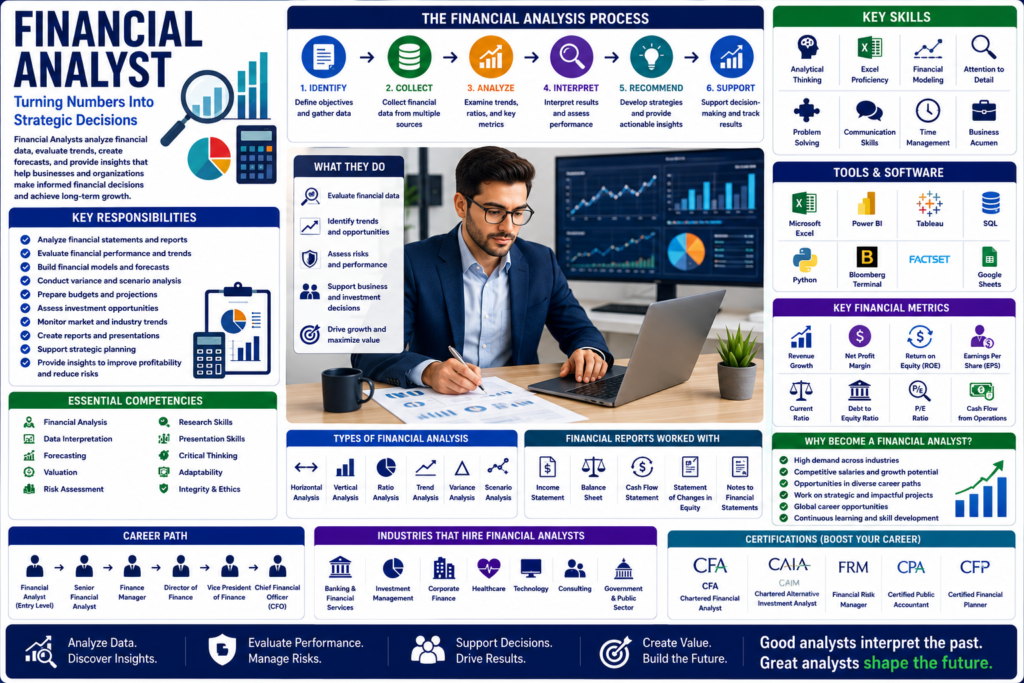
In today’s competitive business environment, organizations rely heavily on financial data to make informed decisions, manage risks, improve profitability, and achieve sustainable growth. At the center of this process is the Financial Analyst, a professional responsible for evaluating financial information and transforming data into actionable business insights.
Financial Analysts help companies understand their financial performance, forecast future outcomes, assess investment opportunities, and support strategic planning. Whether working for corporations, banks, investment firms, government agencies, or consulting organizations, Financial Analysts play a critical role in driving business success.
As financial markets become increasingly complex and data-driven decision-making continues to expand, the demand for skilled Financial Analysts remains strong across industries worldwide.
What Is a Financial Analyst?
A Financial Analyst is a finance professional who examines financial data, evaluates business performance, develops forecasts, and provides recommendations to support decision-making.
Their primary objective is to help organizations make sound financial and investment decisions based on accurate analysis and reliable data.
Financial Analysts typically work with:
- Financial statements
- Budgets
- Forecasts
- Investment opportunities
- Market trends
- Risk assessments
- Economic indicators
- Business performance metrics
They help management teams understand financial conditions and identify opportunities for growth and improvement.
Why Financial Analysts Are Important
Improve Business Decisions
Financial analysis provides leaders with reliable information for strategic planning.
Support Profitability
Analysts identify opportunities to increase revenue and reduce costs.
Manage Risk
Financial Analysts assess risks before organizations make major investments or decisions.
Guide Investments
Companies rely on analysts to evaluate projects, acquisitions, and market opportunities.
Enhance Financial Planning
Accurate forecasting helps organizations prepare for future challenges and opportunities.
Key Responsibilities of a Financial Analyst
Financial Modeling
Creating models that predict future financial performance.
Budgeting
Developing and monitoring organizational budgets.
Forecasting
Estimating future revenues, expenses, and cash flow.
Financial Reporting
Preparing reports for executives and stakeholders.
Investment Analysis
Evaluating investment opportunities and financial projects.
Risk Assessment
Identifying potential financial risks and recommending mitigation strategies.
Performance Analysis
Measuring organizational success using financial metrics.
Types of Financial Analysts
Corporate Financial Analyst
Supports financial planning and decision-making within organizations.
Investment Analyst
Evaluates stocks, bonds, and investment opportunities.
Equity Research Analyst
Provides research and recommendations on publicly traded companies.
Risk Analyst
Focuses on identifying and managing financial risks.
Credit Analyst
Assesses the creditworthiness of individuals and organizations.
Treasury Analyst
Manages cash flow and financial resources.
Portfolio Analyst
Evaluates and manages investment portfolios.
The Financial Analysis Process
1. Data Collection
Gather financial statements, market information, and business data.
2. Data Analysis
Evaluate financial performance and identify trends.
3. Financial Modeling
Develop projections and scenario analyses.
4. Risk Evaluation
Assess potential financial risks and opportunities.
5. Recommendation Development
Create actionable insights for stakeholders.
6. Reporting
Present findings to management and decision-makers.
7. Monitoring
Track performance and update forecasts regularly.
Essential Skills for Financial Analysts
Analytical Thinking
The ability to interpret complex financial information.
Problem Solving
Identifying business challenges and recommending solutions.
Mathematical Skills
Performing financial calculations accurately.
Communication
Presenting financial findings clearly and effectively.
Attention to Detail
Ensuring data accuracy and reliability.
Strategic Thinking
Connecting financial insights with business objectives.
Technology Proficiency
Using financial software and analytical tools efficiently.
Financial Statements Used by Analysts
Income Statement
Shows revenue, expenses, and profitability.
Balance Sheet
Displays assets, liabilities, and equity.
Cash Flow Statement
Tracks cash inflows and outflows.
Statement of Shareholders’ Equity
Reports changes in ownership value.
Financial Analysts use these documents to evaluate organizational health and performance.
Financial Modeling
Financial modeling is one of the most important responsibilities of a Financial Analyst.
Common models include:
Revenue Forecasting Models
Predict future sales and growth.
Budget Models
Estimate future expenses and resource allocation.
Valuation Models
Determine the value of businesses and investments.
Scenario Analysis Models
Evaluate different potential outcomes.
Discounted Cash Flow (DCF) Models
Estimate investment value based on future cash flows.
Budgeting and Forecasting
Organizations depend on Financial Analysts to support planning efforts.
Budgeting
Defines expected revenues and expenses.
Forecasting
Predicts future financial performance based on current trends.
Benefits include:
- Improved planning
- Better resource allocation
- Increased financial control
- Enhanced decision-making
Investment Analysis
Financial Analysts evaluate investment opportunities by examining:
- Expected returns
- Market conditions
- Business performance
- Risk factors
- Industry trends
- Economic indicators
This analysis helps organizations maximize returns while managing risk.
Key Financial Metrics
Revenue Growth
Measures increases in business income.
Gross Margin
Indicates profitability before operating expenses.
Net Profit Margin
Measures overall profitability.
Return on Investment (ROI)
Evaluates investment performance.
Earnings Per Share (EPS)
Measures profitability on a per-share basis.
Debt-to-Equity Ratio
Evaluates financial leverage.
Current Ratio
Measures short-term financial health.
Free Cash Flow
Indicates available cash after operating expenses and investments.
Tools Used by Financial Analysts
Microsoft Excel
The most widely used financial analysis tool.
Power BI
Business intelligence and data visualization platform.
Tableau
Advanced analytics and reporting tool.
Bloomberg Terminal
Financial market data and analytics platform.
SAP
Enterprise financial management software.
Oracle Financials
Corporate financial planning solution.
SQL
Database querying and analysis.
Python
Increasingly used for financial modeling and data analysis.
Financial Analyst vs Accountant
Financial Analyst
Focuses on forecasting, analysis, and decision support.
Accountant
Focuses on recording, reporting, and compliance.
Both roles are essential but serve different purposes within an organization.
Financial Analyst vs Investment Analyst
Financial Analyst
Supports business operations and corporate decision-making.
Investment Analyst
Focuses primarily on investment opportunities and financial markets.
Industries Hiring Financial Analysts
Banking
Analyzing lending, investments, and financial products.
Investment Firms
Supporting portfolio and asset management.
Technology
Providing financial planning and business analysis.
Healthcare
Managing financial performance and forecasting.
Manufacturing
Analyzing production costs and profitability.
Government
Supporting public financial management.
Consulting
Providing financial expertise to clients.
Certifications for Financial Analysts
CFA (Chartered Financial Analyst)
One of the most respected certifications in finance.
CPA (Certified Public Accountant)
Valuable for financial reporting expertise.
CMA (Certified Management Accountant)
Focuses on business finance and management accounting.
FMVA (Financial Modeling & Valuation Analyst)
Specialized financial modeling certification.
FRM (Financial Risk Manager)
Focuses on risk management and analysis.
Career Path for Financial Analysts
Junior Financial Analyst
Entry-level financial analysis role.
Financial Analyst
Conducts financial evaluations and reporting.
Senior Financial Analyst
Leads complex analysis projects.
Finance Manager
Oversees financial planning and analysis teams.
Director of Finance
Manages organizational financial strategy.
Vice President of Finance
Leads corporate financial operations.
Chief Financial Officer (CFO)
Executive responsible for organizational financial leadership.
Best Practices for Financial Analysts
Use Reliable Data
Ensure information sources are accurate and trustworthy.
Stay Updated
Monitor economic conditions and market developments.
Validate Assumptions
Review forecasts regularly.
Communicate Clearly
Present findings in understandable formats.
Focus on Business Value
Connect analysis to organizational objectives.
Continuously Improve Skills
Stay current with financial tools and methodologies.
Future Trends in Financial Analysis
Artificial Intelligence
AI automates data processing and predictive analytics.
Big Data Analytics
Organizations increasingly rely on large-scale data analysis.
Automation
Routine reporting becomes more automated.
Real-Time Financial Insights
Businesses expect faster decision-making support.
Cloud-Based Finance Platforms
Financial data becomes more accessible and collaborative.
Advanced Forecasting
Machine learning improves financial predictions.
Benefits of Becoming a Financial Analyst
- Strong earning potential
- High demand across industries
- Opportunities for advancement
- Exposure to strategic business decisions
- Global career opportunities
- Continuous professional development
- Pathway to executive leadership positions
Conclusion
Financial Analysts play a vital role in helping organizations understand financial performance, manage risk, evaluate opportunities, and make informed decisions. Through financial modeling, forecasting, investment analysis, and strategic planning, they contribute directly to business growth and long-term success.
As businesses increasingly rely on data-driven decision-making and financial intelligence, skilled Financial Analysts will remain highly valuable. Professionals who develop expertise in financial analysis, technology, forecasting, and strategic thinking can build rewarding careers while making a significant impact on organizational performance and profitability.