Introduction
Taxes are a critical part of every business and individual’s financial life. From filing annual tax returns to developing long-term tax-saving strategies, managing taxes effectively requires specialized knowledge and expertise. This is where Tax Consultants play a vital role.
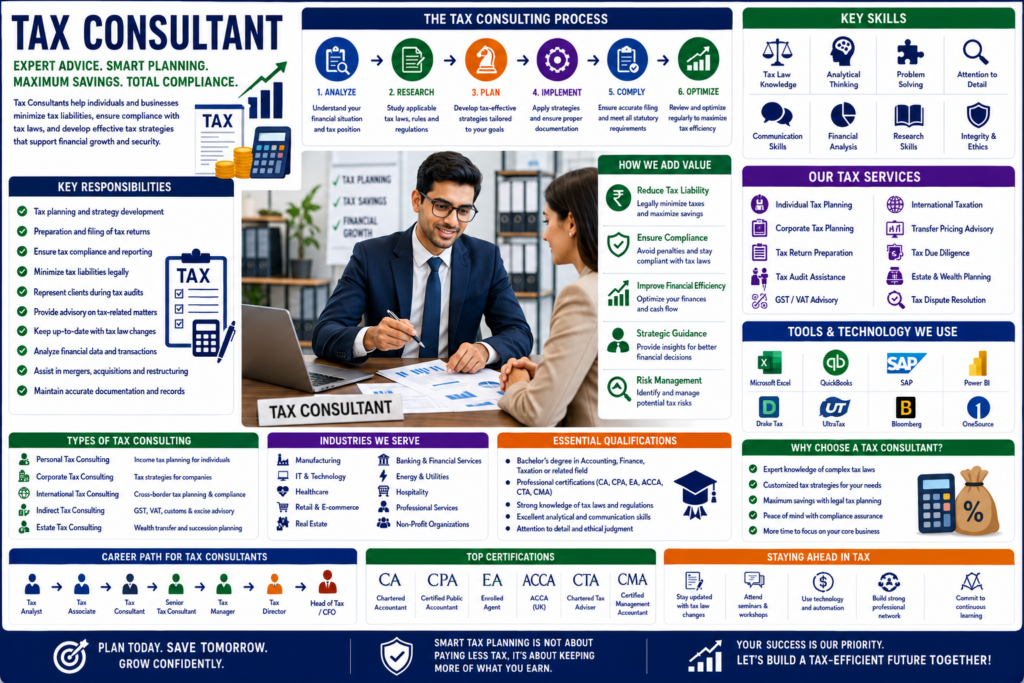
Tax Consultants are financial professionals who help individuals, businesses, and organizations understand tax laws, minimize tax liabilities, maintain compliance, and develop efficient tax strategies. Their expertise allows clients to make informed financial decisions while meeting legal tax obligations.
As tax regulations become increasingly complex and businesses expand globally, the demand for qualified Tax Consultants continues to grow across industries.
What Is a Tax Consultant?
A Tax Consultant is a professional who specializes in taxation and provides advice regarding tax planning, tax compliance, tax reporting, and financial strategies.
Their primary goal is to help clients:
- Reduce tax liabilities legally
- Comply with tax regulations
- Improve financial efficiency
- Avoid tax penalties
- Optimize business structures
- Manage tax risks
- Plan future financial activities
Tax Consultants may work independently, within accounting firms, consulting organizations, law firms, or corporate finance departments.
Why Tax Consultants Are Important
Ensure Tax Compliance
Tax laws change frequently. Consultants help clients remain compliant with current regulations.
Reduce Tax Burdens
Strategic planning can legally lower tax obligations.
Prevent Costly Errors
Professional guidance reduces mistakes that could result in audits or penalties.
Support Business Growth
Tax-efficient strategies help organizations improve profitability.
Manage Financial Risk
Consultants identify and address tax-related risks before they become significant issues.
Key Responsibilities of a Tax Consultant
Tax Planning
Developing strategies to minimize taxes legally.
Tax Return Preparation
Assisting clients with filing accurate tax returns.
Tax Compliance
Ensuring adherence to tax laws and regulations.
Financial Advisory
Providing recommendations that support financial goals.
Audit Support
Assisting clients during tax audits and investigations.
Research and Analysis
Monitoring tax law changes and evaluating their impact.
Client Consultation
Advising businesses and individuals on tax-related decisions.
Types of Tax Consultants
Individual Tax Consultant
Focuses on personal income tax planning and filing.
Corporate Tax Consultant
Works with businesses on corporate tax strategies.
International Tax Consultant
Specializes in cross-border taxation and global compliance.
Sales Tax Consultant
Advises on indirect taxes, VAT, and sales taxes.
Estate Tax Consultant
Supports wealth transfer and inheritance tax planning.
Tax Technology Consultant
Uses technology solutions to improve tax processes and reporting.
Tax Planning Process
1. Financial Assessment
Reviewing income, expenses, assets, and liabilities.
2. Tax Analysis
Evaluating current tax obligations and opportunities.
3. Strategy Development
Creating tax-saving plans aligned with client goals.
4. Implementation
Applying recommended tax strategies.
5. Compliance Monitoring
Ensuring ongoing compliance with regulations.
6. Periodic Review
Updating strategies as tax laws and financial situations change.
Essential Skills for Tax Consultants
Tax Law Knowledge
Understanding local, national, and international tax regulations.
Analytical Thinking
Interpreting financial information and tax implications.
Problem Solving
Developing effective solutions for complex tax challenges.
Attention to Detail
Ensuring accuracy in calculations and filings.
Communication Skills
Explaining technical tax concepts clearly to clients.
Research Skills
Staying informed about evolving tax laws.
Ethical Judgment
Maintaining professional integrity and compliance.
Areas of Tax Consulting
Personal Tax Planning
Helping individuals optimize tax obligations.
Corporate Tax Strategy
Supporting businesses with tax-efficient operations.
International Taxation
Managing cross-border tax requirements.
Tax Compliance
Ensuring accurate reporting and filing.
Mergers and Acquisitions
Providing tax guidance during business transactions.
Estate and Wealth Planning
Supporting long-term wealth preservation strategies.
Common Tax Services Provided
Tax Consultants often assist with:
- Income tax returns
- Business tax filings
- Tax audits
- Tax compliance reviews
- Tax planning strategies
- Retirement planning
- Investment tax analysis
- Business structure optimization
- International tax matters
- Estate planning
Tax Consultant vs Tax Accountant
Tax Consultant
Focuses primarily on advisory services, planning, and strategy.
Tax Accountant
Focuses on preparing tax returns and maintaining financial records.
Many professionals perform both functions depending on their role and expertise.
Tax Consultant vs Financial Advisor
Tax Consultant
Specializes in taxation and compliance.
Financial Advisor
Focuses on investments, wealth management, and broader financial planning.
These professionals often collaborate to support clients’ financial goals.
Tax Regulations and Compliance
Successful Tax Consultants stay current with:
- Income tax laws
- Corporate tax regulations
- Payroll tax requirements
- International tax treaties
- VAT and sales tax regulations
- Government compliance standards
Continuous learning is essential due to frequent legislative changes.
Technology Used by Tax Consultants
Tax Preparation Software
- TurboTax Professional
- Drake Tax
- UltraTax
- ProSeries
Accounting Platforms
- QuickBooks
- Xero
- Sage
- FreshBooks
Analytics Tools
- Microsoft Excel
- Power BI
- Tableau
Research Platforms
Specialized tax databases and compliance systems.
Certifications for Tax Consultants
Professional certifications improve credibility and career opportunities.
CPA (Certified Public Accountant)
Widely respected accounting and tax credential.
EA (Enrolled Agent)
Specialized tax certification recognized by tax authorities.
ACCA
International accounting and taxation qualification.
CTA (Chartered Tax Adviser)
Advanced taxation credential in many countries.
CMA (Certified Management Accountant)
Useful for corporate tax professionals.
Industries Hiring Tax Consultants
Accounting Firms
Providing tax services to diverse clients.
Corporate Finance Departments
Managing business taxation and compliance.
Financial Services
Supporting investment and tax planning.
Government Agencies
Monitoring and enforcing tax regulations.
Legal Firms
Supporting tax-related legal matters.
Consulting Companies
Providing specialized tax advisory services.
Multinational Corporations
Managing global tax operations.
Career Path for Tax Consultants
Tax Associate
Entry-level taxation role.
Junior Tax Consultant
Supports tax planning and compliance activities.
Tax Consultant
Provides independent tax advisory services.
Senior Tax Consultant
Handles complex tax matters and client portfolios.
Tax Manager
Leads tax teams and major client engagements.
Director of Tax
Oversees organizational tax strategies.
Chief Financial Officer (CFO)
Executive leadership role with responsibility for financial strategy.
Best Practices for Tax Consultants
Stay Updated
Monitor changes in tax legislation continuously.
Prioritize Compliance
Ensure all recommendations meet legal requirements.
Focus on Client Goals
Align tax strategies with broader financial objectives.
Maintain Documentation
Keep accurate records and supporting evidence.
Communicate Clearly
Help clients understand tax implications and options.
Uphold Ethical Standards
Provide honest and professional advice.
Future Trends in Tax Consulting
Artificial Intelligence
AI supports tax research, compliance, and automation.
Digital Tax Systems
Governments increasingly require digital reporting.
Global Tax Reform
International regulations continue evolving.
Automation
Routine tax processes become more automated.
Data Analytics
Tax professionals increasingly use advanced analytics.
Remote Consulting
Virtual tax advisory services continue expanding.
Benefits of Becoming a Tax Consultant
- Strong demand for expertise
- Competitive earning potential
- Diverse career opportunities
- Opportunities for specialization
- Professional credibility
- Flexible consulting options
- Long-term career stability
Conclusion
Tax Consultants are essential financial professionals who help individuals and businesses navigate complex tax systems, maintain compliance, and optimize financial outcomes. Through expert planning, strategic advice, and ongoing support, they play a significant role in financial success and risk management.
As tax regulations become increasingly sophisticated and global business continues expanding, skilled Tax Consultants will remain highly valuable. Professionals who develop strong tax expertise, analytical skills, and advisory capabilities can build rewarding careers while helping clients achieve financial efficiency and compliance.