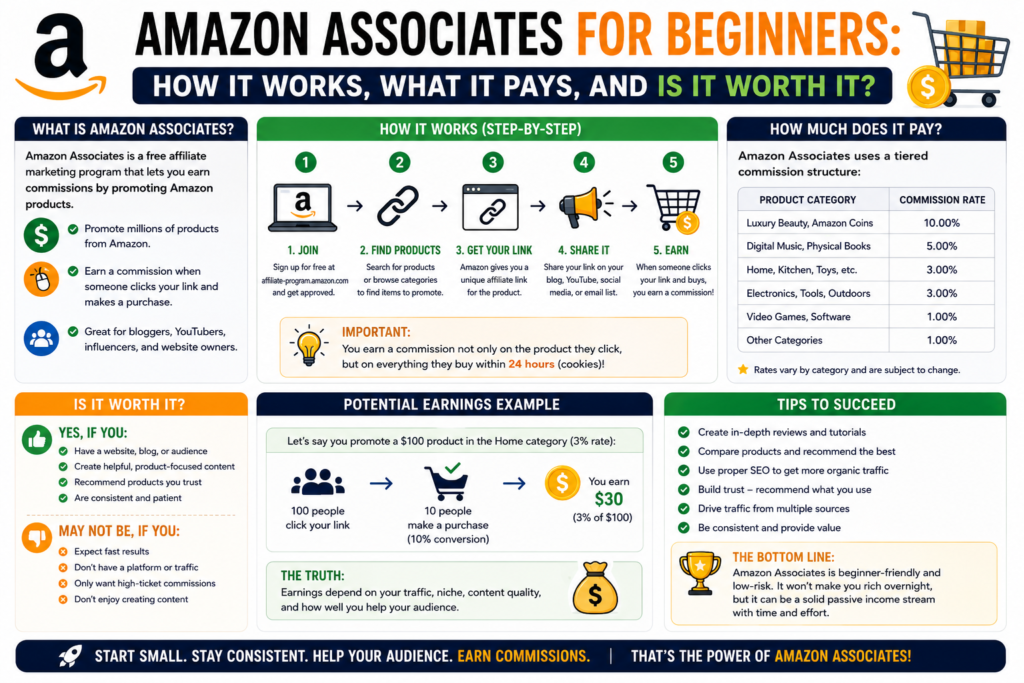
Amazon Associates is the world’s largest affiliate program. It’s been running since 1996, and it was one of the first programs to let regular people earn money by recommending products online.
Nearly three decades later, it remains the starting point for most affiliate marketers. The appeal is obvious: Amazon sells everything, almost everyone already has an Amazon account, and the trust factor behind the brand makes people comfortable clicking “Buy Now” without much hesitation.
But the program has changed significantly over the years. Commission rates have been cut multiple times. The cookie window is one of the shortest in the industry. And competition among affiliates has grown dramatically.
So the real question isn’t whether Amazon Associates works. It does. The real question is whether it works well enough, for your situation, your niche, and your goals, to be worth the time investment.
This guide walks through everything a beginner needs to know: how the program operates, what it actually pays, the sign-up process, common mistakes, and an honest assessment of when Amazon Associates makes sense and when you should look elsewhere.
How Amazon Associates Works
The concept is simple.
You sign up for the Amazon Associates program. Amazon gives you access to tools that generate special tracking links for any product on their site. You place those links in your content, whether that’s a blog post, YouTube video, social media post, or email newsletter. When someone clicks your link and buys something on Amazon, you earn a percentage of the sale.
That’s the 30-second explanation. Here’s what’s happening behind the scenes.
The Tracking Link
Every affiliate link you create through Amazon Associates contains a unique tracking ID tied to your account. When a visitor clicks that link, Amazon drops a cookie in their browser. That cookie tells Amazon, “This person came from [your tracking ID].”
The link format typically looks something like this:
The tag=yourtag-20 portion is your unique identifier. You can create multiple tracking IDs within your account to monitor which content sources drive the most sales (one tag for your blog, one for YouTube, one for email, etc.).
The 24-Hour Cookie Window
This is where Amazon Associates differs from most affiliate programs, and not in a good way.
When someone clicks your affiliate link, you have a 24-hour window for them to make a purchase. If they buy within 24 hours, you earn the commission. If they come back 25 hours later and buy the same product, you earn nothing.
There’s one exception: if the visitor adds an item to their cart within that 24-hour window, the cookie extends to 89 days for that specific item. So if someone clicks your link, adds a $300 blender to their cart on Monday, and doesn’t complete the purchase until Thursday, you still get credit.
But if they click your link, browse around, leave, and come back two days later to make a purchase without going through your link again, you’re out of luck.
Compare this to other affiliate programs that offer 30-day, 60-day, or even 90-day cookie windows, and you can see why experienced affiliates sometimes view Amazon’s terms as limiting.
What Counts Toward Your Commission
Here’s something that surprises most beginners: you earn a commission on everything the customer buys during their session, not just the product you linked to.
If someone clicks your affiliate link for a $15 book, then decides to buy a $800 laptop and a $200 pair of headphones during the same shopping session, you earn commission on all three items. The customer doesn’t even need to buy the original product you recommended.
This “shopping cart” effect is one of Amazon’s biggest strengths as an affiliate program. People rarely buy just one thing on Amazon. Average order values tend to be higher than the single product you promoted, which means your effective earnings per click can exceed what the commission rate on your specific product would suggest.
How You Get Paid
Amazon Associates offers three payment methods:
- Direct deposit (minimum payout threshold: $10)
- Amazon gift card (minimum payout threshold: $10)
- Check (minimum payout threshold: $100)
Payments are made approximately 60 days after the end of the month in which the commissions were earned. So if you earn commissions in January, you’ll receive payment at the end of March. This delay accounts for return periods and order cancellations, since you don’t earn commissions on returned items.
Amazon Associates Commission Rates
This is the part that generates the most debate among affiliate marketers. Amazon has cut commission rates several times over the years, with the most significant reduction happening in April 2020.
Here are the current commission rate categories (rates are subject to change, so always verify the current schedule on Amazon’s official page):
| Product Category | Commission Rate |
|---|---|
| Amazon Games | 20% |
| Luxury Beauty, Luxury Stores Beauty, Amazon Explore | 10% |
| Digital Music, Physical Music, Handmade, Digital Videos | 5% |
| Physical Books, Kitchen, Automotive | 4.5% |
| Amazon Fire Tablet Devices, Amazon Kindle Devices, Amazon Fashion (Women’s, Men’s, Kids), Apparel, Amazon Cloud Cam Devices, Fire TV Edition Smart TVs, Amazon Fire TV Devices, Amazon Echo Devices, Ring Devices, Watches, Jewelry, Luggage, Shoes, Handbags & Accessories | 4% |
| Toys, Furniture, Home, Home Improvement, Lawn & Garden, Pets, Pantry, Headphones, Beauty, Musical Instruments, Business & Industrial Supplies, Outdoors, Tools, Sports, Baby | 3% |
| PC, PC Components, DVD & Blu-Ray | 2.5% |
| Televisions, Digital Video Games | 2% |
| Amazon Fresh, Physical Video Games & Video Game Consoles, Grocery, Health & Personal Care | 1% |
| Gift Cards, Wireless Service Plans, Alcoholic Beverages, Digital Kindle Products (purchased as subscriptions), Food prepared and delivered from restaurants, Amazon Appstore, Prime Now, Amazon Pay Places | 0% |
A few things stand out from this table.
The highest-paying category at 20% (Amazon Games) is narrow. Most physical product categories fall in the 1% to 4.5% range. That means if you’re promoting a $50 kitchen gadget at 4.5%, you’re earning $2.25 per sale. A $25 book earns you $1.13. A $500 TV earns you $10.
These aren’t life-changing numbers per transaction. The math only works at volume, which means you need significant traffic, high click-through rates, or a focus on categories with higher average order values.
How Commission Rates Compare to Other Programs
To put Amazon’s rates in perspective:
- Individual brand affiliate programs often pay 10% to 30% commission
- Software and SaaS affiliate programs frequently pay 20% to 50% recurring commissions
- Web hosting affiliates can earn $50 to $200+ per signup
- Online course platforms typically offer 30% to 50% per sale
- Financial product affiliates can earn $50 to $500+ per lead or signup
Amazon’s rates are among the lowest in the affiliate marketing space. The tradeoff is that Amazon’s conversion rate is exceptionally high because of the brand trust, the seamless checkout experience, and the fact that most buyers already have an Amazon account with saved payment information.
A 4% commission on a product that converts at 8% to 12% can outperform a 30% commission on a product that converts at 1% to 2%. The math depends on your specific traffic volume and audience behavior.
How to Sign Up for Amazon Associates
The application process is straightforward, but there’s a catch that trips up many beginners.
Step-by-Step Sign-Up Process
Step 1: Go to the Amazon Associates homepage.
Visit affiliate-program.amazon.com and click “Sign Up.”
Step 2: Log in with your existing Amazon account (or create one).
Use the same Amazon account you shop with, or create a new one.
Step 3: Enter your account information.
You’ll provide your name, address, and phone number. This is the information tied to your affiliate payments.
Step 4: Add your website(s) or mobile app(s).
List every platform where you plan to use affiliate links: your blog URL, YouTube channel, social media profiles, or mobile app. Amazon wants to know where you’ll be promoting products.
Step 5: Build your profile.
Amazon will ask about your content topics, the type of products you plan to promote, and how you drive traffic to your content. Answer honestly.
Step 6: Enter your tax information.
Complete the tax identity verification. In the US, this means providing your Social Security Number or EIN.
Step 7: Choose your payment method.
Select between direct deposit, Amazon gift card, or check.
The 180-Day Qualification Period
Here’s the catch most beginners don’t know about.
After you’re approved, you enter a 180-day qualification period. During this window, you need to generate at least 3 qualifying sales. If you don’t hit 3 sales within 180 days, your account gets closed and you’ll need to reapply.
This means you shouldn’t sign up for Amazon Associates until you have a content platform with at least some traffic. Signing up before you have an audience means your 180-day clock starts ticking with nobody clicking your links.
When to apply:
- After you’ve published at least 10 to 15 pieces of content on your platform
- When you’re getting some organic traffic (even a few hundred visitors per month)
- When you have content that naturally lends itself to product recommendations
When not to apply:
- Before your website is live
- Before you have any content published
- When your platform has zero traffic
If your account gets closed for failing to make 3 sales, you can reapply. But it’s better to wait until you’re ready than to waste your first attempt.
Where to Use Amazon Affiliate Links
Amazon allows affiliate links on the following platforms:
Blogs and websites – The most common placement. Product review posts, buying guides, comparison articles, “best of” roundups, and tutorial content all work well for embedding Amazon links.
YouTube – Place affiliate links in your video descriptions. Product review and unboxing channels generate significant Amazon affiliate income. Always disclose the affiliate relationship in your video and description.
Social media – Amazon Associates allows links on Facebook, Instagram, Twitter/X, Pinterest, and TikTok (with proper disclosure). The Amazon Influencer Program offers additional features for social media creators, including a dedicated storefront page.
Email newsletters – You can include Amazon affiliate links in emails. Some affiliates use product roundup emails (weekly picks, seasonal gift guides) to drive Amazon purchases from their email list.
Mobile apps – If you have a mobile app, you can integrate Amazon affiliate links with proper disclosure.
Where You Cannot Use Amazon Affiliate Links
- Offline promotions (printed materials, QR codes in physical stores, etc.)
- Closed platforms where content isn’t publicly accessible (private Facebook groups, password-protected websites, etc. can be gray areas, so check Amazon’s current terms)
- Paid search ads bidding on Amazon’s trademark terms
- Pop-ups and pop-unders
- Coupon and deal sites (unless specifically approved by Amazon)
Amazon’s Operating Agreement is lengthy and contains specific restrictions that are worth reading carefully. Violations can result in account termination and forfeiture of unpaid commissions.
Amazon Associates Tools and Features
Once your account is active, you have access to several tools for creating and managing affiliate links.
SiteStripe
SiteStripe is a toolbar that appears at the top of Amazon’s website when you’re logged into your Associates account. It lets you generate affiliate links for any product page you’re viewing without leaving Amazon’s site.
You can create:
- Text links (just the URL)
- Image links (a product image with your affiliate link embedded)
- Text + Image links (both together)
SiteStripe is the fastest way to grab affiliate links while browsing Amazon.
Product Linking Tools
The Associates Central dashboard offers several link-creation tools:
- Product Links – Generate links to specific products by searching Amazon’s catalog within the dashboard
- Banner Links – Pre-made banner ads for seasonal promotions, deals pages, and specific product categories
- Native Shopping Ads – Dynamic ad units that display product recommendations based on your content and the visitor’s browsing history
- OneLink – If you promote to an international audience, OneLink automatically redirects visitors to their local Amazon storefront (Amazon.co.uk, Amazon.de, Amazon.co.jp, etc.) so you can earn commissions from multiple Amazon programs
Amazon Influencer Program
The Amazon Influencer Program is an extension of Associates designed for social media creators. If you’re accepted, you get:
- A custom Amazon storefront (amazon.com/shop/yourusername) where you can curate product recommendations
- The ability to earn commissions from your storefront, on-site shoppable content, and livestreams
- Access to livestreaming features on Amazon Live
The Influencer Program requires a social media following and an active content presence. Approval isn’t automatic, and Amazon evaluates your follower count, engagement rate, and content relevance.
Amazon Bounty Program
Separate from standard product commissions, the Bounty Program pays flat-rate bounties when you refer customers to specific Amazon services:
- Amazon Prime free trial – Fixed bounty per signup
- Audible free trial – Fixed bounty per signup
- Amazon Business account – Fixed bounty per registration
- Amazon Baby Registry, Wedding Registry – Fixed bounty per creation
- Kindle Unlimited – Fixed bounty per signup
Bounty amounts vary and change over time, but they can range from $3 to $15+ per action. For some content creators, promoting Amazon services through the Bounty Program generates more revenue than standard product commissions.
Content Strategies That Work for Amazon Associates
Product Review Posts
The bread and butter of Amazon affiliate marketing. A detailed, honest review of a product you’ve actually used, complete with photos, pros and cons, and a clear recommendation.
What makes a good Amazon product review:
- Specific details about your personal experience (“After 3 months of daily use, the non-stick coating on this pan still performs like day one. No scratching, even with metal utensils.”)
- Photos you took yourself (not Amazon stock photos)
- Honest discussion of drawbacks (“The handle gets warm after 10+ minutes on high heat. I use a silicone grip to solve this, but it’s worth mentioning.”)
- Clear indication of who the product is best for and who should look at alternatives
- A comparison to 1 or 2 competing products to give context
“Best Of” and Roundup Posts
Posts like “Best Budget Headphones Under $50” or “Best Kitchen Gadgets for Small Apartments” aggregate multiple products into a single piece of content. These posts tend to perform well in search engines because they match the way people search for products.
How to structure a roundup post:
- Lead with your top pick and explain why it earned that position
- Include 5 to 10 products with a brief review of each
- Organize by use case, budget, or feature priority (“Best for sound quality,” “Best for comfort,” “Best value”)
- Include a quick-reference comparison table at the top for scanners
- Update the post regularly to keep products and prices current
Comparison Posts
“AirPods Pro vs. Sony WF-1000XM5” or “Instant Pot vs. Ninja Foodi” – these posts capture people who’ve narrowed their choices to 2 or 3 options and need help making a final decision.
Comparison content works well because the reader has already decided to buy something. They’re choosing between options. Your job is to help them pick the right one for their needs, and your Amazon affiliate links give them a direct path to purchase.
How-To and Tutorial Content
Content that teaches people how to do something and naturally references the tools or products needed.
“How to Set Up a Home Recording Studio on a $500 Budget” – walk through the process step by step, and every piece of equipment you mention can include an Amazon affiliate link. The affiliate links feel natural because they’re serving the reader’s need to find and purchase the specific items you’re recommending.
Seasonal and Gift Guide Content
Gift guides perform exceptionally well during Q4 (Black Friday, Cyber Monday, and the holiday shopping season). Content like “Best Gifts for Coffee Lovers Under $50” or “Gift Ideas for Teenage Boys” captures high-volume search traffic during peak buying periods.
The advantage of gift guide content is that the buyer is already committed to spending money. They’re looking for ideas, and your curated list of Amazon products makes their decision easier.
Plan and publish seasonal content at least 4 to 6 weeks before the relevant shopping period to give Google time to index and rank your pages.
Realistic Income Expectations
Let’s run some real numbers to ground this in reality.
The Math Behind Amazon Associates Earnings
Your earnings = Traffic × Click-Through Rate × Conversion Rate × Average Commission
Here’s how that breaks down with realistic numbers:
Scenario 1: New blog, 5,000 monthly visitors
- 5,000 visitors per month
- 5% click-through rate on affiliate links = 250 clicks
- 7% conversion rate on Amazon = 17.5 sales
- Average commission per sale: $3.50
- Monthly earnings: roughly $61
Scenario 2: Growing blog, 25,000 monthly visitors
- 25,000 visitors per month
- 6% click-through rate = 1,500 clicks
- 7% conversion rate = 105 sales
- Average commission per sale: $4.00
- Monthly earnings: roughly $420
Scenario 3: Established blog, 100,000 monthly visitors
- 100,000 visitors per month
- 7% click-through rate = 7,000 clicks
- 8% conversion rate = 560 sales
- Average commission per sale: $4.50
- Monthly earnings: roughly $2,520
Scenario 4: Authority site, 300,000 monthly visitors
- 300,000 visitors per month
- 7% click-through rate = 21,000 clicks
- 8% conversion rate = 1,680 sales
- Average commission per sale: $5.00
- Monthly earnings: roughly $8,400
These scenarios assume primarily US traffic, a mix of product categories, and decent content optimization. Your actual numbers will vary based on niche, product price points, content quality, and seasonal trends.
The Seasonal Factor
Amazon Associates income isn’t flat throughout the year. Most affiliates see a significant spike during Q4 (October through December). During Black Friday, Cyber Monday, and the pre-Christmas shopping period, both traffic and conversion rates increase substantially. It’s not unusual for December earnings to be 2 to 4 times higher than an average month.
January typically sees a sharp drop as post-holiday spending slows. Understanding this seasonal pattern helps you set realistic expectations and avoid panic when January numbers feel low compared to December.
What High-Earning Amazon Affiliates Do Differently
The affiliates making $5,000 to $20,000+ per month with Amazon Associates share a few common traits:
- They focus on categories with higher average order values. Promoting $300 espresso machines at 3% ($9 per sale) pays better per transaction than promoting $15 books at 4.5% ($0.68 per sale). Smart category selection dramatically impacts earnings.
- They optimize for click-through rate obsessively. Button placement, link text, comparison tables, and product image positioning all affect how many visitors click affiliate links. Small improvements in CTR compound across thousands of page views.
- They update content regularly. Amazon products go in and out of stock. Prices change. New models replace old ones. The best affiliates keep their content current, which improves both reader trust and search engine rankings.
- They build topical authority. Instead of covering random products across dozens of categories, they go deep in one or two niches. A site about home coffee brewing that covers every espresso machine, grinder, kettle, and accessory on Amazon will outperform a general “cool products” site.
- They don’t rely on Amazon alone. High earners use Amazon Associates as one revenue stream alongside higher-commission affiliate programs, display ads, sponsored content, and digital products.
Common Beginner Mistakes
Mistake 1: Promoting Products You’ve Never Used
It’s tempting to write about high-commission products you’ve never touched. Readers can tell. Your reviews will lack the specific, experiential details that make recommendations persuasive. Start with products you genuinely own and use. As you grow, invest in purchasing products specifically to review, or request review units from brands.
Mistake 2: Writing Thin, Generic Content
A 300-word “review” that restates the Amazon product description and says “I recommend this product” will not rank in search engines and will not convert visitors into buyers. Depth, originality, and genuine insight are what separate content that earns from content that sits dormant.
Mistake 3: Ignoring Amazon’s Operating Agreement
Amazon has specific rules about how you can and cannot use affiliate links. Common violations that lead to account termination:
- Using affiliate links in emails without proper disclosure (check the current email policy carefully)
- Cloaking links in ways that hide the Amazon destination
- Making price claims in your content (“This product is only $29.99!”) because prices change frequently and Amazon doesn’t allow displaying prices outside their official widgets
- Using affiliate links in offline materials
- Not including the required Amazon Associates disclosure on your website
Read the Operating Agreement. It’s long and dry, but violating terms you didn’t know about is the fastest way to lose your account and all pending commissions.
Mistake 4: Relying Exclusively on Amazon Associates
Amazon’s commission rates are low. The cookie window is 24 hours. And Amazon can change terms, cut rates, or close your account at any time.
Putting all your affiliate income in one basket is a strategic risk. Use Amazon Associates as your foundation (especially while building an audience), but actively pursue partnerships with brands that offer higher commissions and longer cookie windows in your niche.
Mistake 5: Applying Before You’re Ready
If you sign up with a brand-new site that has no content and no traffic, your 180-day clock starts ticking immediately. Three sales from zero traffic in six months is harder than it sounds. Wait until you have content published and at least some visitors finding your site.
Mistake 6: Not Using Proper Disclosure
The FTC requires clear disclosure of affiliate relationships. Amazon requires a specific disclosure statement. At minimum, your website needs a clearly visible statement explaining that you earn commissions from qualifying purchases through Amazon links.
Many affiliates place a short disclosure at the top of every post containing affiliate links and maintain a full disclosure policy page. Not doing this exposes you to both legal risk and Amazon account termination.
Is Amazon Associates Actually Worth It in 2026?
This depends on what you’re comparing it to and what stage you’re at.
When Amazon Associates Is Worth It
You’re a complete beginner.
Amazon Associates has the lowest barrier to entry of any major affiliate program. The product catalog is massive, the tools are user-friendly, and you don’t need to convince readers to buy from an unfamiliar brand. It’s the best training ground for learning affiliate marketing fundamentals.
Your niche involves physical products.
If you review kitchen gear, tech gadgets, outdoor equipment, books, toys, or any tangible product category, Amazon is probably where most of your audience already shops. The conversion advantage of Amazon’s trusted checkout is real.
You get high traffic volumes.
Amazon’s low commission rates are offset by volume. If you’re generating 100,000+ monthly visitors, even 1% to 4% commissions add up to meaningful income.
You create comparison and roundup content.
The breadth of Amazon’s catalog is perfect for “best of” posts. You can compare 10 products in a single article, and every one of them links to Amazon. Try doing that with a single-brand affiliate program.
You sell to an audience that’s already buying on Amazon.
If your readers are Amazon Prime members who buy everything on Amazon anyway, your affiliate links are just giving them a convenient shortcut to products they’d find there themselves. The friction between “clicking your link” and “completing a purchase” is almost zero for existing Amazon customers.
When Amazon Associates Isn’t Enough
Your niche has better-paying alternatives.
If you’re in software, web hosting, online education, financial services, or any niche with high-commission affiliate programs, Amazon’s rates will look like pocket change in comparison. A single web hosting referral can pay more than 50 Amazon product sales.
You promote high-ticket items where 24 hours isn’t enough decision time.
Expensive products ($500+) often require days or weeks of research before purchase. Amazon’s 24-hour cookie means you lose credit for sales that happen after the initial browsing session. Programs with 30-day or 60-day cookies are better suited for high-ticket affiliate marketing.
You want recurring revenue.
Amazon pays a one-time commission per sale. Many SaaS and subscription-based affiliate programs pay recurring commissions for as long as the referred customer stays subscribed. Over time, recurring commissions compound into much more reliable income than one-off product sales.
You have a small but highly engaged audience.
If your traffic is modest (under 10,000 monthly visitors), Amazon’s low commission rates won’t generate meaningful income. You’d be better served by promoting fewer, higher-commission products that your small audience genuinely needs.
The Best Approach: Amazon as Part of a Larger Strategy
The most successful affiliate marketers in 2026 don’t use Amazon Associates as their only income source. They use it strategically:
- Amazon handles the “commodity” product links. When a product is widely available and best purchased on Amazon, use your Associates link.
- Higher-commission programs handle the “signature” recommendations. For your top product picks in categories where brands offer direct affiliate programs with better terms, use those programs instead.
- Amazon fills the gaps. When you mention a product in passing or a reader asks about something you haven’t formally reviewed, Amazon’s massive catalog lets you quickly generate a link for practically anything.
This hybrid approach maximizes your earnings per visitor. Amazon’s strength is breadth and conversion rate. Other programs’ strength is commission depth. Using both gives you the best of each.
Getting Your First Amazon Associates Sales
If you’re just starting out, here’s a practical plan for making your first 3 qualifying sales within the 180-day window.
Week 1 to 2: Publish 3 to 5 product-focused articles.
Write detailed reviews of products you already own and use. Include real photos, specific experiences, and honest pros and cons. These are your fastest path to ranking for long-tail product queries.
Week 3 to 4: Publish 1 to 2 comparison or roundup posts.
“Best [product type] under $[price]” posts cast a wider net than single-product reviews. They rank for multiple product-related keywords and give readers options, increasing the chances that at least one product appeals to them.
Week 5 to 8: Promote your content.
Share your reviews and roundups on relevant social media platforms, in niche forums (following community rules), and through Quora or Reddit (providing genuine value, not just link-dropping). Answer product-related questions and reference your content where appropriate.
Ongoing: Publish consistently and optimize existing content.
Add new product content weekly. Update older posts with current pricing information, new product models, and additional detail based on reader questions and comments.
Three sales in 180 days is a low bar if you have decent content on topics people are searching for. The key is making sure your content exists, is findable, and provides enough value that readers trust your recommendations enough to click through and buy.
Final Thoughts
Amazon Associates isn’t the highest-paying affiliate program. It isn’t the most generous with cookie windows. And it isn’t immune to future commission cuts.
But it remains the most accessible, most trusted, and most broadly applicable affiliate program available. For beginners, it’s the clearest path to earning your first affiliate commissions and learning how affiliate marketing works in practice.
The affiliates who build real income with Amazon Associates treat it like a long-term content business, not a quick money scheme. They publish consistently, choose their niches carefully, optimize their content for both readers and search engines, and diversify their income sources as they grow.
Start with Amazon. Learn the mechanics. Build your audience. Then expand into higher-commission programs as you gain experience and traffic.
The program pays modest commissions on individual sales, but those modest commissions, multiplied across hundreds of pieces of content and thousands of monthly visitors, add up to income that’s well worth the effort for those willing to put in the work.