Choosing your first affiliate network feels like it should be straightforward. Sign up, grab some links, promote products, earn commissions. Three steps, right?
Then you start researching and realize there are dozens of networks, each with different merchants, commission structures, approval processes, payment thresholds, and reporting tools. Hours later, you’ve read fifteen comparison posts and you’re more confused than when you started.
Here’s the reality: ShareASale, CJ Affiliate (formerly Commission Junction), and Impact are three of the most established affiliate networks in the industry. Each one gives you access to thousands of brands willing to pay you for sending customers their way. And each one has meaningful differences that make it a better or worse fit depending on where you are in your affiliate marketing career, what kind of products you want to promote, and how you plan to drive traffic.
This guide strips away the generic advice and compares these three networks across every factor that actually matters when you’re deciding where to apply first.
How Affiliate Networks Work (Quick Primer)
Before the comparison, a quick clarification on what affiliate networks actually do, because the terminology confuses a lot of beginners.
An affiliate network is a middleman between you (the affiliate/publisher) and brands (the merchants/advertisers). The network handles tracking, provides your affiliate links, processes payments, and gives both sides a dashboard to manage the partnership.
Without networks, you’d need to negotiate deals with every brand individually, trust their tracking, and chase them for payment. Networks centralize all of that.
ShareASale, CJ Affiliate, and Impact are all affiliate networks. They each host hundreds or thousands of brands across every niche imaginable. You apply to the network, then apply to individual merchant programs within the network. When someone clicks your link and makes a purchase (or completes another qualifying action), the network tracks it, confirms the sale, and pays you.
Some brands run their affiliate programs on multiple networks simultaneously. Others are exclusive to one. That’s why many experienced affiliates maintain accounts on all three. But as a beginner, starting with one and learning how it works before spreading yourself thin is the smarter move.
ShareASale: The Full Breakdown
Background
ShareASale launched in 2000 and built its reputation as a reliable, affiliate-friendly network with a low barrier to entry. In 2017, Awin (a global affiliate network) acquired ShareASale but continued operating it as a separate platform. As of recent years, Awin has been gradually integrating ShareASale into its broader platform, which has created some uncertainty about ShareASale’s future as a standalone network. That said, it remains operational and continues to host thousands of active merchant programs.
Merchant Selection
ShareASale has historically been home to a large number of small and mid-sized merchants. If you’re looking for niche-specific affiliate programs, brands you’d find on Etsy, Shopify-powered stores, smaller SaaS companies, boutique e-commerce brands, ShareASale tends to have a stronger selection than either CJ or Impact.
Categories where ShareASale has particularly strong merchant representation:
- Fashion and apparel (smaller brands and boutiques)
- Home and garden
- WordPress themes, plugins, and hosting
- Online education and courses
- Small SaaS tools and software
- Arts, crafts, and hobby supplies
- Wedding and event planning
ShareASale hosts some larger brands too, but its strength has always been in the mid-market. If the brands you want to promote are household names, you may find better options on CJ or Impact. If your niche involves smaller, specialized brands, ShareASale often has more to offer.
Approval Process
ShareASale has one of the more accessible approval processes among major networks. You apply to the network itself, which is generally straightforward if you have a functioning website with real content. Once approved as an affiliate, you then apply to individual merchant programs.
Merchant-level approvals vary. Some programs auto-approve any affiliate who meets basic criteria. Others review your website, traffic sources, and promotional methods before accepting you. As a beginner with a new site, expect a mix: some instant approvals and some rejections. Don’t take the rejections personally. Reapply after your site has more content and traffic.
One advantage of ShareASale for beginners: many of its smaller merchants have less strict approval criteria than the enterprise brands on CJ and Impact. You can often get approved for programs even with modest traffic numbers, giving you something to promote while you build your audience.
Dashboard and Reporting
This is where opinions split. ShareASale’s dashboard is functional but feels dated compared to the more modern interfaces of CJ and Impact. The reporting tools cover the basics: clicks, conversions, commission amounts, transaction details, and merchant performance. But the interface can feel cluttered, and finding specific information sometimes takes more clicks than it should.
That said, ShareASale provides several useful features:
- Real-time click tracking: You can see when your links are clicked almost immediately.
- Product datafeed: ShareASale provides product-level data for many merchants, making it easier to create product comparison content.
- Custom link creation: Build deep links to specific product pages, not just the merchant’s homepage.
- PowerRank: ShareASale’s algorithm ranks affiliates and merchants based on performance, giving you a sense of which programs are active and paying.
For beginners, the learning curve on ShareASale’s dashboard is moderate. It’s not intuitive on first glance, but a few hours of exploration will get you comfortable with the layout.
Payment Terms
- Minimum payout: $50
- Payment schedule: Monthly, on the 20th of each month for the previous month’s confirmed commissions
- Payment methods: Direct deposit (ACH), check, wire transfer, Payoneer (for international affiliates)
The $50 minimum payout is reasonable and achievable even for beginners generating modest commissions. Some networks set thresholds at $100 or higher, which can mean waiting months for your first payment when you’re starting out.
One thing to be aware of: ShareASale has a policy where if your account doesn’t generate any affiliate activity (no clicks, no commissions) for an extended period, it can be flagged or deactivated. Keep your account active by maintaining at least some level of promotional activity.
Strengths
- Large selection of small and mid-sized merchants across many niches
- Relatively easy approval process for beginners
- $50 minimum payout threshold
- Strong product datafeed options for creating content
- Good for niche sites targeting specific product categories
Weaknesses
- Dashboard feels outdated compared to competitors
- Ongoing integration with Awin creates uncertainty about the platform’s long-term future
- Fewer enterprise-level, globally recognized brands compared to CJ and Impact
- Reporting tools are adequate but not best-in-class
- Some merchants on the platform are inactive or have low-quality affiliate programs
CJ Affiliate: The Full Breakdown
Background
CJ Affiliate (originally Commission Junction, founded in 1998) is one of the oldest and largest affiliate networks in the world. It’s owned by Publicis Groupe, a global advertising and communications company. CJ positions itself as a premium network, and its merchant roster reflects that positioning. If you want to promote well-known, established brands, CJ is often where you’ll find them.
Merchant Selection
CJ’s merchant selection skews heavily toward larger, more established brands. This is both its greatest strength and a potential barrier for beginners.
Categories and brands where CJ has particularly strong representation:
- Travel and hospitality (major hotel chains, airlines, travel booking platforms)
- Retail (large e-commerce brands, department stores, fashion labels)
- Financial services (credit cards, banking, investment platforms)
- Technology (major software companies, electronics retailers)
- Fitness and wellness (established supplement brands, equipment retailers)
- Business services (web hosting companies, marketing platforms, B2B tools)
When someone asks “where can I find affiliate programs for big brands,” CJ is usually the answer. Many Fortune 500 companies run their affiliate programs through CJ.
The flip side: CJ has fewer small, niche merchants compared to ShareASale. If you’re in a very specific niche promoting smaller brands, CJ’s selection might feel limited.
Approval Process
CJ’s network-level approval is straightforward. You sign up, provide your website URL and basic information, and typically get accepted within a few days.
The real gatekeeping happens at the merchant level, and this is where CJ can be challenging for beginners. Many of CJ’s premium merchants have strict approval criteria:
- Minimum traffic requirements (some want 10,000+ monthly visitors)
- Content quality reviews (your site needs to look professional and have substantive content)
- Niche relevance (your site should be topically related to the merchant’s products)
- Promotional method restrictions (some merchants won’t approve coupon, deal, or incentive sites)
As a new affiliate with a fresh website, expect more rejections on CJ than on ShareASale. Some of the most desirable programs are effectively closed to beginners. This isn’t a permanent barrier. As your site grows in traffic and content quality, these programs become accessible. But on day one, it can be frustrating to browse CJ’s impressive merchant list and get rejected by many of the brands you want to promote.
A workaround: CJ has a “Content Certified” program that gives affiliates with high-quality content easier access to certain premium advertisers. If your site is content-focused (blog, review site, resource site) rather than coupon or deal-focused, this program can be worth pursuing.
Dashboard and Reporting
CJ’s dashboard is a significant step up from ShareASale in terms of design and functionality. It’s cleaner, more modern, and provides deeper analytics out of the box.
Standout features:
- Real-time reporting: Detailed performance data with minimal delay.
- Advanced filtering: Slice your data by date range, merchant, ad type, website, and more.
- Situational commissioning visibility: See how different merchants structure their commission tiers.
- Cross-device tracking: CJ tracks conversions across devices (someone clicks on mobile, buys on desktop), which gives you credit for sales you might lose on networks with less sophisticated tracking.
- Deep link generator: Easily create links to any page on a merchant’s site, with a browser extension that makes the process quick.
- Publisher toolbox: CJ provides a suite of tools including widgets, product feeds, and API access for building content around affiliate products.
For data-oriented affiliates, CJ’s reporting is a clear advantage. You can analyze performance at a granular level that’s harder to achieve on ShareASale.
Payment Terms
- Minimum payout: $50 for direct deposit, $100 for check
- Payment schedule: Monthly, around the 20th to 25th of each month
- Payment methods: Direct deposit, check, Payoneer
CJ’s payment terms are similar to ShareASale’s. The $50 minimum for direct deposit is accessible for beginners. One notable difference: CJ pays based on “locked” (confirmed) commissions, not pending ones. Some merchants have extended validation periods (30 to 90 days) during which they can reverse commissions for returned products. This means there can be a significant delay between earning a commission and receiving payment for it.
Strengths
- Access to major, well-known brands that consumers already trust
- Superior dashboard and reporting tools
- Cross-device tracking captures more conversions
- Strong reputation with large advertisers (which means more stable, long-term programs)
- Content Certified program rewards quality publishers
Weaknesses
- Many premium merchants are hard for beginners to get approved by
- Fewer small and niche merchant options compared to ShareASale
- CJ deactivates accounts that remain inactive for extended periods (and the threshold can feel aggressive)
- The platform can be overwhelming for beginners due to the volume of features and data
- Commission structures on large brand programs are sometimes lower than direct affiliate programs
Impact: The Full Breakdown
Background
Impact (formerly Impact Radius) was founded in 2008 by a team that included former Commission Junction executives. It positions itself as a partnership automation platform rather than a traditional affiliate network, and that distinction matters.
While ShareASale and CJ operate as networks where affiliates browse a marketplace of merchants, Impact functions more as a technology platform that brands use to manage their affiliate programs. The result is a different experience for affiliates, one that’s more modern but comes with its own trade-offs.
In recent years, Impact has attracted a growing number of high-profile brands that have migrated their affiliate programs from older networks. This trend has made Impact increasingly difficult to ignore, even for beginners.
Merchant Selection
Impact’s merchant roster sits somewhere between CJ’s enterprise focus and ShareASale’s mid-market strength. It has a growing number of premium brands, particularly in categories like:
- Direct-to-consumer (DTC) brands (Warby Parker, Allbirds-style companies, modern e-commerce brands)
- SaaS and technology (Canva, Shopify, Semrush, HubSpot, and many other major software companies)
- Financial technology (modern fintech companies, trading platforms, crypto services)
- Travel (Airbnb, Booking.com type platforms)
- Subscription services (meal kits, streaming platforms, subscription boxes)
- E-commerce platforms and marketplaces
Impact has become particularly popular with DTC and SaaS brands that want more control over their affiliate programs. This means if you’re in the tech, software, or modern e-commerce space, Impact often has more relevant programs than CJ or ShareASale.
The downside: Impact’s marketplace can feel less organized than CJ’s or ShareASale’s. Since brands use Impact as a technology platform rather than a traditional network, the experience of finding and browsing programs can be less intuitive.
Approval Process
Impact’s network-level approval is relatively simple. You create an account, provide your website and promotional details, and get access to the platform.
Merchant-level approvals on Impact vary widely:
- Some brands auto-approve affiliates who meet basic criteria
- Others have detailed application forms asking about your traffic sources, content strategy, and promotional plans
- A growing number of Impact merchants actively recruit affiliates (you may receive invitations from brands based on your profile)
One difference from CJ and ShareASale: Impact allows brands to set up their own custom application processes, so the approval experience can feel inconsistent from one merchant to the next. Some applications are a single click. Others ask you to fill out detailed questionnaires and provide traffic screenshots.
For beginners, Impact falls between ShareASale (most accessible) and CJ (most selective) in terms of overall approval difficulty. The modern, DTC-oriented brands on Impact tend to be more open to working with smaller affiliates compared to the legacy enterprise brands on CJ, but they still want to see a real website with real content.
Dashboard and Reporting
Impact’s dashboard is the most modern and polished of the three networks. It was built more recently and reflects current design standards and UX principles.
Standout features:
- Clean, intuitive interface: The dashboard is well-organized and easier to learn than CJ’s feature-dense layout or ShareASale’s dated design.
- Partnership management tools: Impact treats each brand relationship as a “partnership” and provides tools for communication, contract management, and performance tracking within the platform.
- Flexible attribution: Impact supports multiple attribution models (first click, last click, multi-touch), giving both affiliates and brands more sophisticated tracking options.
- Automated workflows: Brands can set up automated commission adjustments, bonus structures, and tiered rewards, which you can see and track directly in your dashboard.
- Real-time analytics: Performance data updates in near real-time with clean visualizations.
- Mobile app: Impact offers a mobile app for tracking performance on the go, which neither CJ nor ShareASale currently matches.
For tech-savvy affiliates, Impact’s platform feels the most contemporary. Its API is well-documented, making it a strong choice if you plan to build custom integrations or automated reporting.
Payment Terms
- Minimum payout: $10 (significantly lower than both CJ and ShareASale)
- Payment schedule: Can be set to monthly, but Impact allows more flexible payment dates depending on the merchant
- Payment methods: Direct deposit (ACH), PayPal, wire transfer, BACS
The $10 minimum payout is a standout advantage for beginners. When you’re just starting and earning small commissions, reaching $10 is far less daunting than reaching $50. You get paid faster, which provides motivation and validates that the system works.
Impact’s payment flexibility is another plus. Rather than a single network-wide payment date, different merchant commissions may process on slightly different schedules. This can mean more frequent (if smaller) payments compared to the single monthly payment from CJ or ShareASale.
Strengths
- Most modern, polished platform of the three
- Strongest selection of DTC, SaaS, and modern e-commerce brands
- $10 minimum payout is excellent for beginners
- Flexible attribution models
- Mobile app for performance tracking
- Growing rapidly with more brands migrating to the platform
- Strong API for technical affiliates
Weaknesses
- Marketplace discovery can feel less organized than CJ or ShareASale
- Inconsistent merchant application processes
- Still building its merchant depth in some traditional categories (home goods, fashion, etc.)
- Platform’s “partnership automation” positioning can feel confusing for beginners expecting a simple affiliate network
- Some brands on Impact manage their programs minimally, resulting in inactive or poorly optimized offers
- Less community and educational content compared to CJ and ShareASale
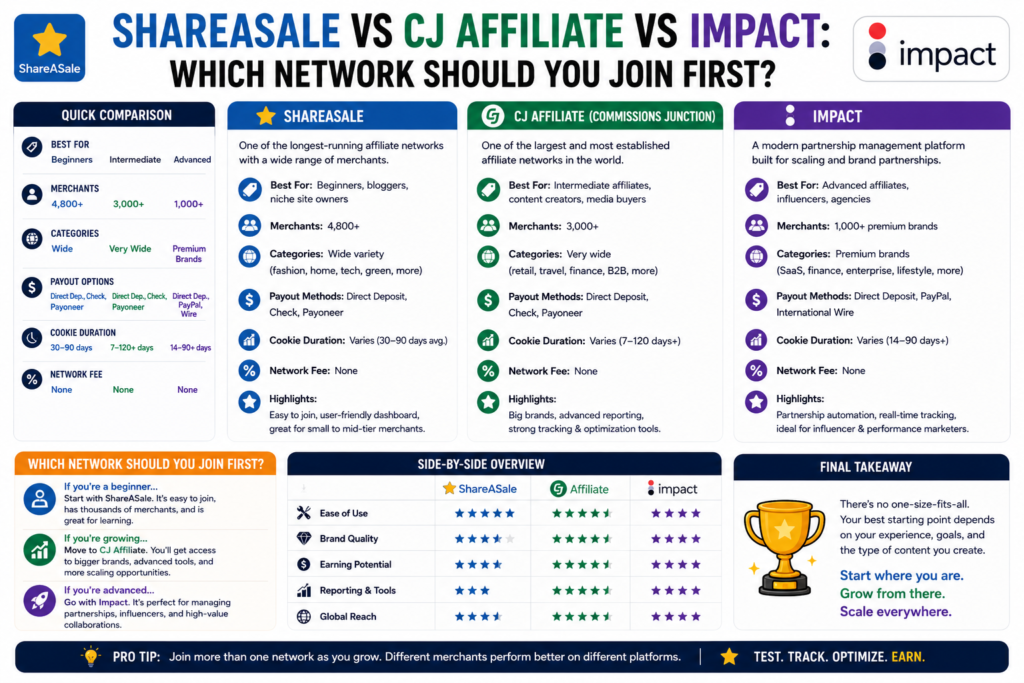
Side-by-Side Comparison
| Factor | ShareASale | CJ Affiliate | Impact |
|---|---|---|---|
| Founded | 2000 | 1998 | 2008 |
| Merchant focus | Small to mid-sized brands | Large, enterprise brands | DTC, SaaS, modern brands |
| Beginner approval difficulty | Easiest | Hardest | Moderate |
| Dashboard quality | Functional but dated | Feature-rich, modern | Most polished, intuitive |
| Minimum payout | $50 | $50 (deposit), $100 (check) | $10 |
| Payment methods | ACH, check, wire, Payoneer | ACH, check, Payoneer | ACH, PayPal, wire, BACS |
| Tracking sophistication | Standard | Advanced, cross-device | Advanced, multi-touch |
| Mobile app | No | No | Yes |
| Best for niches | Niche sites, WordPress, crafts, boutique brands | Travel, retail, finance, enterprise | SaaS, DTC, fintech, subscriptions |
| Merchant program count | 4,000+ | 3,000+ | 3,000+ (growing) |
| API access | Limited | Yes | Yes, well-documented |
Which Network Fits Different Types of Affiliates?
The Brand-New Beginner (0 to 1,000 Monthly Visitors)
Best starting point: ShareASale
When you’re just starting out, you need two things: programs that will actually accept you and a low enough payout threshold to see your first commission check relatively quickly.
ShareASale delivers on both counts. Its large pool of small and mid-sized merchants means more programs with lenient approval criteria. The $50 payout threshold is reachable even with modest commissions. And the variety of niche merchants means you can probably find programs relevant to your content, regardless of how narrow your topic is.
Sign up for Impact as your second network. The $10 minimum payout is motivating, and if your niche involves SaaS tools or modern DTC brands, Impact may have programs ShareASale doesn’t.
Wait on CJ until your site has at least 5,000 to 10,000 monthly visitors and 30+ pieces of published content. You’ll get rejected by most of CJ’s best merchants before that point, and those rejections can be discouraging when you’re already battling the slow early months of building a site.
The Content Creator (Blog, YouTube, or Podcast)
Best starting point: Impact or CJ (depending on niche)
Content creators who already have an audience, even a small one, have more options. If your content focuses on software, tools, apps, or modern brands, Impact is your best match. Many of its merchants actively seek content creators and are willing to work with smaller audiences if the content quality is high.
If your content covers broader consumer topics (travel, fashion, finance, home improvement), CJ’s roster of recognizable brands will give you products your audience already knows and trusts. Promoting a brand people have heard of reduces the selling friction significantly.
Consider joining both Impact and CJ early in your content creation career, then adding ShareASale when you encounter niche brands that aren’t on either platform.
The Niche Site Builder
Best starting point: ShareASale
Niche site builders, people who create focused websites around specific topics like “best standing desks” or “home espresso guides,” need access to the specific brands in their niche. ShareASale’s breadth of small and mid-sized merchants makes it the most likely place to find programs relevant to a narrow topic.
That said, check all three networks for your specific niche before committing. Some niches are better represented on CJ (travel, finance) or Impact (SaaS, DTC) than on ShareASale. The right network is the one that has the merchants you want to promote.
The Influencer or Social Media Marketer
Best starting point: Impact
Impact has invested heavily in attracting influencer-style affiliates. Its platform is designed to manage partnerships, which aligns well with the way influencers work with brands. Many DTC brands on Impact are actively looking for social media promotion and are more open to affiliates who drive traffic through Instagram, TikTok, or YouTube rather than SEO.
Impact’s mobile app is a practical advantage for influencers who manage their business from their phone. And the $10 minimum payout means you get paid quickly even from small campaigns.
CJ is a reasonable second option, especially for influencers in fashion, beauty, or lifestyle niches where CJ’s large retail brands are relevant.
The Advanced Affiliate (Experienced, Multiple Revenue Streams)
Join all three.
Once you’re experienced, limiting yourself to one network means leaving money on the table. The same brand might offer a 10% commission on ShareASale and an 8% commission on CJ, or vice versa. Some brands are only on one network. Advanced affiliates maintain active accounts on all three (and often on additional networks like Rakuten, Awin, PartnerStack, and Amazon Associates) to access every opportunity.
At this stage, the question isn’t which network to join. It’s how to manage multiple networks efficiently. Tracking tools like Affluent, Affiverse, or custom spreadsheets help you monitor performance across platforms without logging into five dashboards every day.
Factors Most Beginners Overlook
Commission Structures Vary Within the Same Network
Two merchants on the same network can have wildly different commission structures. One might pay 5% per sale with a 30-day cookie. Another might pay 20% with a 90-day cookie. A third might pay a flat $50 per lead.
The network doesn’t standardize commissions. Each merchant sets its own terms. This means “which network pays more” is the wrong question. The right question is “which specific merchant programs offer the best commission terms for the products I want to promote.”
Always compare:
- Commission rate (percentage or flat fee per action)
- Cookie duration (how long after a click you still get credit for a sale; ranges from 24 hours to 90+ days)
- Commission type (pay per sale, pay per lead, pay per click, recurring commissions)
- Average order value (a 5% commission on a $500 product is better than a 15% commission on a $30 product)
- Reversal rate (what percentage of commissions get reversed due to returns or fraud; ask the affiliate manager)
Cookie Duration Matters More Than Commission Rate
A 10% commission with a 7-day cookie might earn you less than an 8% commission with a 90-day cookie. Why? Because many buyers don’t purchase immediately. They click your link, browse, leave, and come back three weeks later to buy. With a 7-day cookie, that sale doesn’t count. With a 90-day cookie, it does.
All three networks support various cookie durations, but the specific duration is set by each merchant. Pay attention to this number. It’s one of the most underrated factors in affiliate program selection.
EPC (Earnings Per Click) Is Your Best Comparison Metric
Both CJ and ShareASale display an EPC (earnings per click) metric for each merchant program. This number tells you the average earnings generated per 100 clicks across all affiliates promoting that merchant.
A high EPC suggests the merchant’s offer converts well and pays decently. A low EPC suggests either low commissions, poor conversion rates, or both.
Use EPC as a starting filter when browsing programs. It won’t predict your exact results, but it helps you avoid programs that aren’t performing for anyone.
Impact doesn’t display a public EPC metric in the same way, which makes merchant comparison slightly harder on that platform. You’ll need to rely more on testing and tracking your own performance data.
Affiliate Manager Relationships Matter
Each merchant program has an affiliate manager (sometimes called a partner manager) who oversees the program. A good affiliate manager will:
- Help you understand which products convert best
- Provide exclusive coupon codes or commission bumps
- Share creative assets (banners, images, copy) for your promotions
- Give you early access to sales, launches, and promotions
- Offer higher commission rates for top performers
A bad or absent affiliate manager means you’re on your own, guessing at what works and missing opportunities.
The quality of affiliate management tends to be higher on CJ and Impact compared to ShareASale, simply because the larger brands on those platforms invest more in their affiliate programs. But this varies by merchant, not by network. Some ShareASale merchants have exceptional affiliate managers. Some CJ merchants have absent ones.
When you join a program, introduce yourself to the affiliate manager. A simple email saying who you are, what your site covers, and how you plan to promote their products goes a long way. Affiliate managers prioritize affiliates who communicate and show initiative.
Network Terms of Service Can Bite You
Each network has rules about how you can promote affiliate links. Violating them gets your account suspended and pending commissions forfeited. Common rules to be aware of:
- PPC brand bidding restrictions. Most networks prohibit bidding on a merchant’s brand name in paid search ads unless explicitly allowed.
- Coupon and deal site restrictions. Some merchants don’t allow coupon or deal sites in their programs.
- Social media restrictions. A few programs restrict promotion on specific social platforms.
- Content guidelines. Some programs require that your content meets certain quality standards.
- Cookie stuffing and click fraud. Obviously prohibited, but worth mentioning: any attempt to generate fraudulent clicks or commissions will result in immediate termination and potential legal action.
Read the terms for both the network and each individual merchant program before promoting. It takes five minutes and can save you from losing months of earned commissions.
Making Your Decision: A Practical Framework
If you’ve read this far and still aren’t sure, use this decision tree:
Step 1: Identify five to ten brands you want to promote.
Before picking a network, figure out which specific products and brands fit your content and audience. Write them down.
Step 2: Check which network each brand uses.
Search “[brand name] affiliate program” and see which network hosts it. If most of your target brands are on CJ, join CJ. If they’re on Impact, join Impact. Let your desired merchants drive the network choice, not the other way around.
Step 3: If your target brands are spread across multiple networks (or you’re unsure which brands to promote):
- Under 1,000 monthly visitors: Start with ShareASale. Easier approvals, good variety, and a $50 payout threshold that’s reachable early.
- 1,000 to 10,000 monthly visitors: Start with Impact or CJ. You have enough traffic to get approved by better programs. Choose based on niche alignment.
- Over 10,000 monthly visitors: Apply to all three. You’re at a stage where maximizing your options matters more than simplifying your setup.
Step 4: Apply to your top five merchant programs within your chosen network.
Don’t apply to 50 programs on day one. Pick five that are directly relevant to your content. Focus your energy on getting approved and promoting those well.
Step 5: After 90 days, evaluate and expand.
Which programs generated commissions? Which ones had good affiliate managers? What products resonated with your audience? Use those answers to decide whether to deepen your presence on your current network or expand to a second one.
Setting Up Your Account for Success
Regardless of which network you choose, these steps give you the best chance of getting approved and earning commissions early.
Before you apply:
- Make sure your website has at least 10 to 15 published pieces of quality content
- Have a clear About page that explains who you are and what your site covers
- Include a Privacy Policy and Disclosure page (FTC compliance is non-negotiable)
- Make sure your site looks professional: clean design, fast loading, no broken pages
- Have an active social media presence linked from your site (even a small one signals legitimacy)
On your application:
- Be specific about how you’ll promote products (blog reviews, comparison posts, email recommendations, YouTube videos)
- Mention your traffic sources honestly. Don’t inflate numbers.
- If you have existing traffic data, include it
- Write a brief description of your audience and why they’d be interested in the merchant’s products
- If your traffic is low, emphasize your content quality and growth trajectory rather than current numbers
After approval:
- Introduce yourself to each merchant’s affiliate manager
- Start with one to two products and create thorough, genuine content around them
- Test different link placements (within content, sidebar, resource pages) to see what drives clicks
- Track your clicks and conversions from the first day. Don’t fly blind.
- Set a 30-day review: check which merchants are generating clicks and which ones are dead weight
The Overlap Question: Can You Join Multiple Networks?
Yes. There’s no exclusivity requirement on any of these networks. You can (and eventually should) have active accounts on all three, plus others.
The case for starting with one:
- You learn the interface, tools, and merchant relationships deeply
- You avoid the confusion of managing multiple dashboards when you’re still learning fundamentals
- You concentrate your promotional efforts, which makes early results more likely
- You develop a workflow that you can replicate on other networks later
The case for joining two early:
- Some of your target brands might be on different networks
- Having a backup means you’re not stuck if one network’s merchant rejects you
- You can compare commission rates for brands that exist on multiple networks
A reasonable approach: join your primary network now. Join a second one within 30 to 60 days. Add the third after your first 90 days of affiliate marketing, once you understand the basics and have some performance data to guide your decisions.
Beyond the Big Three: Networks Worth Knowing About
While ShareASale, CJ, and Impact are the three most commonly compared networks, they’re not the only options. A few others deserve mention:
Amazon Associates. The largest e-commerce affiliate program. Nearly every physical product you can think of is on Amazon. Commission rates are low (1% to 5% depending on category) and cookie duration is only 24 hours, but Amazon’s massive brand trust and high conversion rates make it a staple for many affiliates. Join this alongside whichever network you choose.
Rakuten Advertising. Another major network with strong representation among large retailers, particularly in fashion, department stores, and consumer brands. Similar to CJ in its merchant profile but with a smaller overall roster.
PartnerStack. Focused almost exclusively on SaaS and B2B software. If your niche is business tools, project management, marketing software, or developer tools, PartnerStack has programs that don’t exist on the other networks. Many programs offer recurring commissions.
Awin. ShareASale’s parent company, with a stronger presence in European and international markets. If your audience is global or European-focused, Awin may have merchants that the US-centric networks don’t.
Individual brand affiliate programs. Some brands run their affiliate programs independently, without any network. These are often managed through platforms like Refersion, Tapfiliate, or custom-built systems. The application process is usually direct through the brand’s website. These programs sometimes offer higher commissions than network-based programs because the brand saves on network fees.
What Success Looks Like in Your First 90 Days
Setting realistic expectations prevents the disappointment that causes most beginners to quit.
Days 1 to 30:
- Network account approved
- Applied to five to ten merchant programs
- Approved by at least two to three
- Published three to five pieces of content with affiliate links
- Generated your first clicks (even if no commissions yet)
Days 31 to 60:
- Earning your first commissions (even if they’re small, single-digit amounts)
- Data showing which content formats and products generate the most clicks
- Communication established with at least one affiliate manager
- Applied to additional merchant programs based on what you’ve learned about your audience
Days 61 to 90:
- Consistent clicks and occasional commissions from your top-performing content
- Clear understanding of which products and content angles your audience responds to
- First payout received (or close to the minimum threshold)
- A content plan for the next quarter based on actual performance data
- Decision made about whether to add a second network
These milestones aren’t about hitting specific dollar amounts. They’re about building the foundation, creating content, generating data, and learning the mechanics of affiliate marketing through real experience.
The affiliates who earn significant income didn’t get there by choosing the perfect network on day one. They got there by choosing a network, creating content consistently, paying attention to what worked, and refining their approach month after month.
What niche are you building your affiliate content around, and which five brands in that space would you most want to partner with? Answering that question will tell you more about which network to join than any comparison article ever could.