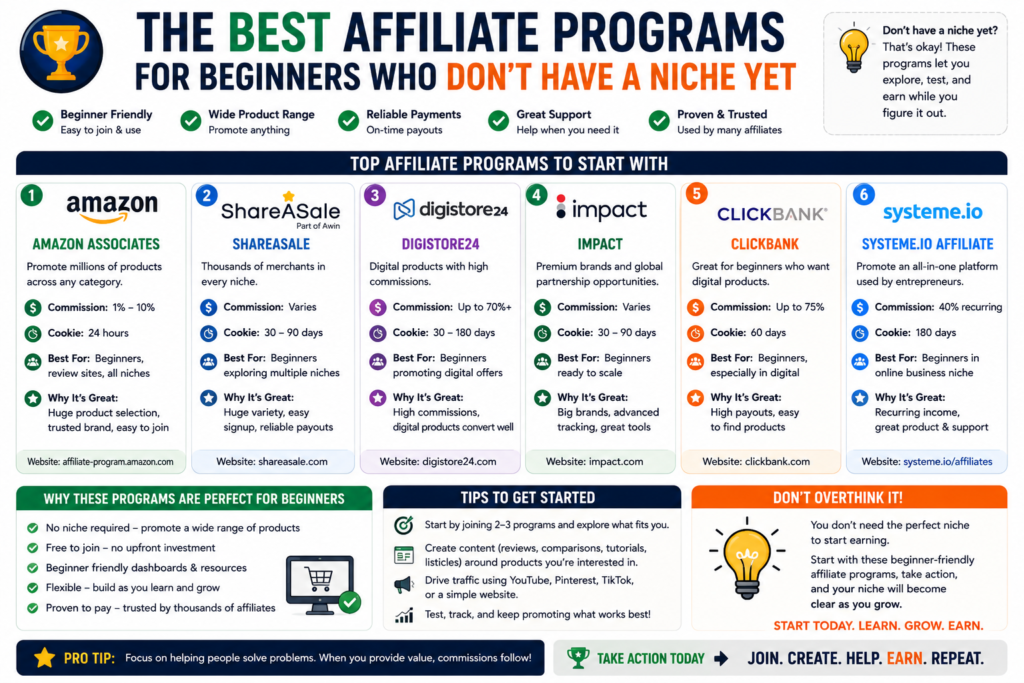
Here’s the scenario most beginner affiliate marketers find themselves in.
You’ve read the guides. You’ve watched the YouTube videos. You understand that affiliate marketing means recommending products, earning commissions, and building passive income over time. You’re ready to start.
But every piece of advice begins with the same instruction: “First, pick your niche.”
And that’s where you stall.
Maybe you have too many interests and can’t commit to one. Maybe you have no idea what you’d want to create content about for the next 2 to 3 years. Maybe you’re worried about choosing a niche with low demand or too much competition. Or maybe you just want to test the waters and earn your first commissions before locking yourself into a topic.
Whatever the reason, not having a niche yet shouldn’t stop you from starting affiliate marketing. There are programs specifically built to work across dozens of categories, products everyone buys regardless of niche, and platforms flexible enough to let you experiment until you find your direction.
This article covers the best affiliate programs for that exact situation: programs that let you start earning while you figure out where you want to land.
Why Most Beginners Get Stuck on the Niche Question
The niche paralysis problem is real, and it’s worth understanding why it happens before jumping into program recommendations.
The “forever decision” pressure.
Most affiliate marketing advice frames niche selection as a permanent, irreversible choice. “Pick the wrong niche and you’ll waste months of work.” That kind of framing makes the decision feel heavier than it actually is. The truth is, many successful affiliate marketers pivoted two or three times before finding their sweet spot. Your first niche doesn’t need to be your final one.
Too many options, not enough data.
When you’re new, you don’t have real-world data about what content you enjoy creating, what audiences respond to, or what products actually convert. Choosing a niche based purely on research and guesswork is like choosing a career based solely on reading job descriptions. Sometimes you need to try a few things to discover what fits.
The profitability trap.
Beginners often try to pick the “most profitable” niche (finance, tech, health) without considering whether they have genuine knowledge or interest in those topics. High commission rates don’t help if you can’t produce content that’s credible enough for people to trust your recommendations.
The solution: start with flexible programs.
Instead of waiting until you’ve identified the perfect niche, start with affiliate programs that work across multiple topics. Create content about different interests, see what gains traction, and let your niche emerge from real performance data rather than hypothetical planning.
What Makes an Affiliate Program Good for Beginners Without a Niche
Not every program fits this situation. The ones that work best share these characteristics:
Broad product catalogs. Programs that sell thousands of products across dozens of categories let you promote whatever matches your current content, even if that content shifts topics from week to week.
Low or no approval barriers. Some programs require an established website, a minimum traffic threshold, or niche-specific content to get accepted. Beginners need programs that let you in the door without a proven track record.
Recognizable brands. When you’re new and haven’t built personal credibility yet, attaching your recommendations to brands your audience already knows and trusts helps bridge the trust gap.
Simple link creation tools. Complicated dashboards and confusing tracking systems slow beginners down. The best starter programs have intuitive interfaces that let you generate links quickly and understand your performance data without a learning curve.
Reasonable cookie windows. Longer cookie durations give you more time to earn credit for purchases, which matters when you’re still learning how to optimize your content for conversions.
The Best Affiliate Programs for Beginners Without a Niche
1. Amazon Associates
What it is: Amazon’s affiliate program, the largest in the world by product volume.
Why it works without a niche:
Amazon sells literally everything. Books, electronics, kitchen tools, pet supplies, outdoor gear, fashion, supplements, home decor, office supplies, and millions of other products. Whatever content you’re creating today, there’s a relevant Amazon product you can link to.
Writing a post about productivity tips? Link to the planner, desk lamp, and noise-canceling headphones you mention. Creating a video about your morning routine? Every product in that routine is on Amazon. Sharing a book recommendation on social media? That’s an Amazon affiliate link.
The breadth of Amazon’s catalog means you never have to force a product recommendation. You can match products to whatever topic you’re covering at the moment.
Commission rates: 1% to 20%, depending on category. Most physical product categories fall between 1% and 4.5%.
Cookie window: 24 hours (89 days if the customer adds an item to their cart within the initial 24-hour window).
Minimum payout: $10 for direct deposit or gift card.
How to get started: Apply at affiliate-program.amazon.com. You’ll need to generate 3 qualifying sales within 180 days of approval to keep your account active. Apply only after you have some published content and at least a small audience.
Best for: Any type of content that references physical products, books, or Amazon services. Particularly strong for product review blogs, YouTube channels, and Pinterest content.
Limitations: Low commission rates on most categories. The 24-hour cookie is one of the shortest in the industry. Amazon can change commission rates at any time (and has cut them multiple times in the past).
2. ShareASale
What it is: An affiliate network that hosts programs from thousands of different brands and merchants, spanning nearly every product and service category.
Why it works without a niche:
ShareASale isn’t a single affiliate program. It’s a marketplace of over 16,000 merchant programs. Once you create a ShareASale account, you can browse and apply to individual programs within the network across categories like fashion, home and garden, technology, business services, food and drink, fitness, education, and dozens more.
This structure is ideal for beginners without a niche because you can join programs in multiple categories simultaneously. If you write about fitness this month and cooking next month, you can find relevant affiliate programs for both without opening separate accounts on different platforms.
Commission rates: Vary by merchant. Anywhere from 2% to 50%+ depending on the program. Many merchants offer flat-rate commissions ($5, $10, $50 per sale or lead).
Cookie window: Varies by merchant, typically 30 to 90 days.
Minimum payout: $50.
How to get started: Sign up at shareasale.com. You’ll need a website or content platform. Once approved for the network, you browse individual merchant programs and apply to each one separately. Some approve instantly; others review your application manually.
Best for: Bloggers and content creators who want access to a wide range of brands. ShareASale has strong representation in fashion (Reebok, Warby Parker), home goods, software, and online services.
Limitations: The dashboard interface feels dated compared to newer platforms. Some high-quality merchant programs have stricter approval requirements. Managing multiple programs within the network requires some organizational effort.
3. CJ Affiliate (formerly Commission Junction)
What it is: One of the oldest and largest affiliate networks, hosting programs from major global brands.
Why it works without a niche:
CJ Affiliate gives you access to affiliate programs from enterprise-level brands across every category: travel (Hotels.com, Priceline), retail (GoPro, Under Armour, Overstock), finance (credit card offers, insurance), technology (Grammarly, Norton), and hundreds more.
For beginners testing different content directions, CJ Affiliate provides a single platform where you can promote a travel product in one piece of content and a tech product in another, all tracked through the same dashboard.
Commission rates: Vary by advertiser. Range from a few percent on physical products to $50 to $200+ for financial and software signups.
Cookie window: Set by individual advertisers, typically 7 to 45 days.
Minimum payout: $50 for direct deposit, $100 for check.
How to get started: Sign up at cj.com. You’ll need an active website or content platform. CJ reviews your application, and individual advertisers within the network may have their own approval processes.
Best for: Creators with an audience large enough to attract brand-name advertisers. CJ Affiliate tends to work best once you have some established traffic, but smaller creators can still get approved by many merchants.
Limitations: Some of the biggest brand programs on CJ require significant traffic or content history to get approved. The platform has a learning curve for new users. Performance reporting can feel complex at first.
4. Impact
What it is: A modern affiliate and partnership platform used by many DTC (direct-to-consumer) and SaaS brands.
Why it works without a niche:
Impact hosts affiliate programs for brands like Canva, Hostinger, Adidas, Levi’s, Lenovo, Uber, Airbnb, and many others. The range of brands spans tech, travel, fashion, fitness, productivity, education, and lifestyle.
What makes Impact particularly good for beginners is the clean, modern interface. The dashboard is intuitive, link creation is straightforward, and performance tracking is easy to understand. If you’ve been intimidated by the clunky interfaces of older affiliate networks, Impact feels refreshingly simple.
Commission rates: Vary by brand. Software and service programs often pay 20% to 50%. Physical product brands typically pay 5% to 15%.
Cookie window: Varies by brand, often 30 days.
Minimum payout: $10 (varies by brand and payment method).
How to get started: Sign up at impact.com. You can search for individual brand programs through their marketplace and apply. Many programs accept new creators with smaller audiences.
Best for: Creators interested in promoting a mix of software, DTC products, and service-based brands. The platform is strong for tech, productivity, and lifestyle content.
Limitations: Not every brand program on Impact accepts beginners. Some programs have traffic or content requirements. The discovery process (finding which brands use Impact) can require some digging.
5. Rakuten Advertising
What it is: A global affiliate network connected to major retail brands, with particular strength in fashion, luxury, and lifestyle categories.
Why it works without a niche:
Rakuten partners with brands like Walmart, Macy’s, New Balance, Sephora, Virgin Holidays, and many others. If your content leans toward fashion, beauty, travel, or mainstream retail, Rakuten gives you access to established brands your audience already shops with.
The network is smaller than ShareASale or CJ Affiliate in terms of total merchants, but the quality of brands tends to be high. For beginners who want to promote recognizable names (which helps with conversion when you don’t have personal brand authority yet), Rakuten is a solid option.
Commission rates: Vary by merchant, typically 2% to 10% for retail. Higher for certain categories and promotional periods.
Cookie window: Varies by merchant, typically 7 to 30 days.
Minimum payout: $50.
How to get started: Apply at rakutenadvertising.com. The approval process considers your website or content platform, and individual merchants may have separate approval steps.
Best for: Content creators in fashion, beauty, lifestyle, and mainstream consumer categories. Works well for social media creators and bloggers who cover retail products.
Limitations: Smaller merchant selection compared to ShareASale or CJ. Some brands have slower approval processes. Payout schedules can be less frequent than other networks.
6. ClickBank
What it is: An affiliate marketplace focused primarily on digital products: online courses, ebooks, software, and subscription services.
Why it works without a niche:
ClickBank’s marketplace covers hundreds of categories: health and fitness, self-help, education, business and marketing, cooking, relationships, finance, hobbies, and more. The products are digital, which means high commission rates (often 30% to 75%) because there’s no physical inventory cost.
For beginners, ClickBank has one of the lowest barriers to entry. You don’t need a website to sign up. You don’t need to be approved by individual merchants. You can browse the marketplace, grab an affiliate link, and start promoting immediately.
The trade-off is product quality. ClickBank’s marketplace includes excellent products alongside questionable ones. You’ll need to evaluate products before promoting them to protect your credibility.
Commission rates: Typically 30% to 75%. Some products pay recurring commissions on subscription renewals.
Cookie window: 60 days (set by the vendor, but 60 days is the default and most common).
Minimum payout: $10.
How to get started: Sign up at clickbank.com. No website required. You can start promoting products immediately after account creation.
Best for: Beginners who want to earn higher commissions per sale and are comfortable promoting digital products. Works well for social media promotion, email marketing, and content that addresses specific problems (weight loss, productivity, learning a skill).
Limitations: Product quality varies significantly. Some products have aggressive sales pages that can reflect poorly on you if the customer feels misled. The marketplace interface is dated. Research each product carefully before promoting.
7. Awin
What it is: A global affiliate network with over 25,000 advertiser programs spanning retail, travel, finance, telecom, and more.
Why it works without a niche:
Awin gives you access to a massive range of brands across multiple sectors. Retailers like Etsy, HP, and StubHub sit alongside telecom providers, insurance companies, and travel brands. This breadth makes Awin useful for creators who are still exploring different content directions.
Awin acquired ShareASale in 2017, so the two networks share some overlap, but they maintain separate platforms and separate merchant rosters. Having accounts on both gives you the widest possible range of program options.
Commission rates: Vary by advertiser, from a few percent to $100+ per sale depending on the category.
Cookie window: Typically 30 days, varies by advertiser.
Minimum payout: $20.
How to get started: Apply at awin.com. Awin charges a $5 refundable deposit on signup (refunded with your first payment). You’ll need an active website or social media presence.
Best for: Creators with a global audience (Awin has strong international brand representation). Good for content that crosses multiple categories including retail, travel, and services.
Limitations: The $5 signup deposit (even though refundable) can feel off-putting to beginners. Some advertisers have slow approval times. The interface takes time to learn.
8. Skimlinks
What it is: A tool that automatically converts regular product links in your content into affiliate links, connecting you to over 48,500 merchant programs without applying to each one individually.
Why it works without a niche:
Skimlinks is different from traditional affiliate programs. Instead of browsing a marketplace and applying to individual brands, you install Skimlinks on your website and it automatically affiliates your existing product links. Mention a product from any of the 48,500+ supported merchants, link to it naturally, and Skimlinks turns that link into a commission-earning affiliate link behind the scenes.
For beginners without a niche, this is powerful. You don’t need to decide in advance which products or brands to promote. You just write your content, include normal product links, and Skimlinks handles the monetization. If you write about cooking today and tech tomorrow, Skimlinks finds the affiliate program for both.
Commission rates: Skimlinks takes a 25% cut of commissions (so if a merchant pays 10%, you receive 7.5%). Rates vary by merchant.
Cookie window: Depends on the individual merchant program.
Minimum payout: $10.
How to get started: Sign up at skimlinks.com and install their JavaScript snippet on your website. They review your site before approval.
Best for: Bloggers who mention products frequently and want passive affiliate monetization without managing individual programs. Strong for lifestyle, product review, and editorial content sites.
Limitations: Skimlinks takes a 25% cut of your commissions, which reduces your per-sale earnings compared to going direct. You have less control over which affiliate programs your links connect to. Requires a website (doesn’t work for social-media-only creators). Some affiliate programs offer higher commissions when you join directly rather than through an aggregator.
9. FlexOffers
What it is: An affiliate network with over 12,000 advertiser programs across mainstream and niche categories.
Why it works without a niche:
FlexOffers provides a wide range of merchant programs similar to ShareASale and CJ, but with a reputation for being more welcoming to newer affiliates. The network spans categories including retail, financial services, health and wellness, education, entertainment, travel, insurance, and lifestyle.
FlexOffers provides “FlexLinks,” a feature similar to Skimlinks that automatically converts product mentions on your site into affiliate links. This hands-off monetization approach works well for beginners who are still experimenting with content topics.
Commission rates: Vary by merchant, ranging from a few percent to $100+ for financial and insurance leads.
Cookie window: Varies by merchant, typically 30 days.
Minimum payout: $50.
How to get started: Apply at flexoffers.com. You’ll need an active website or content platform.
Best for: Beginners who want access to a wide merchant selection with a more beginner-friendly approval process than CJ or Rakuten. Good for content creators covering lifestyle, finance, health, or consumer products.
Limitations: Some merchants pay on a net-60 or net-90 basis, meaning longer waits for payment. The dashboard interface is functional but not the most polished. Some high-value programs still require content history to get approved.
10. The Amazon Influencer Program
What it is: An extension of Amazon Associates designed specifically for social media creators, offering a personalized Amazon storefront and product curation tools.
Why it works without a niche:
If you’re primarily active on social media rather than running a blog, the Amazon Influencer Program gives you a custom Amazon storefront (amazon.com/shop/yourname) where you can curate product recommendations organized by category.
You can create different lists for different interests: “My Favorite Books,” “Home Office Setup,” “Kitchen Gadgets I Use,” “Fitness Equipment.” Each list can cover a different topic, making this program ideal for multi-interest creators who haven’t settled on a single niche.
The Influencer Program pays the same commission rates as standard Amazon Associates, but the storefront format gives your audience a browsable, shoppable experience rather than individual product links scattered across your content.
Commission rates: Same as Amazon Associates (1% to 20% by category).
Cookie window: 24 hours.
How to get started: Apply through the Amazon Influencer Program page. Amazon evaluates your social media following, engagement, and content quality. The program is available for YouTube, Instagram, Facebook, and TikTok creators.
Best for: Social media creators with an engaged following who recommend products across multiple categories. Works well for creators who post “haul” videos, “favorites” lists, or lifestyle content.
Limitations: Requires an established social media presence for approval. Same low commission rates and short cookie window as standard Amazon Associates. Relies entirely on Amazon’s ecosystem.
How to Use These Programs While You Find Your Niche
Signing up for programs is the easy part. Here’s how to use them strategically to both earn commissions and discover your niche at the same time.
Start With 2 to 3 Programs, Not 10
Resist the urge to sign up for everything. Managing too many affiliate dashboards as a beginner creates confusion and dilutes your focus. Start with:
- Amazon Associates (for physical product links across any topic)
- One affiliate network (ShareASale or Impact, for access to brand-specific programs)
- One specialty program (ClickBank for digital products, or the Amazon Influencer Program if you’re social-media-focused)
This combination gives you coverage across physical products, digital products, and branded partnerships without overwhelming you with accounts to manage.
Create Content Around Your Genuine Interests
The fastest way to discover your niche is to create content about the things you already spend time on. Don’t force yourself to write about “profitable” topics you find boring. Create content about:
- Products you already own and have opinions about
- Hobbies you actively participate in
- Problems you’ve recently solved (and the products that helped)
- Skills you’re currently learning
- Purchases you’ve made recently that you’d recommend to a friend
Sprinkle in relevant affiliate links where they fit naturally. Over 4 to 8 weeks, you’ll notice patterns: which topics generate the most engagement, which types of content you enjoy creating, and which product categories generate the most clicks and commissions.
Track Everything From Day One
Set up a simple spreadsheet tracking:
- What topic each piece of content covers
- Which affiliate links you included
- How many clicks each link generated
- Which links resulted in sales
- How much commission each sale earned
- Which content format performed best (blog post, video, social media post)
After 30 to 60 days, this data will tell you more about your ideal niche than any amount of theoretical research. If your cooking content consistently outperforms your tech content in both engagement and affiliate clicks, that’s a strong signal about where your niche might be.
Let the Data Guide Your Niche Decision
Your niche should sit at the intersection of three factors:
- What you enjoy creating content about. You’ll need to produce content consistently for months or years. If you dread creating it, you’ll burn out.
- What your audience responds to. Engagement metrics (comments, shares, saves, watch time) tell you what resonates with real people.
- What generates affiliate revenue. Clicks and conversions tell you which products your audience is willing to buy based on your recommendations.
A topic that scores high on all three is your niche. A topic that you love but nobody engages with isn’t viable. A topic that gets engagement but never converts into sales needs a different monetization strategy. And a topic that converts well but you hate creating content about will lead to burnout within months.
The beauty of starting with broad affiliate programs is that you can test multiple topics simultaneously and let real performance data make the decision for you.
What to Look for When You’re Ready to Specialize
Once you’ve identified your direction (usually after 2 to 6 months of experimenting), you can start adding niche-specific affiliate programs that pay higher commissions than the general programs you started with.
Signs you’re ready to specialize:
- One content topic consistently outperforms others in engagement and affiliate clicks
- You’ve developed genuine expertise and credibility in that area
- You find yourself naturally gravitating toward creating content about that topic
- Your audience is asking you for more recommendations in that specific category
- You can envision creating 100+ pieces of content about the topic without running out of ideas
How to find niche-specific programs:
- Search “[your niche] affiliate program” on Google
- Check the websites of brands you already recommend (look for “Affiliate” or “Partner Program” links in the footer)
- Browse affiliate networks (ShareASale, CJ, Impact) filtered by your niche category
- Ask other creators in your niche which programs they use
- Look at the product pages of items you promote on Amazon and check whether the brand runs its own higher-commission affiliate program
When you find niche-specific programs with better terms than your general programs, gradually shift your top-performing content to the higher-commission links. Keep your general programs active for products and categories not covered by your niche-specific partnerships.
A Realistic Timeline for Beginners
Month 1: Setup and Experimentation
- Sign up for 2 to 3 beginner-friendly affiliate programs
- Publish 8 to 12 pieces of content across different topics you’re interested in
- Include affiliate links where they fit naturally
- Set up basic tracking
- Realistic earnings: $0 to $20
Month 2 to 3: Pattern Recognition
- Continue creating content (aim for 3 to 4 pieces per week)
- Review your tracking data to see which topics and products generate clicks
- Double down on content that’s getting traction
- Engage with your audience to learn what they want more of
- Realistic earnings: $10 to $75/month
Month 4 to 6: Narrowing Focus
- You should start seeing clear patterns in what works
- Begin focusing 70% of your content on your strongest 1 to 2 topic areas
- Apply to niche-specific affiliate programs with better commission rates
- Start building an email list to capture your audience outside of social platforms
- Realistic earnings: $50 to $300/month
Month 7 to 12: Niche Commitment
- Commit to your niche based on real data
- Shift your primary affiliate partnerships to higher-commission niche programs
- Keep Amazon Associates and one general network for supplementary product links
- Create a content calendar focused on your niche with strategic affiliate integration
- Realistic earnings: $200 to $1,500/month
These numbers assume consistent effort, decent content quality, and a topic area with genuine audience demand. Some beginners will exceed these ranges; others will fall below them. The variable that matters most is consistency. Publishing regularly, improving your content based on feedback, and staying patient through the slow early months.
Mistakes Beginners Make When Choosing Affiliate Programs
Chasing the highest commission rates.
A program offering 75% commission sounds amazing until you realize the product costs $9, has a terrible sales page, and nobody’s heard of the brand. A 3% commission on a trusted $200 product from a recognizable brand often earns more in practice because the conversion rate is dramatically higher.
Joining too many programs at once.
Every affiliate network has a different dashboard, different link formats, different payment schedules, and different reporting. Managing 8 programs simultaneously when you’re still learning the basics creates chaos. Start lean and expand gradually.
Ignoring the product quality.
Your reputation is the most valuable asset you have as an affiliate marketer. Recommending a product that disappoints your audience damages that reputation. Before promoting anything, ask yourself: “Would I genuinely recommend this to a close friend?” If the answer isn’t a confident yes, skip it.
Not reading the terms of service.
Each affiliate program has rules about how and where you can use their links. Amazon prohibits displaying prices in your content. Some programs don’t allow email promotion. Others restrict paid advertising. Violating terms you didn’t bother reading can result in account closure and forfeited commissions.
Waiting for the “perfect” program.
No affiliate program is perfect. Every one has trade-offs between commission rates, cookie windows, product selection, and brand recognition. Starting with a good-enough program today beats waiting for the ideal program that may not exist. You can always switch or add programs later.
Focusing on programs instead of content.
The affiliate program you choose matters far less than the quality and quantity of content you produce. A mediocre program promoted through excellent content will always outperform an excellent program promoted through mediocre content. Spend 90% of your energy on creating content that genuinely helps your audience and 10% on optimizing your affiliate program strategy.
Building Beyond Your First Programs
As your affiliate marketing skills develop, you’ll naturally outgrow some beginner programs and graduate to more sophisticated partnerships. Here’s what that progression typically looks like:
Stage 1 (Months 1 to 6): General programs.
Amazon Associates, ShareASale, ClickBank. You’re learning the mechanics of affiliate marketing and discovering what products and topics resonate with your audience.
Stage 2 (Months 6 to 12): Niche programs.
Direct brand partnerships, niche-specific affiliate networks, higher-commission programs in your focus area. You’re earning more per sale and building relationships with specific brands.
Stage 3 (Year 1 to 2): Diversified income.
Multiple affiliate programs, display advertising, sponsored content, digital products (ebooks, courses, templates), and an email list generating consistent revenue. Affiliate commissions are one piece of a larger income puzzle.
Stage 4 (Year 2+): Strategic partnerships.
Negotiated commission rates with top-performing brands, exclusive deals and discount codes for your audience, brand ambassador relationships, and product co-creation opportunities. You’ve built enough authority and traffic to command premium terms.
Not every affiliate marketer reaches Stage 4, and that’s fine. Many people build comfortable side incomes at Stage 2 or Stage 3. The point is that your first affiliate programs are a starting point, not a permanent destination. They exist to get you moving, earning, and learning while you figure out where you’re headed.
The best time to pick your niche was six months ago. The second-best time is after you’ve spent a few months creating content, testing different topics, and letting real audience data show you where to focus.
Sign up for a couple of programs from this list. Start creating content about the things you genuinely care about. Include affiliate links where they make sense. Pay attention to what works.
Your niche will find you. These programs will make sure you’re earning while it does.