Introduction
Copywriting is one of the most powerful skills in marketing and business. Every advertisement, sales page, email campaign, product description, and landing page relies on effective copywriting to persuade readers to take action.
Unlike content writing, which focuses primarily on educating and informing, copywriting is designed to influence behavior. Its purpose is to encourage readers to buy a product, subscribe to a service, join an email list, request a consultation, or complete another desired action.
In today’s competitive digital marketplace, strong copywriting can significantly impact brand awareness, customer engagement, lead generation, and sales performance. This guide explores the fundamentals of copywriting, proven persuasion techniques, and practical strategies for creating high-converting marketing content.
What Is Copywriting?
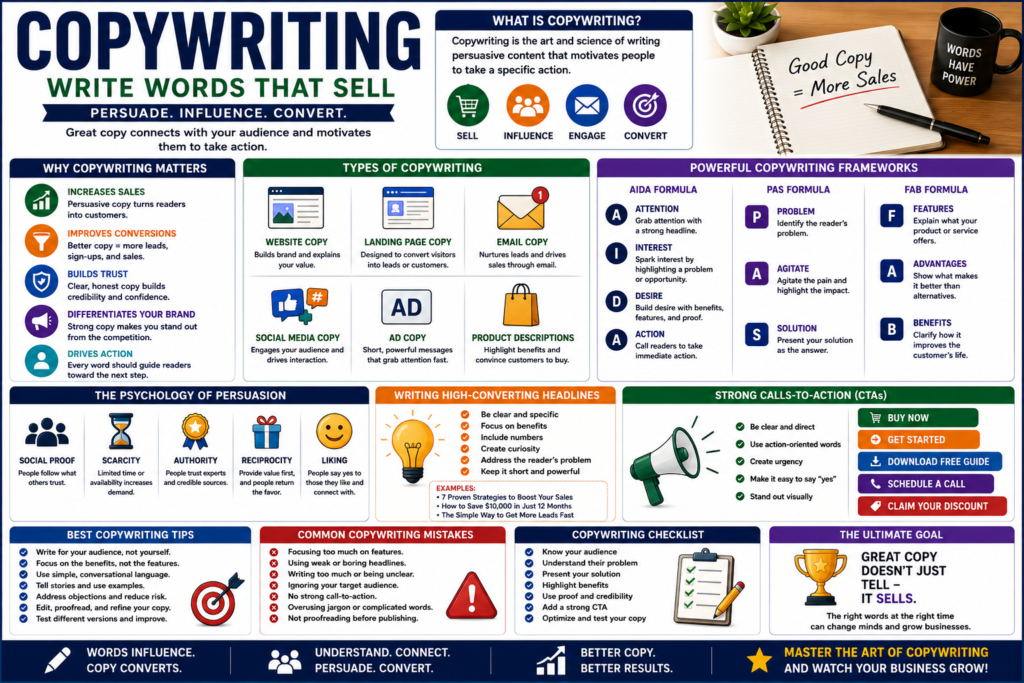
Copywriting is the art and science of writing persuasive text that motivates people to take a specific action.
Common copywriting goals include:
- Generating sales
- Increasing conversions
- Building brand awareness
- Growing email lists
- Driving website traffic
- Encouraging inquiries
- Promoting products and services
The written content created by copywriters is commonly known as “copy.”
Why Copywriting Matters
Effective copywriting can have a significant impact on business success.
Increases Sales
Persuasive copy helps customers understand benefits and make purchasing decisions.
Improves Conversions
Well-written copy encourages visitors to complete desired actions.
Builds Trust
Clear and credible messaging strengthens customer confidence.
Differentiates Brands
Strong copy helps businesses stand out in competitive markets.
Enhances Customer Engagement
Compelling messaging captures attention and encourages interaction.
Copywriting vs. Content Writing
Although related, copywriting and content writing serve different purposes.
Content Writing
Focuses on:
- Education
- Information
- Search engine optimization
- Audience engagement
Examples:
- Blog posts
- Guides
- Articles
- Tutorials
Copywriting
Focuses on:
- Persuasion
- Conversion
- Sales
- Action
Examples:
- Sales pages
- Advertisements
- Landing pages
- Email campaigns
Many successful marketers use both disciplines together.
Types of Copywriting
Website Copywriting
Website copy explains:
- Products
- Services
- Company benefits
- Brand value
Effective website copy guides visitors through the customer journey.
Landing Page Copywriting
Landing pages are designed to achieve a specific conversion goal.
Examples include:
- Lead generation
- Product purchases
- Webinar registrations
Email Copywriting
Email marketing remains one of the highest-performing marketing channels.
Common email types:
- Promotional emails
- Welcome sequences
- Sales campaigns
- Newsletters
Social Media Copywriting
Social media copy must:
- Capture attention quickly
- Encourage engagement
- Drive traffic
Advertising Copywriting
Advertisements require concise and persuasive messaging.
Examples include:
- Google Ads
- Facebook Ads
- Display Ads
- Print Advertisements
Product Description Copywriting
Effective product descriptions focus on:
- Benefits
- Features
- Customer outcomes
Strong descriptions help improve sales performance.
Understanding Your Target Audience
Great copy begins with audience research.
Ask questions such as:
- Who is the customer?
- What problems do they face?
- What goals do they have?
- What motivates their decisions?
- What objections might they have?
The better you understand your audience, the more persuasive your copy becomes.
The Psychology of Persuasion
Successful copywriting often relies on psychological principles.
Social Proof
People trust recommendations from others.
Examples include:
- Testimonials
- Reviews
- Case studies
Scarcity
Limited availability can encourage faster decision-making.
Examples:
- Limited-time offers
- Exclusive access
- Limited inventory
Authority
Expertise builds trust and credibility.
Examples:
- Certifications
- Awards
- Industry recognition
Reciprocity
Providing value encourages people to respond positively.
Examples:
- Free guides
- Free consultations
- Educational content
Essential Copywriting Frameworks
AIDA Formula
One of the most popular copywriting frameworks:
Attention
Capture interest immediately.
Interest
Introduce a problem or opportunity.
Desire
Explain benefits and outcomes.
Action
Encourage the reader to take the next step.
PAS Formula
Problem
Identify the reader’s challenge.
Agitate
Highlight the consequences.
Solution
Present the product or service as the answer.
FAB Formula
Features
What the product offers.
Advantages
Why the feature matters.
Benefits
How the customer gains value.
Writing High-Converting Headlines
Headlines determine whether readers continue reading.
Strong headlines often:
- Address problems
- Offer solutions
- Promise benefits
- Create curiosity
- Include numbers
Examples:
- 10 Proven Ways to Increase Sales
- How to Save Money Without Sacrificing Lifestyle
- The Ultimate Guide to Financial Freedom
A compelling headline can dramatically improve engagement.
Writing Effective Calls-to-Action
Calls-to-action (CTAs) tell readers what to do next.
Examples include:
- Buy Now
- Get Started
- Download Free Guide
- Schedule a Consultation
- Request a Demo
Strong CTAs are:
- Clear
- Specific
- Action-oriented
Best Copywriting Tips
Focus on Benefits
Customers care more about outcomes than features.
Instead of:
“Includes a 500GB hard drive.”
Write:
“Store thousands of files without worrying about space.”
Use Simple Language
Clear communication improves understanding and conversion rates.
Write Conversationally
Engaging copy feels natural and personal.
Address Objections
Anticipate concerns and provide reassurance.
Use Emotion
Many purchasing decisions are influenced by emotions.
Create Urgency
Encourage timely action when appropriate.
Common Copywriting Mistakes
Avoid these frequent errors:
Focusing Too Much on Features
Benefits drive purchasing decisions.
Weak Headlines
Poor headlines reduce engagement.
Overcomplicated Language
Complex wording creates confusion.
Lack of Audience Research
Effective copy requires understanding customer needs.
Weak Calls-to-Action
Readers need clear direction.
Excessive Self-Promotion
Focus on customer outcomes rather than company achievements.
SEO and Copywriting
Modern copywriting often includes SEO optimization.
Best practices include:
- Natural keyword placement
- Optimized headings
- Meta descriptions
- Internal linking
- User-focused content
SEO copywriting balances search visibility with persuasion.
Skills Every Copywriter Should Develop
Successful copywriters often excel in:
- Research
- Consumer psychology
- Storytelling
- Marketing strategy
- Editing
- SEO fundamentals
Continuous learning improves writing effectiveness.
Future of Copywriting
The copywriting industry continues to evolve through:
- AI-assisted writing tools
- Personalization technologies
- Voice search optimization
- Interactive marketing experiences
Despite technological advances, human creativity and persuasion remain essential.
Conclusion
Copywriting is one of the most valuable skills for businesses, marketers, entrepreneurs, and freelancers. Effective copy can attract attention, build trust, increase conversions, and drive long-term business growth.
By understanding your audience, applying proven persuasion techniques, focusing on benefits, and continuously refining your skills, you can create copy that not only engages readers but also motivates action.
Whether you’re writing emails, advertisements, landing pages, or website content, mastering copywriting can help you communicate more effectively and achieve better marketing results.