Introduction
In today’s competitive business environment, organizations must continuously develop their workforce to remain productive, innovative, and adaptable. Employees need ongoing education, skill development, and professional growth opportunities to perform effectively and contribute to organizational success. This responsibility often falls to the Corporate Trainer.
Corporate Trainers design, develop, and deliver training programs that help employees improve their knowledge, skills, and job performance. They play a critical role in workforce development by ensuring employees stay current with industry trends, technologies, company policies, and best practices.
As businesses increasingly invest in employee learning and professional development, Corporate Trainers have become essential contributors to organizational growth and success.
This guide explores the role of a Corporate Trainer, key responsibilities, required skills, training methodologies, tools, certifications, career paths, and future industry trends.
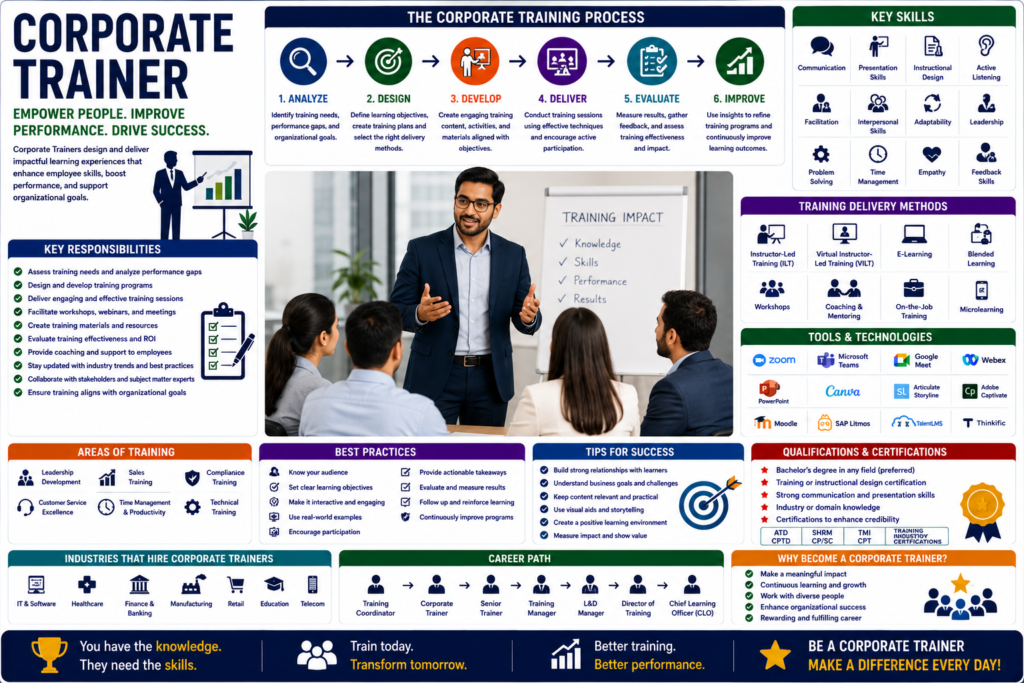
What Is a Corporate Trainer?
A Corporate Trainer is a learning and development professional responsible for creating and delivering educational programs that improve employee performance and organizational effectiveness.
Their primary objectives include:
- Enhancing employee skills
- Improving workplace productivity
- Supporting organizational goals
- Facilitating professional development
- Ensuring compliance with regulations
- Strengthening leadership capabilities
- Supporting technology adoption
- Improving employee engagement
Corporate Trainers work across industries and often collaborate with managers, HR departments, executives, and subject matter experts.
Why Corporate Trainers Are Important
Improve Employee Performance
Training helps employees perform their jobs more effectively.
Increase Productivity
Well-trained teams work more efficiently and confidently.
Support Organizational Growth
Continuous learning enables businesses to adapt and innovate.
Enhance Employee Retention
Professional development opportunities improve job satisfaction.
Ensure Compliance
Training helps organizations meet legal and industry requirements.
Facilitate Change Management
Corporate Trainers help employees adapt to new systems, processes, and technologies.
Key Responsibilities of a Corporate Trainer
Training Needs Analysis
Identifying skill gaps and learning opportunities.
Program Development
Designing educational content and learning experiences.
Training Delivery
Conducting workshops, seminars, and virtual sessions.
Employee Coaching
Providing guidance and performance support.
Assessment and Evaluation
Measuring training effectiveness and learning outcomes.
Content Creation
Developing presentations, manuals, videos, and learning materials.
Learning Technology Management
Utilizing e-learning platforms and training tools.
Types of Corporate Training
Onboarding Training
Helping new employees integrate into the organization.
Leadership Training
Developing management and leadership capabilities.
Compliance Training
Teaching legal, regulatory, and workplace requirements.
Technical Training
Supporting technology and software skills development.
Sales Training
Improving selling techniques and customer interactions.
Customer Service Training
Enhancing client support and communication skills.
Soft Skills Training
Developing communication, teamwork, and problem-solving abilities.
The Corporate Training Process
1. Analyze Training Needs
Identify performance gaps and business objectives.
2. Define Learning Objectives
Establish measurable outcomes.
3. Design Training Programs
Create content and learning activities.
4. Deliver Training
Facilitate workshops, courses, and learning experiences.
5. Evaluate Effectiveness
Measure knowledge transfer and performance improvement.
6. Improve Programs
Update content based on feedback and results.
Essential Skills for Corporate Trainers
Communication Skills
Present information clearly and confidently.
Public Speaking
Engage learners during presentations and workshops.
Instructional Design
Create effective learning experiences.
Facilitation Skills
Guide discussions and encourage participation.
Coaching Ability
Support individual employee development.
Technology Proficiency
Use modern learning tools and platforms.
Adaptability
Adjust training approaches for different audiences.
Leadership
Inspire learners and promote continuous improvement.
Training Delivery Methods
Instructor-Led Training (ILT)
Traditional classroom-based learning.
Virtual Instructor-Led Training (VILT)
Live online training sessions.
E-Learning
Self-paced digital learning experiences.
Blended Learning
Combines online and in-person instruction.
Microlearning
Short, focused learning modules.
Coaching and Mentoring
Personalized development support.
Adult Learning Principles
Corporate Trainers often apply adult learning theories.
Relevance
Adults learn best when content relates to their work.
Experience-Based Learning
Learners benefit from practical applications.
Self-Directed Learning
Adults prefer control over their learning process.
Problem-Centered Learning
Real-world scenarios increase engagement.
Immediate Application
Employees value skills they can use immediately.
Learning and Development (L&D)
Corporate Trainers are key members of Learning and Development teams.
L&D focuses on:
- Employee growth
- Leadership development
- Workforce capability building
- Talent management
- Career advancement
- Organizational learning
Effective L&D programs contribute significantly to business success.
Tools Used by Corporate Trainers
Learning Management Systems (LMS)
- Moodle
- TalentLMS
- Blackboard
- Canvas
Presentation Tools
- Microsoft PowerPoint
- Google Slides
- Canva
Video Conferencing Platforms
- Zoom
- Microsoft Teams
- Google Meet
E-Learning Authoring Tools
- Articulate Storyline
- Rise 360
- Adobe Captivate
Collaboration Platforms
- Slack
- Miro
- Notion
Measuring Training Success
Successful Corporate Trainers evaluate programs using metrics such as:
Knowledge Retention
Assessing what learners remember.
Skill Improvement
Measuring performance improvements.
Employee Satisfaction
Gathering participant feedback.
Productivity Gains
Evaluating workplace performance outcomes.
Training Completion Rates
Tracking learner participation and engagement.
Return on Investment (ROI)
Determining business impact.
Corporate Trainer vs Instructional Designer
Corporate Trainer
Focuses on delivering training and facilitating learning.
Instructional Designer
Focuses on designing learning experiences and materials.
Many organizations employ both roles collaboratively.
Corporate Trainer vs Training Manager
Corporate Trainer
Creates and delivers training programs.
Training Manager
Oversees learning strategy, budgets, and training teams.
Training Managers often supervise Corporate Trainers.
Industries Hiring Corporate Trainers
Technology
Employee onboarding and technical skills development.
Healthcare
Clinical education and compliance training.
Financial Services
Regulatory and professional skills training.
Manufacturing
Safety and operational training.
Retail
Sales and customer service training.
Government
Workforce development and compliance education.
Consulting
Professional development and client training programs.
Certifications for Corporate Trainers
CPTD (Certified Professional in Talent Development)
Highly respected learning and development credential.
ATD Training Certificate
Recognized professional training certification.
Instructional Design Certifications
Support learning program development expertise.
Coaching Certifications
Enhance mentoring and employee development skills.
Project Management Certifications
Useful for managing large training initiatives.
Career Path for Corporate Trainers
Training Coordinator
Supports training administration and logistics.
Corporate Trainer
Develops and delivers training programs.
Senior Corporate Trainer
Leads complex learning initiatives.
Learning and Development Specialist
Focuses on workforce development strategies.
Training Manager
Oversees organizational training programs.
Director of Learning and Development
Leads enterprise-wide learning strategies.
Chief Learning Officer (CLO)
Executive responsible for organizational learning and talent development.
Best Practices for Corporate Trainers
Focus on Business Goals
Align training with organizational objectives.
Engage Learners
Use interactive and participatory learning methods.
Measure Results
Track performance improvements and outcomes.
Customize Content
Adapt training to audience needs.
Encourage Continuous Learning
Promote ongoing professional development.
Leverage Technology
Utilize modern learning tools and digital platforms.
Future Trends in Corporate Training
Artificial Intelligence
AI-powered personalized learning experiences.
Microlearning
Short-form content continues gaining popularity.
Virtual Reality (VR)
Immersive workplace training environments.
Mobile Learning
Employees increasingly learn through mobile devices.
Learning Analytics
Data-driven insights improve training effectiveness.
Remote Workforce Training
Virtual learning becomes increasingly important.
Benefits of Becoming a Corporate Trainer
- Strong demand across industries
- Opportunities to impact organizational success
- Competitive compensation
- Career growth potential
- Flexible work environments
- Continuous learning opportunities
- Ability to help others develop professionally
Conclusion
Corporate Trainers play a vital role in helping organizations develop skilled, knowledgeable, and productive workforces. Through effective training programs, employee coaching, and learning innovation, they contribute directly to business performance and long-term success.
As organizations continue investing in employee development and workforce transformation, skilled Corporate Trainers will remain highly valuable. Professionals who combine communication skills, instructional expertise, technology knowledge, and business understanding can build rewarding careers while helping individuals and organizations achieve their full potential.