The stock market dropped 4% on Monday morning. Financial news anchors are using words like “correction” and “volatility.” Your coworker just told you they pulled everything out of their 401(k). Your cousin texted the group chat saying he’s “waiting for the bottom” before investing again.
And you? You did nothing. Your automatic investment went through on Tuesday, same as every other week. You bought more shares at a lower price. You didn’t check the headlines. You didn’t panic. You didn’t try to predict what happens next.
That’s dollar-cost averaging in action. And it might be the single most underrated strategy in personal finance.
What Dollar-Cost Averaging Actually Means
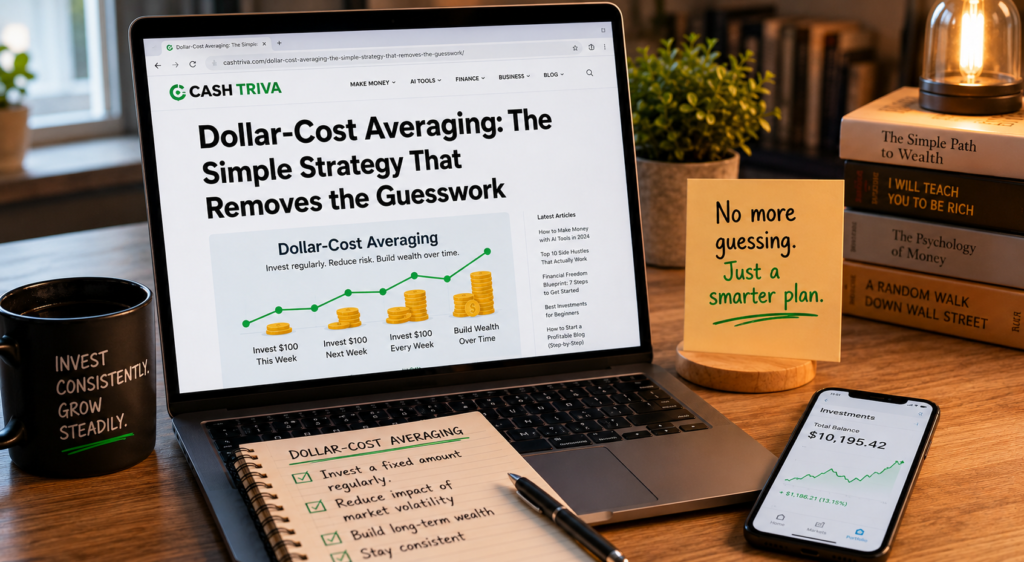
Dollar-cost averaging (DCA) is the practice of investing a fixed amount of money at regular intervals, regardless of what the market is doing. Instead of dropping $12,000 into the stock market all at once, you invest $1,000 per month for 12 months. Instead of trying to pick the “right” day to buy, you buy on the same day every week, every two weeks, or every month.
That’s the entire strategy. No charts. No predictions. No watching CNBC at 6 a.m. trying to read candlestick patterns.
The fixed amount is what makes the math interesting. When prices are high, your $1,000 buys fewer shares. When prices are low, that same $1,000 buys more shares. Over time, this naturally lowers your average cost per share, because you’re automatically buying more when things are cheap and less when things are expensive.
You’re not outsmarting the market. You’re letting basic arithmetic do the heavy lifting.
A Quick Example With Real Numbers
Let’s say you invest $500 per month into an index fund over six months. Here’s what that might look like:
| Month | Share Price | Shares Purchased |
|---|---|---|
| January | $50 | 10.0 shares |
| February | $40 | 12.5 shares |
| March | $45 | 11.1 shares |
| April | $35 | 14.3 shares |
| May | $42 | 11.9 shares |
| June | $48 | 10.4 shares |
Total invested: $3,000
Total shares purchased: 70.2
Average cost per share: $42.74
Simple average of share prices: $43.33
Your average cost per share ($42.74) ended up lower than the simple average of the prices ($43.33). That’s the DCA effect at work. You automatically bought more shares during the cheaper months (February and April) and fewer during the expensive months (January and June).
Nobody told you to buy more in April. The math did it for you.
Why Trying to Time the Market Is a Losing Game
Every investor fantasizes about the same thing: buying at the absolute bottom and selling at the absolute top. In theory, this would massively outperform any other strategy. In practice, almost nobody pulls it off consistently.
A study from J.P. Morgan analyzed the S&P 500 over a 20-year period from 2003 to 2022. An investor who stayed fully invested the entire time earned an annualized return of roughly 9.8%. But an investor who missed just the 10 best trading days during those two decades saw their return drop to around 5.6%. Miss the best 20 days? The return fell below 2.9%.
Here’s the uncomfortable part: many of the market’s best days happen right after its worst days. The same week that triggers panic selling often contains the recovery that panic sellers miss entirely.
Timing the market requires you to be right twice, once when you sell and once when you buy back in. Professional fund managers, people with teams of analysts, decades of experience, and access to institutional-grade data, fail at this consistently. Roughly 90% of actively managed funds underperform their benchmark index over a 15-year period, according to S&P Global’s SPIVA scorecards.
If the pros can’t do it reliably, the rest of us shouldn’t pretend we can.
Dollar-cost averaging sidesteps this entire problem. You don’t need to know if the market will go up tomorrow, next week, or next month. You just invest on schedule and let time do the work.
The Psychology Problem (and How DCA Solves It)
Investing is an emotional minefield. Behavioral finance research has documented dozens of cognitive biases that push investors into bad decisions. Two of the most destructive are loss aversion and recency bias.
Loss aversion means losses feel roughly twice as painful as gains feel good. A $5,000 drop in your portfolio stings far more than a $5,000 gain feels rewarding. This asymmetry makes people sell during downturns (locking in losses) and hesitate to buy during dips (missing opportunities).
Recency bias means we overweight recent events. If the market has been falling for three weeks, it feels like it will fall forever. If it’s been rising for six months, it feels like it will never stop. Both feelings lead to poor decisions.
DCA neutralizes these biases by removing the decision from your hands. You don’t decide whether today is a good day to invest. The calendar decides. Your emotions never get a vote.
This is not a small thing. Dalbar’s annual Quantitative Analysis of Investor Behavior consistently shows that the average investor underperforms the market by a wide margin, not because they pick bad investments, but because they buy and sell at the wrong times. Over a 30-year period, the average equity fund investor earned significantly less than the S&P 500, largely because of emotional, poorly-timed decisions.
DCA doesn’t just protect your portfolio. It protects you from yourself.
DCA vs. Lump Sum Investing: The Honest Comparison
Here’s where things get nuanced. Academic research, including a well-known Vanguard study, shows that lump sum investing (putting all your money in at once) outperforms dollar-cost averaging roughly two-thirds of the time. The reason is straightforward: markets trend upward over the long run. The sooner your money is invested, the more time it has to grow.
So why would anyone choose DCA over lump sum?
Because “optimal” and “realistic” are different things.
Lump sum investing outperforms on average, but it requires you to invest a large amount all at once and then sit still while the market does whatever it wants. If you invest $50,000 on Monday and the market drops 15% over the next month, you’re sitting on a $7,500 loss. Mathematically, you might still come out ahead in ten years. Emotionally, many people can’t handle that drawdown. They sell. They panic. They abandon the plan entirely.
DCA sacrifices a small amount of theoretical performance in exchange for something more valuable: consistency. It keeps you invested during the periods when lump sum investors are most likely to bail.
The best strategy is the one you actually stick with. A theoretically superior plan that you abandon after a bad month is worse than a slightly less optimal plan that you follow for 20 years.
Here’s a practical way to think about it:
- If you receive a large windfall (inheritance, bonus, sale of a property), and you have a high tolerance for short-term volatility, lump sum investing is statistically the better bet.
- If you earn a regular paycheck and invest from each one, you’re already doing DCA by default.
- If you have a large sum but feel anxious about putting it all in at once, DCA over 3 to 12 months lets you get invested while managing your stress. The small performance cost is worth the peace of mind.
Where Dollar-Cost Averaging Works Best
DCA is especially effective in certain situations:
Investing from a regular paycheck. This is the most natural application. You set aside a fixed percentage of each paycheck and invest it automatically. Most 401(k) plans work this way already. If you’re contributing to a 401(k), you’re practicing DCA whether you realize it or not.
Volatile markets. During periods of high uncertainty, DCA shines. You keep buying through dips instead of freezing on the sidelines. When the recovery comes (and historically, it always has), you own more shares at lower prices.
Building a long-term portfolio. If your time horizon is 10, 20, or 30 years, the short-term price fluctuations that stress out traders become background noise. DCA keeps you consistently adding to your positions while those fluctuations smooth out.
New investors getting started. If you’re just beginning and the market feels intimidating, DCA removes the pressure of picking the “perfect” entry point. There is no perfect entry point. Start now, invest regularly, and let compounding take over.
How to Set Up Dollar-Cost Averaging (Step by Step)
Setting up a DCA strategy takes about 30 minutes, and most of the process is automated after that.
1. Choose Your Investment
For most people, a broad market index fund or ETF is the simplest and most effective choice. Options include:
- S&P 500 index funds (like Vanguard’s VOO or Fidelity’s FXAIX), which track the 500 largest U.S. companies
- Total stock market funds (like VTI or SWTSX), which cover the entire U.S. market including small and mid-cap companies
- Target-date funds, which automatically adjust your stock/bond mix as you get closer to retirement
- Global index funds (like VXUS or VT), which include international stocks for broader diversification
You can always add complexity later. Starting with a single, diversified index fund is perfectly fine.
2. Decide on Your Amount and Frequency
Pick a dollar amount you can commit to consistently. This matters more than the size of the amount. $100 per month invested without fail will outperform $500 per month invested sporadically.
Common frequencies:
- Weekly: Provides the most price averaging, but the difference from monthly is marginal for most investors
- Biweekly: Lines up well with most pay schedules
- Monthly: The most popular choice. Simple, easy to track, and effective
3. Set Up Automatic Investments
This is the step that makes the whole strategy work. Automation removes the temptation to skip a month, wait for a dip, or second-guess your plan.
Most brokerages (Fidelity, Vanguard, Charles Schwab, Betterment, M1 Finance) offer automatic recurring investment features. You link your bank account, choose the amount, pick the date, select your investment, and walk away.
If your employer offers a 401(k) with a company match, start there. You get the benefit of DCA plus free money from the match, which is an immediate 50% to 100% return on your contribution before the market even moves.
4. Ignore the Noise
This might be the hardest step. Once your automatic investments are running, your job is to leave them alone. Don’t pause during crashes. Don’t increase during rallies (unless your income has gone up). Don’t check your portfolio daily.
Check in quarterly to make sure your allocations still make sense. Review annually to see if you can increase your contribution. And that’s it.
Dollar-Cost Averaging During Market Crashes
This is where DCA truly earns its reputation. Let’s look at what happened during two of the most significant market downturns in recent history.
The 2008-2009 Financial Crisis
The S&P 500 fell roughly 57% from its peak in October 2007 to its trough in March 2009. Investors who panicked and sold locked in devastating losses. Many didn’t return to the market for years, missing the recovery entirely.
An investor who continued dollar-cost averaging through the crisis kept buying shares at deeply discounted prices throughout 2008 and early 2009. By the time the market recovered to its pre-crisis high in 2013, those discounted shares had generated enormous gains. The DCA investor didn’t just survive the crash. They profited from it.
The 2020 COVID Crash
The S&P 500 dropped about 34% in roughly five weeks during February and March 2020. It was one of the fastest crashes in market history. It was followed by one of the fastest recoveries. By August 2020, the market had already reclaimed its pre-crash highs.
Investors who continued their automatic contributions through March and April 2020 bought shares at prices they’ll likely never see again. Those who sold in panic and waited for “clarity” missed a recovery that happened before most people had processed what was going on.
The pattern repeats across every crash in market history. DCA investors who hold their nerve and keep buying during downturns consistently come out ahead on the other side.
Common Objections (and Straight Answers)
“But what if the market keeps going down after I invest?”
It might. In the short term, anything can happen. But over every 20-year rolling period in U.S. stock market history, stocks have produced positive returns. DCA is a long-term strategy. If you need this money in six months, it shouldn’t be in the stock market regardless of your strategy.
“Shouldn’t I wait until the market hits bottom?”
You will never know the bottom is the bottom until long after it’s passed. By definition, the bottom only becomes visible in hindsight. Every attempt to wait for the bottom is a bet that you can see the future. You can’t. Nobody can.
“Isn’t DCA just for people who are afraid of the market?”
No. It’s for people who understand probability, acknowledge their own psychological limitations, and prefer systematic discipline over emotional guessing. Many sophisticated investors use DCA precisely because they know how unreliable human judgment is during market extremes.
“I only have $50 per month. Is it even worth it?”
Absolutely. $50 per month invested in an S&P 500 index fund at a historical average return of around 10% annually grows to roughly $38,000 over 20 years and over $100,000 over 30 years. Fractional shares (available at most modern brokerages) mean you can invest any amount, no minimum share price required.
“What about fees eating into small investments?”
Most major brokerages now offer commission-free trading on ETFs and index funds. If you’re using a platform that charges per trade, switch. There’s no reason to pay trading commissions in 2026.
The Hidden Power: DCA and Compounding Together
Dollar-cost averaging and compound growth are a powerful combination. DCA keeps you consistently adding to your investments. Compounding turns those consistent contributions into something extraordinary over time.
Here’s a practical illustration:
An investor contributes $300 per month for 30 years into a portfolio averaging 8% annual returns.
- Total amount contributed: $108,000
- Portfolio value after 30 years: approximately $440,000
More than 75% of the ending value came from investment growth, not from the money the investor actually put in. That’s compounding at work. And DCA is the vehicle that kept the contributions flowing, month after month, through bull markets, bear markets, recessions, and recoveries.
The earlier you start and the more consistently you invest, the more dramatically compounding works in your favor. A 25-year-old investing $200 per month will likely build more wealth than a 35-year-old investing $400 per month, simply because of the extra decade of compounding.
Mistakes to Avoid With Dollar-Cost Averaging
DCA is simple, but there are a few ways to get it wrong.
Stopping during downturns. This is the single biggest mistake. Downturns are when DCA works hardest for you. Pausing contributions during a crash means you miss the discounted prices that drive your long-term returns. It’s like leaving a sale early because the discounts were too good.
Checking your portfolio too often. Daily portfolio monitoring creates anxiety without providing useful information. The more frequently you check, the more likely you are to see a loss (markets fluctuate daily), and the more tempted you are to interfere with your plan.
Dollar-cost averaging into bad investments. DCA is a buying strategy, not a substitute for good investment selection. Systematically buying a poorly performing individual stock won’t save you. Stick to diversified index funds unless you have a strong, well-researched reason to do otherwise.
Waiting too long to start. The biggest cost in investing isn’t a bad entry point. It’s delay. Every month you spend “researching the perfect time” is a month your money isn’t growing. Start with whatever amount you can afford, even if it feels embarrassingly small.
Neglecting to increase contributions over time. As your income grows, your investment amount should grow with it. A simple rule: every time you get a raise, increase your monthly investment by at least half the raise amount. You’ll barely notice the difference in your spending, but you’ll see a massive difference in your portfolio over a decade.
Who Shouldn’t Use Dollar-Cost Averaging?
DCA isn’t the right approach for every situation:
- Active traders with short time horizons and a tolerance for high risk may prefer different strategies. But most active traders underperform passive investors over time, so this caveat comes with a warning label.
- Investors sitting on large lump sums who have strong risk tolerance and a long time horizon may benefit from investing the full amount at once, based on historical probability.
- Anyone investing in highly speculative assets (individual penny stocks, meme coins, unproven ventures) shouldn’t assume DCA will protect them. Systematic buying can’t fix a fundamentally bad investment.
For the vast majority of people building long-term wealth through diversified index investing, DCA is hard to beat.
How to Get Started Today
You can have a DCA strategy running before the end of the day. Here’s the minimum viable plan:
- Open a brokerage account if you don’t have one (Fidelity, Vanguard, and Schwab are all solid, no-fee options)
- Pick one broad market index fund or ETF
- Decide on an amount you can invest every pay period without financial stress
- Set up automatic recurring investments
- Set a calendar reminder to review your plan quarterly and increase your contribution annually
That’s it. Five steps. No financial advisor required. No special knowledge needed. No perfect timing necessary.
The stock market will go up. It will go down. It will scare you. It will surprise you. And through all of it, your automatic investment will keep buying, keep accumulating, and keep compounding.
The simplest strategies often produce the best results. Dollar-cost averaging is proof of that.