The financial market plays a central role in the global economy by connecting buyers and sellers of financial assets. It allows individuals, businesses, and governments to exchange securities, raise capital, manage risk, and create investment opportunities. Whether you are a beginner investor or simply interested in understanding economic systems, learning how financial markets function can help you make better financial decisions.
What Is a Financial Market?
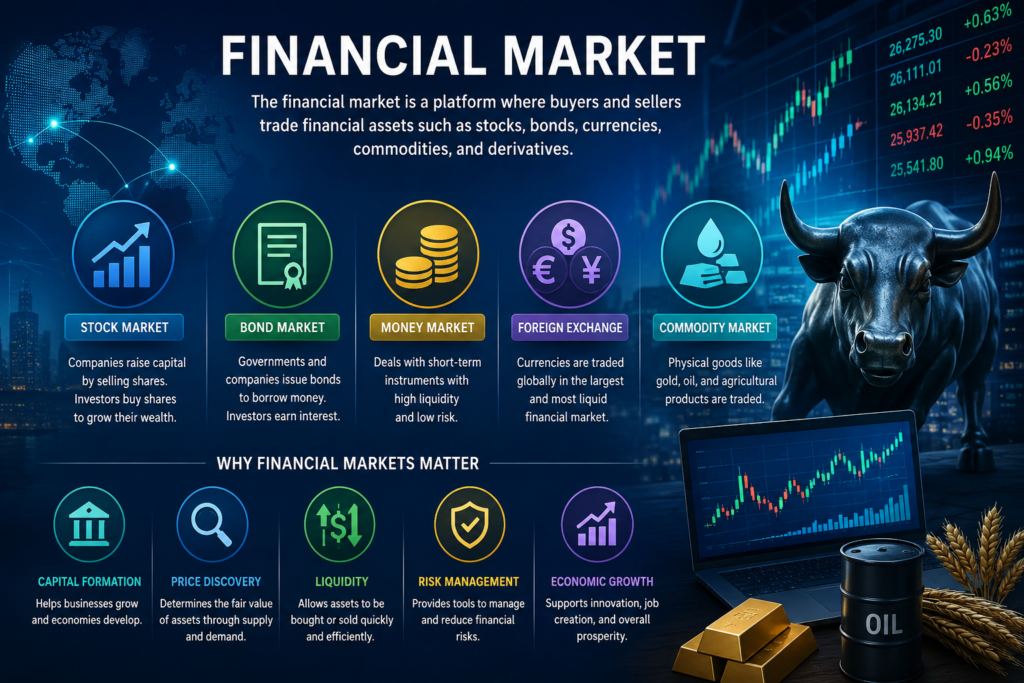
A financial market is a marketplace where financial assets such as stocks, bonds, currencies, commodities, and derivatives are bought and sold. These markets provide a structured environment where participants can trade assets efficiently and determine their value based on supply and demand.
Financial markets are essential because they help move money from people or organizations with extra capital to those who need funding for business expansion, innovation, and economic development.
Main Types of Financial Markets
There are several types of financial markets, each serving a different purpose.
Stock Market
The stock market allows companies to issue shares and raise funds from investors. Investors purchase company shares expecting growth and returns over time. Stock markets are among the most recognized financial markets globally.
Key benefits include:
- Investment opportunities
- Company financing
- Wealth creation
- Liquidity for investors
Bond Market
The bond market involves the buying and selling of debt securities. Governments and companies issue bonds to borrow money for projects and operations.
Investors often consider bonds a lower-risk investment compared to stocks because they usually provide predictable interest payments.
Money Market
The money market focuses on short-term financial instruments with high liquidity and low risk. Businesses and governments commonly use these instruments for managing short-term funding needs.
Examples include:
- Treasury bills
- Certificates of deposit
- Commercial paper
Foreign Exchange Market (Forex)
The foreign exchange market is one of the largest financial markets in the world. It allows currencies to be exchanged and supports international trade and global investments.
Forex markets operate continuously across different time zones and involve banks, institutions, corporations, and individual traders.
Commodity Market
Commodity markets facilitate trading in physical goods and natural resources, including:
- Gold
- Oil
- Natural gas
- Agricultural products
Commodity prices often influence global economies and inflation levels.
Why Financial Markets Are Important
Financial markets provide numerous benefits that support economic growth and financial stability.
Capital Formation
Businesses can raise money to expand operations, hire employees, and invest in innovation.
Price Discovery
Market activity helps determine the fair value of financial assets through supply and demand.
Liquidity
Investors can quickly buy or sell assets without causing major price disruptions.
Risk Management
Financial instruments help investors and businesses reduce exposure to market risks.
Economic Growth
Efficient financial markets contribute to job creation, technological development, and overall economic progress.
Factors That Influence Financial Markets
Financial markets constantly change due to various factors, including:
- Interest rates
- Inflation
- Government policies
- Economic indicators
- Political events
- Global crises
- Investor sentiment
Understanding these factors can help investors make informed decisions and identify market opportunities.
Future of Financial Markets
Technology continues transforming financial markets. Artificial intelligence, digital trading platforms, blockchain technology, and financial automation are changing how investors access and analyze financial information.
As financial systems become more digital, market participation is becoming more accessible to individuals worldwide.
Conclusion
Financial markets are a fundamental part of modern economies. They create opportunities for investment, support business growth, and facilitate the movement of capital across the world. Understanding how financial markets work can help individuals and organizations make smarter financial decisions and navigate an increasingly complex economic environment.
Whether you are planning to invest or simply want to improve your financial knowledge, understanding the financial market is an important step toward financial awareness and long-term success.