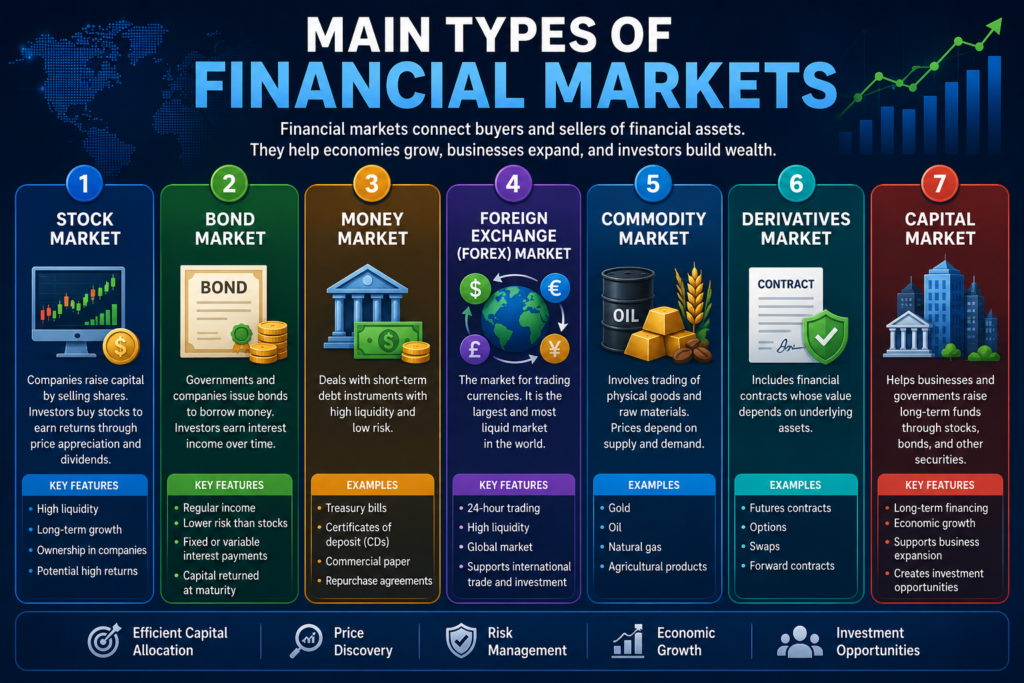
Financial markets are essential components of the global economy. They create opportunities for individuals, businesses, and governments to exchange financial assets, raise capital, and support economic growth. Understanding the main types of financial markets helps investors make better decisions and gain a clearer understanding of how the financial system works.
Each financial market serves a specific purpose and operates with different financial instruments and participants.
What Are Financial Markets?
Financial markets are platforms where buyers and sellers trade financial assets such as stocks, bonds, currencies, commodities, and derivatives. These markets ensure efficient capital allocation and provide liquidity to support economic activities.
Financial markets influence investment opportunities, business growth, and overall economic development worldwide.
Main Types of Financial Markets
Stock Market
The stock market is one of the most popular and widely recognized financial markets. Companies raise capital by issuing shares to investors through public offerings and secondary trading activities.
Investors buy shares to participate in a company’s growth and potentially earn profits through price appreciation and dividends.
Benefits of the stock market:
- Long-term wealth creation
- Company financing opportunities
- Portfolio diversification
- High market liquidity
Bond Market
The bond market involves buying and selling debt securities issued by governments, corporations, and institutions. Bonds allow organizations to borrow money while investors receive fixed or variable interest payments.
Bond markets are often considered less volatile than stock markets and are commonly used by conservative investors.
Key advantages include:
- Stable income opportunities
- Lower investment risk
- Diversification benefits
Money Market
The money market focuses on short-term financial instruments that generally have lower risk and high liquidity. It is mainly used by financial institutions, governments, and corporations to manage short-term funding needs.
Examples of money market instruments include:
- Treasury bills
- Certificates of deposit
- Commercial paper
- Repurchase agreements
Money markets play an important role in maintaining financial stability.
Foreign Exchange Market (Forex)
The foreign exchange market, commonly called Forex, is the largest financial market in the world. It allows participants to exchange currencies and conduct international transactions.
Forex markets operate continuously across global time zones and support international trade and investments.
Key characteristics:
- High liquidity
- 24-hour trading activity
- Global accessibility
- Large trading volume
Commodity Market
Commodity markets involve the trading of raw materials and natural resources. These markets are important for businesses that rely on commodities and for investors seeking portfolio diversification.
Popular commodities include:
- Gold
- Silver
- Oil
- Natural gas
- Agricultural products
Commodity prices often fluctuate due to economic conditions, geopolitical events, and supply-demand changes.
Derivatives Market
The derivatives market includes financial contracts whose value depends on underlying assets such as stocks, commodities, currencies, interest rates, or market indexes.
Common derivative instruments include:
- Futures contracts
- Options contracts
- Swaps
- Forward contracts
Derivatives are often used for hedging risks and speculative investment strategies.
Capital Market
The capital market helps companies and governments raise long-term financing through various investment instruments. It consists mainly of stock and bond markets and plays a major role in economic development.
Capital markets support:
- Business expansion
- Infrastructure projects
- Economic growth
- Investment opportunities
Why Financial Markets Matter
Financial markets contribute significantly to economic stability and development. They provide liquidity, improve resource allocation, and create investment opportunities for individuals and organizations.
The major benefits include:
- Efficient capital allocation
- Price discovery
- Risk management
- Economic growth
- Increased investment opportunities
Conclusion
Understanding the main types of financial markets is essential for anyone interested in investing or economics. Stock markets, bond markets, money markets, Forex markets, commodity markets, derivatives markets, and capital markets each serve unique functions within the financial system.
As global markets continue evolving with technology and digital transformation, having a strong understanding of financial markets can help investors and businesses make smarter financial decisions and navigate changing economic environments.