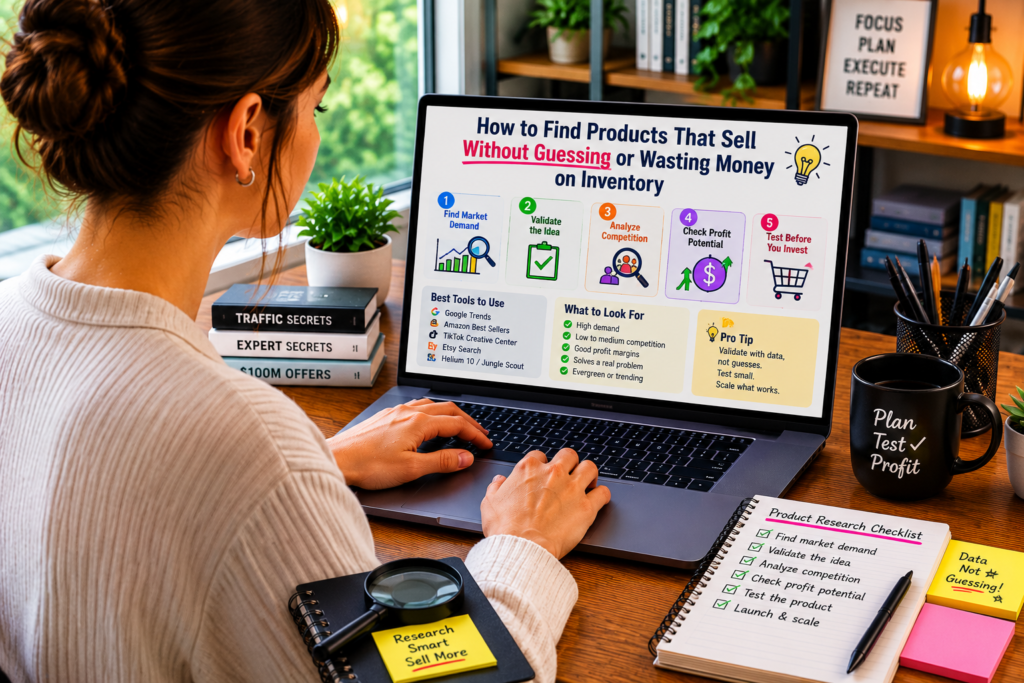
Most people who start selling online make the same mistake. They pick a product based on a hunch, order 500 units from a supplier, and then sit on boxes of inventory that nobody wants to buy.
It’s an expensive lesson, and one you don’t have to learn the hard way.
Finding products that sell is a process, not a lucky guess. And in 2026, the tools and strategies available make it easier than ever to validate demand before you spend a single dollar on inventory.
This guide walks through practical, repeatable methods for identifying products people are already searching for, spending money on, and talking about, so you can build a business around real demand instead of wishful thinking.
Why Most Product Choices Fail
Before getting into what works, it helps to understand why so many product picks don’t pan out.
The most common reasons include:
- Choosing based on personal interest alone. Just because you love hand-carved wooden phone cases doesn’t mean enough other people do. Personal taste is a starting point, not a strategy.
- Ignoring competition. Entering a category dominated by established brands with massive ad budgets and thousands of reviews is a fight most new sellers can’t win.
- Skipping demand validation. “I think people would buy this” is the most expensive sentence in ecommerce. Data tells a different story than assumptions.
- Following trends too late. By the time a product shows up in a “top trending products” blog post, the early movers have already captured most of the profit. The window is closing or already closed.
Each of these traps has a common thread: they skip the research phase. And research is where profitable product decisions actually happen.
Step 1: Start With Problems, Not Products
The most reliable way to find something that sells is to start with a problem people are actively trying to solve.
Products that fix a real pain point have built-in demand. People don’t need convincing. They’re already looking for a solution.
Here’s how to spot those problems:
Read customer complaints. Go to Amazon and look at 2-star and 3-star reviews in categories that interest you. These reviews are goldmines because the customer liked the concept enough to buy but was disappointed by the execution. Pay attention to patterns. If dozens of people complain about the same flaw, that’s a gap you can fill.
Browse forums and communities. Reddit, Facebook groups, Quora, and niche forums are filled with people describing their frustrations in their own words. Search for phrases like “I wish there was,” “does anyone know a good,” and “I can’t find a” to surface unmet needs.
Talk to real people. If you have access to a specific audience (through a social media following, email list, or local community), ask them directly. What do they struggle with? What products have let them down? First-hand conversations often reveal opportunities that online research misses.
The point here is simple: products that solve problems sell themselves. Products that just seem “cool” need a marketing budget to compensate for the lack of natural demand.
Step 2: Use Data to Confirm Demand
Once you have a list of potential product ideas rooted in real problems, the next step is to confirm that enough people care about those problems to create a viable market.
This is where data-driven research separates winners from money pits.
Google Trends. This free tool shows you whether interest in a search term is growing, stable, or declining. Type in your product idea and look at the trajectory over the past 12 months and 5 years. You want to see steady or rising interest, not a spike that’s already fading.
A few things to watch for:
- Seasonal patterns (great for planning, but you need to know if demand disappears for 8 months)
- Geographic concentration (if demand is only strong in one country, that affects your logistics and targeting)
- Related queries (these often reveal adjacent product opportunities you hadn’t considered)
Keyword research tools. Tools like Ahrefs, SEMrush, or even free options like Ubersuggest give you hard numbers on how many people search for specific product terms each month. Look for:
- Monthly search volume of at least 1,000 to 10,000 for your primary product keyword
- A mix of commercial intent keywords (e.g., “buy wireless earbuds for swimming” vs. “how do wireless earbuds work”)
- Long-tail variations that indicate specific buyer needs
Amazon Best Sellers and Movers & Shakers. Amazon’s own data is a snapshot of what’s selling right now. The Best Sellers Rank (BSR) tells you how frequently a product sells relative to others in its category. A BSR under 5,000 in a main category typically indicates strong, consistent sales.
The “Movers & Shakers” section is even more useful for spotting rising products because it shows items with the biggest rank improvements in the last 24 hours.
Step 3: Analyze the Competition (and Find the Gaps)
Demand alone isn’t enough. If a product has high demand but 47 established sellers with thousands of reviews and aggressive pricing, your chances of breaking through are slim.
What you want is the sweet spot: strong demand with weak or mediocre competition.
Here’s how to evaluate competitors:
Count the reviews. On Amazon and other marketplaces, look at the top 10 listings for your target product. If most of them have fewer than 200-300 reviews, there’s room for a new seller to compete. If the top listings all have 5,000+ reviews, that category is mature and expensive to enter.
Assess listing quality. Are the photos professional? Are the product descriptions detailed and benefit-focused? Are the listings optimized with relevant keywords? Poor-quality listings from existing sellers mean opportunity for you. When incumbents are lazy, a well-executed entry can steal market share quickly.
Check pricing and margins. Calculate whether you can price competitively while maintaining at least a 30-40% profit margin after all costs (product cost, shipping, platform fees, advertising, returns). If the category is in a price war with razor-thin margins, walk away unless you have a genuine cost advantage.
Look for differentiation angles. Can you offer a better version, a bundle, a different size, a specific color, or an added feature that existing products lack? Even small differentiators can create enough separation to win customers. Remember those 2-star and 3-star reviews from Step 1. They’re telling you exactly what the differentiated version should include.
Step 4: Validate Before You Invest
This is the step most people skip, and it’s the one that saves the most money.
Before ordering bulk inventory, test whether people will actually pay for your product. There are several low-risk ways to do this:
Pre-sell with a landing page. Create a simple landing page describing your product with mockup images and a “Buy Now” or “Pre-Order” button. Drive a small amount of paid traffic (even $50-100) and measure how many people click the buy button. You don’t have to fulfill orders at this stage. Use a waitlist or pre-order model.
If 2-5% of visitors click the buy button, you have a product worth pursuing. If the click rate is below 1%, the positioning needs work or the product itself may not have enough pull.
Sell a small batch first. Order 20-50 units instead of 500. List them on Amazon, Etsy, eBay, or your own Shopify store. Track how quickly they sell, what questions customers ask, and what feedback they give. This real-world data is worth more than any amount of hypothetical research.
Use print-on-demand or dropshipping for initial tests. For certain product categories (apparel, accessories, home decor), you can test designs and concepts without holding any inventory at all. Margins will be thinner, but you’ll learn whether people actually want the product before investing in bulk production.
Run social media polls and ads. Post product concepts on Instagram, TikTok, or Facebook and gauge engagement. Create a short video ad and run it with a small budget. Watch the metrics: click-through rate, comments, saves, and shares all signal interest. An ad click-through rate above 2% and engagement from strangers (not just friends and family) suggests genuine market interest.
Step 5: Identify the Right Product Categories
While any product can sell if there’s enough demand and the right positioning, some categories are consistently more profitable and accessible for new sellers.
Consumable products. Items people use up and need to reorder (supplements, skincare, coffee, pet food) create repeat customers without requiring you to constantly acquire new ones. A customer who buys once a month is far more valuable than one who buys once and disappears.
Accessories and add-ons. People who own a primary product (a phone, a camera, a car, a pet) will keep buying accessories for it. These items often have high margins, low return rates, and steady demand.
Problem-solving tools. Products that save time, reduce effort, or eliminate frustration, such as kitchen gadgets that actually work, organization systems, or specialized cleaning tools, tend to sell well because the value proposition is clear and immediate.
Hobby and passion products. People who are passionate about a hobby (fishing, gardening, painting, gaming) tend to spend freely on products that improve their experience. These niches are loyal, vocal, and willing to pay premium prices for products that match their standards.
Products with a knowledge gap. If you have specialized knowledge in a field, you can identify products that the general market underserves. A physical therapist might recognize a gap in home exercise equipment. A professional photographer might spot an opportunity in camera accessories that the big brands overlook.
Step 6: Source Smart and Protect Your Margins
Finding the right product means nothing if your margins get eaten by poor sourcing decisions. Here’s how to keep costs in check:
Get multiple supplier quotes. Whether you’re sourcing from Alibaba, domestic manufacturers, or wholesale distributors, always compare at least three suppliers. Prices can vary by 30-50% for the same product.
Calculate your true landed cost. Your product cost isn’t just the price per unit. Factor in:
- Shipping from the manufacturer to your warehouse or fulfillment center
- Import duties and customs fees (if sourcing internationally)
- Packaging and labeling costs
- Quality inspection costs
- Storage and fulfillment fees
Many new sellers underestimate these costs and end up with products that look profitable on paper but lose money in reality.
Order samples before committing. Always. Without exception. Order samples from your top 2-3 suppliers and compare quality, packaging, and consistency. A product that looks great in a catalog photo can be underwhelming in person.
Negotiate payment terms. Many suppliers, especially on Alibaba, are open to negotiation on pricing, minimum order quantities, and payment structures. Don’t accept the first quote. A 5-10% reduction in unit cost can dramatically improve your margins over hundreds or thousands of units.
Step 7: Watch for Emerging Trends (Without Chasing Fads)
There’s a difference between a trend and a fad. A trend is a sustained shift in consumer behavior. A fad is a short burst of excitement that evaporates.
You want to ride trends. You want to avoid fads.
Here’s how to tell the difference:
Trends solve a persistent need in a new way. The shift to remote work tools, the growth of home fitness equipment, and the rise of sustainable products are all trends because they’re driven by lasting behavioral changes.
Fads are driven by novelty alone. Fidget spinners, most viral TikTok products, and anything that relies entirely on “it’s new and different” tends to spike and crash. By the time you’ve sourced and listed the product, the wave has passed.
To spot trends early:
- Follow industry-specific publications and newsletters
- Monitor what’s gaining traction on Kickstarter and Indiegogo (crowdfunding success often predicts retail demand 6-12 months later)
- Watch smaller international markets, as products that are popular in South Korea, Japan, or Scandinavia often hit Western markets a year or two later
- Track social media creators in your niche and pay attention to what products they’re organically excited about (not paid promotions)
Step 8: Build a Product Selection Framework You Can Repeat
Finding one winning product is good. Having a system to consistently find winners is better.
Create a simple scoring system for evaluating product ideas. Rate each opportunity on a 1-5 scale across these dimensions:
| Criteria | What to Evaluate |
|---|---|
| Demand strength | Search volume, trend direction, forum activity |
| Competition level | Number of competitors, review counts, listing quality |
| Margin potential | Can you achieve 30%+ profit after all costs? |
| Differentiation | Can you offer something meaningfully different? |
| Sourcing feasibility | Can you find reliable suppliers at acceptable MOQs? |
| Validation signals | Pre-sell results, ad engagement, small batch sales |
Products that score 4-5 across most criteria are worth pursuing. Products that score 1-2 on any single criteria (especially demand or margin) should be reconsidered no matter how strong they look elsewhere.
Keep a running spreadsheet of product ideas and their scores. Over time, you’ll develop an instinct for what works, backed by data instead of hope.
Common Mistakes to Avoid
Even with a solid research process, there are pitfalls that catch experienced sellers:
Don’t fall in love with your product. Emotional attachment clouds judgment. If the data says no, listen to the data.
Don’t ignore seasonality. A product that sells like crazy in December but goes quiet in March requires careful cash flow planning. Make sure you can handle the off-season months.
Don’t compete on price alone. Racing to the bottom on pricing attracts the worst customers (highest return rates, most complaints) and destroys your margins. Compete on value, quality, and positioning instead.
Don’t skip the math. Before you commit to any product, build a detailed financial model that includes every cost: product, shipping, fees, returns, advertising, and your time. If the numbers don’t work on paper, they won’t work in practice.
Don’t over-diversify too early. It’s tempting to launch 10 products at once. Focus on one or two, learn what works, and expand from a position of knowledge and cash flow.
Putting It All Together
Finding products that sell comes down to a simple principle: let the market tell you what it wants, then deliver it better than anyone else.
Start with real problems. Confirm demand with data. Evaluate the competitive field. Validate with small, low-risk tests. Source carefully. Build a repeatable system.
Every successful product launch starts with research. Not with a guess, not with a gut feeling, and definitely not with a $5,000 inventory order based on what your cousin thinks is a good idea.
The sellers who consistently win are the ones who treat product selection as a discipline, a process they refine over time, grounded in evidence, and aimed at real customer needs.
Your next step? Open a fresh spreadsheet. Pick three product ideas using the methods in this guide. Score each one. Validate the best candidate. And only then, place that first order.
The products that sell are out there. With the right approach, you’ll find them before your competitors do.