Introduction
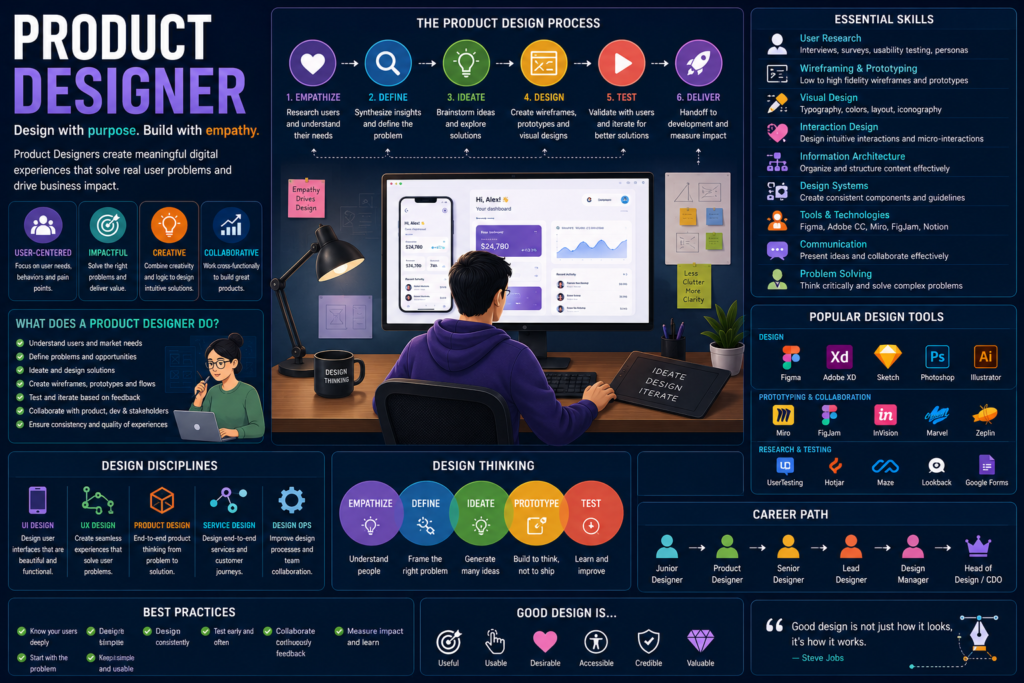
In today’s digital-first world, exceptional products are built by understanding users, solving meaningful problems, and delivering intuitive experiences. At the center of this process is the Product Designer—a professional responsible for shaping how products look, feel, and function.
Product Designers combine creativity, user empathy, business understanding, and technical knowledge to create products that meet both user needs and business goals. They work across the entire product lifecycle, from research and ideation to prototyping, testing, and final implementation.
As companies increasingly focus on customer experience and digital innovation, Product Designers have become one of the most valuable roles in technology, startups, and enterprise organizations.
This guide explores the role of a Product Designer, essential skills, design methodologies, tools, career opportunities, and best practices for building impactful digital products.
What Is a Product Designer?
A Product Designer is responsible for creating and improving products by combining user experience (UX), user interface (UI), research, and product strategy.
Unlike traditional graphic designers who focus primarily on visuals, Product Designers take a holistic approach to solving user problems while aligning with business objectives.
Their responsibilities often include:
- User research
- Problem identification
- Product strategy
- User experience design
- User interface design
- Wireframing and prototyping
- Usability testing
- Design system creation
- Collaboration with developers and stakeholders
The ultimate goal is to create products that are useful, usable, desirable, and valuable.
Why Product Design Matters
Improves User Experience
Well-designed products make it easier for users to accomplish their goals.
Increases Customer Satisfaction
Products that solve real problems effectively lead to happier users.
Drives Business Growth
Better experiences often result in increased engagement, retention, and revenue.
Reduces Development Costs
Identifying issues early through design and testing minimizes expensive changes later.
Strengthens Brand Value
Consistent and thoughtful design helps build trust and loyalty.
The Product Design Process
Successful Product Designers follow a structured process that focuses on users and outcomes.
1. User Research
Research is the foundation of great product design.
Common research methods include:
- User interviews
- Surveys
- Customer feedback
- Market research
- Competitor analysis
- Behavioral analytics
The objective is to understand user needs, motivations, challenges, and goals.
2. Problem Definition
After gathering insights, designers define the core problem that needs solving.
This phase often includes:
- User personas
- Customer journey maps
- Problem statements
- Opportunity identification
3. Ideation
Designers brainstorm possible solutions and explore multiple concepts.
Techniques include:
- Brainstorming workshops
- Sketching
- Design sprints
- Mind mapping
4. Wireframing
Wireframes provide a structural blueprint of the product.
Benefits include:
- Early validation
- Improved communication
- Faster iterations
- Clear information architecture
5. Prototyping
Prototypes simulate product functionality before development begins.
Types include:
- Low-fidelity prototypes
- Mid-fidelity prototypes
- High-fidelity prototypes
- Interactive prototypes
6. Usability Testing
Real users interact with prototypes to identify issues and opportunities for improvement.
Testing helps answer questions such as:
- Is the interface intuitive?
- Can users complete tasks successfully?
- Where do users experience friction?
7. Implementation and Iteration
After validation, designs move into development and continue evolving based on feedback and performance metrics.
Key Responsibilities of a Product Designer
User Experience Design (UX)
Product Designers ensure products are:
- Useful
- Intuitive
- Efficient
- Accessible
- Enjoyable
User Interface Design (UI)
Designing visually appealing and consistent interfaces.
Includes:
- Layouts
- Typography
- Colors
- Icons
- Components
- Interactions
Product Strategy
Understanding business goals and aligning design solutions with company objectives.
Collaboration
Working closely with:
- Product Managers
- Developers
- Researchers
- Marketing Teams
- Stakeholders
Essential Skills for Product Designers
User Research
The ability to gather and analyze user insights effectively.
Wireframing and Prototyping
Creating visual representations of product ideas.
Visual Design
Strong understanding of:
- Typography
- Color theory
- Layout principles
- Branding
Interaction Design
Designing intuitive interactions and workflows.
Problem Solving
Identifying challenges and developing innovative solutions.
Communication
Presenting ideas clearly and collaborating across teams.
Product Thinking
Understanding how design decisions impact business outcomes.
Popular Product Design Tools
Figma
The leading collaborative design platform.
Key features:
- Interface design
- Prototyping
- Design systems
- Team collaboration
FigJam
Supports brainstorming, workshops, and ideation.
Adobe Creative Cloud
Useful for advanced visual design work.
Sketch
Popular for interface and product design.
Miro
Ideal for collaborative planning and journey mapping.
Notion
Supports documentation and design collaboration.
Maze
Facilitates usability testing and user research.
Design Thinking in Product Design
Design Thinking is a user-centered framework widely used by Product Designers.
The process typically includes:
Empathize
Understand user needs.
Define
Clearly identify the problem.
Ideate
Generate potential solutions.
Prototype
Build representations of ideas.
Test
Gather feedback and improve solutions.
Design Thinking encourages innovation while minimizing risk.
Design Systems
A design system is a collection of reusable components, standards, and guidelines.
Benefits include:
- Consistency
- Faster development
- Improved collaboration
- Better scalability
Common elements include:
- Typography styles
- Color palettes
- Buttons
- Forms
- Icons
- Layout grids
Product Designer vs UX Designer
Although similar, these roles differ slightly.
UX Designer
Focuses primarily on user experience, research, and usability.
Product Designer
Combines UX, UI, business strategy, and product development.
Product Designers often take a broader view of product success.
Product Designer vs UI Designer
UI Designer
Focuses mainly on visual interfaces and aesthetics.
Product Designer
Addresses both functionality and visual design while considering business objectives.
Product Design Best Practices
Design for Users
User needs should guide every decision.
Validate Assumptions
Test ideas before investing heavily in development.
Keep Interfaces Simple
Reduce complexity whenever possible.
Prioritize Accessibility
Design products that work for all users.
Measure Outcomes
Track performance metrics and user feedback.
Collaborate Frequently
Cross-functional collaboration leads to better products.
Career Path for Product Designers
Junior Product Designer
Learns design fundamentals and contributes to projects.
Product Designer
Handles end-to-end design responsibilities independently.
Senior Product Designer
Leads major initiatives and mentors team members.
Lead Product Designer
Guides design direction across multiple products.
Design Manager
Oversees teams and design operations.
Head of Design
Defines organizational design strategy.
Chief Design Officer (CDO)
Leads company-wide design vision and innovation.
Future Trends in Product Design
Artificial Intelligence
AI-powered tools are accelerating research, design, and prototyping.
Personalized Experiences
Products increasingly adapt to individual user preferences.
Voice and Conversational Interfaces
Designing for voice interactions continues to grow.
Augmented Reality (AR)
AR creates immersive and interactive user experiences.
Design Systems at Scale
Organizations continue investing in scalable design frameworks.
Accessibility-First Design
Inclusive design is becoming a core business requirement.
Benefits of Becoming a Product Designer
- High demand worldwide
- Excellent salary opportunities
- Creative and strategic work
- Remote work flexibility
- Continuous learning
- Strong career progression
- Direct impact on products and users
Conclusion
Product Designers play a critical role in creating products that people love to use. By combining research, strategy, UX, UI, and problem-solving skills, they help organizations build meaningful experiences that drive customer satisfaction and business success.
As digital products continue to evolve, Product Design remains one of the most exciting and influential careers in technology. Professionals who master user-centered design, collaboration, and product thinking will be well-positioned to shape the future of digital innovation.