Introduction
Quality Assurance (QA) Testers play a vital role in software development by ensuring applications function correctly, meet business requirements, and provide excellent user experiences. Before any software product reaches customers, QA professionals thoroughly test it to identify defects, verify functionality, and maintain quality standards.
As software systems become increasingly complex, organizations depend on skilled QA Testers to deliver reliable, secure, and high-performing products. Whether testing websites, mobile applications, enterprise software, or cloud platforms, QA professionals help prevent costly issues and improve customer satisfaction.
This guide explores the responsibilities, skills, testing methodologies, tools, career paths, and best practices for becoming a successful QA Tester.
What Is a QA Tester?
A QA Tester is a professional responsible for evaluating software applications to ensure they meet specified requirements and quality standards.
QA Testers identify bugs, verify functionality, test performance, and help improve the overall quality of software products before release.
Typical responsibilities include:
- Creating test cases
- Executing test plans
- Identifying bugs and defects
- Reporting issues to developers
- Verifying bug fixes
- Performing regression testing
- Collaborating with development teams
- Ensuring product quality
Why Quality Assurance Matters
Improves Software Quality
Testing helps identify issues before customers encounter them.
Enhances User Experience
Reliable software creates positive customer experiences.
Reduces Development Costs
Finding defects early is significantly less expensive than fixing production issues.
Increases Customer Satisfaction
High-quality products improve trust and brand reputation.
Supports Business Success
Reliable applications contribute to customer retention and business growth.
Types of Software Testing
Manual Testing
Manual testing involves executing test cases without automation tools.
Benefits include:
- Human perspective
- Exploratory testing
- Usability validation
Automation Testing
Automated testing uses scripts and tools to execute tests repeatedly.
Advantages include:
- Faster execution
- Greater test coverage
- Improved efficiency
Functional Testing
Verifies that software features work according to requirements.
Regression Testing
Ensures new changes do not break existing functionality.
Integration Testing
Tests interactions between multiple components or systems.
System Testing
Evaluates the complete application in a production-like environment.
User Acceptance Testing (UAT)
Confirms the software meets business and user expectations.
Performance Testing
Measures speed, scalability, and system responsiveness.
Security Testing
Identifies vulnerabilities and security weaknesses.
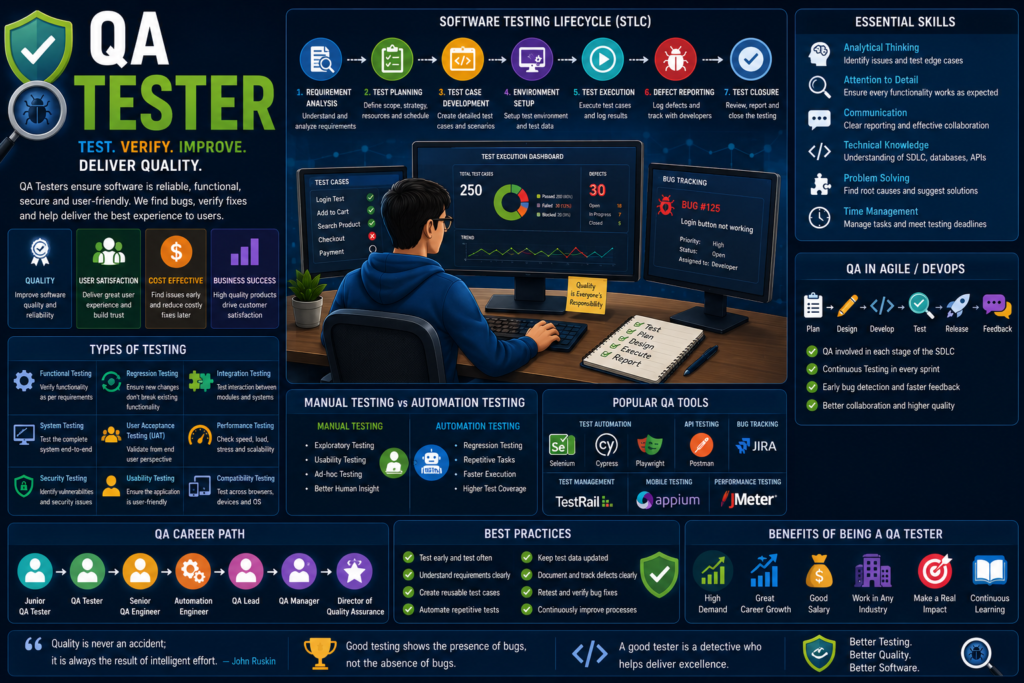
Software Testing Lifecycle (STLC)
Requirement Analysis
Understanding business and technical requirements.
Test Planning
Defining testing scope, objectives, resources, and timelines.
Test Case Development
Creating detailed scenarios for validation.
Test Environment Setup
Preparing hardware, software, and configurations.
Test Execution
Running tests and documenting results.
Defect Reporting
Logging issues and collaborating with developers.
Test Closure
Reviewing outcomes and documenting lessons learned.
Essential Skills for QA Testers
Analytical Thinking
Ability to identify potential problems and edge cases.
Attention to Detail
Small issues can significantly impact software quality.
Communication Skills
QA professionals must clearly document and communicate findings.
Problem Solving
Understanding root causes of defects and testing challenges.
Technical Knowledge
Familiarity with software development concepts and technologies.
Popular QA Testing Tools
Selenium
One of the most widely used automation testing frameworks.
Cypress
Modern testing tool for web applications.
Playwright
Powerful automation framework for modern browsers.
Postman
Used for API testing and validation.
JIRA
Popular bug tracking and project management platform.
TestRail
Test case management and reporting solution.
Appium
Automation testing framework for mobile applications.
Manual Testing vs Automation Testing
Manual Testing
Best for:
- Exploratory testing
- User experience validation
- Ad-hoc testing
Automation Testing
Best for:
- Regression testing
- Repetitive tasks
- Continuous integration pipelines
Most organizations combine both approaches for maximum effectiveness.
QA in Agile Development
Modern software teams often follow Agile methodologies.
QA professionals participate in:
- Sprint planning
- Daily standups
- User story reviews
- Continuous testing
- Sprint retrospectives
This approach promotes faster feedback and improved product quality.
Bug Reporting Best Practices
Effective bug reports should include:
- Clear title
- Detailed description
- Reproduction steps
- Expected results
- Actual results
- Screenshots or videos
- Environment information
- Severity level
Well-documented defects help developers resolve issues efficiently.
Career Path for QA Professionals
Junior QA Tester
Learns testing fundamentals and executes test cases.
QA Tester
Independently performs testing activities and reports defects.
Senior QA Engineer
Leads testing efforts and mentors team members.
Automation Engineer
Develops automated testing frameworks and scripts.
QA Lead
Manages QA teams and testing strategies.
QA Manager
Oversees quality assurance operations across projects.
Director of Quality Assurance
Defines organizational quality strategies and standards.
Best Practices for QA Testing
- Test early and often
- Automate repetitive tests
- Maintain clear documentation
- Prioritize critical functionality
- Collaborate closely with developers
- Focus on user experience
- Continuously improve testing processes
- Keep learning new tools and technologies
Future Trends in Quality Assurance
AI-Powered Testing
Artificial intelligence is helping automate test creation and defect detection.
Continuous Testing
Testing is increasingly integrated throughout the development lifecycle.
Shift-Left Testing
Quality activities begin earlier in development processes.
Test Automation Expansion
Organizations continue increasing automation coverage.
Cloud-Based Testing
Cloud platforms provide scalable testing environments.
DevOps and QA Integration
Testing becomes more tightly integrated with CI/CD pipelines.
Benefits of Becoming a QA Tester
- High industry demand
- Strong career growth opportunities
- Entry point into technology careers
- Opportunities in automation and DevOps
- Remote work possibilities
- Continuous learning
- Critical role in software development
Conclusion
QA Testers are essential to delivering reliable, secure, and user-friendly software products. Through systematic testing, defect identification, and quality validation, they help organizations release software with confidence.
As software development continues evolving, QA professionals who master modern testing methodologies, automation tools, and Agile practices will remain highly valuable. A career in Quality Assurance offers excellent opportunities for growth, specialization, and long-term success in the technology industry.