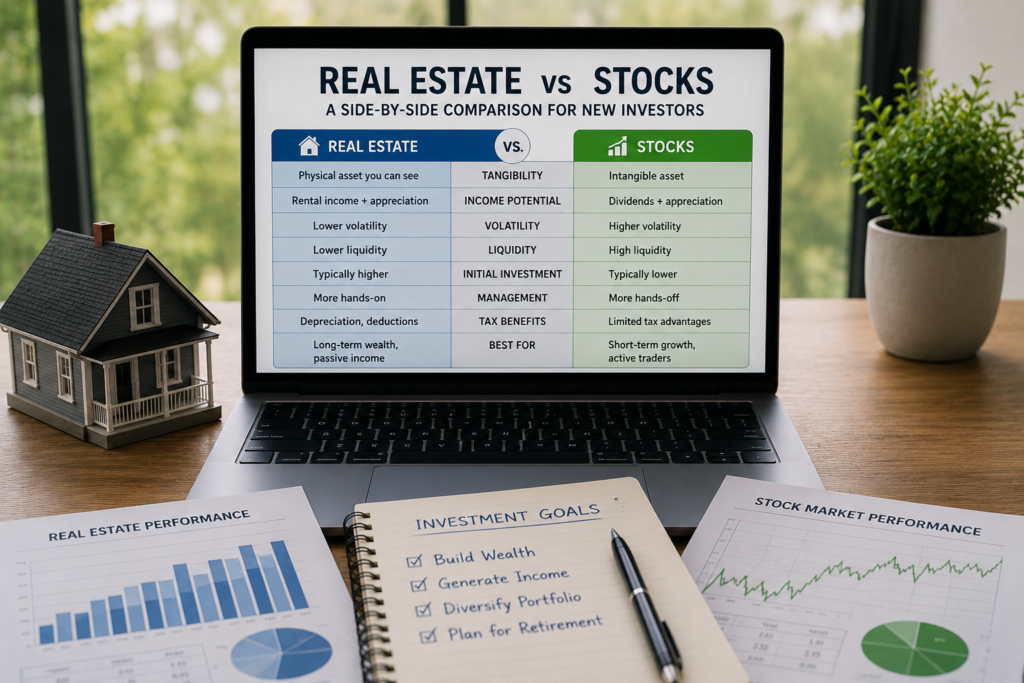
You’ve got some money saved up. Maybe it’s $10,000 from a year of disciplined budgeting, maybe it’s $50,000 from an inheritance, or maybe it’s just the steady drip of a paycheck that you’re finally ready to put to work. Either way, you’ve arrived at the question that every beginning investor faces:
Should I put my money into real estate or stocks?
The internet is full of passionate advocates on both sides. Real estate investors will tell you that stocks are just numbers on a screen and that tangible property is the only “real” investment. Stock market enthusiasts will counter that real estate is illiquid, management-heavy, and that the S&P 500 has outperformed most landlords over the long haul.
Both sides are right about some things and wrong about others. The honest answer is that both asset classes can build serious wealth, and the best choice depends on your financial situation, your personality, your goals, and how much time you’re willing to invest alongside your money.
This comparison breaks down both options across every dimension that matters: returns, risk, time commitment, tax treatment, liquidity, accessibility, and more. No cheerleading for either side. Just a clear-eyed look at what each path demands and what each path delivers.
The Returns Question: Which One Actually Makes More Money?
This is the question everyone asks first, and the answer is more complicated than either camp admits.
Stock Market Returns
The S&P 500, the most commonly cited benchmark for U.S. stock market performance, has delivered an average annual return of approximately 10% over the past century. Adjusted for inflation, that number drops to roughly 7%.
That 10% figure includes both price appreciation (stocks going up in value) and dividends (cash payments companies distribute to shareholders). It assumes you reinvest those dividends, which is how compounding does its work.
A $10,000 investment in an S&P 500 index fund growing at 10% per year becomes roughly $67,000 in 20 years and $174,000 in 30 years. Without adding a single dollar beyond the initial investment.
But averages can mislead. The stock market doesn’t deliver a smooth 10% every year. It delivers 25% one year, -15% the next, 32% the year after, and -38% during a crash. The average over decades is 10%, but the experience along the way is volatile. An investor who put money in at the peak before the 2008 financial crisis didn’t break even for roughly five years.
Real Estate Returns
Real estate returns are harder to pin down because they come from multiple sources and vary dramatically by market, property type, and strategy.
The components of real estate returns include:
Appreciation. The increase in property value over time. Nationally, U.S. home prices have appreciated at roughly 3-4% per year over the long term. In high-growth markets, appreciation can run 6-10% annually for extended periods. In stagnant markets, it might hover near zero.
Cash flow. The monthly income from rent after subtracting all expenses (mortgage, taxes, insurance, maintenance, vacancy). A well-chosen rental property might generate 4-8% cash-on-cash return annually, meaning the cash profit relative to the cash you invested.
Loan paydown. Your tenants’ rent payments reduce your mortgage balance each month. Over 30 years, this converts a large debt into full ownership of an asset. The equity gain from principal paydown isn’t cash in your pocket today, but it builds wealth steadily.
Tax benefits. Depreciation deductions, mortgage interest deductions, and other tax advantages effectively increase your after-tax return. We’ll cover these in detail later.
When you combine all four components, a leveraged rental property can deliver total returns of 15-25% annually on invested capital. That sounds dramatically higher than stocks, and it can be, but it comes with caveats we’ll address in the risk section.
The Leverage Factor
The biggest reason real estate returns can outpace stock returns is leverage: you’re investing with borrowed money.
When you buy $300,000 worth of stock, you typically invest $300,000 of your own cash. When you buy a $300,000 rental property, you might invest $60,000 (20% down) and borrow $240,000.
If both assets appreciate by 5% in a year, your stock portfolio gains $15,000 on a $300,000 investment (5% return). Your real estate gains $15,000 on a $60,000 investment (25% return). The asset appreciated at the same rate, but leverage multiplied your return on invested capital.
Leverage is a double-edged mechanism, though. If that property drops 10% in value, you’ve lost $30,000, which is 50% of your $60,000 investment. The same 10% drop on a $300,000 stock portfolio costs you $30,000, or 10% of your investment. Leverage amplifies gains and losses in equal measure.
The Honest Comparison
Comparing raw returns between real estate and stocks is like comparing a business you run to a business you invest in passively. The higher potential returns in real estate reflect the additional work, risk, and complexity involved. Stocks deliver lower but more passive returns that require almost no ongoing effort.
Neither is objectively “better.” They’re different tools that serve different purposes.
Risk: What Can Go Wrong With Each
Every investment carries risk. Understanding the specific risks of each asset class helps you decide which ones you’re equipped to handle.
Stock Market Risks
Market volatility. Stock prices fluctuate daily, sometimes dramatically. A portfolio can lose 20-40% of its value during a market crash. The COVID crash of March 2020 wiped out 34% of the S&P 500 in 23 trading days. The 2008 financial crisis saw a peak-to-trough decline of 57%.
The counterpoint: every major crash in U.S. stock market history has been followed by a full recovery and new highs. The 2020 crash recovered in less than five months. The 2008 crash took about five years. If you don’t panic-sell during downturns, volatility is a temporary experience rather than a permanent loss.
Individual stock risk. If you buy shares of a single company and that company fails, you lose your entire investment. Enron, Lehman Brothers, and Blockbuster shareholders learned this the hard way. This risk is almost entirely eliminated through diversification (owning an index fund with hundreds or thousands of stocks).
Inflation risk. Stocks generally outpace inflation over the long term, but certain market environments (prolonged stagflation, for example) can erode real returns for extended periods.
Behavioral risk. The biggest risk in stock investing is the investor, not the investment. Studies consistently show that average investors significantly underperform the market because they buy when prices are high (excitement), sell when prices are low (fear), and trade too frequently (overconfidence). The S&P 500 might return 10% annually, but the average equity investor captures only 6-7% because of poorly timed decisions.
Real Estate Risks
Illiquidity risk. If you need to sell a property quickly, you’re at the mercy of the local market. Selling a house takes 30 to 90 days in a healthy market and much longer in a slow one. You can’t sell 10% of a house the way you can sell 10% of a stock portfolio.
Concentration risk. A single rental property might represent $300,000 or more of your net worth, all concentrated in one asset, in one neighborhood, in one city. If the local economy declines, your employer shuts down, or the neighborhood deteriorates, your investment suffers in a way that a diversified stock portfolio wouldn’t.
Tenant risk. Bad tenants can damage property, stop paying rent, and drag you through expensive eviction proceedings. A six-month eviction process with a non-paying tenant can easily cost $10,000 to $20,000 in lost rent, legal fees, and repairs.
Maintenance and capital expenditure risk. Properties break. Roofs need replacement ($8,000-$15,000). HVAC systems fail ($5,000-$12,000). Plumbing develops problems that cost thousands to fix. These expenses hit irregularly and can wipe out months or years of cash flow if you haven’t reserved for them.
Interest rate risk. If you have a variable-rate mortgage or need to refinance, rising interest rates can significantly increase your monthly payments and reduce cash flow. Even with a fixed-rate mortgage, rising rates affect property values because higher rates mean fewer qualified buyers.
Regulatory risk. Rent control ordinances, eviction moratoriums, zoning changes, and new landlord-tenant regulations can affect your income and property rights. The COVID-era eviction moratoriums demonstrated how quickly government action can alter the operating environment for landlords.
Local market dependency. Stock markets are global and diversified by default (an S&P 500 index fund holds 500 companies across every sector). Real estate is inherently local. Your returns depend heavily on the economic health of one specific geographic area.
Risk Comparison Summary
Stock market risk is primarily about volatility (temporary price swings that recover over time) and behavioral mistakes (selling at the wrong time). The risk is largely psychological.
Real estate risk is primarily about operational problems (bad tenants, expensive repairs, regulatory changes) and concentration (too much wealth tied to one asset in one location). The risk is largely practical and managerial.
Time and Effort: The Hidden Cost
This is the dimension that most investment comparisons ignore, and it’s often the deciding factor.
Time Investment for Stocks
A passive stock investor (someone who buys and holds index funds) spends almost zero time managing their investments. You set up automatic contributions to an index fund, rebalance once a year (or let a target-date fund do it for you), and check your account occasionally. Total annual time commitment: 2-5 hours.
Even active stock investors who research individual companies, read earnings reports, and manage their own portfolios rarely spend more than 5-10 hours per week. And that activity is optional, since passive investing matches or outperforms most active strategies.
Time Investment for Real Estate
Active real estate investing is a part-time job, sometimes a full-time one.
Before you even buy a property, expect to spend 50-200 hours on education, market research, property searches, financial analysis, inspections, negotiations, and closing. The acquisition process alone demands significant time and mental energy.
After you own the property, ongoing responsibilities include:
- Finding and screening tenants (5-20 hours per vacancy)
- Handling maintenance requests (variable, but plan for 2-5 hours per month)
- Coordinating repairs with contractors (highly variable)
- Managing bookkeeping and financial records (2-3 hours per month)
- Handling lease renewals, rent increases, and tenant communications
- Dealing with emergencies (midnight plumbing floods, heating failures in winter)
You can outsource much of this to a property management company, but that typically costs 8-12% of gross rent, which directly reduces your returns. A property that cash flows $400/month before management fees might cash flow $200/month after paying a manager. The time-money trade-off is real and measurable.
The Value of Your Time
If you earn $50/hour at your job and spend 15 hours per month managing a rental property, that’s $750/month in opportunity cost. If the property cash flows $500/month, you’re effectively earning negative returns on your time.
This calculation matters most for high-income professionals. A surgeon earning $400/hour is probably better off investing in index funds and spending their time seeing patients. A teacher earning $35/hour might find that the returns from a well-managed rental property justify the time investment.
Neither answer is wrong. But ignoring the time component leads to an incomplete comparison.
Liquidity: How Quickly Can You Access Your Money?
Liquidity, the speed and ease with which you can convert an investment to cash, is one of the starkest differences between real estate and stocks.
Stock Liquidity
Publicly traded stocks are among the most liquid investments on earth. You can sell shares of an S&P 500 index fund at any point during market hours and have cash in your brokerage account within one to two business days. There’s no negotiation, no listing period, no waiting for a buyer. You click “sell,” and it’s done.
This liquidity provides both financial and psychological benefits. You always know you can access your money if you need it. A medical emergency, a job loss, or an unexpected opportunity doesn’t require you to sell a house.
The downside of stock liquidity is that it makes impulsive decisions too easy. Selling during a market crash takes about 30 seconds. The barrier to making a bad decision is almost nonexistent.
Real Estate Liquidity
Real estate is one of the least liquid major asset classes. Selling a property involves listing preparation, marketing, showings, negotiations, inspections, appraisals, and closing. The process takes 30 to 90 days in a healthy market and can stretch much longer in a slow one.
Selling costs are substantial: real estate agent commissions (5-6% of sale price), closing costs, potential repair credits, and staging expenses. On a $300,000 property, selling costs might total $20,000 to $25,000. Compare that to selling $300,000 worth of index funds, where the transaction cost is essentially zero.
You can access equity without selling through refinancing or a home equity line of credit (HELOC), but these take weeks to arrange and add debt to your balance sheet.
The illiquidity of real estate is a genuine constraint. If you need cash quickly, a rental property is the wrong place to store it. But illiquidity has an unexpected upside: it prevents impulsive decisions. You can’t panic-sell a house at 2 AM during a market dip. The friction of selling real estate protects investors from their own worst instincts.
Getting Started: Minimum Investment and Accessibility
Starting With Stocks
The barrier to entry for stock investing has never been lower. Most major brokerages have zero account minimums, zero trading commissions, and offer fractional shares, meaning you can buy a piece of an S&P 500 index fund for as little as $1.
A complete stock investing setup takes about 30 minutes:
- Open a brokerage account (Fidelity, Schwab, Vanguard, or similar)
- Link your bank account
- Transfer funds
- Buy shares of a broad market index fund
That’s it. You’re now invested in 500 of the largest companies in America. No special knowledge required. No license needed. No employees to manage.
You can start with virtually any amount, add money whenever you can, and automate the entire process. A 22-year-old contributing $200/month to an index fund is building real wealth from day one.
Starting With Real Estate
The barrier to entry for real estate is meaningfully higher.
Cash requirements. Even with low-down-payment options like FHA loans (3.5% down), a $300,000 property requires roughly $10,500 for the down payment plus $8,000 to $12,000 in closing costs. You’ll want cash reserves of three to six months of property expenses on top of that. Total cash needed: $25,000 to $40,000 for a modest property in a mid-price market.
Credit requirements. Mortgage lenders require a minimum credit score (580 for FHA, 620+ for conventional), verified income history, and a manageable debt-to-income ratio. Not everyone qualifies.
Knowledge requirements. Buying an investment property without understanding market analysis, property evaluation, rental income projections, and landlord-tenant law is a recipe for expensive mistakes. The learning curve is real, and the cost of errors is measured in thousands or tens of thousands of dollars.
Geographic constraints. Stock investors can invest in companies anywhere in the world from their couch. Real estate investors are constrained by geography, either investing locally (where they can manage the property) or learning to invest remotely (which adds complexity and risk).
The Middle Ground: REITs
Real Estate Investment Trusts (REITs) offer a hybrid approach. REITs are companies that own, operate, or finance income-producing real estate. They trade on stock exchanges like regular stocks, meaning you can buy and sell them instantly with no minimum investment.
REITs give you exposure to real estate returns (including dividends that typically yield 3-6%) without the down payment, management burden, or illiquidity of direct property ownership.
The trade-off is that you lose the leverage advantage, the hands-on control, and some of the tax benefits that direct real estate ownership provides. REITs are taxed as ordinary income rather than receiving the preferential capital gains treatment that direct ownership can offer.
For investors who want real estate exposure without becoming landlords, REITs are worth serious consideration. They can serve as a bridge while you save up for direct property investment, or as a permanent allocation in a diversified portfolio.
Tax Treatment: Where Real Estate Has a Clear Edge
If there’s one area where real estate has an unambiguous advantage over stocks, it’s tax treatment. The U.S. tax code is structured in ways that favor real estate investors at almost every stage of the investment lifecycle.
Tax Advantages of Real Estate
Depreciation. The IRS allows you to deduct the theoretical “wear and tear” on your rental property over 27.5 years for residential real estate. This is a paper deduction, meaning you’re not spending any actual money, but it reduces your taxable rental income.
Example: A rental property with a building value of $250,000 generates an annual depreciation deduction of approximately $9,090 ($250,000 ÷ 27.5). If the property generates $12,000 in net rental income, depreciation reduces your taxable income to just $2,910. On a $12,000 income stream, you might owe taxes on less than $3,000.
Mortgage interest deduction. Interest paid on a rental property mortgage is fully deductible against rental income. In the early years of a mortgage, when interest makes up the majority of each payment, this deduction can be substantial.
1031 exchange. When you sell an investment property, you can defer all capital gains taxes by reinvesting the proceeds into a “like-kind” property through a 1031 exchange. You can repeat this process indefinitely, deferring taxes across multiple properties for decades. Some investors never pay capital gains taxes on real estate because they continue exchanging into larger properties throughout their lifetime.
Pass-through deduction. Rental income may qualify for the 20% qualified business income (QBI) deduction under Section 199A, further reducing the effective tax rate on rental profits.
Cost segregation. An advanced strategy where a professional engineer identifies components of your property (appliances, carpeting, certain fixtures) that can be depreciated faster than 27.5 years. This front-loads depreciation deductions and can create paper losses that offset other income.
Step-up in basis at death. If you hold real estate until you pass away, your heirs receive the property at its current market value (stepped-up basis), eliminating all accumulated capital gains and depreciation recapture. All the taxes you deferred during your lifetime through 1031 exchanges? Gone permanently.
Tax Treatment of Stocks
Stock investors have fewer tax advantages, but the ones that exist are meaningful:
Long-term capital gains rates. Stocks held for more than one year qualify for long-term capital gains tax rates (0%, 15%, or 20% depending on income), which are lower than ordinary income tax rates.
Tax-advantaged accounts. IRAs, 401(k)s, Roth IRAs, and other retirement accounts allow stock investments to grow tax-deferred or tax-free. A Roth IRA, where gains are never taxed, is one of the most powerful wealth-building tools available. Real estate can be held in self-directed IRAs, but the process is complex and restrictive.
Tax-loss harvesting. Stock investors can sell losing positions to offset gains, reducing their tax bill. This strategy is straightforward to execute and can save meaningful amounts in taxable accounts.
Qualified dividends. Most dividends from U.S. stocks are taxed at the lower long-term capital gains rate rather than ordinary income rates.
The Tax Verdict
For taxable investment accounts, real estate offers more and larger tax advantages than stocks. Depreciation alone is a powerful tool that has no direct equivalent in stock investing. The ability to defer taxes indefinitely through 1031 exchanges and eliminate them entirely through the stepped-up basis at death creates a tax efficiency that stocks can’t match.
Stocks close the gap significantly when held in tax-advantaged retirement accounts (Roth IRAs, 401(k)s), where gains compound tax-free. The combination of low-cost index funds and tax-free growth in a Roth IRA is one of the simplest and most tax-efficient wealth-building strategies available.
Cash Flow and Passive Income
Both asset classes can generate ongoing income, but they do it differently.
Stock Income
Dividend-paying stocks and funds distribute cash payments, typically quarterly. The average dividend yield of the S&P 500 hovers around 1.3-1.8%. A $500,000 stock portfolio might generate $7,500 to $9,000 per year in dividends.
You can increase dividend income by focusing on high-dividend stocks or dividend-focused ETFs, where yields can reach 3-5%. But higher yields sometimes come with higher risk or slower price appreciation.
The advantage of stock dividends is that they require zero effort. You don’t maintain anything, manage anyone, or fix anything. The cash appears in your account automatically.
The disadvantage is that dividend income from a typical portfolio is relatively modest. You need a large portfolio (often $1 million or more) to generate enough dividend income to meaningfully impact your lifestyle.
Real Estate Income
Rental income tends to be larger in absolute dollars relative to invested capital, thanks to leverage. A $60,000 down payment on a $300,000 rental property might generate $400 to $800/month in net cash flow. That’s $4,800 to $9,600 per year on a $60,000 investment, a cash-on-cash return of 8-16%.
To generate that same $9,600/year from stock dividends at a 2% yield, you’d need a $480,000 portfolio.
The advantage is clear: real estate produces more income per dollar invested. The disadvantage is that the income isn’t passive in the way stock dividends are. Rental income comes with management responsibilities, tenant interactions, and occasional capital calls when things break.
Which Type of Income Is More Reliable?
Stock dividends can be cut or eliminated at any time. During the 2020 pandemic, hundreds of companies reduced or suspended their dividends. That said, high-quality dividend stocks (companies with 25+ year track records of increasing dividends, known as Dividend Aristocrats) have historically maintained payments through multiple recessions.
Rental income is contractually obligated by a lease, which provides short-term predictability. But tenants can stop paying (triggering eviction proceedings), move out (creating vacancy), or the local rental market can soften (forcing you to lower rents). A single bad tenant or extended vacancy can eliminate months of cash flow.
Neither income stream is guaranteed. Both require smart selection and ongoing attention to maintain.
Diversification: Spreading Your Risk
Diversifying With Stocks
Stock diversification is easy and cheap. A single share of a total stock market index fund gives you ownership in thousands of companies across every industry. You can add international exposure with a global index fund, bond exposure with a bond fund, and sector-specific exposure with targeted ETFs.
Building a diversified stock portfolio takes minutes and costs nothing beyond the share price.
Diversifying With Real Estate
Real estate diversification is expensive and slow. Each property costs tens of thousands in down payment and closing costs. Building a diversified real estate portfolio (multiple properties in different markets, different property types) requires significant capital and years of accumulation.
Most small real estate investors have one to three properties, all in the same geographic area. That’s concentrated risk by any definition. A local economic downturn, a natural disaster, or a regulatory change can affect every property simultaneously.
REITs offer instant real estate diversification (owning a share of hundreds of properties across multiple markets), but at the cost of the leverage, control, and tax advantages that direct ownership provides.
The Diversification Verdict
Stocks win on diversification accessibility. A $10,000 investment can be spread across thousands of companies worldwide. Achieving the same level of diversification in direct real estate would require millions of dollars and years of acquisition work.
Inflation Protection
Inflation erodes purchasing power. An investment that grows at 5% while inflation runs at 4% is only delivering 1% real growth. How do stocks and real estate perform when prices rise?
Stocks and Inflation
Stocks have historically outpaced inflation over the long term. Companies can raise prices to match inflation, which supports revenue and earnings growth. Over periods of 20+ years, stocks have consistently delivered positive real (after-inflation) returns.
Short-term performance during inflationary spikes is less reliable. During the high-inflation period of the late 1970s and early 1980s, stock returns were poor for several years. Rising interest rates (the Federal Reserve’s primary tool for fighting inflation) tend to pressure stock valuations.
Real Estate and Inflation
Real estate is one of the strongest inflation hedges available. When inflation rises, two things typically happen that benefit real estate investors:
Rents increase. Landlords raise rents to keep pace with rising costs of living. This directly increases your income stream. In inflationary periods, rental income often grows faster than inflation because housing is a basic need with inelastic demand.
Property values rise. The replacement cost of building new housing increases with inflation (higher material costs, higher labor costs), which supports the value of existing properties. Your fixed-rate mortgage becomes cheaper in real terms because you’re repaying it with dollars that are worth less than when you borrowed them.
Fixed-rate debt becomes a weapon. This is the part that makes real estate investors smile during inflation. If you locked in a 30-year fixed mortgage at 6%, and inflation pushes everything else higher, your mortgage payment stays the same while your rental income grows. You’re paying back borrowed money with cheaper dollars while your income and asset value increase.
The Inflation Verdict
Real estate provides stronger direct inflation protection than stocks, especially for leveraged investors with fixed-rate debt. Stocks provide adequate long-term inflation protection but can underperform during acute inflationary periods.
Emotional and Psychological Factors
Numbers don’t tell the whole story. How an investment makes you feel affects how long you hold it, whether you make rational decisions, and ultimately whether you build wealth or destroy it.
The Psychology of Stock Investing
Stock portfolios update in real time. You can check your balance every five minutes (please don’t). This constant visibility means you watch every gain and every loss happen in front of you.
During bull markets, this feels great. During bear markets, it’s agonizing. The temptation to sell during a crash is intense and visceral. You’re watching your net worth shrink by thousands of dollars per day, and the sell button is right there.
The investors who build the most wealth in stocks are the ones who can ignore short-term volatility entirely. This sounds simple, but decades of behavioral finance research confirm that most people can’t do it. Emotional reactions to market swings are the single largest destroyer of stock market returns for individual investors.
The Psychology of Real Estate Investing
Real estate values don’t update in real time. Your property doesn’t send you a push notification when it drops 2% in value. This reduced visibility makes it much easier to hold through market downturns. You’re still collecting rent, still living in or driving past the property, and the absence of a flashing red number on a screen keeps panic at bay.
The emotional challenge with real estate is different. It’s the stress of dealing with tenants, contractors, and unexpected expenses. A stock portfolio never calls you at 1 AM about a burst pipe. A stock portfolio never stops paying dividends because it lost its job. The stress in real estate is operational rather than market-driven.
Control and Agency
Some people find comfort in control. Real estate gives you direct control over your investment. You choose the property, set the rent, select tenants, make improvements, and decide when to sell. If the investment isn’t performing, you can take action to fix it: renovate, raise rents, reduce expenses, change property managers.
Stocks offer no control. You can’t call Apple’s CEO and suggest they cut costs. You can’t vote on Google’s product strategy (technically you can vote shares, but your impact is negligible). Your only decision is buy, hold, or sell.
Neither model is inherently better. People who value control and enjoy hands-on management tend to gravitate to real estate. People who value simplicity and prefer to set-and-forget tend to gravitate to stocks. Know which type you are before choosing where to put your money.
Building Wealth Over 20 Years: Two Scenarios
Let’s model two hypothetical investors over a 20-year period to see how each approach compounds.
Investor A: Stock Market
- Starting investment: $50,000
- Monthly contribution: $1,000
- Average annual return: 9% (conservative, after fees)
- Tax-advantaged account (no taxes on growth)
After 20 years, Investor A’s portfolio is worth approximately $740,000. They spent approximately 5 hours per year managing it (rebalancing and reviewing allocations). Total time invested: 100 hours over 20 years. Their investment grew through market appreciation and compound interest with minimal effort.
Investor B: Real Estate
- Starting investment: $50,000 (used as down payment and closing costs on a duplex)
- Purchase price: $300,000
- Rental income covers mortgage and expenses, with $300/month positive cash flow
- Property appreciates at 3.5% per year
- Mortgage paydown builds equity over time
- After year 3, buys a second property using equity and savings
- After year 7, buys a third property
After 20 years, Investor B owns three properties worth a combined $750,000 to $900,000, with substantial equity from mortgage paydown and appreciation. Monthly cash flow across all properties might reach $2,000 to $3,000/month. They spent 10-15 hours per month managing properties (or paying 8-10% to a property manager). Total time invested: 2,400 to 3,600 hours over 20 years.
What the Scenarios Show
Both investors built comparable wealth. Investor A did it with dramatically less time investment. Investor B has higher monthly cash flow and stronger tax advantages but traded thousands of hours for those benefits.
The stock investor had a simpler, less stressful path. The real estate investor had more control and more current income. Neither approach was wrong.
The key variable isn’t which investment performed better. It’s how each investor valued their time, and whether they preferred passive growth or active income.
When Stocks Are the Better Choice
Stock investing makes more sense when:
You’re just starting out with small amounts. If you have $100 to $500/month to invest, stocks are your only practical option. You can start immediately, invest any amount, and let compounding do the work while you build capital.
You value simplicity and automation. If you want an investment strategy you can set up in 30 minutes and manage in 5 hours per year, passive index fund investing is hard to beat.
You need liquidity. If there’s a reasonable chance you’ll need access to your money within the next few years, stocks provide that flexibility. You can sell any amount at any time without the costs and delays of selling property.
You’re maximizing tax-advantaged accounts. If you haven’t maxed out your 401(k) match, IRA, or Roth IRA contributions, that’s generally the best first use of investment dollars. The combination of tax-free growth and low-cost index funds inside these accounts is extraordinarily efficient.
You don’t want to be a landlord. If the idea of dealing with tenants, maintenance calls, and property management sounds deeply unappealing, don’t force yourself into real estate. An unhappy landlord makes poor decisions. There’s no shame in choosing the simpler path if it matches your temperament and goals.
You want geographic flexibility. If your career might require relocating, or you simply don’t want to be tied to a specific city, stock investing lets you maintain your strategy from anywhere in the world with an internet connection.
When Real Estate Is the Better Choice
Real estate makes more sense when:
You want current income. If generating monthly cash flow is a priority (rather than building a nest egg for 30 years), real estate delivers more income per dollar invested than stocks, thanks to leverage.
You want to use leverage safely. Borrowing money to buy stocks (margin trading) is risky and can result in losses exceeding your investment. Borrowing money to buy real estate (a mortgage) is standard practice, supported by decades of lending infrastructure, and carries far less margin-call risk.
You’re focused on tax optimization. If you’re in a high tax bracket and want to reduce your taxable income, real estate’s depreciation deductions, 1031 exchanges, and other tax benefits can save thousands of dollars per year in taxes. No stock market strategy offers the same depth of tax advantages outside of retirement accounts.
You enjoy hands-on management. If you find property management interesting rather than burdensome, if you like evaluating deals, improving properties, and building relationships with tenants, real estate investing aligns with your natural tendencies.
You have capital for a down payment. If you’ve saved enough for a property down payment, closing costs, and cash reserves, real estate becomes accessible and the leverage advantage kicks in.
You want inflation protection with income. If you’re worried about inflation eroding your purchasing power, a leveraged real estate portfolio with fixed-rate debt and rising rents is one of the strongest inflation hedges available.
The Case for Both
Here’s what the most thoughtful investors eventually figure out: you don’t have to choose.
A portfolio that includes both stocks and real estate captures the strengths of each while offsetting the weaknesses.
Stocks provide liquidity, diversification, simplicity, and access to global economic growth. Real estate provides leverage, tax advantages, inflation protection, and current income.
A practical combined approach might look like this:
- Max out your 401(k) match and Roth IRA with low-cost index funds (stocks)
- Build an emergency fund and down payment savings in a high-yield savings account
- Purchase your first rental property (real estate)
- Continue contributing to index funds monthly while managing the property
- Use real estate cash flow to accelerate stock investments, or use stock market gains to fund the next property down payment
This blended strategy builds wealth on two fronts simultaneously. If the stock market has a bad decade, your real estate provides income and tax-advantaged growth. If the real estate market in your area stagnates, your diversified stock portfolio captures growth elsewhere.
The debate between “real estate vs. stocks” assumes you need to pick a team. You don’t. The wealthiest individual investors typically own both, in proportions that match their personal skills, risk tolerance, and lifestyle preferences.
Making Your Decision
Here’s a framework for deciding where to start:
If you have less than $10,000 to invest: Start with stocks. Open a brokerage account, buy a broad market index fund, and set up automatic monthly contributions. Build capital while learning about both asset classes.
If you have $20,000 to $50,000 and want to be hands-on: Consider a house hack. Buy a duplex or small multi-family property with an FHA loan, live in one unit, rent the others. This gives you real estate exposure while reducing your living expenses, freeing up more cash to invest in stocks on the side.
If you have $50,000+ and want simplicity: A three-fund portfolio (U.S. stocks, international stocks, bonds) inside tax-advantaged accounts is one of the most reliable wealth-building strategies ever documented. It requires almost no maintenance and has produced strong results across every 20-year period in modern market history.
If you have $50,000+ and want maximum returns with active involvement: Direct real estate investing, particularly leveraged rental property, offers the highest potential returns among mainstream investment options. But it requires education, time, and willingness to manage the operational demands of property ownership.
If you’re genuinely unsure: Start with stocks. You can always add real estate later, but you can’t start compounding later. Every year you delay investing because you’re waiting for the “right” first move is a year of lost growth. Put money to work today in the simplest way available (an index fund), and continue researching real estate on the side.
The worst decision is no decision. Both real estate and stocks have created generational wealth for millions of ordinary people. The common ingredient in every success story isn’t the asset class. It’s the investor who started, stayed consistent, and let time do what time does.
Pick the path that matches your resources, your temperament, and your goals. Then start. The comparison matters far less than the commitment.