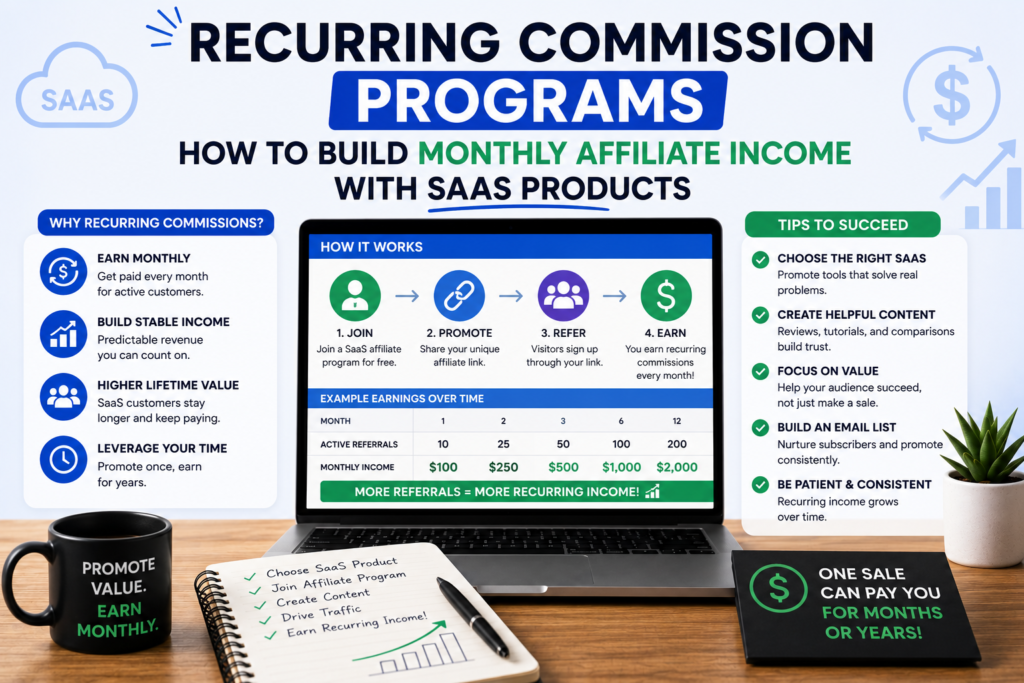
There’s a moment every affiliate marketer hits. You check your dashboard, see a solid month of commissions, and feel great. Then the first of the next month rolls around, and the counter resets to zero. You’re starting from scratch, again, chasing new clicks, new conversions, and new one-time payouts just to match what you earned last month.
That’s the hamster wheel of one-time commission affiliate marketing. And it’s exhausting.
Now picture a different scenario. You wake up on the first of the month and your affiliate dashboard already shows $2,400 in pending commissions. Not from new sales. From customers you referred three, six, or twelve months ago who are still paying for the software you recommended. You haven’t lifted a finger this month, and you’ve already earned more than many affiliates make in a quarter.
That’s the power of recurring commission programs, and SaaS (Software as a Service) products are the best vehicle to get there.
This guide breaks down everything you need to know about building predictable, growing monthly affiliate income through SaaS recurring commissions. You’ll learn how these programs work, how to pick the right ones, and exactly how to promote them so that each month’s income stacks on top of the last.
The Math That Changes Everything
Before we get into strategy, let’s look at the numbers. Because once you see the math behind recurring commissions versus one-time payouts, you’ll understand why experienced affiliates are obsessed with this model.
Scenario A: One-time commissions. You promote a $200 product that pays a 30% commission ($60 per sale). You average 20 sales per month. Monthly income: $1,200. Annual income: $14,400. Every month, you need 20 new sales just to maintain that income. If you take a month off, your income drops to zero.
Scenario B: Recurring commissions. You promote a SaaS tool that costs $49/month and pays a 30% recurring commission ($14.70 per referred customer per month). You average 20 new referrals per month. Month 1: $294. Month 2: $588 (20 new customers plus 20 from last month). Month 6: $1,764. Month 12: $3,528. Annual total: $22,932.
But here’s the part that really matters. In month 13, you start the year with $3,528 already locked in, before you make a single new referral. By month 24, your monthly recurring revenue could exceed $5,000 from the same 20-referrals-per-month pace, even accounting for customer churn.
The compounding effect is the entire game. Each new referral adds a permanent (or at least long-lasting) layer to your monthly income. One-time commissions are like filling a bathtub with the drain open. Recurring commissions gradually close that drain.
Why SaaS Products Are the Ideal Recurring Commission Vehicle
Subscription-based products exist across many industries: meal kits, subscription boxes, membership sites, streaming services. But SaaS products stand out as the strongest recurring commission opportunity for affiliates. Here’s why.
Low churn rates. When a business adopts a SaaS tool, especially one that handles email marketing, CRM, project management, or accounting, switching costs are high. Migrating data, retraining team members, and rebuilding workflows takes real effort. That friction keeps customers subscribed for years, not months. Many SaaS products see average customer lifetimes of 24 to 48 months, which means your recurring commissions keep flowing for a long time.
Predictable billing cycles. SaaS products bill monthly or annually like clockwork. There’s no seasonality, no impulse-buy-and-return pattern, and no inventory issues. Your commissions are steady and predictable, which makes financial planning and business scaling much easier.
Growing customer value. SaaS customers tend to upgrade over time. A solopreneur might start with a $29/month plan and grow into a $99/month plan as their business expands. Many SaaS affiliate programs pay you a percentage of the customer’s actual plan, so your commission grows as they upgrade. You earn more without doing anything extra.
Clear product-market fit is easy to verify. SaaS companies publish case studies, maintain public review profiles on sites like G2 and Capterra, and often share customer counts or revenue milestones. This transparency makes it easy to evaluate whether a product genuinely solves a problem before you promote it.
High perceived value relative to cost. A $49/month tool that saves a business owner 10 hours per week is an obvious value proposition. Customers don’t agonize over that purchase the way they might with a $200 ebook. Lower purchase resistance means higher conversion rates for your promotions.
How SaaS Recurring Commission Programs Actually Work
The mechanics vary by program, but here’s the standard structure you’ll encounter.
Commission percentage. Most SaaS affiliate programs pay between 20% and 40% recurring commission. Some go higher (a few pay up to 50%), while enterprise-focused tools with high price points may pay lower percentages but larger absolute dollar amounts.
Cookie duration. When someone clicks your affiliate link, a tracking cookie is placed in their browser. The cookie duration determines how long that click is “remembered.” If someone clicks your link today but doesn’t sign up until three weeks later, a 90-day cookie means you still get credit. SaaS cookie durations typically range from 30 to 120 days. Longer is better.
Recurring duration. This is the big question: how long do you keep earning? Some programs pay recurring commissions for the lifetime of the customer (as long as they remain a paying subscriber). Others cap recurring payments at 12 or 24 months. Lifetime recurring programs are obviously the gold standard, but even a 12-month recurring window is dramatically better than a one-time payout.
Attribution model. Most SaaS programs use last-click attribution, meaning the last affiliate link a customer clicked before signing up gets the credit. Some programs use first-click attribution, which rewards the first affiliate who introduced the customer. A handful use multi-touch models. Understand the attribution model before you invest time promoting a product.
Free trial handling. Many SaaS products offer free trials (7-day, 14-day, or 30-day). You typically earn your first commission only after the trial converts to a paid subscription. The trial-to-paid conversion rate matters a lot, because a product with a 60% trial conversion rate is worth far more than one with a 15% rate, even if the commission percentage is identical.
Payment schedule. SaaS affiliate programs usually pay monthly, with a 30 to 60-day holdback period to account for refunds and chargebacks. PayPal and direct bank transfer are the most common payment methods.
How to Evaluate SaaS Affiliate Programs
Not all SaaS affiliate programs are created equal. Here’s a structured framework for evaluating which ones deserve your promotion.
1. Product Quality and Market Reputation
This comes first because nothing else matters if the product isn’t good. Promoting a mediocre SaaS tool for a higher commission rate is a losing strategy. Customers will churn quickly (killing your recurring income), and your audience will stop trusting your recommendations.
Check third-party review sites. Look at the product’s ratings on G2, Capterra, TrustRadius, and Product Hunt. Pay attention to both the overall score and the content of individual reviews. A product with a 4.5-star average and detailed positive reviews is a strong candidate. A product with a 3.2-star average and recurring complaints about bugs, poor support, or misleading pricing is one to avoid.
Evaluate the onboarding experience. Sign up for a free trial yourself. Is the setup process smooth and intuitive? Do they provide helpful tutorials, documentation, and support? A tool that’s confusing to set up will have high early churn, which directly reduces your recurring commissions.
Assess the support infrastructure. SaaS customers who can’t get help when they’re stuck will cancel. Look for products with responsive support teams, live chat, knowledge bases, and active community forums. Strong support reduces churn and protects your commissions.
2. Commission Structure and Terms
Once you’ve confirmed the product is worth recommending, evaluate the affiliate program’s financial terms.
Commission rate. Higher is obviously better, but not at the expense of product quality. A 20% recurring commission on a product with low churn will outperform a 50% recurring commission on a product customers abandon after two months.
Recurring vs. one-time. Confirm the program actually pays recurring commissions. Some SaaS companies offer affiliate programs that only pay a one-time bonus per referral. That’s not what you’re looking for here. Read the program terms carefully.
Lifetime vs. capped recurring. “Lifetime” recurring means you earn commissions for as long as the referred customer pays. “Capped” means your recurring commissions stop after a set period (often 12 or 24 months). Lifetime programs should be your priority, but capped programs can still be worthwhile if the product has a high monthly commission and strong retention.
Tiered commission structures. Some programs increase your commission rate as you refer more customers. You might start at 20% and climb to 30% after 50 referrals, then 40% after 200. These tiers reward consistent performance and can significantly increase your effective earnings over time.
3. Customer Retention Metrics
This is the variable that makes or breaks recurring commission income. A product with a 5% monthly churn rate loses half its customers within a year. A product with a 2% monthly churn rate retains 78% of customers after 12 months.
How to estimate churn when programs don’t publish it:
- Read customer reviews for patterns. If you see recurring themes like “I loved it for the first few months but then…” or “Great concept but I outgrew it quickly,” that suggests above-average churn.
- Check how long the product has been around. Products that have been operating profitably for 5+ years typically have sustainable retention. A three-month-old startup is a riskier bet.
- Look at the pricing model. Products offering annual plans at a discount tend to have lower churn because customers commit upfront. A product where 60% of customers choose annual billing is stickier than one where everyone pays month-to-month.
- Evaluate the product’s stickiness. Tools where customers store data, build workflows, or create assets (email marketing platforms, CRMs, project management tools) are inherently stickier than utility tools customers can easily replace.
4. Affiliate Support and Resources
The best SaaS affiliate programs treat their affiliates as partners, not as afterthoughts.
Dedicated affiliate manager. Programs with a real person you can contact for questions, custom deals, or promotional support are far easier to work with than programs that offer nothing but an automated signup page.
Marketing materials. Look for programs that provide banner ads, email templates, landing page copy, comparison charts, and case studies. These resources save you time and are often split-tested by the vendor, meaning they’re optimized for conversion.
Real-time reporting dashboard. You need to see clicks, conversions, trial signups, paid conversions, and commission earnings in real time. Programs with clunky or delayed reporting make it impossible to optimize your promotional efforts.
Custom landing pages or co-branded materials. Some top-tier programs will create custom landing pages for high-performing affiliates. This level of support signals a vendor that’s serious about their affiliate channel.
Top SaaS Niches for Recurring Affiliate Commissions
Certain SaaS categories consistently produce the best results for affiliates. Here’s where to focus your energy.
Email Marketing Platforms
Email marketing tools sit at the intersection of high demand, strong retention, and generous affiliate terms. Every online business needs email marketing, and once a company builds its list and automation sequences on a platform, switching is painful. That translates to long customer lifetimes and reliable recurring income.
Popular programs in this space offer commissions ranging from 20% to 40% recurring, with cookie windows of 30 to 120 days. The target audience is massive: bloggers, ecommerce stores, coaches, consultants, SaaS companies, nonprofits, and freelancers all need email tools.
Content angles that work: platform comparisons (Platform A vs. Platform B), migration guides (“how to switch from X to Y”), tutorials (“how to set up your first email automation”), and buyer’s guides (“best email marketing tools for small businesses”).
Website Builders and Hosting
Anyone launching a website or online store needs hosting and a builder. These products have broad appeal, high search volume, and strong retention rates. Customers who build their website on a platform rarely switch because migrating an entire site is a significant undertaking.
Commission structures vary widely in this category. Some pay generous recurring percentages, while others offer substantial one-time bounties. For the recurring income strategy, focus on platforms that pay monthly commissions rather than one-time signup bonuses.
Content angles that work: “how to build a website” tutorials (one of the highest-volume keyword categories online), platform comparisons, niche-specific guides (“best website builder for photographers”), and speed/performance reviews.
CRM and Sales Tools
CRM (Customer Relationship Management) software is deeply embedded in business operations. Once a sales team has its pipeline, contacts, and automations set up in a CRM, the switching costs are enormous. This makes CRM products some of the stickiest SaaS subscriptions available, and that stickiness directly benefits affiliates earning recurring commissions.
CRM tools tend to have higher price points ($25 to $300+ per user per month), which means even a 20% commission generates meaningful monthly income per referral. The audience is business owners, sales managers, and entrepreneurs, a demographic that makes purchasing decisions based on ROI rather than price sensitivity.
Content angles that work: implementation guides, CRM comparisons for specific industries (“best CRM for real estate agents”), workflow tutorials, and “how I use [CRM] to manage my sales pipeline” case studies.
Project Management and Productivity Tools
Teams that adopt a project management platform organize their entire workflow around it. Tasks, deadlines, files, and communications all live inside the tool. That level of integration makes these products extremely sticky. Many project management tools charge per user, so your commission grows as the referred company adds team members.
Content angles that work: productivity workflow guides, tool comparisons, team collaboration tutorials, and industry-specific recommendations (“best project management tools for marketing agencies”).
Accounting and Financial Software
Small businesses that set up their books on an accounting platform almost never switch. The thought of migrating years of financial records, reconciled transactions, and tax reports is enough to keep customers subscribed indefinitely. For affiliates, this means exceptionally long commission lifetimes.
Content angles that work: setup guides for specific business types, feature comparisons, tax preparation workflows, and “how to manage your freelance finances” tutorials.
SEO and Marketing Analytics Tools
Digital marketers and content creators rely on SEO tools to track rankings, research keywords, analyze competitors, and monitor backlinks. These tools become part of daily or weekly workflows, making them very sticky. Commission rates in this category tend to be generous because customer lifetime values are high.
Content angles that work: keyword research tutorials, SEO audit guides, competitor analysis walkthroughs, and head-to-head tool comparisons.
Building Your Recurring Commission Content Strategy
Picking the right programs is half the battle. The other half is creating content that consistently drives trial signups and paid conversions. Here’s a content strategy built for SaaS affiliate promotion.
Layer 1: Bottom-of-Funnel Conversion Content
This is your money content, the pages that directly generate affiliate clicks and signups. Prioritize these first.
Product reviews. Write in-depth, honest reviews of each SaaS product you promote. Cover pricing, features, ease of use, customer support, pros, cons, and who the tool is best (and worst) suited for. Include screenshots, walkthrough videos, and your personal experience. A genuine review that acknowledges limitations converts far better than a puff piece that reads like a press release.
Product comparisons. “ConvertKit vs. Mailchimp” or “Monday.com vs. Asana” posts attract readers who are already in decision mode. They’ve narrowed their options and need help choosing. Structure these posts with a clear comparison framework: pricing, features, ease of use, integrations, and support. Give a definitive recommendation at the end.
“Best of” category posts. “Best Email Marketing Tools for Creators in 2026” or “Best CRM Software for Startups” capture readers researching their options. Include 5 to 8 tools, with your top-recommended products (the ones with the strongest affiliate programs) featured prominently. Be genuinely helpful with your selections rather than just listing the programs with the highest commissions.
Alternative posts. “Best [Popular Tool] Alternatives” target users who are dissatisfied with a competitor’s product and actively looking to switch. These readers have high purchase intent and often convert quickly.
Layer 2: Middle-of-Funnel Education Content
This content builds your authority and warms readers up to the idea of using the tools you recommend.
Tutorial content. “How to Set Up Email Automation for Your Online Store” or “How to Build a Sales Pipeline That Closes Deals” posts teach readers how to accomplish a goal. Within the tutorial, you naturally recommend the SaaS tool as the platform for implementation. This is soft selling at its best. You’re providing genuine value, and the product recommendation feels like a helpful suggestion rather than a pitch.
Use case and workflow content. “How I Use [Tool] to Manage My Content Calendar” or “My Complete Email Marketing Setup for a 6-Figure Blog” posts show readers a real-world application. This type of content is incredibly persuasive because it demonstrates results rather than just describing features.
Problem-solution content. “Why Your Email Open Rates Are Dropping (And How to Fix Them)” addresses a pain point and positions the SaaS tool as part of the solution. Readers arrive looking for answers and leave with a product recommendation that feels relevant and earned.
Layer 3: Top-of-Funnel Awareness Content
This content casts a wide net and brings new readers into your ecosystem.
Industry trend content. “The State of Email Marketing in 2026” or “5 CRM Trends Reshaping Small Business Sales” articles attract readers interested in the broader topic. These pieces build your credibility and drive email signups, even if they don’t directly convert to affiliate sales.
Beginner guides. “Email Marketing for Beginners: Everything You Need to Know” captures readers at the very start of their search. They’re not ready to buy yet, but they will be. If you capture their email and nurture them with helpful content, you’ll be the trusted source they turn to when they’re ready to choose a platform.
Resource roundups. “47 Email Marketing Statistics Every Marketer Should Know” or “The Complete Guide to SaaS Tools for Solopreneurs” attract links, social shares, and organic traffic that feeds your entire content funnel.
The Email List: Your Recurring Commission Multiplier
If there’s one tactic that separates affiliates earning a few hundred dollars in recurring commissions from those earning five figures, it’s email marketing. And yes, the irony of using email marketing to promote email marketing tools is not lost here.
Why email is so effective for SaaS affiliate promotion:
- SaaS purchases are considered decisions. People don’t impulse-buy a CRM or project management tool. They research, compare, think about it, and often circle back days or weeks later. An email sequence keeps you in their consideration set during that entire decision process.
- You can segment by interest. Someone who read your article about email marketing tools should get different recommendations than someone who read about CRM software. Email lets you match the right product to the right person.
- You can time your recommendations. A well-structured email sequence can introduce a problem (Day 1), explore solutions (Day 3), share a case study (Day 5), and make a recommendation (Day 7). This mirrors the natural buying process and feels helpful rather than pushy.
- You control the channel. Search algorithms change. Social media reach declines. But an email in someone’s inbox gets seen. Your list is the one marketing asset that no platform change can take away from you.
How to build a SaaS-focused email funnel:
- Create lead magnets tied to your niche. A “SaaS Tool Selection Checklist” or “Email Marketing Setup Template” attracts exactly the right audience. The lead magnet should be genuinely useful on its own, not just a teaser for your affiliate recommendations.
- Write a welcome sequence (5 to 7 emails). Introduce yourself, deliver value, share your best content, and gradually introduce tool recommendations with your affiliate links. Space the emails 2 to 3 days apart.
- Send a weekly or biweekly newsletter. Share tips, industry updates, and product recommendations. Each email should provide standalone value while naturally weaving in affiliate links where relevant. A reader should feel smarter after reading your email, whether or not they click a single link.
- Create dedicated product launch sequences. When a SaaS tool you promote releases a major update, new feature, or special promotion, create a short 2 to 3-email sequence highlighting the news. These timely sequences often produce conversion spikes.
Managing and Growing Your Recurring Income
Once commissions start flowing, shift your focus from pure acquisition to portfolio management.
Track your effective earnings per click (EPC). Divide your total recurring commissions from a product by the total clicks you’ve sent to that product. This gives you a true measure of how profitable each promotion is. A product paying 20% commission with an EPC of $2.50 is more valuable than a product paying 40% commission with an EPC of $0.80.
Monitor churn at the program level. Keep a monthly spreadsheet tracking your active referred customers per program. If you notice a product’s churn rate climbing (you’re losing more existing referrals than you’re adding new ones), investigate. It might be time to shift your promotion to a more stable alternative.
Reinvest early commissions. In the early months, consider using your recurring commission income to invest back into your business. Upgrade your hosting, buy a premium SEO tool, invest in a paid email platform, or pay for content production. These investments compound, helping you generate more referrals faster.
Diversify across programs and niches. Relying on a single SaaS affiliate program is risky. Companies change their commission terms, shut down affiliate programs, or get acquired. Aim to have 3 to 5 core SaaS products across at least 2 different niches generating recurring income. If one program cuts its rates or closes, your overall income takes a manageable hit rather than a catastrophic one.
Negotiate better terms as you grow. Once you’re consistently referring 20+ customers per month to a program, reach out to the affiliate manager and ask about upgraded commission rates, exclusive promotions, or custom landing pages. Many SaaS companies have unpublished higher tiers for top-performing affiliates. You don’t get what you don’t ask for.
Stay current with product changes. SaaS products evolve constantly. New features, pricing changes, UI redesigns, and competitor moves all affect your promotional content. Review your top-performing posts quarterly and update them with current screenshots, pricing, and feature information. Outdated content erodes trust and kills conversions.
Common Mistakes That Destroy Recurring Commission Income
Promoting too many products at once. New affiliates often sign up for 15 different SaaS affiliate programs and scatter their effort across all of them. This produces thin, unconvincing content that ranks poorly and converts worse. Pick 3 to 5 products maximum and go deep with each one.
Ignoring product quality for commission rates. A SaaS tool offering 50% recurring commissions sounds incredible until you realize customers churn after 45 days because the product is buggy, the interface is confusing, or the support team is unresponsive. High commissions on a leaky bucket still leave you empty-handed. Always prioritize product quality and retention over commission percentage.
Not using the products you promote. This is the fastest way to produce generic, unconvincing content. When you genuinely use a SaaS tool, you discover specific workflows, hidden features, and real-world benefits that no amount of sales page reading can replicate. Your content sounds different. Readers can tell. And they convert at dramatically higher rates.
Failing to update content. A SaaS product review published in 2024 with outdated screenshots, old pricing, and discontinued features actively harms your credibility. Readers who land on stale content bounce. Search engines eventually demote it. Schedule quarterly content audits for every product review and comparison post on your site.
Overlooking the free trial conversion gap. You might generate 100 free trial signups through your affiliate links, but if only 10 convert to paid plans, your effective commission rate is 10% of what it could be. Some of this is outside your control (the product’s onboarding quality matters), but you can influence it. Create “getting started” email sequences for people who sign up through your links. Send them helpful tips during their trial period. Guide them to the features that deliver the most value quickly. Higher trial-to-paid conversion rates mean more recurring commissions from the same traffic.
Not building an email list. Relying entirely on organic search traffic to drive SaaS affiliate signups is fragile. One algorithm update can cut your traffic in half overnight. An email list gives you a direct line to an engaged audience that you can promote to regardless of what Google does. Start building your list from the very first day.
The Long Game: How Recurring Commissions Transform Your Business
Let’s zoom out and look at where this strategy leads over 2 to 3 years of consistent execution.
Year 1. You build your content library, refine your product selection, and grow your email list. By month 12, you’re earning $1,000 to $3,000/month in recurring commissions. It feels slow at first, but the curve steepens noticeably in the second half of the year as compounding takes effect.
Year 2. Your older content matures in search rankings and drives steady traffic. Your email list has grown to several thousand subscribers. You’ve established relationships with affiliate managers and possibly negotiated better terms. Monthly recurring income reaches $3,000 to $8,000, with less effort required per dollar earned. You spend more time optimizing existing content than creating new pieces from scratch.
Year 3. You have a diversified portfolio of SaaS products generating recurring income across multiple niches. Your content library attracts organic traffic on autopilot. Your email list is a reliable conversion engine. Monthly income exceeds $8,000 to $15,000+, and a significant portion comes from referrals you made 12 to 24 months ago. The business runs with a fraction of the time investment it required in year one.
The magic of this model is that your floor keeps rising. Even if you take a month off from creating new content, your recurring commissions continue. Customer churn gradually reduces older cohorts, but new referrals from existing content keep adding fresh recurring revenue. The net effect is a business that grows even when you’re not actively pushing it forward.
Compare that to one-time commissions, where every month starts at zero, and the appeal of the recurring model becomes undeniable.
Your Starting Plan
Here’s a practical roadmap for your first 30 days:
Week 1: Research and select your niche. Sign up for 2 to 3 SaaS affiliate programs that meet the criteria outlined above. Start free trials of each product and use them genuinely.
Week 2: Create your website (if you don’t have one) and set up basic analytics tracking. Outline your first 10 content pieces, prioritizing bottom-of-funnel conversion content (reviews and comparisons).
Week 3: Publish your first 2 to 3 pieces of content. Set up an email opt-in with a lead magnet related to your niche. Write a 5-email welcome sequence that educates subscribers and introduces your top SaaS recommendation.
Week 4: Publish 2 to 3 more content pieces. Review your initial analytics data. Start promoting your content through relevant online communities, social media, or guest posting. Set up a content calendar for the next 90 days.
The affiliates building real recurring commission income a year from now are the ones who start this process today and commit to showing up consistently. The SaaS products are there. The affiliate programs are there. The audience searching for honest recommendations is there. The only variable left is your execution.
Start with one product you genuinely believe in. Write one honest review. Send one email to your first subscriber. Then do it again tomorrow. That’s how predictable monthly income gets built, one referred customer at a time, compounding month after month into something that fundamentally changes what’s possible for your business.