Introduction
Software developers are the architects and builders of the digital world. Every mobile application, website, business platform, video game, and cloud service relies on software developers to transform ideas into functional and innovative digital products.
As technology continues to evolve, software development remains one of the most in-demand and rewarding career paths globally. Organizations across industries depend on skilled developers to create applications, automate processes, improve customer experiences, and drive digital transformation.
This comprehensive guide explores the role of a software developer, essential skills, development methodologies, career opportunities, tools, and future trends shaping the software industry.
What Is a Software Developer?
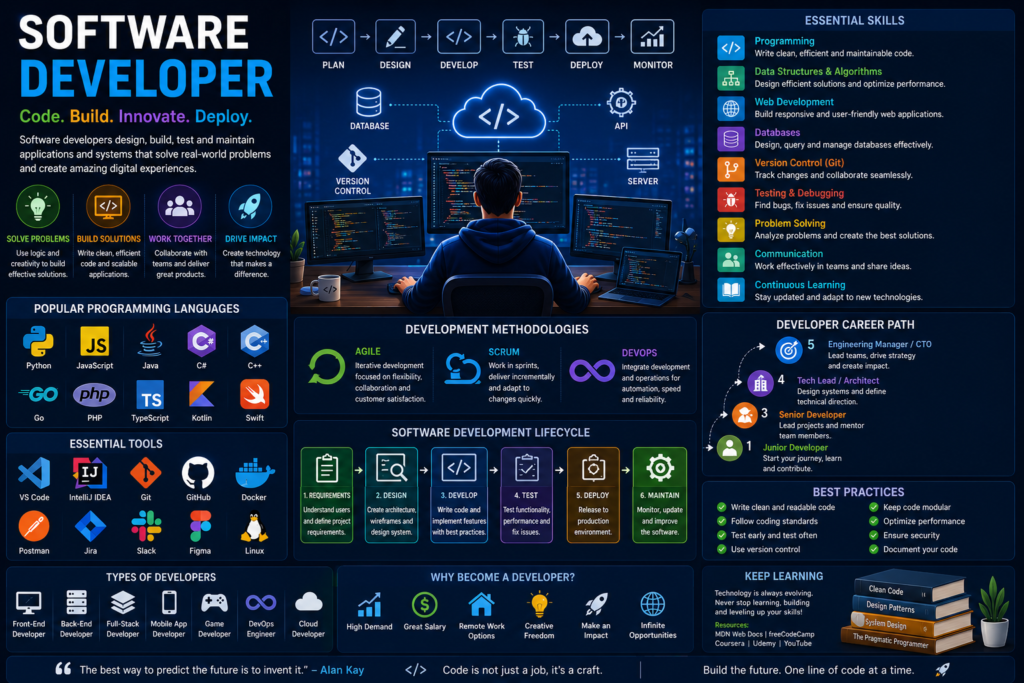
A software developer is a professional who designs, develops, tests, deploys, and maintains software applications and systems.
Software developers solve problems by creating software solutions that meet user needs and business objectives. They collaborate with designers, project managers, quality assurance teams, and stakeholders throughout the software development lifecycle.
Key responsibilities include:
- Writing code
- Designing software solutions
- Debugging applications
- Testing software functionality
- Maintaining existing systems
- Improving application performance
- Collaborating with development teams
Why Software Developers Are Important
Drive Innovation
Developers create new products and technologies that improve everyday life and business operations.
Support Digital Transformation
Organizations rely on software developers to modernize systems and automate processes.
Improve Efficiency
Custom software solutions help businesses increase productivity and reduce costs.
Enhance Customer Experiences
Developers build applications that make products and services more accessible and user-friendly.
Types of Software Developers
Front-End Developer
Front-end developers create the visual components users interact with.
Technologies include:
- HTML
- CSS
- JavaScript
- React
- Vue.js
- Angular
Back-End Developer
Back-end developers build server-side logic, APIs, and databases.
Common technologies include:
- Node.js
- Python
- Java
- PHP
- C#
- SQL
Full-Stack Developer
Full-stack developers work with both front-end and back-end technologies.
Mobile App Developer
Specializes in creating applications for smartphones and tablets.
Platforms include:
- Android
- iOS
- Cross-platform frameworks
Game Developer
Designs and develops interactive gaming experiences.
DevOps Developer
Focuses on automation, infrastructure management, and deployment pipelines.
Cloud Developer
Builds cloud-native applications and services.
Essential Programming Languages
Python
Popular for:
- Web development
- Data science
- Automation
- Artificial intelligence
JavaScript
The primary language of modern web development.
Java
Widely used for enterprise software and Android applications.
C#
Popular in enterprise development and game creation.
C++
Known for high-performance applications and systems programming.
Go
Increasingly used for cloud and distributed systems.
Rust
Gaining popularity for security, performance, and reliability.
Software Development Lifecycle
Software development follows a structured process.
Requirements Gathering
Understanding business needs and user expectations.
Planning
Defining project scope, resources, and timelines.
Design
Creating technical architecture and user workflows.
Development
Writing and implementing software code.
Testing
Ensuring software quality and functionality.
Deployment
Releasing software to production environments.
Maintenance
Updating, improving, and supporting applications.
Software Development Methodologies
Agile
Agile focuses on flexibility, collaboration, and iterative development.
Scrum
Organizes work into short development cycles called sprints.
Kanban
Visual workflow management that supports continuous delivery.
DevOps
Integrates development and operations to improve deployment speed and reliability.
Essential Tools for Software Developers
Code Editors
Popular options include:
- Visual Studio Code
- IntelliJ IDEA
- Sublime Text
Version Control
Git is the industry standard for managing source code changes.
Platforms include:
- GitHub
- GitLab
- Bitbucket
Project Management Tools
- Jira
- Trello
- Asana
- ClickUp
Collaboration Tools
- Slack
- Microsoft Teams
- Notion
Best Practices for Software Development
Write Clean Code
Code should be readable, maintainable, and well-organized.
Use Version Control
Track changes and collaborate efficiently.
Test Thoroughly
Implement:
- Unit testing
- Integration testing
- End-to-end testing
Document Code
Proper documentation improves maintainability and team collaboration.
Prioritize Security
Developers should follow secure coding practices and protect user data.
Continuously Learn
Technology evolves rapidly, requiring ongoing skill development.
Soft Skills Every Developer Needs
Problem-Solving
Developers must identify issues and create effective solutions.
Communication
Collaboration requires clear communication with team members and stakeholders.
Teamwork
Modern software projects rely on cross-functional teams.
Adaptability
Developers must learn new technologies and methodologies regularly.
Time Management
Managing deadlines and priorities is essential for project success.
Career Opportunities
Software development offers diverse career paths.
Junior Developer
Entry-level position focused on learning and contributing to projects.
Mid-Level Developer
Handles more complex development tasks independently.
Senior Developer
Provides technical leadership and mentorship.
Software Architect
Designs large-scale systems and technical frameworks.
Engineering Manager
Leads development teams and project execution.
Chief Technology Officer (CTO)
Oversees technology strategy at the executive level.
Emerging Trends in Software Development
Artificial Intelligence
AI-powered tools are transforming coding, testing, and software delivery.
Cloud Computing
Cloud-native applications continue to dominate modern development.
Low-Code and No-Code Platforms
These platforms accelerate software creation for businesses.
Cybersecurity Integration
Security is increasingly embedded throughout the development lifecycle.
Remote Development Teams
Global collaboration has become standard across the software industry.
Benefits of Becoming a Software Developer
- High earning potential
- Strong job demand
- Remote work opportunities
- Continuous learning
- Career flexibility
- Global employment options
- Entrepreneurial opportunities
Conclusion
Software developers play a critical role in shaping the digital future. Through programming, problem-solving, and innovation, they create the applications and systems that power modern businesses and everyday life.
As technology continues to advance, software development remains one of the most exciting and valuable careers available. By mastering programming languages, development tools, best practices, and emerging technologies, aspiring developers can build successful careers and contribute to the next generation of digital innovation.