Introduction
Software engineering is one of the most influential disciplines in the modern digital world. From smartphones and websites to cloud platforms and artificial intelligence systems, software engineering powers nearly every aspect of contemporary life. As businesses and organizations continue to embrace digital transformation, the demand for skilled software engineers has grown exponentially.
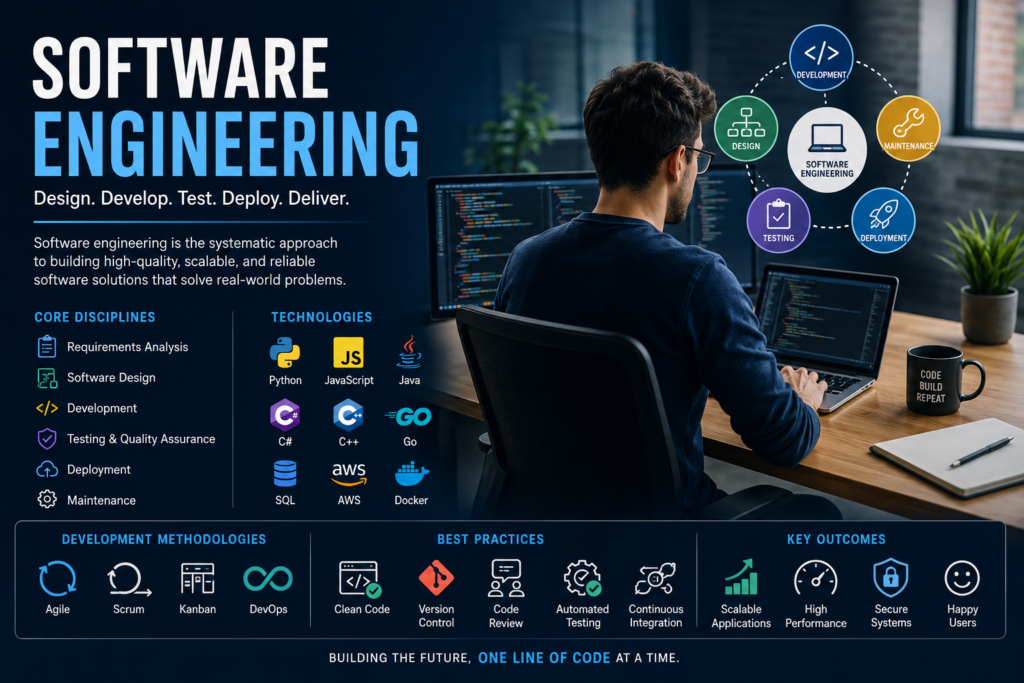
Software engineering is more than writing code. It is a systematic approach to designing, developing, testing, deploying, and maintaining software systems. By applying engineering principles, software engineers create reliable, scalable, secure, and efficient applications that meet user needs and business objectives.
This comprehensive guide explores the core concepts of software engineering, development methodologies, technologies, career opportunities, and best practices that drive successful software projects.
What Is Software Engineering?
Software engineering is the application of engineering principles and methodologies to software development. It involves analyzing requirements, designing solutions, implementing functionality, testing systems, and maintaining software throughout its lifecycle.
Unlike simple programming, software engineering focuses on creating robust and maintainable systems that can evolve over time while meeting performance, security, and reliability requirements.
The primary goals of software engineering include:
- Building reliable software systems
- Improving development efficiency
- Reducing maintenance costs
- Enhancing software quality
- Ensuring scalability and performance
- Delivering value to users and stakeholders
The Software Development Life Cycle (SDLC)
The Software Development Life Cycle (SDLC) provides a structured framework for software creation. It typically includes the following stages:
1. Requirements Analysis
During this phase, stakeholders define project goals, business requirements, and user expectations. Engineers gather information to understand the problem and identify functional and non-functional requirements.
2. Planning
Project managers and engineering teams estimate resources, timelines, budgets, and risks. Planning establishes the foundation for successful project execution.
3. System Design
Software architects create technical specifications and system designs. This stage includes:
- Database design
- User interface planning
- API architecture
- Security frameworks
- Infrastructure planning
4. Development
Developers write code according to design specifications. This phase often involves collaboration among front-end, back-end, database, and DevOps engineers.
5. Testing
Quality assurance teams verify software functionality through various testing methods, including:
- Unit testing
- Integration testing
- System testing
- Performance testing
- Security testing
- User acceptance testing
6. Deployment
The software is released to production environments where users can access and utilize the application.
7. Maintenance
After deployment, engineers monitor performance, fix bugs, release updates, and implement new features.
Key Principles of Software Engineering
Successful software engineering relies on several fundamental principles.
Modularity
Software should be divided into independent modules that can be developed, tested, and maintained separately.
Reusability
Engineers should design components that can be reused across multiple projects, reducing development time and costs.
Scalability
Applications must accommodate increasing numbers of users, transactions, and data without sacrificing performance.
Maintainability
Well-structured code makes future updates and modifications easier and less expensive.
Reliability
Software systems must perform consistently and accurately under various conditions.
Security
Protecting user data and preventing unauthorized access are critical aspects of modern software engineering.
Popular Programming Languages
Software engineers use numerous programming languages depending on project requirements.
Python
Python is widely used for:
- Web development
- Artificial intelligence
- Machine learning
- Data science
- Automation
JavaScript
JavaScript powers interactive web applications and modern front-end frameworks such as React, Angular, and Vue.
Java
Java remains popular for enterprise applications, Android development, and large-scale systems.
C#
C# is commonly used for:
- Enterprise software
- Windows applications
- Game development
- Cloud solutions
Go
Go offers excellent performance and simplicity for cloud-native and distributed systems.
Rust
Rust is gaining popularity because of its focus on memory safety, performance, and reliability.
Software Architecture
Software architecture defines the high-level structure of a system.
Monolithic Architecture
All application components operate as a single unit. Monoliths are simpler initially but may become difficult to scale.
Microservices Architecture
Applications consist of independent services communicating through APIs. Benefits include:
- Better scalability
- Independent deployments
- Improved fault isolation
Event-Driven Architecture
Components communicate through events, enabling highly scalable and responsive systems.
Serverless Architecture
Cloud providers automatically manage infrastructure, allowing developers to focus on business logic.
Agile Software Development
Agile has become one of the most widely adopted software development methodologies.
Agile emphasizes:
- Continuous improvement
- Customer collaboration
- Frequent releases
- Adaptive planning
- Cross-functional teamwork
Popular Agile frameworks include:
Scrum
Scrum organizes development into short iterations called sprints, typically lasting two to four weeks.
Kanban
Kanban focuses on visual workflow management and continuous delivery.
Extreme Programming (XP)
XP promotes high-quality software through practices such as:
- Pair programming
- Test-driven development
- Continuous integration
DevOps and Modern Software Delivery
DevOps bridges the gap between software development and IT operations.
Key DevOps practices include:
Continuous Integration (CI)
Developers frequently merge code changes into shared repositories where automated tests run.
Continuous Delivery (CD)
Software can be released quickly and safely through automated deployment pipelines.
Infrastructure as Code (IaC)
Infrastructure configurations are managed using code, ensuring consistency and repeatability.
Monitoring and Observability
Engineers use monitoring tools to track performance, detect issues, and improve reliability.
Software Testing
Testing ensures software quality and reliability.
Unit Testing
Verifies individual functions or components.
Integration Testing
Checks interactions between multiple modules.
End-to-End Testing
Simulates real user workflows.
Security Testing
Identifies vulnerabilities and potential attack vectors.
Performance Testing
Measures speed, scalability, and system responsiveness under load.
Cloud Computing and Software Engineering
Cloud platforms have transformed software development.
Leading cloud providers include:
- Amazon Web Services (AWS)
- Microsoft Azure
- Google Cloud Platform (GCP)
Cloud benefits include:
- Elastic scalability
- Reduced infrastructure costs
- Global availability
- Faster deployment cycles
Software Engineering Career Paths
Software engineering offers diverse career opportunities.
Front-End Engineer
Builds user interfaces and experiences.
Back-End Engineer
Develops server-side logic, APIs, and databases.
Full-Stack Engineer
Works across both front-end and back-end systems.
DevOps Engineer
Manages infrastructure, automation, and deployments.
Cloud Engineer
Designs and maintains cloud-based solutions.
Security Engineer
Protects systems from cyber threats.
Software Architect
Creates technical blueprints and system designs.
Machine Learning Engineer
Develops AI and machine learning solutions.
Essential Skills for Software Engineers
Successful software engineers combine technical and soft skills.
Technical skills include:
- Programming
- Algorithms
- Data structures
- Databases
- Cloud technologies
- Version control systems
- System design
Soft skills include:
- Communication
- Problem-solving
- Teamwork
- Adaptability
- Critical thinking
- Project management
Future Trends in Software Engineering
The software engineering industry continues to evolve rapidly.
Major trends include:
Artificial Intelligence
AI-assisted development tools are improving productivity and code quality.
Cloud-Native Development
Organizations increasingly adopt containerized and microservices-based architectures.
Cybersecurity
Security is becoming an integral part of every stage of software development.
Low-Code and No-Code Platforms
These solutions enable faster application development for non-technical users.
Edge Computing
Applications are moving closer to users to reduce latency and improve performance.
Quantum Computing
Although still emerging, quantum computing may revolutionize complex problem-solving in the future.
Conclusion
Software engineering remains one of the most dynamic and impactful fields in technology. By combining engineering principles with innovative technologies, software engineers create the applications and systems that power modern businesses and everyday life.
As digital transformation accelerates, organizations increasingly rely on software engineering to build scalable, secure, and user-friendly solutions. Whether pursuing a career in software engineering or seeking to understand the discipline, mastering its principles, methodologies, and best practices provides a strong foundation for success in the digital age.
The future of software engineering is bright, driven by advancements in artificial intelligence, cloud computing, cybersecurity, and emerging technologies. Professionals who continuously learn and adapt will remain at the forefront of innovation and technological progress.