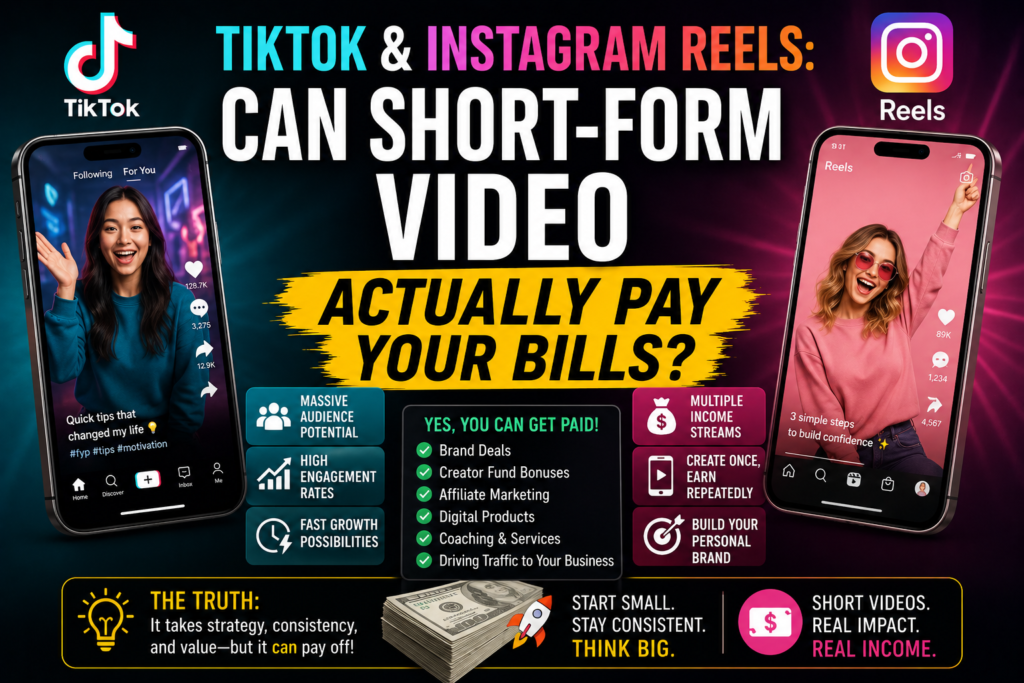
Fifteen seconds. Thirty seconds. Maybe a minute or two.
That’s all it takes to go viral on TikTok or Instagram Reels. A single clip filmed on your phone, edited with free in-app tools, and posted between breakfast and lunch can reach a million people before dinner.
But here’s the question nobody seems to answer honestly: can those views actually pay your rent?
The success stories are everywhere. A 22-year-old makes $50,000 a month selling lip gloss through TikTok. A fitness coach quits her day job after building 500,000 followers on Reels. A college dropout earns six figures reviewing gadgets in 60-second clips. The stories are real. The money is real. But what’s missing from those headlines is context, the full picture of how the money actually flows, how long it takes, and what percentage of creators ever reach that level.
This article breaks all of it down. No hype. No motivational fluff. Just an honest look at every income stream available on TikTok and Instagram Reels, what the actual numbers look like, and a clear framework for deciding whether short-form video is a realistic path to paying your bills.
How the Money Actually Works on Each Platform
Before we talk about income potential, you need to understand the mechanics. TikTok and Instagram Reels pay creators through completely different systems, and the way you earn on each platform affects how much you can realistically make.
TikTok’s Payment Systems
TikTok has gone through several iterations of its creator payment structure. Here’s what exists right now.
TikTok Creativity Program (replaced the original Creator Fund)
The original TikTok Creator Fund launched in 2020 with a fixed pool of money ($200 million in the U.S., later expanded). The problem was obvious: as more creators joined, the same pool got divided among more people, and per-view payouts dropped to almost nothing. Creators were earning $0.02 to $0.05 per 1,000 views, which meant a video with 1 million views might earn $20 to $50. That’s not a typo.
TikTok replaced the Creator Fund with the Creativity Program in 2023, which pays significantly more but comes with requirements:
- You must be 18+
- You need at least 10,000 followers
- Your account needs at least 100,000 video views in the last 30 days
- You must be based in a qualifying country (U.S., UK, France, Germany, and others)
- Videos must be at least 1 minute long to qualify for the program
The Creativity Program pays roughly $0.50 to $1.50 per 1,000 qualified views, though rates fluctuate based on engagement metrics, audience demographics, and advertiser demand. Some creators report earning up to $2 per 1,000 views on their best-performing content.
Translation: A video with 1 million qualified views earns approximately $500 to $1,500. A massive improvement over the old Creator Fund, but still modest compared to YouTube ad revenue.
TikTok LIVE Gifts
When you go live on TikTok, viewers can send virtual gifts purchased with real money. These gifts convert to “diamonds,” which you can cash out. TikTok takes approximately 50% of the gift value. Going live consistently with an engaged audience can generate $50 to $500+ per session for mid-sized creators, and significantly more for creators with large, dedicated followings.
Requirements: 1,000+ followers and 18+ years old.
TikTok Shop
TikTok Shop allows creators to sell products directly through their videos, livestreams, and profile. You can sell your own products or earn commissions as an affiliate by promoting other brands’ products. Creators earn commissions ranging from 5% to 20% on affiliate sales, and there’s no follower minimum to start as a TikTok Shop affiliate.
This is quietly becoming the most lucrative TikTok monetization feature. Some creators earn more from TikTok Shop commissions than from all other TikTok income streams combined.
TikTok Pulse
TikTok Pulse places premium ads alongside the top 4% of performing content in each category. Selected creators earn a 50% revenue share from these ads. The catch: you need to be consistently producing top-performing content to qualify, and TikTok selects eligible creators (you can’t apply directly).
Instagram Reels Payment Systems
Instagram’s monetization for Reels has shifted multiple times, and Meta’s approach has been less consistent than TikTok’s.
Instagram Bonuses (Limited and Invite-Only)
Meta has periodically offered Reels Play Bonuses, which paid creators for reaching view milestones on their Reels. These bonuses ranged from a few hundred dollars to $35,000 per month for top-performing creators. The program was invite-only, temporary, and has been rolled back in many regions. As of 2026, bonus availability varies by country and changes frequently. Don’t build a business plan around bonuses that may disappear.
Instagram Subscriptions
Creators can offer monthly subscriptions to their followers (starting at $0.99/month). Subscribers get access to exclusive content, subscriber-only Lives, badges, and subscriber-only Stories. Instagram takes a 0% to 30% cut depending on platform (0% through the web, up to 30% through in-app purchases on iOS).
Requirements: Professional account, 18+, and available in select countries.
Instagram Gifts on Reels
Viewers can purchase “Stars” and send them as gifts on your Reels. Each Star is worth $0.01 to the creator. A Reel that receives 10,000 Stars earns you $100. The feature is still rolling out and has limited adoption compared to TikTok’s gifting system.
Branded Content and the Creator Marketplace
Instagram’s Creator Marketplace connects brands with creators for sponsored content deals. This isn’t a direct payment from Instagram. It’s a matchmaking platform. Brands find you, negotiate a deal, and pay you directly for creating branded Reels. This is where the real money is on Instagram (more on this below).
Instagram Affiliate and Shopping Features
Similar to TikTok Shop, Instagram allows creators to tag products in their content and earn commissions on sales. The integration with Meta’s commerce tools makes this increasingly seamless, though adoption varies by market.
The Real Numbers: What Creators Actually Earn
Let’s move past the theoretical and look at what real creators at different levels are earning. These figures are based on publicly reported earnings, creator surveys, and industry data.
Micro-Creators (1,000–10,000 followers)
TikTok direct earnings: $0 to $50/month. Most micro-creators don’t qualify for the Creativity Program. Income at this level comes almost entirely from affiliate commissions and small brand deals.
Instagram direct earnings: $0 to $100/month. Occasional gifts, minimal subscription income.
Brand deals: $50 to $250 per sponsored post (if you can land them). Most brands won’t work with creators under 5,000 followers unless your engagement rate is exceptionally high or you’re in a very specific niche.
Affiliate income: $0 to $200/month. Depends entirely on your niche and how well you promote products.
Realistic total at this level: $0 to $500/month. Not bill-paying money for most people.
Mid-Tier Creators (10,000–100,000 followers)
TikTok Creativity Program: $200 to $2,000/month depending on posting frequency and view counts.
Instagram direct earnings: $100 to $500/month through gifts, bonuses (if available), and subscriptions.
Brand deals: $250 to $2,500 per sponsored post. At 50,000 followers with strong engagement, you might land 2 to 4 brand deals per month.
Affiliate income: $200 to $2,000/month. Mid-tier creators in high-commission niches (beauty, tech, finance, SaaS) can generate meaningful affiliate income.
TikTok Shop commissions: $100 to $3,000/month for creators who actively promote products.
Realistic total at this level: $1,000 to $8,000/month. This is where short-form video starts paying real bills, especially if you’re strategic about brand deals and affiliate partnerships.
Large Creators (100,000–1,000,000 followers)
TikTok Creativity Program: $1,000 to $5,000/month.
Brand deals: $2,500 to $25,000 per sponsored post. At this level, brand partnerships are your primary income source. Creators with 500,000 followers in desirable niches can command $5,000 to $15,000 per post.
Affiliate and shop income: $1,000 to $10,000+/month.
Subscriptions, lives, and gifts: $500 to $5,000/month.
Realistic total at this level: $5,000 to $40,000+/month. This is full-time income territory, and some creators at this level earn more than doctors, lawyers, and engineers.
Mega-Creators (1,000,000+ followers)
Brand deals: $10,000 to $100,000+ per sponsored post. Top TikTok and Instagram creators charge $50,000 to $250,000 for a single branded video.
Product lines and businesses: Many mega-creators launch their own brands, leveraging their audience as a built-in customer base. This is often where the biggest money is, not from the platform itself, but from the business the platform helped build.
Realistic total at this level: $50,000 to $500,000+/month. But reaching this level requires a rare combination of talent, consistency, timing, and luck.
The Income Breakdown Most People Get Wrong
Here’s something that surprises almost every new creator: direct platform payments are the smallest slice of the pie.
For most full-time short-form video creators, income breaks down roughly like this:
- Brand deals and sponsorships: 40% to 60% of total income
- Affiliate marketing and product commissions: 15% to 25%
- Own products or services: 10% to 25%
- Platform payments (Creator Fund, gifts, bonuses): 5% to 15%
Read that again. The money TikTok and Instagram pay you directly is often the least significant income stream. The real money comes from the audience you build, not from the platform’s payment features.
This is a critical mindset shift. If your entire monetization strategy is “post videos → collect Creator Fund payments,” you’re leaving 85% to 95% of your earning potential on the table.
The creators who actually pay their bills with short-form video treat TikTok and Reels as audience-building tools, not as employers. The platform gives you reach. You turn that reach into revenue through brand partnerships, affiliate links, product sales, email list building, course launches, consulting offers, and a dozen other monetization strategies that happen outside the app.
The Seven Real Income Streams for Short-Form Video Creators
Let’s break down each monetization path in detail so you can build a diversified income.
1. Brand Deals and Sponsorships
This is the single most lucrative income stream for 90% of full-time creators. A brand pays you to create content featuring their product or service. The deal structure varies:
Flat fee per post: You get paid a set amount for creating and posting one or more pieces of content. This is the most common structure.
Performance-based: You get paid based on views, clicks, or sales your content generates. Riskier for you, but can pay more if the content performs well.
Retainer/ambassador deals: A brand pays you a monthly fee to be an ongoing creator or ambassador. These are the most desirable deals because they provide predictable recurring income.
How to price yourself:
A common starting formula: charge $100 per 10,000 followers for a single TikTok or Reel. So a creator with 50,000 followers would charge roughly $500 per post. But this is a loose guideline. Your actual rates depend on:
- Your engagement rate (high engagement = higher rates)
- Your niche (finance, tech, and beauty command premium rates)
- The deliverables (one Reel vs. a package of three Reels plus Stories)
- Usage rights (can the brand reuse your content in their own ads? That costs extra)
- Exclusivity (are they asking you not to work with competitors? That costs extra too)
How to land brand deals:
- Under 10,000 followers: Pitch directly to small brands in your niche. Email their marketing team with your media kit, engagement stats, and 2 to 3 content ideas specific to their product. Expect most pitches to be ignored. That’s normal. You need a 5% to 10% response rate to stay consistently booked.
- 10,000 to 50,000 followers: Join influencer platforms (AspireIQ, Grin, Collabstr, The Cirqle) where brands actively search for creators. You’ll start receiving inbound requests at this level, though many will be low-paying or product-only offers. Be selective.
- 50,000+ followers: At this point, consider working with a talent manager or agency who negotiates deals on your behalf (typically for a 15% to 20% commission). Inbound deal flow increases significantly, and brands will approach you with budgets already allocated.
2. Affiliate Marketing
You recommend products in your videos and earn a commission when someone buys through your link. The major affiliate options:
- Amazon Associates: 1% to 10% commissions depending on product category. Low per-sale earnings but high conversion rates because people trust Amazon.
- Platform-specific affiliate programs (TikTok Shop, Instagram Shopping): 5% to 20% commissions with native in-app checkout that reduces friction.
- Direct brand affiliate programs: Many brands (especially software, beauty, and health companies) offer 15% to 40% commissions. These pay more per sale than Amazon but require more trust from your audience.
- Affiliate networks (ShareASale, Impact, CJ Affiliate, PartnerStack): Aggregators that connect you to hundreds of brand programs.
What works for affiliate income on short-form video:
- “Products I use every day” roundup videos
- “Amazon finds” and “TikTok made me buy it” style content
- Genuine product reviews and comparisons
- Problem-solution videos where the product solves a real pain point
What doesn’t work: Overtly salesy content, fake enthusiasm, promoting products you’ve never used, and stuffing affiliate links into unrelated content. Audiences on TikTok and Instagram are extremely good at detecting inauthentic recommendations, and they’ll punish you for it with unfollows and negative comments.
3. Selling Your Own Products
If you have a product to sell, short-form video is one of the fastest ways to drive sales. Types of products that sell well through short-form content:
Physical products:
- Beauty and skincare products
- Apparel and accessories
- Home goods and organization products
- Food products and supplements
- Handmade and craft items
Digital products:
- Online courses and workshops
- Ebooks and guides
- Templates (Canva, Notion, spreadsheet templates)
- Presets and filters (for photography and video editing)
- Printables and planners
Services:
- Coaching and consulting
- Freelance services (design, copywriting, photography)
- Membership communities
The playbook: Create content that demonstrates your expertise, solves problems, or entertains your target audience. Build trust. Then introduce your product as a natural extension of the value you’ve already provided for free.
A fitness creator who posts daily workout tips for 3 months has already proven their knowledge. When they launch a $47 workout program, their audience is primed to buy because they’ve seen the results and trust the creator’s expertise.
4. TikTok Shop and Social Commerce
TikTok Shop deserves its own section because it’s rapidly becoming one of the platform’s most profitable features for creators.
How it works: Brands list products on TikTok Shop. Creators can add these products to their videos, and viewers purchase directly within the TikTok app. The creator earns a commission on every sale. No need to send people to external links. No friction from leaving the app. The purchase happens in seconds.
Why it’s powerful: TikTok’s algorithm actively promotes content with TikTok Shop links because it makes TikTok money. This means your Shop-linked videos often get a reach boost compared to your regular content. Some creators report 2x to 5x more views on videos with Shop links.
What’s working right now:
- Live selling sessions where creators demonstrate products in real time (this format is generating enormous revenue for creators in beauty, fashion, and home goods)
- “TikTok made me buy it” style reviews of Shop products
- Comparison videos that end with a Shop link to the winning product
- “Outfit of the day” and “Get ready with me” content with tagged products
Income potential: Dedicated TikTok Shop affiliates earning $1,000 to $20,000+/month in commissions are increasingly common. The top TikTok Shop affiliates earn six figures monthly. This income stream barely existed two years ago and is growing rapidly.
5. Subscriptions and Memberships
Both TikTok and Instagram offer subscription features, but you can build subscription income outside the apps too.
On-platform: Instagram Subscriptions let you charge $0.99 to $99.99/month for exclusive content. TikTok’s subscription features are rolling out with similar functionality.
Off-platform: Patreon, Buy Me a Coffee, Ko-fi, and membership platforms like Skool or Circle let you create paid communities and exclusive content offerings. You promote these in your bio link and in your content.
What subscribers pay for:
- Behind-the-scenes content
- Exclusive tutorials or deeper dives on topics you cover publicly
- Early access to new content
- Direct access to you (Q&A sessions, DM access, monthly calls)
- Community membership (being part of a group of like-minded people)
Realistic subscription income: A creator with 50,000 followers might convert 0.5% to 1% of their audience into subscribers at $5/month. That’s 250 to 500 subscribers generating $1,250 to $2,500/month. Not massive on its own, but it’s predictable, recurring income that doesn’t depend on algorithms or brand deals.
6. LIVE Streaming
Going live on TikTok or Instagram unlocks real-time income through virtual gifts. But beyond gifts, live streaming is a multiplier for almost every other income stream.
Live selling: Demonstrate and sell products in real time. This is driving enormous revenue on TikTok, especially in beauty, fashion, and home goods categories. Some creators earn $5,000 to $50,000+ in a single live selling session.
Live Q&A and coaching: Offer free value through live sessions and funnel viewers into paid coaching, courses, or consultations.
Live entertainment: Build a community of regular viewers who support you through gifts. Top live streamers on TikTok earn $10,000 to $100,000+/month from gifts alone (though TikTok takes a significant cut).
The compound effect of going live: Live sessions boost your algorithmic visibility, deepen audience relationships, and create a sense of urgency that pre-recorded content can’t match. Creators who go live at least 2 to 3 times per week consistently grow faster and earn more than those who only post pre-recorded content.
7. Funneling to Higher-Value Offers
The most sophisticated creators use short-form video as the top of a funnel that leads to much higher-value transactions.
The funnel looks like this:
Free short-form content (TikTok/Reels) → Bio link → Email list or free resource → Nurture sequence → Paid product, course, consulting, or service
Real examples:
- A real estate creator posts market analysis Reels → funnels viewers to a free “First-Time Buyer Guide” → captures emails → sells a $997 homebuying course
- A nutritionist posts quick meal prep TikToks → funnels viewers to a free meal plan → captures emails → sells 1-on-1 coaching packages at $200/month
- A business coach posts short motivational and tactical clips → funnels viewers to a free webinar → sells a $2,000 group coaching program
Why this matters: A single coaching client at $2,000 is worth more than 2 million views on TikTok’s Creativity Program. One course sale at $497 is worth more than 500,000 views. When you think about short-form video as a lead generation tool rather than a direct income source, the math changes dramatically.
What It Takes to Go Full-Time: The Real Requirements
Let’s cut through the fantasy and talk about what’s actually required to pay your bills with short-form video.
The Numbers You Need
Assume your bills require $4,000/month after taxes (roughly $48,000/year, which covers a modest lifestyle in most mid-size U.S. cities).
If you rely solely on platform payments: You’d need approximately 3 to 8 million qualified views per month on TikTok’s Creativity Program. That requires either going viral regularly or maintaining a very large, active following. Most creators cannot sustain this.
If you combine brand deals and affiliate income: You’d need 2 to 4 brand deals per month at $500 to $1,000 each, plus $1,000 to $2,000 in affiliate commissions. This is achievable with 30,000 to 100,000 engaged followers in a monetizable niche.
If you sell your own products: You’d need to sell 80 units of a $50 product per month, or 8 units of a $500 product. With a decent following and strong content, this is very achievable.
If you combine everything: Most full-time creators mix multiple income streams. A realistic breakdown for a creator earning $5,000/month:
- 2 brand deals: $2,000
- Affiliate commissions: $1,000
- Product sales (digital course): $1,200
- TikTok Creativity Program: $400
- Subscriptions/gifts: $400
Notice how platform payments account for less than 10% of the total. This is why treating TikTok or Instagram as an employer (create content → receive paycheck) is the wrong framework. You’re building a business on top of these platforms, not working for them.
The Follower Threshold for Full-Time Income
Based on creator surveys and publicly available data:
- Under 10,000 followers: Full-time income is extremely unlikely from short-form video alone. Focus on growth and building skills.
- 10,000–50,000 followers: Part-time income is realistic ($500 to $3,000/month). Full-time is possible if you’re in a high-value niche with strong monetization.
- 50,000–200,000 followers: Full-time income becomes realistic for creators who actively pursue brand deals, affiliate partnerships, and product sales.
- 200,000+ followers: Full-time income is very achievable, and many creators at this level earn more than traditional high-paying careers.
These thresholds drop significantly if you have a product or service to sell. A creator with 15,000 followers who sells a $200 online course can earn more than a creator with 200,000 followers who relies solely on the Creativity Program.
The Time Investment to Reach Full-Time
Posting schedule: Most full-time creators post 1 to 3 times per day on their primary platform. Some post even more, especially during growth phases.
Content creation time: Plan for 2 to 4 hours per day on content creation, including ideation, filming, editing, and posting. Plus another 1 to 2 hours on engagement (responding to comments, DMs, and community interaction).
Timeline to full-time income: For a creator who posts consistently and improves rapidly:
- Month 1–3: Learning the platform, finding your voice, testing content formats. Income: $0.
- Month 3–6: Gaining traction, building a small following, landing first small brand deals or affiliate commissions. Income: $0 to $500/month.
- Month 6–12: Growing steadily, refining your niche, building relationships with brands. Income: $500 to $3,000/month.
- Month 12–24: If everything goes well, reaching a level where full-time income is realistic. Income: $2,000 to $10,000+/month.
The honest truth: most creators who go full-time take 12 to 24 months to get there. A small percentage get there faster (thanks to viral moments or being in the right niche at the right time). Many take longer. And a significant number never reach full-time income because they quit too early, choose a hard-to-monetize niche, or never develop the business skills needed to turn attention into revenue.
TikTok vs. Instagram Reels: Which Pays Better?
Both platforms have strengths. Here’s a direct comparison for monetization.
Where TikTok Wins
Organic reach for new creators. TikTok’s algorithm gives new creators a genuine shot at reaching large audiences from day one. Your follower count matters less on TikTok than on any other platform. A video from an account with 0 followers can reach 1 million people if the content is strong. Instagram’s algorithm is stingier with reach for small, new accounts.
TikTok Shop and social commerce. TikTok’s in-app shopping experience is more developed and more aggressively promoted by the algorithm. Creators who sell through TikTok Shop often earn more from commissions than from all other income streams combined.
Live streaming culture. TikTok’s live streaming ecosystem is more mature and more profitable for creators. The gifting culture is stronger, and live selling is generating enormous revenue.
Creativity Program payments. While still modest, TikTok’s direct payments to creators are currently more consistent and predictable than Instagram’s sporadic bonus programs.
Where Instagram Reels Wins
Higher brand deal rates. Brands pay more for Instagram content than for TikTok content, on average. The reason: Instagram’s audience skews slightly older and more affluent, which many advertisers prefer. A creator with 100,000 followers on Instagram can often command 1.5x to 2x the rate of a creator with the same following on TikTok.
Shopping and product discovery. Instagram’s integration with Meta’s advertising and commerce ecosystem makes it a strong platform for product-based businesses. The “link in bio” culture on Instagram is well-established, and audiences are accustomed to clicking through to purchase.
Subscriptions. Instagram’s subscription feature is more developed and offers more flexibility (pricing tiers, exclusive content types) than TikTok’s current subscription options.
Cross-platform with Facebook. Content posted on Instagram can be distributed across Facebook, reaching an older demographic with significant purchasing power. This doubles your reach from a single piece of content.
Longer content lifespan. Instagram Reels tend to have a slightly longer shelf life than TikToks. A Reel can continue gaining views for weeks or months through the Explore page and hashtag feeds, while TikTok’s content cycle tends to be faster (most views come within the first 48 to 72 hours).
The Platform Verdict
Use TikTok for: Rapid audience growth, social commerce (TikTok Shop), live selling, reaching younger audiences (16 to 34), and testing content ideas quickly.
Use Instagram Reels for: Higher-value brand partnerships, reaching audiences with more purchasing power (25 to 44), subscription income, and product-based businesses.
The best strategy: Use both. Most full-time creators post on TikTok and Instagram simultaneously (often repurposing the same content). TikTok brings the growth. Instagram brings the monetization. Together, they create a more stable and diversified income than either platform alone.
The Five Niches That Pay the Most on Short-Form Video
Your niche determines your earning potential more than your follower count. A creator with 30,000 followers in a high-CPM, sponsor-friendly niche can earn more than a creator with 500,000 followers in a low-value niche.
1. Finance and Money
Why it pays well: Financial services companies (banks, investment apps, credit card companies, crypto platforms) have the highest advertising budgets and pay the most for creator partnerships. CPM on finance content is the highest of any niche on both platforms.
Brand deal rates: $500 to $5,000+ per post at 50,000 followers. Finance brands pay premium rates because a single customer acquisition is worth hundreds or thousands of dollars to them.
Content examples: Budgeting tips, “money mistakes I stopped making,” investing for beginners, credit score hacks, side hustle breakdowns.
2. Beauty and Skincare
Why it pays well: The beauty industry spends billions on influencer marketing. Products are visual, demonstrate well in short video, and have high repurchase rates. Affiliate commissions in beauty are strong because of high product margins.
Brand deal rates: $300 to $3,000+ per post at 50,000 followers. Beauty brands are among the most active on both TikTok and Instagram.
Content examples: Get ready with me, product reviews, skincare routines, makeup tutorials, “dupes” for expensive products, ingredient breakdowns.
3. Technology and Software
Why it pays well: Tech companies and SaaS brands have large marketing budgets and are increasingly investing in creator partnerships. Affiliate commissions on software products are recurring (you earn monthly as long as the customer stays subscribed).
Brand deal rates: $400 to $4,000+ per post at 50,000 followers. Software and app companies pay well because customer lifetime value is high.
Content examples: App reviews, productivity setups, “tools I use every day,” tech comparisons, hidden features and tips.
4. Health and Fitness
Why it pays well: The health and fitness industry has a massive consumer market. Supplement brands, fitness apps, and workout equipment companies actively seek creator partnerships. Audiences in this niche are highly engaged and willing to buy products that promise results.
Brand deal rates: $300 to $2,500+ per post at 50,000 followers.
Content examples: Workout routines, meal prep, transformation stories, supplement reviews, form corrections, myth-busting.
5. Business and Entrepreneurship
Why it pays well: Business tools, coaching programs, online course platforms, and B2B software companies pay premium rates for access to an entrepreneurial audience. The audience is predisposed to spending money on tools and education.
Brand deal rates: $400 to $5,000+ per post at 50,000 followers.
Content examples: Business tips, marketing strategies, side hustle ideas, tool recommendations, “how I built my business” stories, revenue breakdowns.
Niches That Struggle to Monetize
Not all niches are created equal. These categories typically have lower earning potential:
- Comedy and entertainment: Huge audiences but low advertiser demand. Brands that sponsor comedy content pay less per impression.
- Dance and lip-sync: High views, low commercial intent. Audiences are there for entertainment, not to buy products.
- General lifestyle without a specific angle: “Day in my life” content is hard to monetize unless you tie it to a specific niche (day in my life as a nurse, as a software developer, as a small business owner).
- Political and news commentary: Many brands avoid associating with political content. Monetization relies on audience support (Patreon, subscriptions) rather than sponsorships.
Building a Sustainable Short-Form Video Business
Viral moments are nice. They’re not a business strategy. Here’s how to build something that actually lasts.
Treat It Like a Business From Day One
Set up a separate business account or LLC. Track your income and expenses. Set aside money for taxes (30% of your earnings if you’re in the U.S. and self-employed is a safe starting point). Invest in your skills and equipment. Think in terms of revenue streams, not just views.
Build Assets You Own
Your TikTok and Instagram followers are rented. You don’t own them. The platform can change its algorithm, ban your account, or shut down entirely, and you’d lose your entire audience overnight.
Build an email list. Every piece of content should have a call to action that moves people to a platform you own. A free guide, a discount code, a newsletter signup. Even 1,000 email subscribers is more valuable than 100,000 followers on a platform you don’t control because you can reach them directly, anytime, without asking an algorithm for permission.
Build a website. Even a simple one-page site with your email signup, portfolio of brand partnerships, and links to your products gives you a professional presence and a hub you own.
Diversify Across Platforms
Never put 100% of your effort into one platform. At minimum, post on both TikTok and Instagram. Ideally, repurpose your short-form content into:
- YouTube Shorts (tap into YouTube’s ecosystem and monetization)
- Pinterest Idea Pins (great for driving traffic to products and blog content)
- Your own website or blog (capture search traffic and build domain authority)
If one platform changes its algorithm or policies, you have other channels sustaining your business.
Create a Content System
Full-time creators don’t wing it. They have systems.
Batch filming: Film 5 to 10 videos in one session. Change outfits and backdrops between videos so they look like different days. This is far more efficient than filming one video at a time.
Content pillars: Define 3 to 5 content categories you rotate through. If you’re a finance creator, your pillars might be: budgeting tips, investing basics, money mistakes, income ideas, and financial news. Pillars prevent the “what should I post today?” paralysis.
Trend monitoring: Spend 15 to 20 minutes per day scrolling your For You page and Explore page, not mindlessly, but studying what’s trending. Adapt trending formats to your niche quickly. Speed matters with trends.
Analytics review: Check your analytics weekly. Which videos performed best? Why? What did they have in common? Double down on patterns that work. Stop doing what doesn’t.
Develop Real Skills
The creators who earn the most money long-term are the ones who develop genuine expertise in:
- Storytelling. The ability to hook someone in the first second and hold their attention. This is the single most valuable skill in short-form video.
- Sales and persuasion. Understanding what makes people buy and how to present products authentically without sounding pushy.
- Negotiation. Learning to price your services correctly and negotiate brand deals that reflect your actual value.
- Business fundamentals. Understanding profit margins, cash flow, tax obligations, and how to scale.
- Community building. Creating a sense of belonging among your audience that makes them loyal, engaged, and willing to support you financially.
The Honest Risks Nobody Talks About
Algorithm Dependency
Your income is directly tied to how many people see your content. If the algorithm changes (and it will, repeatedly), your reach can drop overnight. Creators who went from 1 million views per video to 50,000 views per video after an algorithm shift aren’t rare. They’re common.
Mitigation: Diversify platforms and income streams. Build an email list. Don’t let more than 50% of your income depend on any single platform.
Income Instability
Short-form video income is volatile. Brand deal flow is inconsistent. Affiliate income fluctuates with content performance. Platform payments vary month to month. You might earn $8,000 one month and $2,000 the next.
Mitigation: Build a 3 to 6 month emergency fund before going full-time. Create recurring revenue through subscriptions, retainer deals, or digital products that sell consistently.
Burnout
Creating content every day, engaging with comments, managing brand relationships, staying on top of trends, responding to DMs, and dealing with negative comments takes a psychological toll. Creator burnout is real and widespread.
Mitigation: Set boundaries. Take scheduled breaks. Batch content so you can take days off without missing posts. Don’t read every comment. Outsource editing and admin tasks as soon as you can afford to.
Platform Risk
TikTok has faced potential bans in several countries. Instagram changes its features and priorities frequently. Building your entire livelihood on a platform owned by someone else is inherently risky.
Mitigation: This is why owning assets (email list, website, product catalog) matters so much. The platform is your distribution channel, not your business.
Mental Health
Tying your income to public metrics (views, likes, follower count) creates a toxic feedback loop. A video that underperforms feels like a personal failure. Comparison with other creators is constant. Public comments can be brutal.
Mitigation: Separate your self-worth from your metrics. Measure success by revenue and business growth, not by vanity metrics. Consider working with a therapist or joining a creator community where you can discuss challenges openly.
So, Can Short-Form Video Actually Pay Your Bills?
The honest answer: yes, but probably not the way you think.
If your plan is to post videos, collect platform payments, and call it a day, you’ll be disappointed. Platform payments alone won’t cover your bills unless you’re consistently generating millions of views per month.
If your plan is to use short-form video as a powerful, free audience-building tool and then monetize that audience through brand partnerships, affiliate marketing, product sales, subscriptions, and business development, then yes, absolutely, short-form video can pay your bills and then some.
The creators who earn full-time incomes from TikTok and Instagram Reels aren’t just content creators. They’re entrepreneurs who happen to use short-form video as their primary marketing channel. They think about revenue diversification, customer acquisition, product development, and brand building. They treat their content as the front door of a business, not as the business itself.
Here’s the minimum viable path to paying your bills with short-form video:
- Pick a monetizable niche (finance, beauty, tech, health, or business)
- Post 1 to 3 times per day for 6 to 12 months on TikTok and Instagram
- Build to 10,000+ followers with strong engagement
- Start landing brand deals and promoting affiliate products
- Build an email list from day one
- Launch a digital product or service by month 6 to 9
- Diversify income across 3+ revenue streams
- Scale what works, cut what doesn’t, and reinvest profits into growth
That’s not a get-rich-quick path. It’s a build-a-real-business path. It takes time, skill development, and consistent effort. But it works. Thousands of creators are proving it every single day.
The question isn’t whether short-form video can pay your bills. The question is whether you’re willing to put in the 6 to 18 months of work required to build the business that makes it possible.
What niche are you considering, and which income stream are you most interested in building first? Your answer to those two questions shapes everything else about your strategy.