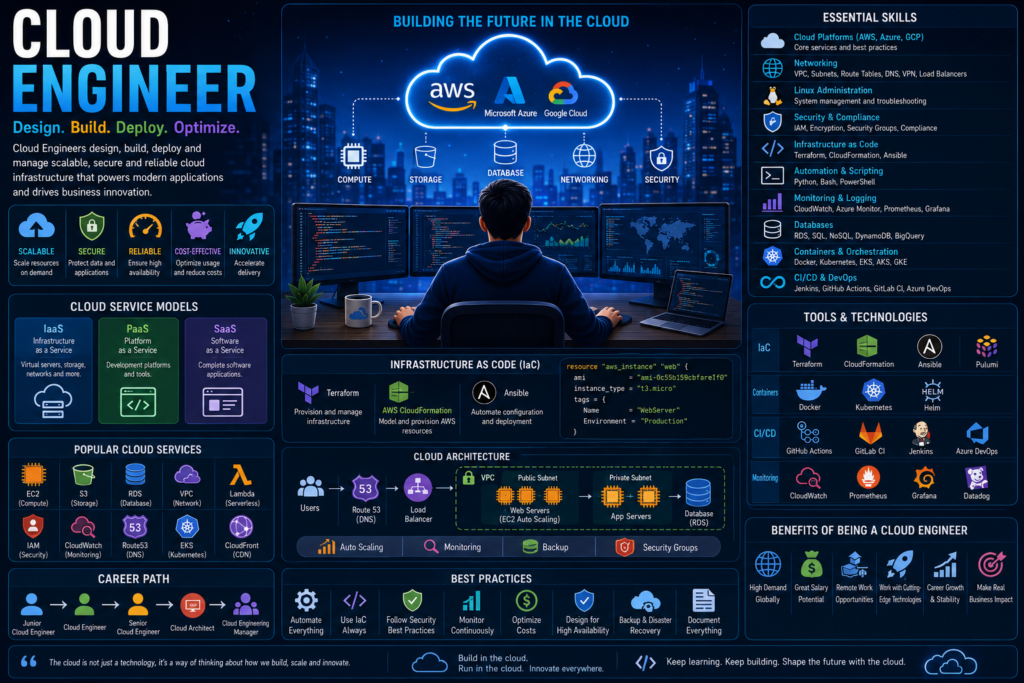
Introduction
Cloud computing has transformed the way businesses build, deploy, and manage technology solutions. Organizations increasingly rely on cloud platforms to improve scalability, reduce infrastructure costs, enhance security, and accelerate innovation. At the center of this transformation are Cloud Engineers.
Cloud Engineers design, implement, manage, and optimize cloud-based systems and services. They help organizations migrate from traditional infrastructure to modern cloud environments while ensuring performance, security, reliability, and efficiency.
As cloud adoption continues to grow worldwide, Cloud Engineering has become one of the most valuable and in-demand careers in the technology industry.
What Is a Cloud Engineer?
A Cloud Engineer is an IT professional responsible for designing, deploying, maintaining, and optimizing cloud infrastructure and services.
Cloud Engineers work with cloud platforms to create scalable and secure environments that support applications, databases, storage systems, and business operations.
Typical responsibilities include:
- Designing cloud architectures
- Managing cloud resources
- Automating infrastructure
- Monitoring system performance
- Ensuring security and compliance
- Supporting cloud migrations
- Optimizing cloud costs
- Troubleshooting cloud environments
Why Cloud Engineering Matters
Scalability
Cloud platforms allow businesses to scale resources on demand.
Cost Efficiency
Organizations only pay for the resources they use.
Reliability
Cloud providers offer highly available infrastructure and disaster recovery capabilities.
Faster Innovation
Teams can deploy applications and services quickly without managing physical hardware.
Global Accessibility
Cloud services enable worldwide access to applications and data.
Major Cloud Platforms
Amazon Web Services (AWS)
AWS is one of the most widely used cloud platforms, offering services for:
- Computing
- Storage
- Databases
- Machine Learning
- Networking
- Security
Microsoft Azure
Azure is popular among enterprises and organizations using Microsoft technologies.
Google Cloud Platform (GCP)
GCP is known for:
- Data analytics
- Artificial intelligence
- Kubernetes
- Cloud-native solutions
Types of Cloud Computing
Public Cloud
Resources are hosted and managed by third-party cloud providers.
Private Cloud
Dedicated cloud infrastructure used by a single organization.
Hybrid Cloud
Combines public and private cloud environments.
Multi-Cloud
Uses services from multiple cloud providers for flexibility and resilience.
Cloud Service Models
Infrastructure as a Service (IaaS)
Provides virtualized computing resources such as servers and storage.
Examples:
- AWS EC2
- Azure Virtual Machines
- Google Compute Engine
Platform as a Service (PaaS)
Offers development platforms without infrastructure management.
Examples:
- Azure App Service
- Google App Engine
Software as a Service (SaaS)
Provides software applications accessible through the internet.
Examples:
- Microsoft 365
- Salesforce
- Google Workspace
Essential Skills for Cloud Engineers
Cloud Platform Expertise
Understanding AWS, Azure, or Google Cloud services.
Networking
Knowledge of:
- DNS
- VPNs
- Load Balancers
- Firewalls
- TCP/IP
Linux Administration
Most cloud environments rely heavily on Linux-based systems.
Security
Cloud Engineers must understand:
- Identity and Access Management (IAM)
- Encryption
- Security Groups
- Compliance Standards
Scripting and Automation
Common languages include:
- Python
- Bash
- PowerShell
Infrastructure as Code (IaC)
Managing infrastructure through code rather than manual configuration.
Infrastructure as Code
Infrastructure as Code improves consistency and automation.
Popular tools include:
Terraform
Automates cloud resource provisioning across multiple providers.
AWS CloudFormation
AWS-native infrastructure automation service.
Ansible
Configuration management and deployment automation.
Benefits include:
- Faster deployments
- Version control
- Repeatable infrastructure
- Reduced human error
Containers and Cloud-Native Technologies
Docker
Packages applications and dependencies into portable containers.
Kubernetes
Manages container orchestration and scaling.
Benefits include:
- High availability
- Auto-scaling
- Self-healing infrastructure
- Efficient resource utilization
Cloud Security
Security is one of the most important responsibilities of a Cloud Engineer.
Identity and Access Management (IAM)
Controls user permissions and access rights.
Encryption
Protects data both at rest and in transit.
Security Monitoring
Identifies threats and suspicious activities.
Compliance
Supports standards such as:
- GDPR
- ISO 27001
- HIPAA
- SOC 2
Cloud Monitoring and Operations
Cloud Engineers continuously monitor systems to maintain performance and reliability.
Popular tools include:
- CloudWatch
- Azure Monitor
- Google Operations Suite
- Datadog
- Grafana
- Prometheus
Key metrics include:
- CPU utilization
- Memory usage
- Network performance
- Application latency
- Error rates
Cloud Migration
Organizations frequently migrate workloads from on-premises systems to cloud environments.
Migration benefits include:
- Lower infrastructure costs
- Improved scalability
- Better disaster recovery
- Enhanced flexibility
Cloud Engineers help plan, execute, and optimize migration projects.
Career Path for Cloud Engineers
Junior Cloud Engineer
Supports cloud operations and learns platform fundamentals.
Cloud Engineer
Manages cloud resources and infrastructure independently.
Senior Cloud Engineer
Leads cloud projects and architecture decisions.
Cloud Architect
Designs enterprise-scale cloud solutions.
DevOps Engineer
Combines cloud expertise with automation and deployment processes.
Cloud Engineering Manager
Leads teams responsible for cloud infrastructure and operations.
Best Practices for Cloud Engineering
- Automate repetitive tasks
- Implement Infrastructure as Code
- Monitor systems continuously
- Follow security best practices
- Optimize cloud costs regularly
- Design for high availability
- Document configurations thoroughly
- Maintain disaster recovery plans
Future Trends in Cloud Engineering
Serverless Computing
Developers focus on code while cloud providers manage infrastructure.
Artificial Intelligence Integration
Cloud platforms increasingly offer AI-powered services and automation.
Edge Computing
Processing data closer to users reduces latency.
Multi-Cloud Strategies
Organizations continue adopting multiple cloud providers.
Cloud Security Expansion
Security and compliance remain top priorities.
Benefits of Becoming a Cloud Engineer
- High global demand
- Excellent salary opportunities
- Remote work flexibility
- Exposure to cutting-edge technologies
- Strong career growth potential
- Diverse industry applications
- Continuous learning opportunities
Conclusion
Cloud Engineers are essential to modern digital transformation. They design and manage the infrastructure that powers today’s applications, services, and business operations.
As organizations continue moving toward cloud-first strategies, the demand for skilled Cloud Engineers will remain strong. Professionals who develop expertise in cloud platforms, automation, security, networking, and cloud-native technologies will enjoy exciting career opportunities and play a vital role in shaping the future of technology.