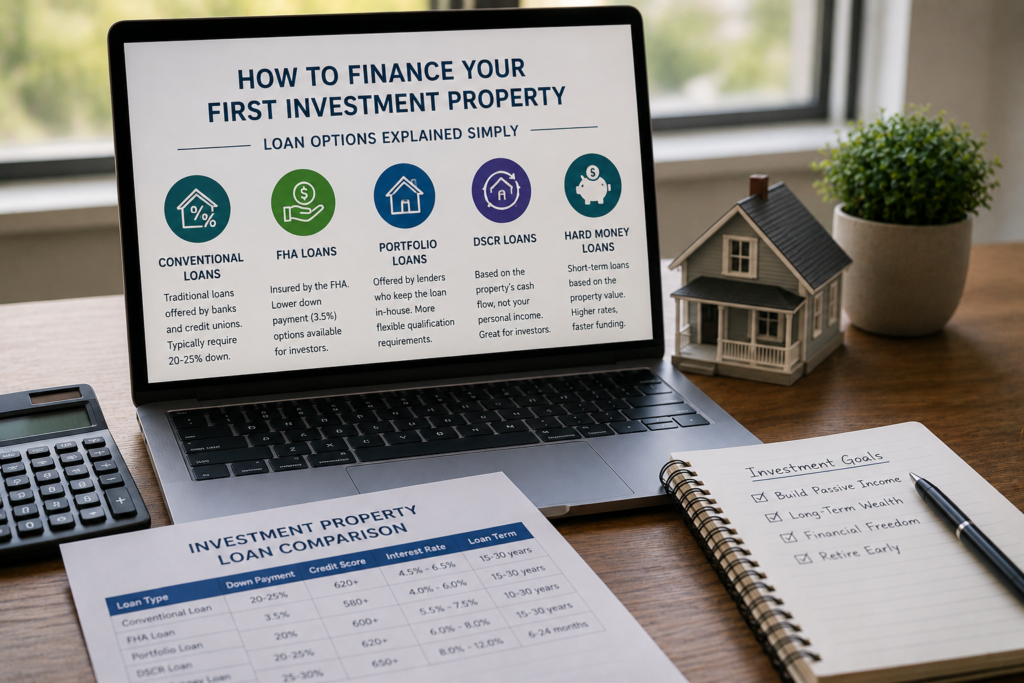
You’ve found a property that makes sense on paper. The cash flow works. The neighborhood is solid. The numbers check out. Then you hit the wall that stops most first-time investors cold:
How do you actually pay for it?
Financing an investment property is different from financing a home you live in. The down payments are larger. The interest rates are higher. The qualification requirements are stricter. And the options are far more varied than most people realize.
Walk into a bank and ask for an investment property loan, and you’ll get one answer: a conventional mortgage with 20% to 25% down. That’s a perfectly valid path. But it’s one path among many, and for a lot of first-time investors, it’s not even the best one.
Seller financing, house hacking, DSCR loans, portfolio lenders, home equity strategies, partnerships, and several other approaches can get you into your first property with less cash, fewer hurdles, or better terms than the standard bank loan.
This guide walks through every major financing option available to first-time investment property buyers. No jargon without explanation. No options listed without honest pros and cons. Just a clear breakdown of how each method works, what it costs, who qualifies, and when it makes the most sense.
Why Investment Property Loans Are Different
Before we get into specific options, you need to understand why lenders treat investment properties differently from primary residences.
When you buy a home to live in, the lender knows you’re personally motivated to make payments. Losing your own roof is a powerful incentive. Government-backed programs (FHA, VA, USDA) exist specifically to help people buy primary residences, keeping rates low and down payments small.
Investment properties carry more risk from the lender’s perspective for three reasons:
Default rates are higher. When finances get tight, people prioritize the mortgage on the home they live in. The rental property payment is the first one they skip. Lenders know this and price the additional risk into their terms.
Income projections are uncertain. Your salary is verifiable and relatively predictable. Rental income depends on occupancy, market conditions, tenant quality, and property condition. Lenders can’t predict rental income with the same confidence as employment income.
The borrower’s skin in the game matters. A buyer who puts 3% down on a primary residence has little equity to lose if they walk away. For investment properties, lenders require larger down payments specifically to ensure the borrower has enough at stake to stay committed through difficult periods.
These risk factors translate into concrete differences you’ll encounter:
- Higher down payments: 15% to 25% minimum for most investment property loans, compared to 3% to 5% for primary residences
- Higher interest rates: Typically 0.5% to 1.0% above primary residence rates
- Stricter credit requirements: Most lenders want a 680+ credit score, with the best rates reserved for 740+
- Larger cash reserves: Lenders often require three to six months of mortgage payments in liquid savings after closing
- More documentation: Expect to provide detailed income verification, tax returns, bank statements, and sometimes a business plan
Understanding these baseline differences helps you evaluate which financing options offer the best combination of accessibility, cost, and flexibility for your specific situation.
Option 1: Conventional Investment Property Mortgage
This is the standard path. You walk into a bank, credit union, or mortgage broker’s office and apply for a traditional mortgage on an investment property.
How It Works
You apply for a mortgage the same way you would for a primary residence, with the investment property designated as a non-owner-occupied purchase. The lender underwrites the loan based on your personal income, credit score, existing debts, and the property’s appraised value. If approved, you close on the property with your down payment and the lender’s funds.
Typical Terms
Down payment: 20% to 25% of purchase price. Some lenders offer 15% down programs, but these come with higher rates and often require private mortgage insurance (PMI).
Interest rates: 0.5% to 0.875% above current primary residence rates. If a 30-year primary residence mortgage is at 6.5%, expect 7.0% to 7.375% for an investment property.
Loan terms: 15-year and 30-year fixed-rate options are standard. Adjustable-rate mortgages (ARMs) are available and may offer lower initial rates, but they carry the risk of payment increases when the rate adjusts.
Credit score requirements: 680 minimum at most lenders. 720+ for the best rates. Below 680, you’ll face either denial or significantly worse terms.
Cash reserve requirements: Most lenders require two to six months of mortgage payments (including taxes and insurance) in liquid reserves after closing. If your monthly PITI (principal, interest, taxes, insurance) is $1,500, you’ll need $3,000 to $9,000 sitting in a savings or investment account.
Debt-to-income ratio (DTI): Lenders typically cap total DTI at 43% to 45%. This means your total monthly debt payments (including the new investment property mortgage) can’t exceed 43% to 45% of your gross monthly income. Some lenders allow you to count projected rental income (usually 75% of market rent) toward your qualifying income, which helps offset the new mortgage payment.
Who This Works Best For
- Buyers with stable W-2 income and verifiable employment history
- Borrowers with good to excellent credit (700+)
- Investors who have saved a substantial down payment
- People buying their first or second investment property (conventional financing gets progressively harder after four financed properties, with a hard cap at ten)
Pros
- Widely available from thousands of lenders
- Competitive interest rates (the lowest available for investment properties)
- Fixed-rate options provide predictable payments for the life of the loan
- No prepayment penalties on most conventional loans
- Familiar, well-understood process
Cons
- Large down payment requirement ties up significant capital
- Strict qualification criteria exclude self-employed borrowers and those with complex income
- Limited to ten financed properties per borrower (Fannie Mae/Freddie Mac limit)
- Lengthy approval process (30 to 45 days is typical)
- Rental income from the property being purchased often can’t be used for qualification until you have landlord experience documented on tax returns
The Real Cost
On a $250,000 property with 20% down:
- Down payment: $50,000
- Closing costs (3%): $7,500
- Cash reserves required (6 months): $9,000
- Total cash needed: $66,500
Monthly mortgage payment (P&I on $200,000 at 7%): approximately $1,331
You need significant savings before you even start looking at properties. For many first-time investors, this cash requirement is the biggest obstacle, which is why the alternative options below exist.
Option 2: House Hacking (Using Owner-Occupied Financing)
House hacking is the single most accessible financing strategy for first-time investment property buyers. It lets you use owner-occupied loan programs, with their lower down payments and better rates, to buy a property that generates rental income.
How It Works
You buy a property that you live in while simultaneously renting out part of it. The property is your primary residence, which qualifies you for primary residence financing terms. The rental income from the other units or rooms offsets your housing costs and, in the right scenario, covers the entire mortgage.
House hacking takes several forms:
Small multi-family (duplex, triplex, or fourplex). You buy a two-to-four-unit building, live in one unit, and rent out the others. A fourplex where you occupy one unit and rent three units at $1,200 each generates $3,600/month in rental income against your mortgage. Properties with up to four units still qualify for residential (not commercial) financing.
Single-family with room rentals. You buy a house and rent out individual bedrooms. In college towns or high-cost cities, renting three spare bedrooms at $700 each generates $2,100/month.
Single-family with an accessory dwelling unit (ADU). You buy a house with a basement apartment, detached guest house, or converted garage. You live in the main house and rent the ADU (or vice versa).
Financing Options for House Hacking
Because you’re living in the property, you qualify for owner-occupied loan programs:
FHA loan:
- Down payment: 3.5% (with 580+ credit score)
- Credit score minimum: 500 (with 10% down) or 580 (with 3.5% down)
- Mortgage insurance: Required upfront (1.75% of loan amount) and annually (0.55% to 0.85% of loan amount) for the life of the loan
- DTI limit: Up to 57% in some cases
- Available for 1-to-4-unit properties as long as you occupy one unit
VA loan (for eligible veterans and active military):
- Down payment: 0% (no down payment required)
- Credit score minimum: No official minimum, though most lenders require 620+
- No mortgage insurance
- Funding fee: 1.25% to 3.3% of loan amount (can be rolled into the loan)
- Available for 1-to-4-unit properties as long as you occupy one unit
Conventional owner-occupied:
- Down payment: 5% to 15% for multi-unit properties (5% for duplexes at some lenders, 15% for 3-4 units)
- Better rates than investment property conventional loans
- PMI required if down payment is below 20%, but can be removed once you reach 20% equity
Real Example: House Hacking a Duplex with FHA
- Purchase price: $300,000 duplex
- FHA down payment (3.5%): $10,500
- Closing costs (3%): $9,000
- Total cash needed: approximately $19,500
- Unit 1 (you live here): no rental income
- Unit 2 (rented): $1,400/month
- Monthly mortgage (P&I on $289,500 at 6.75%): $1,878
- Property taxes: $300/month
- Insurance: $175/month
- Mortgage insurance (FHA): $165/month
- Total monthly cost: $2,518
- Rent collected: $1,400
- Your out-of-pocket housing cost: $1,118/month
You’re living for $1,118/month in a property that might otherwise cost $1,400+ to rent as a tenant. And you’re building equity with every payment. When you eventually move out and rent both units (at say $1,400 each), the property generates $2,800/month against $2,518 in costs, producing positive cash flow.
Who This Works Best For
- First-time real estate investors with limited savings
- Young professionals willing to live in a multi-unit property or share their home with roommates
- Veterans and active military members who can use VA financing
- Anyone comfortable with a one-to-two-year commitment to living in the property before converting it to a full rental
Pros
- Dramatically lower down payment (3.5% FHA vs. 20% to 25% conventional investment)
- Better interest rates than investment property loans
- Rental income helps you qualify for a larger loan
- Builds landlord experience while you live on-site
- Tax benefits: you can deduct expenses for the rented portion of the property
Cons
- You have to actually live in the property (lender fraud for falsely claiming owner occupancy is a federal crime)
- Most lenders require you to live there for at least one year before moving out
- Living next to your tenants isn’t for everyone
- FHA mortgage insurance increases your monthly payment and can’t be removed (without refinancing)
- Multi-unit properties in good neighborhoods can be hard to find at prices that work
The Transition Strategy
The real power of house hacking becomes clear when you think multi-year. Here’s a common progression:
Year 1: Buy a duplex with FHA financing. Live in one unit, rent the other. Total cash invested: $20,000.
Year 2: Refinance out of FHA (to remove mortgage insurance) or simply continue living there while saving aggressively from reduced housing costs.
Year 3: Buy a second property (either another house hack or a straight investment property). Rent out both units of your original duplex. You now own two properties with rental income from three to four units.
Year 5: Repeat. Each property builds equity and cash flow that funds the next acquisition.
This snowball effect is how many successful real estate investors built their portfolios. And it all started with a 3.5% down payment on a duplex.
Option 3: DSCR Loans (Debt Service Coverage Ratio Loans)
DSCR loans have become one of the most popular financing tools for real estate investors over the past several years, especially for self-employed borrowers and investors with complex tax situations.
How It Works
A DSCR loan qualifies based on the property’s income, not your personal income. The lender evaluates whether the property’s rental income can cover the mortgage payment (plus taxes, insurance, and HOA if applicable). If the property’s income is sufficient, you qualify, regardless of your W-2 wages, tax returns, or employment status.
The key metric is the debt service coverage ratio:
DSCR = Property’s gross rental income ÷ Total monthly debt service (PITI)
A DSCR of 1.0 means the rent exactly covers the mortgage payment. Most DSCR lenders require a minimum DSCR of 1.0 to 1.25, meaning the rent must be equal to or greater than the mortgage payment.
Typical Terms
Down payment: 20% to 25% (some lenders offer 15% down with higher rates or stricter DSCR requirements)
Interest rates: Typically 1% to 2% above conventional investment property rates. If conventional is at 7%, expect 8% to 9% on a DSCR loan.
Credit score requirements: 660 to 680 minimum at most lenders. Higher scores get better rates.
Documentation: Minimal compared to conventional. No tax returns, no W-2s, no pay stubs. The lender needs the property appraisal (including a rent schedule or market rent analysis), your credit report, bank statements showing down payment and reserves, and the property insurance and tax documentation.
Loan terms: 30-year fixed and adjustable-rate options available. Some lenders offer interest-only periods (typically five to ten years) to maximize cash flow.
Prepayment penalties: Many DSCR loans include prepayment penalties (typically three to five years), unlike conventional mortgages. Read the terms carefully.
Property types: Single-family, 2-4 units, condos, townhomes, and some lenders cover 5+ unit properties and short-term rentals.
Real Example
- Purchase price: $250,000
- Down payment (25%): $62,500
- Loan amount: $187,500
- Interest rate: 8.25% (30-year fixed)
- Monthly P&I: $1,408
- Monthly taxes: $250
- Monthly insurance: $150
- Total PITI: $1,808
- Market rent: $2,200/month
DSCR = $2,200 ÷ $1,808 = 1.22
This meets most lenders’ minimum DSCR requirement. The loan qualifies based entirely on the property’s ability to service the debt.
Who This Works Best For
- Self-employed borrowers whose tax returns show low income due to write-offs and deductions
- Investors who already own multiple financed properties and have hit conventional lending limits
- Borrowers with strong cash reserves but non-traditional income documentation
- Investors scaling quickly who want a streamlined qualification process
- Foreign nationals or investors without U.S. tax return history (some DSCR lenders accommodate these borrowers)
Pros
- No personal income verification required
- No limit on the number of financed properties
- Faster closing process (often 21 to 30 days vs. 30 to 45 for conventional)
- Available through a wide network of non-QM (non-qualified mortgage) lenders
- Can finance properties in LLCs (many conventional lenders require personal-name ownership)
Cons
- Higher interest rates than conventional financing (1% to 2% more)
- Larger down payment requirement at most lenders
- Prepayment penalties are common (can cost thousands if you sell or refinance early)
- Not available for owner-occupied properties (investment only)
- Lender fees and closing costs are often higher
- Some DSCR lenders have minimum loan amounts ($75,000 to $150,000), excluding lower-priced properties
Option 4: Seller Financing (Owner Financing)
Seller financing is one of the most flexible and underused options available to first-time investors. Instead of borrowing from a bank, you borrow directly from the person selling the property.
How It Works
The seller acts as the lender. You negotiate the purchase price, down payment, interest rate, loan term, and repayment schedule directly with the seller. The seller holds a mortgage (or deed of trust) on the property. You make monthly payments to the seller instead of a bank.
The seller receives steady monthly income (often at a better rate than they’d earn in a savings account or bond), and you get a property without going through traditional underwriting.
Typical Terms
Seller financing terms are fully negotiable. There’s no standard rate or down payment because every deal is a private agreement between buyer and seller. That said, here are common ranges:
Down payment: 5% to 20% (varies widely based on the seller’s comfort level and negotiation)
Interest rates: 5% to 9% (often comparable to or slightly above conventional rates, though creative negotiations can produce below-market rates)
Loan term: 5 to 30 years, with balloon payments common. A typical structure is a 30-year amortization with a 5-year balloon, meaning your monthly payments are calculated as if the loan is 30 years long, but the entire remaining balance is due after five years (requiring refinancing or sale).
Amortization: Fully amortizing, interest-only, or partially amortizing with a balloon payment. The structure depends on what both parties agree to.
Finding Seller Financing Deals
Not every seller is open to financing. The best candidates are:
Owners who own the property free and clear. If the seller has no existing mortgage, they can offer financing without needing their lender’s permission. This is most common with long-term owners, inherited properties, and retirees.
Motivated sellers who’ve had difficulty selling. Properties that have sat on the market for months may be owned by sellers willing to consider creative terms in exchange for a completed sale.
Landlords looking to exit. Experienced landlords who want to stop managing properties but still want real estate-backed income can be excellent seller financing candidates. They understand the asset class and are comfortable holding a mortgage instead of managing tenants.
Off-market properties. Direct mail campaigns, driving for dollars, and networking at local real estate meetups can connect you with sellers who haven’t listed their properties and may be open to creative deal structures.
Real Example
- Purchase price: $200,000
- Down payment (10%): $20,000
- Seller-financed loan: $180,000
- Interest rate: 6.5%
- Term: 30-year amortization, 7-year balloon
- Monthly payment (P&I): $1,138
Compare this to a conventional investment property loan at 7.25%:
- Down payment (20%): $40,000
- Monthly payment (P&I on $160,000): $1,091
With seller financing in this scenario, you put $20,000 less down and pay $47 more per month. That’s $20,000 in freed-up capital that could fund repairs, reserves, or a down payment on another property.
Who This Works Best For
- Investors who can’t qualify for conventional financing (credit issues, self-employment, limited income documentation)
- Buyers who want to minimize their cash outlay
- Investors targeting off-market or hard-to-finance properties
- Creative deal-makers comfortable with direct negotiation
Pros
- Flexible terms negotiated directly between buyer and seller
- Lower or no closing costs (no lender fees, no appraisal required by a bank)
- Faster closing (can close in one to two weeks without bank bureaucracy)
- No credit score minimums (though sellers may check your credit)
- Down payment is negotiable (sometimes as low as 0% to 5%)
- Can finance properties that banks won’t lend on (older properties, properties needing significant repairs, mixed-use buildings)
Cons
- Balloon payments create refinancing risk (you must refinance or pay off the balance when the balloon comes due)
- Not every seller is willing or able to offer financing
- No standardized process, meaning you need to handle (or hire someone to handle) the legal documentation properly
- If the seller still has a mortgage, offering seller financing may violate their lender’s due-on-sale clause
- Interest rates can be higher than conventional depending on negotiation
- Fewer consumer protections than regulated bank lending
Protecting Both Parties
Seller financing deals should always be documented properly with a real estate attorney. The key documents include:
- Promissory note: Details the loan amount, interest rate, payment schedule, default provisions, and balloon payment terms
- Mortgage or deed of trust: Secures the loan against the property
- Purchase agreement: Documents the sale terms
- Title insurance: Protects both parties against title defects
Don’t skip the attorney. A handshake deal on a $200,000 property is a recipe for a legal nightmare if anything goes wrong.
Option 5: Home Equity Loan or HELOC on Your Primary Residence
If you own a home with equity, you can borrow against that equity to fund a rental property purchase.
How It Works
A home equity loan or home equity line of credit (HELOC) uses your primary residence as collateral. The lender lets you borrow a percentage of your home’s equity (the difference between your home’s value and your remaining mortgage balance).
You use the borrowed funds as a down payment (or full purchase price for less expensive properties) on the investment property.
Home Equity Loan vs. HELOC
Home equity loan: A lump-sum loan with a fixed interest rate and fixed monthly payments. You borrow a specific amount and start repaying immediately. Think of it as a second mortgage.
HELOC: A revolving line of credit (similar to a credit card) with a variable interest rate. You can draw funds as needed during the “draw period” (typically 10 years), paying interest only on the amount drawn. After the draw period, the loan enters a “repayment period” (typically 10 to 20 years) where you pay principal and interest.
Typical Terms
Loan-to-value (LTV) limits: Most lenders allow you to borrow up to 80% to 85% of your home’s value, minus your existing mortgage balance.
Example: Your home is worth $400,000. You owe $250,000 on your mortgage. At 80% LTV, you can borrow up to $320,000 – $250,000 = $70,000 in home equity.
Interest rates: Home equity loans typically carry fixed rates of 7% to 10%. HELOCs carry variable rates often starting lower (6% to 9%) but subject to increase.
Credit score requirements: 680+ for most lenders. Some require 700+.
Repayment terms: 10 to 30 years for home equity loans. 10-year draw period plus 10 to 20-year repayment for HELOCs.
Strategy: Using a HELOC as a Down Payment Fund
This is one of the most common strategies for investors transitioning from homeowner to investor:
- Open a HELOC on your primary residence ($70,000 available)
- Find an investment property for $250,000
- Use $50,000 from the HELOC as your 20% down payment
- Get a conventional investment property mortgage for $200,000
- Repay the HELOC over time using rental cash flow
The investment property’s rental income covers its own mortgage, and the surplus cash flow goes toward repaying the HELOC. Once the HELOC is repaid, the full cash flow from the rental property is yours, and the HELOC is available again for the next acquisition.
Who This Works Best For
- Homeowners with significant equity in their primary residence
- Investors who want to avoid depleting savings accounts for a down payment
- Borrowers who want access to revolving credit for multiple future deals
- People in markets where home values have appreciated significantly
Pros
- Access capital without selling your home
- Interest may be tax-deductible (consult a tax advisor for current rules)
- HELOC provides flexible, revolving access to funds for future deals
- Faster process than saving a down payment from scratch
- Keeps your liquid savings intact for reserves and emergencies
Cons
- Your primary residence is collateral. If you can’t make payments on the HELOC, you risk losing your home.
- Variable HELOC rates can increase unexpectedly, raising your costs
- Adding a HELOC payment to your existing mortgage and the new investment property mortgage increases your total debt burden
- Lenders may restrict HELOC access during economic downturns (this happened widely in 2008-2009 and briefly in 2020)
- The investment property needs to cash flow well enough to service both its own mortgage and the HELOC repayment
The Risk to Understand
Using home equity to invest in real estate is leveraging one property to buy another. This amplifies both gains and losses. If the rental property performs well, you’ve used cheap access to capital to build wealth. If the rental property loses money and you can’t repay the HELOC, both properties are at risk.
Only use this strategy if the rental property’s numbers work conservatively, including the HELOC repayment as an expense, and you maintain adequate cash reserves to handle vacancies, repairs, and payment fluctuations.
Option 6: Portfolio Loans (Local Banks and Credit Unions)
Portfolio loans are mortgages that the lender keeps on their own books rather than selling to Fannie Mae or Freddie Mac. Because the lender holds the loan, they can set their own qualification criteria, which are often more flexible than conventional guidelines.
How It Works
You apply at a local bank or credit union that does portfolio lending. The loan officer evaluates your application using the bank’s internal criteria rather than standardized agency guidelines. If the bank believes you’re a good credit risk and the property is a sound investment, they’ll approve the loan even if you don’t fit the conventional lending box.
Typical Terms
Down payment: 15% to 25% (sometimes negotiable for strong borrowers with existing bank relationships)
Interest rates: Varies widely. Some portfolio lenders are competitive with conventional rates. Others charge 0.5% to 1.5% more. The rate depends on the lender, your relationship with them, and the deal specifics.
Loan terms: Often shorter than conventional (15 to 20 years is common, though 30-year terms are available at some lenders). Some portfolio lenders offer adjustable rates with three-to-seven-year fixed periods.
Credit score requirements: More flexible. Some portfolio lenders will work with borrowers in the 620 to 660 range who can demonstrate compensating factors (strong cash reserves, high income, significant real estate experience).
Property types: Portfolio lenders are often more flexible on property types. Mixed-use buildings, properties needing renovation, and properties that don’t meet Fannie/Freddie standards can sometimes be financed through portfolio lending.
Finding Portfolio Lenders
Portfolio lenders are typically:
- Community banks (locally owned banks with one to ten branches)
- Credit unions (especially those serving specific communities or professional groups)
- Small regional banks (focused on a specific geographic area)
Call five to ten small banks and credit unions in your target market and ask: “Do you do portfolio lending for investment properties?” Not all will say yes, but the ones that do can become valuable long-term lending partners.
Who This Works Best For
- Investors buying property types that don’t fit conventional lending criteria
- Borrowers with strong financial profiles who don’t meet standardized guidelines
- Investors who value relationship-based lending and want a long-term banking partner
- Buyers purchasing in smaller markets where local lenders understand the area better than national banks
Pros
- Flexible qualification criteria compared to conventional lending
- Ability to finance non-standard property types
- Relationship-based lending can lead to better terms over time
- Faster decision-making (local loan committee vs. corporate underwriting)
- May finance properties in LLCs without requiring personal-name ownership
- No limit on number of financed properties (the bank sets its own policies)
Cons
- Rates may be higher than conventional
- Shorter loan terms or adjustable rates are common, creating future refinancing needs
- Availability depends on your local market (some areas have few portfolio lenders)
- Loan terms vary significantly between lenders, requiring comparison shopping
- Some portfolio lenders have less sophisticated online platforms and technology
- The lender can change their policies or exit real estate lending at any time
Option 7: Private Money Lending
Private money lenders are individuals (not institutions) who lend their personal funds for real estate investments. Think of it as borrowing from someone you know (or can build a relationship with) rather than a faceless bank.
How It Works
You find an individual with available capital, present them with your investment opportunity, and negotiate loan terms. The lender provides the funds, secured by a mortgage on the property, and you make payments according to the agreed terms.
Private lenders are typically people with investable cash who want real estate-backed returns without doing the work of finding, buying, and managing properties themselves. Retired professionals, successful business owners, self-directed IRA holders, and experienced real estate investors who’ve shifted to a lending role are common private lender profiles.
Typical Terms
Like seller financing, private money terms are negotiable. Common ranges:
Down payment: 10% to 30% (private lenders want the borrower to have skin in the game, but the exact amount is negotiable)
Interest rates: 8% to 12% (higher than bank rates, reflecting the higher risk to an individual lender)
Loan term: 6 months to 5 years (private loans are typically short-term, used as bridge financing until you refinance into a permanent loan)
Points and fees: 1 to 3 points (1% to 3% of loan amount) charged upfront as an origination fee
Collateral: The property itself, with the private lender holding a mortgage or deed of trust
Finding Private Lenders
- Real estate investment meetups and clubs. Local REI groups are full of potential private lenders. Attend regularly, build relationships, and demonstrate your knowledge and credibility.
- Your existing network. Family members, friends, colleagues, and professional contacts may be interested in earning 8% to 10% on their money, secured by real estate. (Proceed carefully with family lending, as it can strain relationships if things go wrong.)
- Self-directed IRA investors. People who hold self-directed IRAs can lend those funds for real estate investments. They earn interest tax-deferred (traditional IRA) or tax-free (Roth IRA), which makes real estate lending attractive from a tax perspective.
- Online private lending platforms. Several platforms connect borrowers with private lenders, streamlining the matching process.
Who This Works Best For
- Investors who need fast funding (private loans can close in days, not weeks)
- Borrowers purchasing properties that need significant renovation (buy, rehab, then refinance into a permanent loan)
- Investors with strong deals but imperfect credit or non-traditional income
- Experienced investors with a track record who can demonstrate competence to lenders
Pros
- Extremely fast funding (as quick as three to seven days)
- Flexible qualification, focused on the deal quality rather than the borrower’s credit score
- Can finance properties that banks won’t touch (severe disrepair, title issues being resolved, etc.)
- Relationship-based lending can improve terms over time as trust builds
- No standardized underwriting paperwork
Cons
- Higher interest rates than institutional lending
- Short loan terms require a clear exit strategy (refinance, sale, or repayment plan)
- Upfront points and fees add to acquisition costs
- Less regulatory protection than bank lending (for both borrower and lender)
- Finding reliable private lenders takes time and relationship building
- Mixing money and personal relationships carries interpersonal risk
Option 8: Hard Money Loans
Hard money loans are short-term, asset-based loans from professional lending companies that specialize in real estate investment financing.
How It Works
Hard money lenders evaluate the property (the “hard asset”) rather than the borrower’s income or employment. If the property has sufficient value and the deal makes sense, the lender funds the loan. These loans are designed for speed and flexibility, not long-term holding.
Typical Terms
Down payment: 10% to 30% of purchase price (some lenders will fund up to 90% of purchase price and 100% of renovation costs for fix-and-flip projects, based on the after-repair value)
Interest rates: 9% to 14% (significantly higher than conventional)
Points: 2 to 4 points charged at origination
Loan term: 6 to 18 months (these are short-term bridge loans, not permanent financing)
Loan-to-value (LTV): 60% to 75% of current property value, or 65% to 80% of after-repair value (ARV) for renovation projects
Who This Works Best For
- Fix-and-flip investors who need fast funding, plan to renovate, and will sell within 12 months
- BRRRR strategy investors (Buy, Rehab, Rent, Refinance, Repeat) who plan to refinance into permanent financing after renovation
- Investors who need to close quickly to win competitive deals
- Borrowers who can’t qualify for any other loan type but have a strong deal
Pros
- Very fast funding (often seven to fourteen days)
- Credit and income requirements are minimal
- Property condition doesn’t need to meet bank standards (lenders finance properties needing major work)
- Available for LLC-owned properties
- Experienced hard money lenders can provide valuable feedback on deal quality
Cons
- Very high cost (interest plus points can total 15% to 20% annualized)
- Short terms create pressure to execute the business plan quickly
- Default consequences are severe (the lender can foreclose quickly)
- Not suitable for long-term buy-and-hold investors unless combined with a refinancing plan
- Requires a clear exit strategy before borrowing
Hard Money as Part of a Larger Strategy
Hard money loans rarely make sense as standalone financing for a buy-and-hold rental property. The rates are too high for long-term holding. But they make excellent sense as the first step in a BRRRR strategy:
- Buy a distressed property with hard money (fast close, flexible on property condition)
- Rehab the property (using remaining hard money funds or your own cash)
- Rent the property to a qualified tenant
- Refinance into a conventional or DSCR loan (paying off the hard money loan)
- Repeat with the recycled capital
This strategy lets you access properties that banks won’t finance, add value through renovation, and transition to affordable long-term financing once the property is stabilized.
Option 9: Partnerships and Joint Ventures
If you have skills but no money, or money but no skills, a partnership can fill the gap.
How It Works
Two or more investors combine resources to purchase a property. Typically, one partner provides the capital (down payment, closing costs, reserves) while the other provides the labor (finding deals, managing renovations, handling property management). Profits and responsibilities are split according to a partnership agreement.
Common Structures
50/50 equity split: One partner provides all capital, the other provides all management. Profits (cash flow and appreciation) split equally. This is the simplest structure but may not feel fair if contributions are significantly unequal.
Preferred return plus equity split: The capital partner receives a preferred return on their investment (say, 8% annually) before any profits are split. Remaining profits split 50/50 or 60/40. This structure compensates the capital partner for their financial risk before the operating partner shares in profits.
Syndication structure: For larger deals, one partner (the general partner or sponsor) manages the investment while multiple passive investors (limited partners) provide capital. This structure is more complex and often involves securities law compliance.
Who This Works Best For
- First-time investors with deal-finding ability but limited capital
- Investors with capital who want passive involvement
- People who want to learn by partnering with an experienced investor
- Buyers targeting larger properties that exceed their individual financial capacity
Pros
- Access to deals you couldn’t do alone
- Shared risk between partners
- Complementary skills and resources
- Learning opportunity for less experienced partners
- Can acquire larger or more profitable properties
Cons
- Shared profits (you keep less than if you did it alone)
- Partnership disagreements can destroy deals and relationships
- Legal complexity requires a well-drafted partnership agreement
- Each partner’s credit and financial situation can affect the other’s
- Exit strategy must be agreed upon in advance (what happens if one partner wants to sell and the other doesn’t?)
Protecting the Partnership
Never enter a real estate partnership without a written agreement drafted by a real estate attorney. The agreement should cover:
- Capital contributions from each partner
- Profit and loss allocation
- Management responsibilities and decision-making authority
- How additional capital calls will be handled
- Dispute resolution process
- Exit provisions (buyout rights, sale triggers, dissolution terms)
- What happens if one partner dies, becomes incapacitated, or goes bankrupt
The time to negotiate these terms is before you buy the property, when everyone is optimistic and cooperative. Waiting until a disagreement arises to figure out the rules guarantees a bad outcome.
Comparing Your Options: A Decision Framework
With nine financing options on the table, choosing the right one comes down to four variables:
Variable 1: How Much Cash Do You Have?
| Cash Available | Best Options |
|---|---|
| Under $15,000 | House hacking (FHA or VA), partnership, seller financing with low down |
| $15,000 to $40,000 | House hacking, seller financing, DSCR with minimum down |
| $40,000 to $75,000 | Conventional, DSCR, seller financing, HELOC-funded down payment |
| $75,000+ | Any option; conventional offers the best rates at this level |
Variable 2: What’s Your Income Documentation Situation?
| Income Type | Best Options |
|---|---|
| Stable W-2 employment | Conventional, FHA, VA, HELOC |
| Self-employed (strong tax returns) | Conventional, DSCR, portfolio |
| Self-employed (heavy write-offs reducing taxable income) | DSCR, seller financing, private money, portfolio |
| No verifiable income | Seller financing, private money, hard money, partnership |
Variable 3: What’s Your Credit Score?
| Credit Range | Best Options |
|---|---|
| 740+ | Conventional (best rates), HELOC |
| 700 to 739 | Conventional, DSCR, FHA, portfolio |
| 660 to 699 | DSCR, FHA, portfolio, seller financing |
| Below 660 | Seller financing, private money, hard money, partnership |
Variable 4: What’s Your Timeline?
| Timeline | Best Options |
|---|---|
| Need to close in under 2 weeks | Hard money, private money, cash (from HELOC or savings) |
| Can wait 3 to 4 weeks | DSCR, portfolio, seller financing |
| Can wait 4 to 6 weeks | Conventional, FHA, VA |
The True Cost of Financing: What Most Guides Don’t Show You
Interest rates get all the attention. But the true cost of financing includes several factors that dramatically affect your long-term returns.
The Down Payment Opportunity Cost
Money you put into a down payment can’t be invested elsewhere. If you put $50,000 down on a rental property, that $50,000 isn’t earning returns in the stock market, funding another deal, or sitting in reserves for emergencies.
This opportunity cost means that a financing option with a lower down payment can sometimes produce better overall returns, even if the interest rate is slightly higher. Keeping $25,000 in reserve or deployed in another investment might be worth paying an extra 0.5% on your mortgage.
The Points and Fees Factor
Origination fees, discount points, and other closing costs reduce your effective return. A loan with a 7% rate and zero points may cost less over five years than a loan with a 6.75% rate and two points ($4,000 on a $200,000 loan).
Calculate the break-even point: how many months of lower payments does it take to recoup the upfront cost of the points? If you plan to hold or keep the loan for longer than the break-even period, paying points can make sense. If you might sell or refinance sooner, skip the points and take the higher rate.
The Prepayment Penalty Trap
Some loans (especially DSCR and hard money) include prepayment penalties that charge you for paying off the loan early. A 3% prepayment penalty on a $200,000 loan costs $6,000 if you refinance or sell within the penalty period.
Before signing, calculate the worst-case penalty cost and factor it into your deal analysis. If you plan to refinance within two to three years, a loan with no prepayment penalty at a slightly higher rate may cost less than a lower-rate loan with a steep penalty.
The Refinancing Assumption Risk
Several strategies in this guide assume you’ll refinance at some point: balloon payments from seller financing, BRRRR from hard money, HELOC repayment from cash flow. Each of these assumptions carries risk.
What if interest rates are higher when you need to refinance? What if the property appraises lower than expected? What if your credit situation has changed? What if lenders tighten their criteria?
Every financing plan that depends on future refinancing should include a backup plan. Can you extend the balloon payment? Can you repay the hard money loan from savings if the refinance falls through? Can you make the higher HELOC payments indefinitely?
Hope is not a financing strategy. Plan for the refinancing to work. Prepare for the possibility that it doesn’t.
Getting Pre-Approved: The Practical First Step
Regardless of which financing option you choose, getting pre-approved before you start looking at properties gives you two advantages:
You know your budget. A pre-approval letter tells you exactly how much you can borrow and at what approximate terms. This prevents wasting time analyzing properties you can’t afford.
You can act quickly. In competitive markets, properties sell fast. A pre-approved buyer can make an offer within hours. A buyer who hasn’t started the financing process needs weeks just to determine if they qualify.
For conventional financing, the pre-approval process involves:
- Gathering documents: two years of tax returns, two months of bank statements, recent pay stubs, a list of assets and liabilities
- Submitting an application with a lender
- Authorizing a credit check
- Receiving a pre-approval letter stating the maximum loan amount you qualify for
For DSCR loans, pre-approval is simpler: credit check, proof of down payment funds, and a general discussion of the property type and rental market you’re targeting.
For seller financing and private money, “pre-approval” means having your down payment funds verified and ready, and being prepared to present your financial credibility to the seller or lender.
The First-Time Investor’s Financing Action Plan
Here’s a step-by-step plan to go from “I want to buy a rental property” to “I have the financing in place.”
Week 1: Assess your position.
- Calculate your total available cash (savings, investments you’re willing to liquidate, home equity)
- Pull your credit report and credit score from all three bureaus
- Gather your income documentation (tax returns, pay stubs, bank statements)
- Determine which financing options you qualify for based on the frameworks above
Week 2: Research lenders.
- Contact three to five conventional lenders for rate quotes on investment property mortgages
- Contact two to three DSCR lenders for comparison
- Call three to five local banks and credit unions about portfolio lending
- If you own a home, get HELOC quotes from your current mortgage servicer and two other banks
Week 3: Get pre-approved.
- Submit applications to your top two lending options
- Compare pre-approval terms (rates, fees, down payment, closing timeline)
- Select your primary financing strategy and identify a backup option
Week 4 and beyond: Start analyzing properties.
- Use your pre-approval terms to run accurate cash flow projections
- Calculate all return metrics using your actual financing costs
- Make offers only on properties where the numbers work with your specific loan terms
Throughout the process: Attend local real estate investor meetups, build relationships with potential private lenders, and keep learning about seller financing opportunities. Even if you start with conventional financing, having alternative options available gives you flexibility and leverage in future deals.
The Mindset Shift: Financing as a Tool, Not an Obstacle
First-time investors often view financing as the gatekeeper standing between them and their first deal. That perspective is backward.
Financing is a tool. Like any tool, it works well when matched to the job and poorly when forced into the wrong application. A conventional mortgage is the right tool for a clean, rent-ready property bought by a W-2 employee with good credit and ample savings. It’s the wrong tool for a distressed property bought by a self-employed investor with a complex tax return.
The most successful real estate investors don’t have one financing strategy. They have a toolkit. They use conventional loans when they offer the best terms. They use DSCR loans when income documentation is the bottleneck. They use seller financing when the seller is motivated and the terms are favorable. They use private money when speed matters. They use HELOCs to recycle equity from one deal into the next.
Your first deal will probably use one financing method. Your fifth deal might combine two or three. The point is to understand all of your options so you can pick the right one for each specific situation.
The money to finance rental properties exists. Banks have it. Sellers have it. Private lenders have it. Your own home equity might have it. The question isn’t whether financing is available. The question is which financing structure turns this specific property into a profitable investment.
Run the numbers with real loan terms. Compare the true cost across multiple options. Choose the financing that produces the best risk-adjusted return on your cash. And make the offer.
The property isn’t going to buy itself. But with the right financing in place, you can.