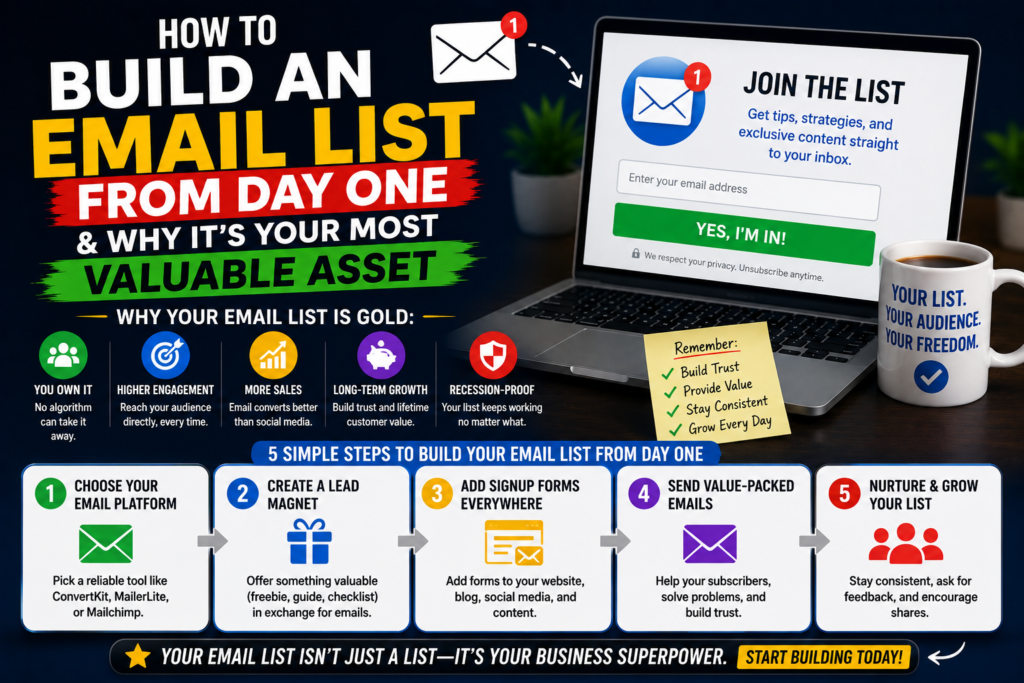
Every platform you’re building on right now could disappear tomorrow.
That’s not fear-mongering. It’s a pattern. Vine shut down overnight. Organic Facebook reach dropped from 16% to under 2% in a few years. Instagram’s algorithm changes have buried accounts that once reached millions. TikTok faces recurring ban threats in entire countries. Twitter’s rebrand to X sent advertisers and users scrambling.
And every time a platform shifts, stumbles, or dies, creators and business owners who built their entire audience there lose access to the people they spent years reaching.
Except the ones who built an email list.
An email list is the only audience you fully own. No algorithm stands between you and your subscribers. No platform policy change can cut your reach in half. No corporate acquisition can lock you out of the community you built. When you send an email, it lands in an inbox. What happens from there depends on the quality of your message, not the mood of an algorithm.
This guide breaks down exactly how to start building an email list from your very first day online, even if you have zero traffic, zero followers, and zero technical experience. It covers the strategy, the tools, the lead magnets, the opt-in placements, the welcome sequences, and the long-term approach that turns a list of email addresses into a revenue-generating asset worth more than any social media following.
Why Your Email List Is Worth More Than Every Other Channel Combined
Before investing time in building something, you should understand why it matters. The case for email is backed by hard numbers and practical reality.
The Math That Changes Your Perspective
Email marketing generates an average return of $36-$42 for every $1 spent. No other marketing channel comes close to that ratio. Social media advertising, Google ads, influencer partnerships, none of them match the ROI of a well-maintained email list.
Here’s why the math works so well:
You pay once to acquire a subscriber. Whether that subscriber came from a blog post, a social media ad, or a lead magnet shared in a Facebook group, the acquisition cost is a one-time event. Every email you send to that subscriber after the first one costs almost nothing.
Email conversion rates dwarf social media conversion rates. The average email click-through rate is 2-5%. The average organic social media post reaches 1-5% of your followers, and the click-through rate on that reach is a fraction of a percent. A 5,000-person email list routinely outperforms a 50,000-person Instagram following in sales, traffic, and engagement.
Subscribers stay accessible. A social media follower who never sees your post due to algorithmic filtering doesn’t know your offer exists. An email subscriber at least has the opportunity to see your subject line every time you send. Even if they don’t open every email, your name stays in their inbox, which keeps you in their awareness.
Email Subscribers Are Warmer Leads
Someone who gives you their email address has taken a deliberate action. They typed in their address, hit submit, and often confirmed through a double opt-in process. That’s a fundamentally different level of commitment than tapping a “follow” button while scrolling through a feed.
Email subscribers have told you, through their action, that they want to hear from you. They’ve invited you into their inbox, one of the most personal digital spaces they have. That invitation carries weight, and it translates directly into higher trust, higher engagement, and higher purchase rates.
You Control the Platform
Your email list lives on a platform you choose (ConvertKit, MailerLite, Beehiiv, ActiveCampaign), and you can export your list and move it to another platform anytime. Try exporting your Instagram followers to a different app. It can’t be done.
This portability means your email list is a true business asset. It has value independent of any single platform, tool, or service provider. If your email tool raises prices, you move your list. If they shut down, you move your list. The subscribers are yours.
When to Start Building Your List (the Answer Is Now)
The most common mistake new bloggers, creators, and business owners make with email is waiting. They tell themselves:
“I’ll start collecting emails once I have more traffic.”
“I’ll set up my email list after I finish my website.”
“I need more content before I ask people to subscribe.”
Every day you delay, visitors arrive at your site, consume your content, and leave without any way for you to reach them again. Those visitors are gone. Some might come back through search. Most won’t.
Starting your email list on day one means every piece of content you publish, every social media post you share, and every interaction you have online becomes an opportunity to grow an asset that compounds over time.
You don’t need a perfect lead magnet. You don’t need a polished welcome sequence. You need a way to collect email addresses and a reason for people to give you theirs. That’s it. Everything else can be refined as you grow.
Choosing Your Email Marketing Platform
Your email platform handles storing your subscribers, sending emails, creating opt-in forms, and automating sequences. Pick one that fits your current needs without overcomplicating things.
Best Platforms for Beginners
ConvertKit (now Kit): Built specifically for creators, bloggers, and small businesses. Free plan supports up to 10,000 subscribers with limited features. The paid plan unlocks automation, sequences, and advanced segmentation. Clean interface. Strong deliverability rates.
MailerLite: Generous free plan (up to 1,000 subscribers with almost all features). Intuitive drag-and-drop email editor. Good automation capabilities. A strong choice for budget-conscious beginners.
Beehiiv: Designed for newsletter-first creators. Free plan includes up to 2,500 subscribers. Built-in referral program, recommendations network, and monetization tools. Growing quickly in the creator space.
Flodesk: Flat-rate pricing regardless of list size ($38/month). Beautifully designed email templates. Simple interface. A good fit for creators who prioritize visual aesthetics in their emails.
ActiveCampaign: More advanced automation and CRM features. Better suited for businesses that need complex segmentation and sales funnels. Higher learning curve. Starts at a higher price point.
What to Look For
When choosing a platform, prioritize these features:
- Deliverability rate. The percentage of emails that actually reach inboxes rather than spam folders. This is the most underrated factor. A platform with great features but poor deliverability defeats the purpose.
- Ease of creating opt-in forms. You’ll embed forms on your website, create pop-ups, and build landing pages. This should be straightforward.
- Automation capabilities. At minimum, you need automated welcome sequences. As you grow, you’ll want behavior-triggered emails and segmentation.
- Tagging and segmentation. The ability to organize subscribers based on interests, behavior, or how they found you. This becomes critical when you have different products or topics.
- Migration options. Can you easily export your subscriber list if you want to switch platforms later?
Don’t overthink this decision. Any of the platforms listed above will serve a beginner well. You can always switch later, and your subscriber list comes with you.
Lead Magnets: The Reason People Subscribe
Nobody wakes up thinking, “I’d love to get more email today.” Your potential subscribers are drowning in email. Their inboxes are crowded. They guard their email address with increasing skepticism.
To earn that email address, you need to offer something valuable enough to overcome their resistance. That “something” is your lead magnet: a free resource delivered in exchange for an email address.
What Makes a Lead Magnet Work
The best lead magnets share four qualities:
They solve a specific problem. “Free Marketing Guide” is vague. “The 5-Email Welcome Sequence Template That Converts 40% of New Subscribers” solves a precise problem for a defined audience.
They deliver quick value. A 200-page ebook that takes three weeks to read isn’t appealing to someone who needs help right now. A one-page checklist they can use today is. Speed of value delivery matters more than comprehensiveness.
They’re relevant to what you sell. Your lead magnet should attract people who are likely to become customers. A fitness coach offering a free recipe ebook attracts people interested in food, not necessarily people who want coaching. A free “7-Day Home Workout Plan” attracts the right audience.
They require low effort to consume. PDFs that can be read in 5-10 minutes, templates that can be used immediately, checklists that simplify a process. The lower the effort barrier, the higher the conversion rate.
20 Lead Magnet Ideas That Convert
Quick-win formats (highest conversion rates):
- Checklists (“The Complete Blog Post SEO Checklist”)
- Cheat sheets (“Instagram Hashtag Cheat Sheet: 200 Tags Organized by Niche”)
- Templates (“Freelance Proposal Template That Wins Clients”)
- Swipe files (“50 Email Subject Lines That Get 40%+ Open Rates”)
- Spreadsheets (“Monthly Budget Tracker Spreadsheet”)
Educational formats:
- Short ebooks or guides (10-20 pages max)
- Email courses (“5-Day Course: Learn Basic Photo Editing”)
- Video tutorials (one specific skill, under 15 minutes)
- Workshops or webinar recordings
- Curated resource lists (“The 25 Best Free Tools for Freelance Designers”)
Interactive formats:
- Quizzes (“What Type of Investor Are You?”)
- Calculators (“How Much Should You Charge as a Freelancer?”)
- Assessments (“Score Your Website’s SEO Health in 2 Minutes”)
- Challenges (“7-Day Declutter Challenge with Daily Email Prompts”)
Exclusive access formats:
- Private community invitations (Slack, Discord, or Facebook group)
- Early access to new content, products, or features
- Behind-the-scenes content not published publicly
- Monthly insider newsletters with exclusive insights
High-value formats (best for premium audiences):
- Free strategy sessions or consultations (15-20 minutes)
- Mini-courses with actionable frameworks
How to Choose Your First Lead Magnet
Ask yourself two questions:
- What question do I get asked most often? Your lead magnet should answer that question in a format people can use immediately.
- What small win can I help someone achieve quickly? The lead magnet should deliver a result, not just information. A “Social Media Audit Checklist” that helps someone identify three things to fix on their profiles today delivers a win. A “Social Media Overview” document delivers information. The first one gets more signups.
Start with one lead magnet. Make it simple. You can create additional lead magnets later as you learn what your audience responds to.
Content Upgrades: The Highest-Converting Lead Magnet Type
A content upgrade is a lead magnet designed specifically for a single blog post. Instead of offering one generic freebie across your entire site, you offer a resource that directly extends the value of the post the reader is currently reading.
Example: A blog post titled “How to Write a Business Plan” offers a downloadable business plan template as a content upgrade. The reader is already engaged with the topic. The template is the obvious next step. Conversion rates on content upgrades typically run 3-8%, compared to 1-3% for generic site-wide opt-ins.
How to create content upgrades at scale without losing your mind:
- Turn your blog post’s key steps into a printable checklist
- Summarize a long post into a one-page cheat sheet
- Create a spreadsheet version of any list or comparison in your post
- Record a short video walking through the post’s main process
- Package the post’s resources and links into a downloadable PDF
You don’t need a content upgrade for every post. Start with your five highest-traffic posts, then add content upgrades to new posts as you publish them.
Opt-In Form Placement: Where to Ask for the Email
You’ve built your lead magnet. Now you need to put it where people will actually see it and act. Placement matters as much as the offer itself.
The Five Highest-Converting Placements
1. Within the blog post content (inline opt-in)
An opt-in form embedded naturally inside your blog post, between paragraphs, after a section break, or at a point where the content naturally leads to the offer.
Why it works: The reader is already engaged with the content. An inline opt-in placed after a particularly valuable section catches them at peak interest.
Where to place it: After the first major section (around 300-500 words in), and again near the end of the post. Two inline opt-ins per post is a good baseline.
2. End of post
A clear call-to-action with an opt-in form at the bottom of every blog post. The reader has just consumed your content and is deciding what to do next. Give them a next step.
Why it works: The reader has proven interest by reading the entire post. They’ve invested time and attention. Offering them a related free resource at this moment converts well because they’re already engaged.
3. Exit-intent pop-up
A pop-up that appears when the reader’s cursor moves toward the browser’s close button or back arrow. It catches people who are about to leave without subscribing.
Why it works: You’re reaching visitors at the moment you’d otherwise lose them entirely. A well-designed exit-intent pop-up with a compelling offer converts 2-5% of departing visitors.
Tip: Keep the pop-up clean. One headline, one sentence about the benefit, one email field, one button. Don’t ask for first name, last name, company, and shoe size. Every additional field reduces conversion rates by 10-25%.
4. Dedicated landing page
A standalone page with no navigation, no sidebar, and no distractions. The only action a visitor can take is subscribing.
Why it works: Landing pages eliminate decision fatigue. The visitor doesn’t have 15 other things competing for their attention. Conversion rates on well-designed landing pages run 20-50%, compared to 1-5% for forms embedded on content pages.
When to use it: Link to your landing page from social media bios, podcast show notes, guest post author bios, and email signatures. Any time you’re sending traffic specifically to grow your email list, send it to a landing page, not your homepage.
5. Top of homepage or header bar
A slim banner or opt-in section at the top of your homepage (or across your entire site via a header bar). It’s subtle but persistent.
Why it works: It’s visible on every page without being intrusive. Visitors who aren’t ready to commit during their first visit might return later and finally subscribe when they’ve seen the offer enough times.
Placements to Avoid
Sidebar opt-in forms. The sidebar sounds logical but performs poorly. On mobile (60%+ of traffic), sidebars are pushed below the main content where nobody scrolls. On desktop, banner blindness causes readers to ignore sidebar elements entirely.
Pop-ups that fire immediately on page load. A pop-up that appears before the reader has seen a single word of your content feels aggressive and disrespectful. It says, “Give me your email before I’ve given you any reason to.” Set pop-ups to trigger after 30-60 seconds of engagement, a scroll depth of 50%+, or on exit intent.
Multiple different offers on the same page. One lead magnet per page keeps the message focused. Offering three different freebies on the same blog post splits attention and confuses the visitor. Choose the most relevant one and commit.
Writing Opt-In Copy That Converts
The words around your opt-in form determine whether someone subscribes or scrolls past. Most opt-in copy is forgettable because it follows the same tired formula: “Subscribe to our newsletter for tips and updates!”
Nobody gets excited about “tips and updates.” Here’s how to write opt-in copy that people actually respond to.
The Headline Formula
Your opt-in headline should answer one question from the reader’s perspective: “What do I get, and why should I care?”
Weak: “Join Our Mailing List”
Strong: “Get the Free Template I Use to Plan a Week of Content in 30 Minutes”
Weak: “Subscribe for Updates”
Strong: “Every Tuesday: One Actionable SEO Tip You Can Implement in 10 Minutes”
Weak: “Download Our Free Guide”
Strong: “The First-Time Homebuyer Checklist That Saved Me From 3 Expensive Mistakes”
Notice the pattern. Strong headlines are specific about the benefit, concrete about the format, and focused on what the subscriber gains.
The Supporting Line
One sentence below the headline that adds context or overcomes an objection.
- “Join 3,400 freelancers who get this every Friday.” (social proof)
- “No spam. Unsubscribe anytime with one click.” (objection handling)
- “Takes 5 minutes to read and saves you hours.” (value proposition)
- “Plus, get instant access to our resource library.” (bonus value)
The Button Text
“Submit” is the worst button text in the history of the internet. It sounds like you’re handing in homework.
Better options:
- “Send Me the Template”
- “Get Instant Access”
- “Start the Free Course”
- “Yes, I Want This”
- “Download Now”
The button text should describe what happens when you click it. First-person phrasing (“Send Me…”) often outperforms third-person (“Get Your…”) because it creates a sense of personal ownership.
The Welcome Sequence: Your First Impression at Scale
When someone subscribes, the worst thing you can do is go silent. They’ve just raised their hand and said, “I’m interested.” If you don’t respond for two weeks, they’ve forgotten who you are by the time you send something.
A welcome sequence is a series of automated emails that fire immediately after someone subscribes. It’s your introduction, your credibility builder, and your first sales opportunity, all running on autopilot.
The 5-Email Welcome Sequence Framework
Email 1: Deliver and connect (sent immediately)
Subject line example: “Here’s your [lead magnet name] + a quick hello”
This email delivers the promised lead magnet and introduces you briefly. Keep the introduction personal and short. Who are you, what do you help people with, and one sentence about why you’re worth listening to.
Close with a question: “What’s your biggest struggle with [topic]?” This turns a one-way broadcast into a two-way conversation. The replies you receive are market research gold, telling you exactly what your audience needs help with.
Email 2: Share your story or philosophy (sent day 2)
Subject line example: “How I went from [struggling state] to [desired state]”
Tell your origin story. Not a polished brand narrative, but the real version. What problem did you face? What did you try that didn’t work? What shifted? How does that experience inform what you teach or create today?
People subscribe to learn from you. Before they trust your advice, they need to trust you as a person. A vulnerable, honest story builds that trust faster than any credential or statistic.
Email 3: Deliver unexpected value (sent day 4)
Subject line example: “The one thing most people get wrong about [topic]”
Share your best tip, your most counterintuitive insight, or a quick win that proves you know what you’re talking about. This email should make the subscriber think, “If the free stuff is this good, the paid stuff must be incredible.”
Don’t hold back. The impulse to save your best material for paid products is understandable but counterproductive. Generosity in your free content is what creates demand for paid content.
Email 4: Social proof and credibility (sent day 6)
Subject line example: “What happened when [person/audience] tried this approach”
Share a case study, testimonial, or result. This could be your own results, a client’s transformation, or a reader success story. Concrete outcomes build credibility in ways that abstract claims never can.
“I helped a client increase their email open rates from 12% to 38% in six weeks” hits harder than “I’m an email marketing expert.”
Email 5: Introduce your offer (sent day 8)
Subject line example: “If you’re ready to [desired outcome], this might help”
You’ve delivered value for a week. You’ve built trust and credibility. Now introduce your product, service, or primary recommendation. Do it with the same helpfulness and honesty that defined the previous emails.
Frame the offer around the subscriber’s problem, not your product’s features. “If you’ve been spending three hours every week struggling with meal planning, this template cuts that time to 20 minutes” is about their pain. “My meal planning template has 52 weeks of customizable plans” is about your product. Lead with their pain.
Welcome Sequence Tips
Set realistic expectations. In Email 1, tell subscribers how often you’ll email them and what kind of content to expect. “I send one email every Tuesday with a practical tip you can use that week” sets a clear expectation that reduces unsubscribes.
Don’t rush to sell. Five emails over eight days with a soft sell in the final email is a comfortable pace. Some marketers sell in Email 1. That can work for certain audiences, but for most beginners, building trust first produces better long-term results.
Watch your data. Track open rates and click rates on each email in your sequence. If Email 3 has a significantly lower open rate than Email 2, your Email 2 might be underwhelming, which causes subscribers to stop opening subsequent emails. Diagnose and fix weak links.
Personalize where possible. If you collected the subscriber’s first name, use it in the greeting. “Hey Sarah” feels different from “Hey there.” Small touches of personalization increase engagement.
Growing Your List: Strategies for Every Stage
When You Have Zero Traffic
Starting from nothing feels like shouting into a void. But you don’t need traffic to get your first subscribers. You need resourcefulness.
Tell everyone you know. Send a personal email to friends, family, and professional contacts: “I’m starting a newsletter about [topic]. If that’s something you’re interested in, here’s the link to subscribe.” You won’t get hundreds of subscribers this way, but you’ll get your first 20-50, which gives you real people to write for and data to learn from.
Share in communities where your audience gathers. Facebook groups, Reddit communities, Discord servers, Slack groups, niche forums. Don’t drop your link and run. Contribute genuine value to discussions, then mention your newsletter where it’s relevant. “I actually wrote about this in my newsletter last week, here’s the link if you want to go deeper” feels helpful. “Subscribe to my newsletter!” feels like spam.
Leverage social media bios and pinned posts. Even if you have 200 followers, optimize your bio with a link to your lead magnet landing page. Pin a post that highlights your free resource. Every new follower sees it.
Guest post on established blogs. Write articles for blogs that already have the audience you want to reach. Include a link to your lead magnet in your author bio. One guest post on a high-traffic site can bring in 50-200 subscribers.
Collaborate with creators in adjacent niches. Find someone with a similar-sized audience in a complementary (not competing) niche. Cross-promote each other’s newsletters. A fitness creator and a meal planning creator sharing each other’s lead magnets with their respective audiences is a win for both.
When You Have Some Traffic (1,000-10,000 Monthly Visitors)
Optimize your existing traffic for conversions. Before chasing more traffic, make sure you’re converting the visitors you already have. Add inline opt-ins to your top 10 posts. Set up an exit-intent pop-up. Create content upgrades for your highest-traffic pages.
Most blogs convert less than 1% of visitors into subscribers. Even small improvements to opt-in placement and copy can double that rate, which doubles your list growth without any additional traffic.
Use Pinterest strategically. Pinterest drives long-tail search traffic for months and years after you publish a pin. Create pins that link to blog posts with strong content upgrades. A single Pinterest pin that performs well can drive a steady stream of subscribers for months.
Start a referral program. Tools like SparkLoop, ReferralHero, or Beehiiv’s built-in referral system reward existing subscribers for sharing your newsletter with friends. “Refer 3 friends and get access to my exclusive resource library” gives subscribers a reason to actively promote your list.
Add email capture to every touchpoint. Your email signature, your social media link-in-bio, your YouTube video descriptions, your podcast show notes, your online community profiles. Anywhere someone encounters you online should include a path to your email list.
When You Have Meaningful Traffic (10,000+ Monthly Visitors)
Segment your list based on interests. Not every subscriber cares about every topic you cover. Use tags to track which lead magnet someone downloaded or which links they click in your emails. Then send targeted content based on those interests.
A segmented email campaign generates 760% more revenue than a one-size-fits-all blast. Subscribers who receive content matched to their interests stay subscribed longer, open more emails, and buy more frequently.
Run paid ads to your lead magnet. Facebook and Instagram ads targeting your ideal audience, directed to a high-converting landing page, can acquire email subscribers for $1-$5 each in many niches. If your email list generates $5+ per subscriber over their lifetime (through product sales, affiliate commissions, or ad revenue from traffic), paid acquisition becomes profitable.
Partner with complementary newsletters. Newsletter sponsorships and cross-promotions with creators who serve the same audience can bring in hundreds of subscribers in a single send. Platforms like Swapstack and SparkLoop connect newsletter owners for cross-promotion opportunities.
Create a viral lead magnet. Design a resource that subscribers naturally want to share: a calculator, an interactive quiz, a comprehensive industry report, or a free tool. The best lead magnets grow your list passively because every new subscriber becomes a distribution channel.
What to Send Your Subscribers (Beyond the Welcome Sequence)
Building a list means nothing if you don’t email it. A dormant list decays. Subscribers forget who you are. Open rates plummet. The list becomes worthless.
Consistency is the lifeblood of email marketing. Pick a cadence and stick with it.
Cadence Options
Weekly: The most popular choice for newsletters and blogs. Frequent enough to stay top-of-mind, infrequent enough to avoid fatigue. Best for most creators and small businesses.
Biweekly (every two weeks): A good compromise if weekly feels unsustainable. Still maintains connection without overwhelming your audience or your schedule.
Daily: Aggressive but effective for certain niches (finance, news, deals, motivation). Daily emails build a strong habit loop with your audience but require significant content production capacity.
Monthly: Too infrequent for most purposes. By the time your next email arrives, subscribers have forgotten you exist. The unsubscribe rate on monthly emails tends to be higher because each email feels unexpected rather than anticipated.
Content Formats That Keep Subscribers Engaged
The curated newsletter. Share 3-5 valuable resources, articles, or tools each week with your brief commentary on each. This positions you as a trusted filter in a noisy world. (“Here are 5 things worth your time this week.”)
The single-topic deep dive. One idea, explored thoroughly, in each email. This format works well for thought leadership and building authority. (“This week, I want to talk about one counterintuitive pricing strategy that changed how I think about my products.”)
The personal update with a lesson. Share something that happened to you recently, then extract a practical lesson your audience can apply. This format builds connection and delivers value simultaneously. (“Last week, I lost my biggest client. Here’s what it taught me about income diversification.”)
The actionable tip. One specific, implementable tip per email. Short, practical, immediately useful. (“This week’s tip: Change your email subject lines from statements to questions. I tested this on my last 10 emails and saw a 22% increase in open rates.”)
The story-driven sell. When you’re promoting a product, wrap the promotion in a story. Share the problem your product solves through a real scenario, build empathy and understanding, then introduce the product as the resolution. (“Last month, a reader named James told me he was spending 6 hours a week on social media scheduling. Here’s what I suggested, and here’s the tool that made it possible.”)
The Ratio That Keeps Subscribers Happy
For every promotional email you send, send 3-4 value-driven emails. This ratio ensures that your list doesn’t feel like a constant sales pitch. When you do promote something, your audience is receptive because you’ve earned their attention with consistent value.
Some creators follow a stricter ratio of 5:1 or even 10:1. The right balance depends on your audience’s tolerance and expectations. Pay attention to unsubscribe rates after promotional emails. If you see a spike, pull back on frequency.
Email Deliverability: Getting Into the Inbox
Sending an email and having it reach the inbox are two different things. If your emails land in spam or the “Promotions” tab, your open rates tank regardless of how good your content is.
Factors That Affect Deliverability
Sender reputation. Email providers (Gmail, Outlook, Yahoo) assign a reputation score to your sending domain and IP address. High complaint rates, bounces, and spam flags lower your reputation. Consistent sends with good engagement rates build it.
List hygiene. Subscribers who never open your emails drag down your deliverability. Email providers interpret low engagement as a signal that your content is unwanted. Clean your list every 3-6 months by removing subscribers who haven’t opened an email in 90-180 days. (Send a re-engagement email first: “Still interested? Click here to stay subscribed.” Remove anyone who doesn’t respond.)
Authentication. Set up SPF, DKIM, and DMARC records for your sending domain. These are technical authentication protocols that prove to email providers that you are who you say you are. Most email platforms provide step-by-step guides for setting these up.
Content quality. Emails with excessive images, too many links, spammy subject lines (ALL CAPS, excessive punctuation, misleading claims), or sloppy HTML formatting trigger spam filters.
Quick Wins for Better Deliverability
- Use a recognizable sender name (your name or brand name, not “info@” or “noreply@”)
- Write subject lines that sound human, not promotional
- Include a plain text version of every email
- Make the unsubscribe link easy to find (counterintuitively, this improves deliverability because people unsubscribe rather than marking you as spam)
- Warm up a new email domain by starting with small sends and gradually increasing volume
- Send consistently so email providers learn to expect your messages
Segmentation and Tagging: Sending the Right Message to the Right Person
As your list grows beyond a few hundred subscribers, the value of segmentation increases dramatically.
Why Segmentation Matters
A subscriber who downloaded your “Beginner’s Guide to Investing” has different needs than one who downloaded your “Advanced Options Trading Strategies” checklist. Sending both of them the same email about options trading means the beginner receives irrelevant content, and the advanced trader receives content that’s too basic.
Segmented emails solve this by matching content to interest. The beginner gets introductory investing tips. The advanced trader gets sophisticated strategy breakdowns. Both feel like the email was written specifically for them.
How to Segment Your List
By lead magnet. Tag subscribers based on which freebie they downloaded. This tells you their interest area and experience level.
By behavior. Track which links subscribers click in your emails. Someone who clicks every link about content writing but ignores every link about social media is telling you something. Tag them accordingly.
By purchase history. Customers and non-customers should receive different emails. A subscriber who already bought your course doesn’t need five more emails selling it.
By engagement level. Separate your most engaged subscribers (open every email, click frequently) from your least engaged ones (haven’t opened in months). Your most engaged subscribers are your launch audience, your survey respondents, and your word-of-mouth promoters. Treat them accordingly.
By self-selection. Ask subscribers directly. A simple email saying “I’m going to be writing about these three topics in the coming months. Click the one that interests you most” lets subscribers choose their own segment.
Monetizing Your Email List
Your email list is an asset, and assets should generate returns. Here are the primary ways to turn subscribers into revenue.
Selling Your Own Products
The most profitable path. Digital products (ebooks, courses, templates), physical products, or services sold directly to your email list carry no affiliate commissions, no middlemen, and no platform fees beyond your email tool’s cost.
The launch sequence for selling via email typically follows this pattern:
Pre-launch (5-7 days before): Build anticipation. Tease the problem your product solves. Share a behind-the-scenes look at the creation process. Ask subscribers what they’d want included.
Launch day: Announce the product with a dedicated email. Focus on the transformation it delivers, not the features it includes. Include clear pricing and a direct link to purchase.
Social proof (day 2-3): Share early buyer testimonials, screenshots of positive responses, or a quick case study showing results.
FAQ and objection handling (day 4-5): Address the most common reasons someone might hesitate. Price concerns, time concerns, “is this right for me” concerns.
Final call (last day): If the offer has a deadline (limited-time price, enrollment closing), send a clear final reminder. Scarcity and urgency, when honest, drive action.
Affiliate Recommendations
Recommend products and services you genuinely use, and earn a commission on each sale through your affiliate link. Email is one of the highest-converting channels for affiliate marketing because subscribers trust your recommendations more than a random blog visitor does.
Best practices for email affiliate promotions:
- Only recommend products you’ve personally used and can speak about honestly
- Disclose the affiliate relationship transparently
- Provide genuine context: why you use it, what you’ve tried before, and what makes this option stand out
- Limit affiliate emails to maintain trust; don’t turn every email into a promotion
Sponsored Content
Brands will pay to reach your audience through sponsored placements in your newsletter. Rates vary based on list size, niche, and engagement metrics, but even a 2,000-subscriber list in a high-value niche can command $50-$200 per sponsored mention.
Platforms like Swapstack, Paved, and Sparkloop connect newsletter owners with advertisers. Alternatively, reach out directly to brands whose products your audience would appreciate.
Protect your reputation: Only accept sponsorships from brands you’d genuinely recommend. A single sponsored email that feels inauthentic can damage the trust you’ve spent months building.
Paid Newsletter or Premium Tier
Charge subscribers for access to premium content. This works well for creators who provide information with clear, direct value: investment insights, industry analysis, curated deals, advanced strategies.
Platforms like Substack, Beehiiv, Ghost, and ConvertKit support paid subscriptions natively. Pricing typically ranges from $5-$25/month or $50-$200/year.
The conversion math: If 3-5% of a free list converts to paid, a free list of 2,000 subscribers produces 60-100 paying members. At $10/month, that’s $600-$1,000 in monthly recurring revenue.
Metrics That Matter (and the Ones That Don’t)
Metrics Worth Tracking
Open rate. The percentage of subscribers who open your email. Industry average is 20-25%. Above 30% is strong. Below 15% suggests deliverability issues, poor subject lines, or a disengaged list.
Click-through rate (CTR). The percentage of subscribers who click a link in your email. Average is 2-5%. This measures how compelling your content and calls-to-action are.
Conversion rate. The percentage of subscribers who take a desired action (buy, sign up, download) after clicking. This is the metric that directly ties to revenue.
List growth rate. New subscribers minus unsubscribes and bounces, divided by total list size. A healthy list grows by 5-10% per month in the early stages.
Revenue per subscriber. Total email-driven revenue divided by list size. This tells you the monetary value of each subscriber, which informs how much you can profitably spend to acquire new ones.
Metrics That Distract
Total list size (in isolation). A 10,000-subscriber list with a 5% open rate (500 engaged readers) is less valuable than a 2,000-subscriber list with a 45% open rate (900 engaged readers). Size without engagement is vanity.
Unsubscribe rate (in isolation). Some unsubscribes are healthy. People who aren’t interested in your content leaving your list improves your engagement metrics and deliverability. Worry about unsubscribes only if they spike after a specific email or exceed 1-2% per send.
Common Email List Building Mistakes
Buying an email list. Purchased lists are filled with people who didn’t ask to hear from you. Open rates will be near zero, spam complaints will be high, and your sender reputation will be damaged. This approach is counterproductive in every measurable way and violates GDPR and CAN-SPAM regulations.
Waiting until your list is “big enough” to email. Your list is big enough at one subscriber. The practice of writing, sending, and learning from email performance starts the day your first subscriber joins. Waiting until you have 1,000 subscribers means your first 1,000 subscribers received no value from being on your list, and many will have gone cold.
Sending only when you want to sell something. If your subscribers only hear from you when you’re promoting a product, they’ll stop opening your emails. Consistent value-driven emails keep the relationship warm so promotional emails don’t feel intrusive.
Making it hard to unsubscribe. Hidden unsubscribe links and multi-step unsubscribe processes don’t keep people on your list. They make people hit the “spam” button instead, which is far more damaging to your deliverability than an unsubscribe.
Not testing subject lines. Your subject line determines whether your email gets opened. Small changes in wording can produce 20-40% differences in open rates. Most email platforms let you A/B test two subject lines against each other. Use this feature on every send.
Neglecting mobile formatting. Over 60% of emails are opened on mobile devices. If your emails have wide images, tiny text, or layouts that break on phone screens, most of your audience is having a poor experience. Preview every email on mobile before sending.
Using a no-reply email address. Sending from “noreply@yourdomain.com” tells subscribers you don’t want to hear from them. Use a real email address. The replies you receive are valuable feedback, customer service opportunities, and relationship builders.
A 90-Day Email List Building Plan
Days 1-30: Foundation
Week 1: Choose your email platform. Set up your account. Create one lead magnet. Build one landing page and one inline opt-in form.
Week 2: Install opt-in forms on your website (inline in top posts, end of posts, exit-intent pop-up). Write and schedule your 5-email welcome sequence.
Week 3: Share your lead magnet in 3-5 online communities where your audience gathers. Add the landing page link to all social media bios. Send a personal email to your contacts letting them know about your newsletter.
Week 4: Send your first regular newsletter to your list, even if it’s only 15 people. Analyze your first month’s data: how many subscribers, which opt-in placement converted best, what your welcome sequence open rates look like.
Goal: 50-200 subscribers.
Days 31-60: Optimization
Week 5-6: Create content upgrades for your three highest-traffic blog posts. Test a new opt-in headline or lead magnet on your highest-traffic page. Send two newsletters this period.
Week 7-8: Write one guest post with a lead magnet link in your author bio. Start a cross-promotion conversation with one creator in an adjacent niche. A/B test your welcome sequence subject lines.
Goal: 200-500 subscribers. Open rate above 35%. Clear understanding of which content and placements drive the most signups.
Days 61-90: Growth
Week 9-10: Launch a referral program or sharing incentive. Create two additional lead magnets for different audience segments. Add segmentation tags based on subscriber interests.
Week 11-12: Introduce your first monetized email: a product recommendation, affiliate link, or your own product launch. Analyze revenue per subscriber. Clean your list of inactive subscribers for the first time.
Goal: 500-1,000 subscribers. First revenue generated from email. A repeatable weekly sending rhythm established.
The Long Game: What an Email List Becomes Over Time
Building an email list feels slow in the beginning. The numbers are small. The effort-per-subscriber is high. The revenue is negligible.
But email lists compound in ways that no other channel does.
Your content library works for you. Every blog post with an opt-in, every lead magnet, every landing page you’ve built continues generating subscribers around the clock. A blog post published six months ago with a strong content upgrade is still adding 5-10 subscribers per week without any ongoing effort from you.
Your relationship deepens with each send. A subscriber who has received 50 weekly emails from you has a fundamentally different relationship with your brand than a social media follower who saw 3 of your posts in a noisy feed. That depth of relationship translates directly into customer loyalty and lifetime value.
Your launch power grows. An email list of 5,000 engaged subscribers means that every product launch, every new offer, every important announcement reaches thousands of people who already trust you, immediately, without paying for ads or battling algorithms.
Your negotiating leverage increases. Brands, sponsors, and potential partners take you more seriously when you can say, “I have an email list of 10,000 subscribers with a 40% open rate.” That metric communicates a level of audience connection that follower counts cannot.
A year from now, you’ll wish you’d started building your list today. The creators who treat email as their primary audience channel from the beginning, not as an afterthought they’ll get to later, are the ones who build sustainable businesses that survive platform changes, algorithm shifts, and industry disruptions.
Your email list is the one asset that grows in value every single day you invest in it. Start with one subscriber. Send one email. Build from there.
The inbox is waiting.