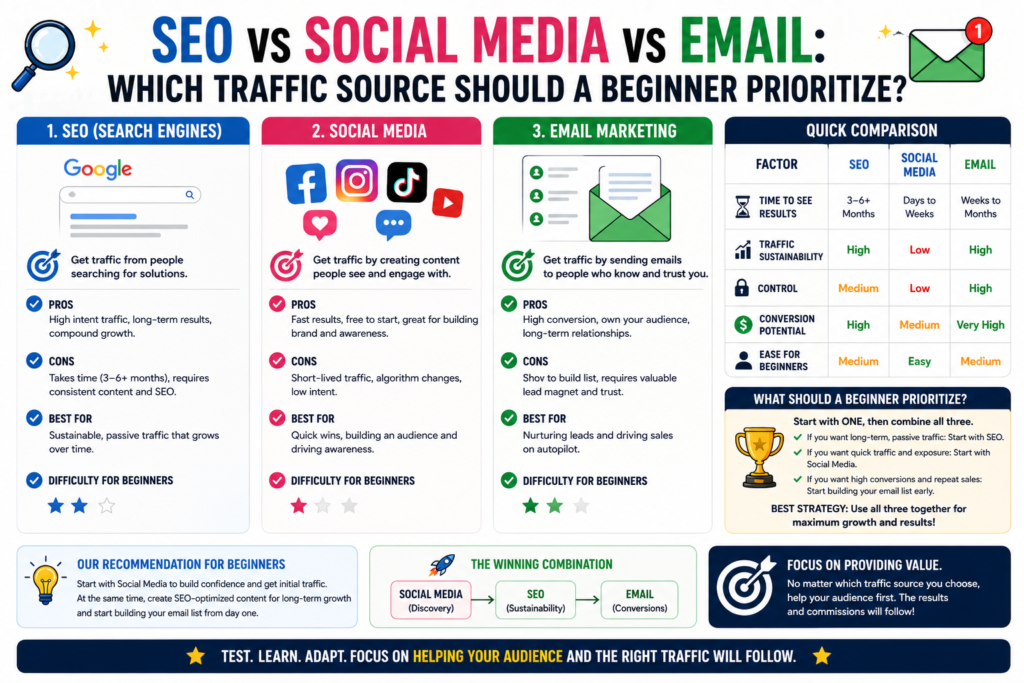
You’ve launched your website, set up your blog, maybe even created a product or joined an affiliate program. Now comes the question that stalls more beginners than any other: where should you spend your time getting traffic?
Three options dominate every marketing conversation: SEO (search engine optimization), social media, and email marketing. Each one has vocal advocates who’ll tell you their channel is the only one that matters. Each one has success stories that make it look easy. And each one has a graveyard of people who tried, saw nothing happen, and quit.
The truth is messier than any guru’s advice. All three channels work. None of them work for everyone in the same way. And the right choice depends on factors most advice ignores: your available time, your skills, your patience for delayed results, and the type of business you’re building.
This guide breaks down each traffic source honestly, compares them head to head across the metrics that matter for beginners, and gives you a clear framework for deciding where to put your energy first.
What Each Traffic Source Actually Does
Before comparing them, let’s make sure we’re talking about the same things.
SEO (Search Engine Optimization)
SEO is the practice of creating content and optimizing your website so it ranks in search engines, primarily Google, for terms your target audience is searching for.
When someone types “best running shoes for flat feet” into Google and clicks on a blog post from your website, that’s SEO traffic. You didn’t pay for that click. You didn’t post on social media to attract it. The visitor found you because your content matched what they were looking for, and Google decided your page deserved a spot in the results.
SEO traffic comes from blog posts, product pages, resource pages, videos (YouTube is a search engine too), and any other content indexed by search engines.
Social Media Marketing
Social media marketing means building an audience and driving traffic from platforms like Instagram, TikTok, X (Twitter), LinkedIn, Pinterest, Facebook, or YouTube.
This includes organic social (posting content without paying for reach) and paid social (running ads). For this comparison, we’re focusing primarily on organic social since most beginners don’t have an ad budget on day one.
When someone sees your Instagram Reel, taps your bio link, and lands on your website, that’s social media traffic. You earned that visit by creating content that performed well on the platform’s algorithm.
Email Marketing
Email marketing means building a list of subscribers and sending them content, offers, and recommendations directly to their inbox.
When someone opens your weekly newsletter and clicks a link to your latest blog post or product page, that’s email traffic. You earned that visit by providing enough value that they subscribed, stayed subscribed, and opened your message.
Email is different from SEO and social media in one critical way: it’s not a discovery channel. People don’t find you through email. They find you through some other channel first (search, social, word of mouth) and then join your email list. Email is what you use to bring them back repeatedly and build a deeper relationship.
The Honest Case for SEO
What SEO gets right:
Compounding returns. A blog post you publish today could drive traffic for three, five, even ten years. Unlike social media posts that peak within 24 to 48 hours, search-optimized content builds momentum over time. The more high-quality pages you publish, the more authority your site gains, which helps every new page rank faster.
A site with 50 well-optimized articles can generate thousands of visitors per month without any ongoing promotion. That’s the compounding effect in action, and it’s the single biggest advantage SEO has over every other channel.
High buyer intent. People using search engines are actively looking for answers, solutions, or products. Someone searching “best email marketing platform for small business” is closer to making a purchase decision than someone scrolling Instagram between cat videos. This intent translates into higher conversion rates from SEO traffic compared to most social media traffic.
You own the asset. Your website is yours. Google can change its algorithm (and it does), but your content library remains. You’re building on land you own, not renting space on someone else’s platform.
Scalability without proportional time investment. Once a page ranks, it requires minimal maintenance. You don’t need to post daily, respond to comments in real time, or stay on top of trending audio. Occasional updates to keep content fresh are enough to maintain rankings.
What SEO gets wrong (or at least, what nobody warns you about):
The timeline is brutal. New websites typically need six to twelve months of consistent publishing before seeing meaningful organic traffic. Some niches take longer. If you need results within the next 30 to 60 days, SEO alone won’t deliver.
The learning curve is steep. Keyword research, on-page optimization, site structure, link building, technical SEO, content strategy. There’s a lot to learn, and doing it poorly means months of effort with nothing to show for it. A beginner who publishes 30 blog posts without understanding keyword difficulty or search intent will likely rank for nothing.
Google’s algorithm updates create volatility. Sites that ranked well for years can lose 50% or more of their traffic overnight after a major algorithm update. This doesn’t happen to every site, and quality content is generally rewarded long-term, but the risk is real and it’s outside your control.
Link building is hard. For many competitive niches, great content alone isn’t enough. You need other websites linking to yours, and acquiring those links is time-consuming and often frustrating.
Content production is resource-intensive. Writing thorough, well-researched articles takes significant time. If you’re doing everything yourself, producing two to three quality posts per week is a full workload. One post per week is more realistic for most solo beginners.
The Honest Case for Social Media
What social media gets right:
Speed to first results. You can post a TikTok video today and have 10,000 people see it tomorrow. No other channel offers that kind of immediate feedback loop. For beginners who need validation that their topic resonates with a real audience, social media provides it faster than anything else.
Lower barrier to entry. You don’t need a website to start on social media. You don’t need to understand technical SEO. You don’t need to write 2,000-word articles. You need a phone, a perspective, and the willingness to hit publish. The production bar, especially on platforms like TikTok, X, and LinkedIn, is refreshingly low.
Relationship building happens naturally. Comments, DMs, replies, duets, quote tweets. Social media creates two-way conversations that blogs and emails can’t replicate as easily. These interactions build trust and community in a way that feels personal and immediate.
Algorithm-driven discovery. On platforms like TikTok, YouTube Shorts, Instagram Reels, and LinkedIn, the algorithm shows your content to people who don’t follow you. Your audience can grow from zero without any existing traffic, backlinks, or email list. The algorithm is your distribution engine.
You learn what resonates in real time. Post ten different content angles this week. See which ones get engagement. Double down on winners. This rapid feedback loop teaches you more about your audience in a month than most beginners learn from SEO data in six months.
What social media gets wrong:
The treadmill effect. Social media demands constant content production. Stop posting for a week and your reach drops. Stop for a month and you’re practically starting over. Unlike SEO, where old content continues working, social media posts have a shelf life measured in hours, not years.
This is the biggest hidden cost of social media. The traffic isn’t free. You’re paying with your time, every single day, with no end in sight.
You’re building on rented land. Instagram can change its algorithm tomorrow and cut your reach by 80%. TikTok faces potential bans in some countries. X is in constant flux. Facebook’s organic reach for pages has been declining for a decade. You don’t control these platforms, and they don’t owe you anything.
Creators with millions of followers have watched their reach collapse overnight because of algorithm changes they had no say in and no warning about.
Traffic quality can be low. Social media audiences are often browsing, not buying. They’re in entertainment mode, not purchase mode. A visitor who arrives at your site from an Instagram Story is, on average, less likely to buy something compared to a visitor who searched Google for a product review. There are exceptions (Pinterest, for instance, drives surprisingly high-intent traffic), but the general pattern holds.
Engagement doesn’t always translate to revenue. Thousands of likes and comments feel good. But likes don’t pay rent. Many creators with large, engaged social followings struggle to monetize because their audience follows them for entertainment, not because they’re ready to spend money.
Burnout is common. The pressure to post daily, stay on top of trends, respond to every comment, and maintain a public persona takes a psychological toll. Burnout rates among content creators are staggeringly high, and most people underestimate how exhausting the consistency requirement becomes after a few months.
The Honest Case for Email Marketing
What email marketing gets right:
You own the channel. Your email list belongs to you. No algorithm decides whether your subscribers see your message. No platform can take your list away. When you press send, your email goes directly to their inbox. That level of control is unmatched by any other channel.
Highest revenue per visitor. Email consistently generates the highest return on investment of any marketing channel. The commonly cited figure is $36 returned for every $1 spent. While your specific numbers will vary, the principle holds: a subscriber who has opted in, received value from you, and opened your email is far more likely to click, buy, and become a repeat customer than a random social media follower.
Automation creates genuine leverage. Set up a welcome sequence once, and it runs for every new subscriber automatically. A five-email sequence you write today could be generating sales for you two years from now without any additional effort. This is the closest thing to true “autopilot” income that exists in online marketing.
Segmentation allows precision. You can send different messages to different subscribers based on their interests, behavior, and purchase history. Someone who clicked on your article about running shoes gets different recommendations than someone who read about hiking boots. This precision dramatically increases conversion rates.
It deepens every other channel. Email doesn’t replace SEO or social media. It amplifies them. A blog reader who becomes an email subscriber is ten times more valuable than one who visits once and never returns. A social media follower who joins your email list becomes reachable even when the algorithm buries your posts.
What email marketing gets wrong:
It can’t generate traffic by itself. This is the fundamental limitation. You need an existing traffic source (SEO, social media, paid ads, word of mouth) to build an email list. Email is a retention and conversion channel, not a discovery channel. If nobody visits your website or social profiles, nobody joins your list.
Building a meaningful list takes time. Growing from zero to 1,000 subscribers can take months. Growing to 10,000 can take a year or more, depending on your niche and traffic sources. During that time, the revenue potential of your list is limited by its size.
Deliverability is a constant battle. Spam filters, promotions tabs, and email fatigue all reduce the percentage of subscribers who actually see and open your messages. Average open rates sit around 20 to 25%, meaning three out of four subscribers never see any given email. Maintaining good deliverability requires clean list hygiene, consistent sending patterns, and attention to technical details.
Bad email marketing damages trust fast. Send too many promotional emails, recommend bad products, or fail to deliver value, and subscribers unsubscribe, mark you as spam, or simply stop opening your emails. Rebuilding trust with an email audience is nearly impossible once you’ve lost it.
There’s a writing quality bar. Emails need to be engaging enough that people choose to open them instead of the 50 other emails competing for attention. If your emails are bland, generic, or obviously templated, engagement will be low regardless of your list size.
Head-to-Head Comparison
| Factor | SEO | Social Media | Email Marketing |
|---|---|---|---|
| Time to first results | 3-12 months | Days to weeks | Depends on list growth |
| Content shelf life | Years | Hours to days | One-time per send |
| Ongoing time commitment | Moderate (after setup) | High (constant posting) | Low to moderate |
| Traffic ownership | You own your site | Platform owns reach | You own the list |
| Buyer intent of traffic | High | Low to moderate | High (warm audience) |
| Upfront learning curve | Steep | Moderate | Low to moderate |
| Revenue per visitor | Moderate to high | Low to moderate | Highest |
| Scalability | High (compounds) | Linear (more posts = more reach) | High (automation) |
| Risk of sudden traffic loss | Moderate (algorithm updates) | High (platform changes) | Low |
| Works without other channels | Yes | Yes | No (needs a traffic source) |
Which Traffic Source Fits Your Situation?
The right answer depends on your specific circumstances. Here are five common beginner profiles and the best starting point for each.
Profile 1: “I have more time than money, and I’m patient.”
Start with: SEO
If you can commit to creating one to two pieces of quality content per week for six to twelve months without expecting immediate returns, SEO is your strongest long-term play. You’re building assets that compound. Every month that passes, your traffic grows, and the effort you put in during month one continues paying off in month twelve and beyond.
This path suits you if:
- You enjoy writing or creating in-depth content
- Your niche has clear search demand (people Google problems you can solve)
- You’re comfortable with delayed gratification
- You want traffic that doesn’t require daily maintenance once established
Your first 90-day plan:
- Learn keyword research basics (use free tools like Ubersuggest or Google’s Keyword Planner)
- Identify 20 to 30 low-competition keywords with clear search intent
- Publish one well-researched, optimized article per week
- Set up Google Search Console to track impressions and rankings
- Don’t check your analytics obsessively. Focus on publishing. Results come later.
Profile 2: “I need feedback and traction fast. Waiting months will kill my motivation.”
Start with: Social media
If you’re the kind of person who needs to see proof that people care about your topic within the first two weeks, social media gives you that. The rapid feedback loop keeps you motivated and teaches you what resonates with your audience. You can validate ideas, build an initial following, and develop your voice, all within a few weeks.
This path suits you if:
- You’re comfortable being visible (on camera, in posts, in comments)
- Your niche performs well on visual or short-form platforms
- You thrive on interaction and real-time engagement
- You’re okay with the ongoing time commitment of daily posting
Your first 90-day plan:
- Pick one platform (not three, one) based on where your audience spends time
- Post daily for the first 30 days, testing different content formats and topics
- Track which posts get the most saves, shares, and comments (not just likes)
- Engage with other creators and potential followers in your niche for 20 to 30 minutes daily
- By day 30, identify your top three performing content types and focus on those
Profile 3: “I already get some traffic but can’t convert visitors into anything.”
Start with: Email marketing
If you have a blog with a few hundred visitors per month, a social media account with an engaged following, or any other traffic source that’s working but not generating revenue, email is your missing piece. You’re losing 95%+ of your visitors because they leave and never come back. An email list fixes that.
This path suits you if:
- You already have traffic from any source (even small amounts)
- You want to maximize the value of visitors you’re already getting
- You’re good at writing consistently (weekly emails minimum)
- You want to build a direct relationship with your audience
Your first 90-day plan:
- Set up an email platform (ConvertKit, MailerLite, or GetResponse are solid starting points)
- Create one lead magnet that solves a specific problem your audience has
- Add opt-in forms to your website, blog posts, and social profiles
- Write a five to seven email welcome sequence that delivers value and includes one to two product recommendations
- Send one broadcast email per week mixing valuable content with occasional offers
Profile 4: “I’m building a personal brand or service business.”
Start with: Social media, then add email within 30 days
Personal brands and service businesses live on relationships. Social media lets potential clients see your expertise, personality, and approach before they ever contact you. It’s a showcase and a trust-building machine rolled into one.
But social media followers are fragile. Add email early so you capture your best followers onto a list you control.
Your first 90-day plan:
- Choose one platform where your ideal clients spend time (LinkedIn for B2B, Instagram for B2C, YouTube for education-heavy niches)
- Post content that demonstrates your expertise: case studies, frameworks, before-and-afters, client results, process breakdowns
- Set up an email opt-in by day 30 with a lead magnet relevant to your service
- Mention your email list in social posts and direct engaged followers to sign up
- By day 60, you should have both channels working together: social for discovery, email for depth
Profile 5: “I’m building a content or affiliate site and want long-term passive income.”
Start with: SEO, then add email by month 3
Content and affiliate sites depend on search traffic. People searching for product reviews, how-to guides, and comparison articles are the lifeblood of this business model. Social media can supplement, but search is the foundation.
Add email once you have enough traffic to make list-building worthwhile (even 500 visitors per month is enough to start). Email lets you bring visitors back to new content, recommend affiliate products multiple times, and increase the lifetime value of every person who finds you through search.
Your first 90-day plan:
- Research your niche thoroughly: what are people searching for, what’s the competition like, which affiliate programs have the best payouts
- Publish two articles per week targeting low-competition buyer-intent keywords
- By month two, set up a simple email opt-in (content upgrade or free resource related to your most popular topic)
- By month three, create a basic welcome sequence that includes affiliate recommendations
- Track everything: which articles rank, which ones drive affiliate clicks, which keywords bring the highest-intent visitors
The Biggest Mistake: Trying All Three at Once
New marketers read advice about SEO, get excited, and start a blog. Then they see someone blow up on TikTok and think they should be posting videos daily. Then they read about email marketing’s ROI and set up a newsletter. Within a month, they’re doing all three badly instead of one well.
Spreading yourself across three channels as a beginner means:
- Your blog posts are thin because you’re rushing to film videos
- Your social posts are inconsistent because you’re writing blog articles
- Your emails are sporadic because you’re burned out from doing everything else
- None of your channels gain enough momentum to produce meaningful results
- You conclude that “online marketing doesn’t work” and quit
Pick one primary channel. Give it your best effort for 90 days. Learn its nuances. Build systems. See results (or at least see enough data to understand why results aren’t coming). Then, and only then, add a second channel.
The addition sequence that works best for most beginners:
- Primary channel (SEO or social media, depending on your profile)
- Email (add this second, regardless of your primary channel, because it amplifies everything)
- Second traffic channel (add this third, once your primary channel is producing consistent results)
How the Three Channels Work Together (The Real Goal)
The ultimate destination isn’t choosing one channel forever. It’s building a system where all three work together, each playing its strongest role.
Here’s what that system looks like when it’s running well:
SEO brings in cold traffic. People discover your content through Google searches. They’re looking for answers, and your articles provide them. A percentage of these visitors become email subscribers through opt-in forms and lead magnets on your site.
Social media expands your reach and builds trust. You share insights, behind-the-scenes content, and snippets of your expertise on one or two social platforms. Some followers visit your website and become email subscribers. Others share your content, expanding your reach to audiences you wouldn’t have found through search alone.
Email converts and retains. Subscribers receive consistent value from your emails. When you recommend a product, share a new piece of content, or launch something of your own, you have a direct line to an engaged audience. Email drives repeat visits to your site, which signals to Google that your content is valuable (boosting SEO). Email drives traffic back to your social profiles too, increasing engagement metrics.
Each channel feeds the others. SEO feeds the email list. Social media feeds the email list and drives initial engagement signals for new content. Email drives repeat traffic that strengthens both SEO and social metrics.
But this system takes months to build. Don’t try to construct it on day one.
Platform-Specific Considerations for Beginners
If you choose SEO as your primary channel:
The platform question is simple: you need a website. WordPress (self-hosted, not WordPress.com) remains the most flexible option for content sites. Alternatives like Webflow or Ghost work well for specific use cases.
Budget considerations:
- Domain name: $10 to $15/year
- Hosting: $5 to $30/month (SiteGround, Cloudways, or A2 Hosting are reliable options)
- SEO tools: Free options (Google Search Console, Ubersuggest’s free tier) work fine for beginners. Paid tools like Ahrefs, Semrush, or Mangools become valuable as you grow.
If you choose social media as your primary channel:
Pick the platform where your target audience is most active, not the platform you personally enjoy using most. Here’s a rough guide:
- LinkedIn: B2B services, career advice, professional development, SaaS, consulting
- Instagram: Lifestyle, fashion, food, fitness, travel, visual brands, e-commerce
- TikTok: Broad consumer topics, younger demographics, entertainment-adjacent niches, quick tips and tutorials
- YouTube: Long-form education, product reviews, tutorials, anything where depth matters
- X (Twitter): Tech, startups, writing, media, real-time commentary, thought leadership
- Pinterest: Home decor, recipes, DIY, fashion, wedding planning, visual planning content (and it works more like a search engine than a social platform)
Budget considerations:
- Most platforms are completely free to use
- A decent smartphone is your production studio
- Canva’s free tier handles most graphic design needs
- Optional: Scheduling tools like Buffer or Later ($0 to $15/month)
If you choose email as your primary channel (added to an existing traffic source):
Email platform options for beginners:
- MailerLite: Best free plan (up to 1,000 subscribers with full features)
- ConvertKit (now Kit): Built for creators, free up to 1,000 subscribers with limited features
- GetResponse: Good all-in-one option with landing pages and automation
- Brevo (formerly Sendinblue): Generous free tier based on send volume rather than subscriber count
Budget considerations:
- Free up to 1,000 to 2,500 subscribers on most platforms
- $15 to $50/month once you pass the free tier
- Landing page builder (often included with your email platform or free via Carrd)
Measuring Success: What to Track for Each Channel
Tracking the wrong metrics leads to wrong conclusions. Here’s what actually matters for each channel at the beginner stage.
SEO metrics that matter:
- Impressions in Google Search Console. This grows before clicks do. Rising impressions mean Google is starting to show your content in search results, even if people aren’t clicking yet. It’s the earliest signal that your SEO is working.
- Average position for target keywords. Track whether your target keywords are moving from page five to page three to page one. Progress is rarely linear, but the overall trend should be upward over months.
- Organic traffic (Google Analytics or similar). The ultimate metric. How many people are finding your site through search?
- Organic conversions. Whether that’s email sign-ups, affiliate clicks, or product sales, this is what pays the bills.
Don’t track: vanity metrics like domain authority or total backlinks. These are proxies, not outcomes.
Social media metrics that matter:
- Engagement rate per post. Likes, comments, saves, and shares relative to your reach. This tells you whether your content resonates, regardless of follower count.
- Follower growth rate. Not total followers, but the rate of growth. Are you gaining 10 followers/week or 100? Is the rate increasing or plateauing?
- Website clicks from social. How many people actually leave the platform and visit your site? This is the metric that connects social effort to business outcomes.
- DMs and inbound inquiries. For service businesses, this is the most direct measure of social media’s impact.
Don’t track: total likes per post in isolation, follower count as a vanity number, or platform-provided metrics like “accounts reached” that inflate actual impact.
Email metrics that matter:
- List growth rate. How many new subscribers are you adding per week or month? And at what rate are you losing them to unsubscribes?
- Open rate. What percentage of subscribers open your emails? Benchmark against your own history, not industry averages. Your trend matters more than someone else’s number.
- Click-through rate. What percentage of openers click a link in your email? This measures how compelling your content and calls to action are.
- Revenue per email. Total revenue generated divided by the number of emails sent. This is the bottom-line metric for whether your email marketing is working financially.
Don’t track: total list size as a vanity number. A list of 500 engaged subscribers outperforms a list of 5,000 unengaged ones.
Common Misconceptions That Lead Beginners Astray
“SEO is dead.”
This gets said every year, usually by social media marketers. Google processes over 8.5 billion searches per day. People aren’t going to stop searching for information. SEO changes, and old tactics stop working, but search as a traffic source is nowhere close to dying.
What is true: SEO is harder than it used to be. Google’s quality standards are higher. Competition is fiercer. AI overviews are changing how some results look. But websites that publish genuinely helpful, well-structured content continue to earn organic traffic.
“Social media is free marketing.”
It’s free in terms of money (if you don’t run ads). It’s enormously expensive in terms of time. If you spend two hours a day creating content, engaging with followers, and staying current on trends, that’s 14 hours a week. Value your time at even $20/hour and social media is costing you $280/week.
That doesn’t mean it’s not worth it. But calling it “free” misrepresents the real cost.
“Email is old-fashioned.”
Email has been the highest-ROI marketing channel for over a decade, and that hasn’t changed. The people who say email is outdated are usually selling a social media course. Every serious online business, from solo creators to billion-dollar companies, uses email as a primary revenue driver.
“You need a huge audience to make money.”
You don’t. You need the right audience, even a small one. A thousand email subscribers who trust your recommendations can generate more income than 100,000 Instagram followers who scroll past your posts. Quality of traffic beats quantity of traffic every single time.
“You should be on every platform.”
For beginners, this is a recipe for burnout and mediocre results. Successful creators and businesses are usually excellent on one or two platforms and absent from the rest. Choose your channels intentionally.
The 6-Month Roadmap for Beginners
Here’s a realistic timeline for building a traffic system from zero, assuming you have five to ten hours per week to dedicate to marketing.
Month 1: Foundation and Primary Channel
- Choose your primary traffic channel based on the profiles outlined earlier
- Set up the basics (website for SEO, social profile for social, or both if you’re adding email to existing traffic)
- Learn the fundamentals of your chosen channel through two to three quality resources (courses, guides, YouTube tutorials)
- Start publishing content consistently (one to two blog posts/week for SEO, daily posts for social)
Month 2: Consistency and Learning
- Continue publishing on your primary channel
- Analyze your first month’s data: what performed well, what flopped, and what patterns do you see
- Adjust your content strategy based on data
- Start planning your email setup (choose a platform, brainstorm lead magnet ideas)
Month 3: Add Email
- Create your first lead magnet
- Build an opt-in page and add sign-up forms to your website or social bio
- Write a five-email welcome sequence
- Continue primary channel activity
Month 4: Optimize and Refine
- Review three months of data from your primary channel
- Double down on what’s working, cut what isn’t
- Start sending weekly emails to your growing list
- Experiment with one new content format on your primary channel
Month 5: Consider a Second Traffic Channel
- If your primary channel is gaining traction, consider adding a secondary one
- Keep the secondary channel low-effort initially (repurpose content from your primary channel)
- Focus on email list growth as a priority since every new subscriber increases your marketing reach
Month 6: System and Scale
- By now you should have a primary traffic channel producing consistent results, a growing email list, and possibly a secondary traffic channel in its early stages
- Create systems and templates to make content production more efficient
- Identify your highest-performing content and create more of it
- Set revenue and traffic goals for the next six months based on your actual data
When to Reconsider Your Choice
Sometimes you pick a channel and it doesn’t work. That’s okay. But don’t abandon ship too early.
Give SEO at least 6 months before concluding it isn’t working. If you’ve published 25+ quality, keyword-targeted articles and see zero movement in search impressions after six months, reassess your keyword strategy and content quality.
Give social media at least 90 days of consistent daily posting before concluding it isn’t working. If you’ve posted 90+ times with zero engagement growth, reassess your content format, platform choice, or niche.
Give email at least 3 months after reaching 250+ subscribers before concluding it isn’t generating revenue. Below that subscriber count, the sample size is too small to draw conclusions.
Signs it’s time to switch or adjust:
- Your niche has almost no search volume (SEO won’t work without searches to rank for)
- Your content topic doesn’t translate well to the platform you chose (highly technical B2B topics struggle on TikTok)
- The time investment required by your chosen channel is unsustainable for your life situation
- You’re seeing traction on a different channel without even trying (a signal that channel might be a natural fit)
The Question Behind the Question
Most beginners asking “Which traffic source should I prioritize?” are really asking something deeper: “What’s the fastest path to results with the least risk of wasting my time?”
Here’s the most honest answer: there is no fast path that’s risk-free. Every channel requires real effort over real time. But here’s what you can do to minimize wasted effort:
- Match the channel to your strengths. If you love writing, SEO is a natural fit. If you’re energized by interaction and short-form content, social media makes sense. If you’re analytical and systems-oriented, email marketing will feel like home.
- Match the channel to your niche. Some niches are search-heavy (finance, health, tech, how-to topics). Others are social-heavy (fashion, food, lifestyle, entertainment). Go where your audience already looks for information.
- Commit to consistency over intensity. Publishing one blog post per week for a year beats publishing ten posts this month and nothing for the next five months. Sending one email per week for six months beats sending daily emails for two weeks and burning out.
- Track leading indicators, not just lagging ones. Lagging indicators (revenue, sales) take time to appear. Leading indicators (impressions, engagement rate, list growth rate, click-through rate) tell you whether you’re on the right track long before the money shows up.
- Remember that channel selection is a starting point, not a life sentence. You can always add, adjust, or shift channels as you learn what works. The worst choice is no choice, spending weeks deliberating instead of publishing your first piece of content.
What’s one piece of content you could create this week using your strongest skill? Whether it’s a blog post, a social media video, or an email to a tiny list, that first piece of content is the only decision that matters right now. Everything else is optimization you can figure out along the way.