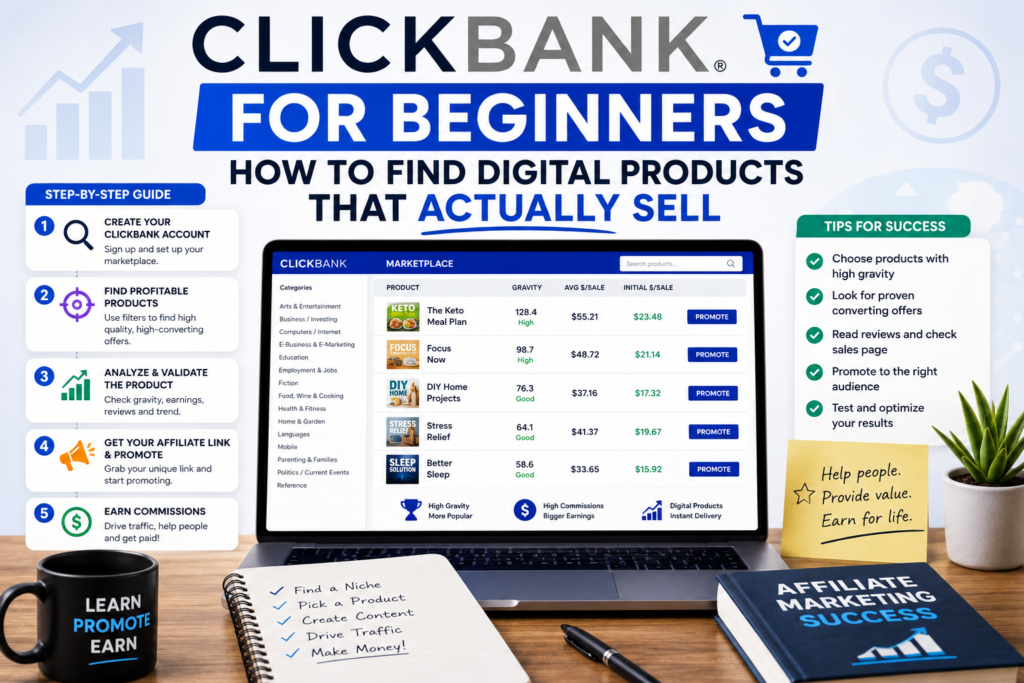
ClickBank has been around since 1998. In that time, it’s paid out over $6 billion in affiliate commissions. And while plenty of affiliate networks have come and gone over the years, ClickBank keeps attracting new affiliates for one simple reason: it’s one of the easiest places to start earning commissions on digital products.
But here’s the catch. The ClickBank marketplace lists thousands of products. Some of them convert like crazy and pay generous commissions. Others are borderline scams that will tank your credibility and waste your time. Knowing how to tell the difference is the single most valuable skill a new ClickBank affiliate can develop.
This guide walks you through the entire process, from setting up your account to identifying high-quality products that your audience will actually want to buy. No fluff, no hype. Just practical steps you can follow starting today.
What Is ClickBank and How Does It Work?
ClickBank is a digital marketplace that connects product creators (called vendors) with affiliate marketers (called affiliates). Vendors create digital products like online courses, ebooks, software, and membership programs. Affiliates promote those products and earn a commission on every sale they generate.
The business model is straightforward:
- You sign up for a free ClickBank affiliate account.
- You browse the marketplace and pick a product to promote.
- ClickBank gives you a tracking link (called a hoplink) for that product.
- You share that link through your blog, email list, social media, or paid ads.
- When someone clicks your link and buys the product, ClickBank records the sale and credits your account.
- ClickBank pays you on a regular schedule (weekly or biweekly, depending on your settings).
The commission rates on ClickBank are significantly higher than physical product affiliates like Amazon Associates. While Amazon pays between 1% and 10% depending on the category, ClickBank affiliates routinely earn 50% to 75% per sale. On a $47 product, that’s $23 to $35 in your pocket for a single conversion. Some products even offer recurring commissions on subscription billing, which means you keep earning every month as long as the customer stays subscribed.
Why Digital Products (and Why ClickBank Specifically)?
If you’ve only promoted physical products through programs like Amazon Associates, digital products might feel unfamiliar. Here’s why they deserve a spot in your affiliate strategy.
Higher commission rates. Digital products have almost zero marginal cost. Once a vendor creates an online course, selling one copy costs the same as selling ten thousand copies. That low overhead is why vendors can afford to share 50% to 75% of revenue with affiliates. Compare that to physical products where manufacturing, shipping, and warehousing eat into margins.
No inventory or shipping headaches. Everything is delivered electronically. There are no shipping delays, no lost packages, and no return logistics for you to worry about. The customer gets instant access after purchase, which also means faster buyer satisfaction and fewer refund requests.
Recurring revenue potential. Many ClickBank products include monthly subscriptions, ongoing coaching programs, or software with recurring billing. One sale can turn into months or even years of passive commission income. A customer who signs up for a $29/month membership and stays for twelve months generates $348 in commissions from a single referral (at 50% commission).
Why ClickBank specifically? Three reasons. First, the barrier to entry is low. You don’t need approval from individual vendors like you do on some networks. You can start promoting most products immediately. Second, ClickBank handles all payment processing, refund management, and commission tracking. You never have to chase vendors for payment. Third, the marketplace covers dozens of niches, so you can find products that align with almost any audience.
Setting Up Your ClickBank Account (The Right Way)
Creating a ClickBank account takes about five minutes, but a few setup details matter more than most beginners realize.
Step 1: Go to ClickBank.com and click “Start Here.” Fill in your personal information, including your country, name, phone number, and email. You’ll also choose a ClickBank nickname (sometimes called an account ID). This nickname appears in your hoplinks, so pick something professional. “john_reviews” looks better than “xXmoneymaker99Xx.”
Step 2: Set up your payment information. ClickBank can pay you via direct deposit, wire transfer, or check. Direct deposit is the fastest option for U.S. affiliates. International affiliates may prefer Payoneer, which ClickBank supports. Set your payment threshold to the minimum ($10) in the beginning so you get paid quickly and can verify everything works.
Step 3: Fill out your tax information. ClickBank requires a W-9 (for U.S. affiliates) or W-8BEN (for international affiliates) before they’ll release payments. Complete this during setup so there’s no delay when your first commissions come in.
Step 4: Familiarize yourself with the dashboard. Spend 10 minutes clicking through the reporting tabs. The main areas you’ll use are the Marketplace (where you find products), the Reporting section (where you track clicks and sales), and the Account Settings (where you manage payment details).
Understanding ClickBank Marketplace Metrics
This is where most beginners either succeed or stumble. The ClickBank marketplace displays several data points for every product listing, and knowing how to read them gives you a massive advantage in picking winners.
Gravity Score
Gravity is the number one metric most affiliates look at, and for good reason. ClickBank’s Gravity score reflects how many distinct affiliates have earned at least one commission promoting that product over the past 12 weeks. A higher Gravity means more affiliates are making sales, which suggests the product converts well.
But Gravity isn’t as simple as “higher is better.” Here’s the nuance:
- Gravity under 10: Very few affiliates are making sales. This could mean the product is new, the niche is small, or the product simply doesn’t convert. Proceed with caution. Do thorough research before promoting.
- Gravity between 20 and 100: The sweet spot for most beginners. Enough affiliates are selling to prove the product converts, but competition isn’t overwhelming.
- Gravity above 150: The product is a proven seller, but you’ll face intense competition from experienced affiliates with established audiences and bigger advertising budgets. Not impossible to promote, but harder to stand out.
A word of caution about Gravity: it measures affiliate activity, not product quality. A product with a Gravity of 200 might convert well because it has a slick sales page, but it could have a high refund rate because the actual product disappoints. Always evaluate the product itself, not just the numbers.
Average $/Sale (Avg $/Sale)
This shows the average commission you earn per sale, including any upsells or order bumps the vendor offers. A product priced at $37 with a 50% commission would show roughly $18.50 here. But if the vendor has a strong upsell funnel, the Avg $/Sale might be $45 or $60, meaning customers frequently buy add-ons after the initial purchase.
Look for products where the Avg $/Sale is significantly higher than the base commission. That signals a well-built sales funnel that maximizes revenue per customer, and your commission benefits directly.
Average Rebill Total (Avg %/Rebill)
This metric appears on products with recurring billing. It shows the average total rebill commission per customer. A high rebill total means customers tend to stay subscribed for multiple months, which translates to ongoing passive income for you.
Products with strong rebill numbers are gold for affiliates who think long-term. One hundred customers generating $15/month in recurring commissions adds up to $1,500/month without any additional promotion.
Initial $/Sale vs. Avg $/Sale
Compare these two numbers. If the Initial $/Sale is $18 but the Avg $/Sale is $55, the vendor has a powerful upsell sequence. This is a positive sign. It means the vendor invests in maximizing customer value, which directly increases your earnings per referral.
How to Find Products That Actually Sell: A Step-by-Step Process
Now that you understand the metrics, here’s a systematic process for identifying ClickBank products worth promoting.
Step 1: Start With a Niche You Understand
Too many beginners pick products based purely on commission rates. They see a $300 commission on a product in a niche they know nothing about and dive in headfirst. This almost never works.
You need at least a basic understanding of your audience’s problems, desires, and language. If you’ve never struggled with weight loss, you’ll have a hard time writing convincing content about weight loss products. If you’ve never tried learning guitar, you won’t know what frustrations beginner guitar players face or what solutions they’re searching for.
Start with niches where you have personal experience, genuine interest, or existing knowledge. ClickBank’s top-performing categories include:
- Health and fitness (weight loss, supplements, workout programs, diets)
- Wealth and business (online business, investing, side hustles, freelancing)
- Relationships and self-help (dating advice, personal development, communication skills)
- Education and skills (language learning, music, photography, cooking)
- Software and technology (productivity tools, design software, privacy tools)
Pick one niche. Go deep instead of going wide.
Step 2: Filter the Marketplace Strategically
Once you’ve chosen a niche, go to the ClickBank Marketplace and select the relevant category. Then apply these filters:
- Sort by Gravity to see the best-selling products first.
- Look for Gravity between 20 and 100 as your starting range.
- Check that Avg $/Sale is at least $20. Anything lower, and you’ll need very high traffic volume to make meaningful income.
- Prefer products with rebill commissions if available in your niche.
This filtering process will narrow thousands of listings down to a manageable shortlist of 10 to 20 products worth investigating further.
Step 3: Evaluate the Sales Page Like a Customer
This step separates amateurs from professionals. Click the product’s sales page link and experience it the way a potential customer would.
Ask yourself these questions:
Does the sales page look professional? A modern, clean design with proper formatting, good images, and mobile responsiveness signals a vendor who takes their business seriously. A page that looks like it was built in 2008, with walls of red text, flashing arrows, and aggressive countdown timers, is a red flag.
Is the copy compelling and clear? The sales page should clearly explain what the product is, who it’s for, what problem it solves, and what the customer gets. Vague promises like “discover the secret to unlimited wealth” without any substance should make you walk away.
Are there customer testimonials or social proof? Real testimonials with names, photos, and specific results add credibility. Generic quotes from “John D.” with a stock photo don’t carry the same weight. Look for video testimonials or detailed written reviews.
Is there a money-back guarantee? Most successful ClickBank products offer a 60-day refund policy (ClickBank’s standard). This reduces buyer hesitation and typically increases conversion rates. Products without a guarantee tend to convert poorly because buyers feel trapped.
What’s the checkout process like? Click through to the order form (you don’t need to buy). Is it clean and trustworthy? Does it clearly display the price, guarantee, and what’s included? A confusing or cluttered checkout page kills conversions.
Step 4: Buy the Product Yourself (Yes, Really)
This is the step most beginners skip, and it’s the one that makes the biggest difference.
Buying the product yourself does several things:
- You experience the product quality firsthand. If it’s genuinely good, you can promote it with conviction and write authentic reviews. If it’s garbage, you’ve saved yourself from destroying your credibility with your audience.
- You discover specific details, features, and benefits that you can reference in your content. Real firsthand knowledge makes your reviews infinitely more persuasive than rehashing the sales page copy.
- You can take screenshots, show the inside of the member area, and share real results. This kind of original content is what separates high-converting affiliate pages from generic ones.
Think of the product purchase as a business investment. If you spend $37 to buy a product and it helps you write a review that generates thousands in commissions over the next year, that’s an extraordinary return on investment.
Step 5: Research the Vendor’s Reputation
A few minutes of research can save you from promoting products by vendors with a history of complaints, poor customer support, or high refund rates.
Search for “[Product Name] review” and “[Product Name] scam.” Look at what real customers are saying. Every product has some negative reviews, but if the majority of feedback is negative, that’s a clear warning sign.
Check the vendor’s affiliate resources page. Serious vendors provide affiliates with email swipes, banner ads, demographic data, and sometimes even custom landing pages. If a vendor puts effort into supporting their affiliates, it’s a good indication they run a professional operation.
Look at the refund rate. While ClickBank doesn’t publicly display refund rates, you can get a rough sense from customer reviews and forum discussions. Products with refund rates above 10-15% are risky to promote because refunded sales mean reversed commissions for you.
Check if the vendor runs retargeting ads. When a vendor runs their own retargeting campaigns, they help convert prospects who clicked your link but didn’t buy immediately. This increases your effective conversion rate without any extra work on your part.
Step 6: Analyze the Competition
Before committing to a product, Google the keywords you plan to target and see who’s already ranking.
- Who ranks on page one? If the top results are all massive authority sites like Forbes, Healthline, or NerdWallet, you’ll struggle to compete as a new affiliate. Look for niches where smaller blogs and niche sites rank on the first page, because that signals an opportunity.
- What does their content look like? Study the top-ranking pages. What format do they use (listicles, long-form reviews, comparison tables)? How long are they? What angles do they take? Your goal is to create something measurably better, more thorough, more current, better formatted, or more genuinely helpful.
- Are other affiliates promoting the same ClickBank product? Some competition is healthy (it validates demand). But if every search result is promoting the exact same product with nearly identical content, differentiation becomes difficult. Consider whether you can bring a different angle or target a different audience segment.
Red Flags: Products You Should Avoid
Not every product in the ClickBank marketplace deserves your promotion. Watch out for these warning signs:
Outrageous income claims. Products that promise you’ll “make $10,000 in your first week” or “earn money while you sleep starting tonight” are almost always low-quality. Legitimate products set realistic expectations.
Extremely long video sales letters with no skip option. While VSLs (video sales letters) can convert well, the ones that hide the price, refuse to let you pause or skip, and spend 45 minutes on hype before revealing what the product actually is tend to attract impulse buyers who refund quickly.
No clear product description. If you can’t figure out what the customer actually receives after reading the entire sales page, that’s a problem. Legitimate products clearly explain their deliverables: “You get a 12-module video course, a 50-page workbook, and access to a private community.”
Very low Gravity with a high price. A $297 product with a Gravity of 2 likely has conversion issues. Either the price is too high for the perceived value, or the sales page isn’t doing its job. New affiliates should avoid high-priced products with unproven track records.
Products in regulated or sensitive niches with bold claims. Health products that claim to “cure” diseases, financial products that “guarantee” returns, or supplements with miracle claims expose you to legal risk and audience backlash. Stay away from products that make claims they can’t substantiate.
Fake scarcity and manipulation tactics. Countdown timers that reset every time you visit the page, “only 3 spots left” messages that never change, and fake social proof notifications (“Sarah from Ohio just purchased!”) signal a vendor who prioritizes tricks over genuine value.
Creating Content That Drives ClickBank Sales
Finding a great product is only half the equation. You need content that attracts the right audience and motivates them to click your affiliate link. Here are the content types that perform best for ClickBank affiliates.
Honest Product Reviews
A detailed, honest review is the highest-converting content format for ClickBank products. The key word is “honest.” Don’t write a 2,000-word sales pitch. Include genuine pros and cons, share your personal experience, and be upfront about who the product is right for and who should skip it.
A strong review structure looks like this:
- Quick summary and your overall verdict (for readers who want the bottom line immediately)
- What the product is and what it includes
- Who it’s best suited for
- What you liked (with specific examples)
- What could be improved (be honest, because this builds trust)
- Pricing and value assessment
- Your final recommendation with your affiliate link
The counterintuitive truth: mentioning a product’s weaknesses actually increases conversions. When you say “this course is excellent for complete beginners, but intermediate marketers will find the first three modules too basic,” readers trust your positive assessments more. They can see you’re not just pushing a sale.
Comparison Posts
“Product A vs. Product B” posts attract readers who are already in buying mode. They’ve narrowed their options and need help deciding. This is high-intent traffic that converts well.
For ClickBank products, you might compare two competing offers in the same niche. “Keto Program A vs. Keto Program B: Which Plan Gets Better Results?” or “Two Popular Guitar Courses Compared: Here’s Which One Is Worth Your Money.”
Include a comparison table that hits the key decision factors: price, what’s included, refund policy, difficulty level, and your personal recommendation. Be clear about which product you’d choose and why, but give the reader enough information to make their own decision.
“Best Of” Roundup Posts
Roundup posts like “7 Best Online Photography Courses in 2026” cast a wider net and capture readers who are early in their research process. These posts work well because they target broad search queries with good traffic volume.
For each product in your roundup, include a brief overview, key features, pricing, and a link. Save your most detailed analysis for your top picks. Be selective. Don’t just list every product in the ClickBank marketplace. Curate genuinely good options and explain your selection criteria.
Tutorial and How-To Content
Create content that solves a problem related to your niche, and naturally recommend a ClickBank product as part of the solution. A post titled “How to Start a Keto Diet: A Complete Week-by-Week Plan” can organically mention a ClickBank keto program as a resource for meal plans and recipes.
This content type attracts top-of-funnel traffic (people with a problem who haven’t started looking for products yet) and warms them up to the idea of purchasing a solution. It’s a slower path to conversion but generates a steady stream of traffic and builds long-term authority.
Maximizing Your ClickBank Commissions
Once you’ve selected a product and started creating content, these strategies help you earn more from every visitor.
Build an email list around your niche. Readers who join your email list are significantly more likely to buy than first-time visitors. Offer a free resource related to your niche, collect emails, and nurture subscribers with helpful content before recommending a ClickBank product. A three-email sequence that educates, builds trust, and then recommends is a proven formula.
Target buyer-intent keywords. Focus your SEO efforts on keywords that signal purchase readiness: “[product name] review,” “is [product] worth it,” “best [category] course,” “[product A] vs [product B].” These keywords attract visitors who are ready to spend money, not just browse.
Use bonus incentives. Create a bonus package that buyers receive when they purchase through your link. This could be a supplementary ebook, a video tutorial, a template pack, or a resource list that complements the ClickBank product. Bonuses give people a reason to buy through your link instead of someone else’s.
Track everything. Use ClickBank’s built-in tracking IDs (TIDs) to tag your links by traffic source, content type, and placement. This data shows you exactly which promotional strategies generate sales so you can double down on winners and cut losers.
Diversify across 3 to 5 products. Don’t bet everything on a single product. If a vendor pulls their offer, raises the price, or slashes commission rates, your entire income disappears overnight. Promote a small portfolio of quality products so no single vendor controls your earnings.
A Realistic Timeline: What to Expect
Let’s set honest expectations. ClickBank affiliate marketing works, but it’s not instant.
Month 1: Set up your account, research your niche, select 2 to 3 products, and publish your first review or comparison post. You’ll likely earn $0 this month, and that’s completely normal.
Months 2-3: Publish consistently (aim for 2 to 4 pieces of content per week). Start building an email list. Your content begins appearing in search results, but traffic is still low. You might earn your first commission, or you might not. Stay patient.
Months 4-6: If you’ve been consistent, organic traffic starts picking up. Your reviews gain traction. Email subscribers grow. You should see regular (if modest) commissions, perhaps $100 to $500 per month depending on your niche and effort level.
Months 6-12: Compounding kicks in. Older content ranks higher and earns more traffic. Your email list grows faster because more content means more entry points. You refine your product selection and content strategy based on real data. Earnings of $500 to $2,000+ per month are realistic for affiliates who’ve worked consistently.
The affiliates who fail almost always quit during months 2 and 3, right before their efforts would have started paying off. Persistence through the early plateau is what separates earners from quitters.
Wrapping Up: Your ClickBank Action Plan
Here’s exactly what to do this week:
- Create your ClickBank account and complete all payment and tax setup.
- Choose one niche based on your knowledge, interest, and market demand.
- Identify 3 products using the evaluation process described above (Gravity, sales page quality, vendor reputation, personal purchase).
- Buy your top product pick and spend time going through it thoroughly.
- Publish your first honest review targeting a buyer-intent keyword.
- Set up a simple email opt-in on your site to start capturing subscribers from day one.
- Commit to a publishing schedule and stick to it for at least six months before evaluating your results.
ClickBank remains one of the most accessible entry points into affiliate marketing. The commission rates are generous, the payment process is reliable, and the product selection spans dozens of profitable niches. What determines your success isn’t the platform. It’s your willingness to research products thoroughly, create genuinely helpful content, and keep showing up when results are slow.
The best product to promote is never the one with the highest Gravity score or the biggest commission. It’s the one you can recommend with confidence because you’ve used it, you believe in it, and you know it will deliver real value to the person who buys it through your link. Start there, and the commissions will follow.